GENERAL METHODSGENERAL METHODS
AND TECHNIQUES OFAND TECHNIQUES OF
TEACHINGTEACHING
Basic Concepts:
• Approach - one’s viewpoint toward teaching
• Method - a series of related and
progressive acts performed by
a teacher and students to
achieve the objective of the
lesson.
• Technique – the personal art and style of the
teacher in carrying out the procedure of
teaching.
• Strategy – set of decisions to achieve an
objective that results in plan.
METHODS OF TEACHING
Two Types of Teaching Methods
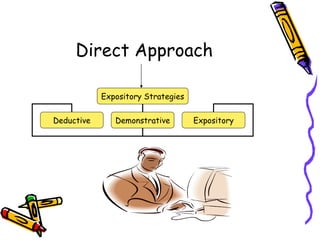
Direct Approach
Expository Strategies
Deductive Demonstrative Expository
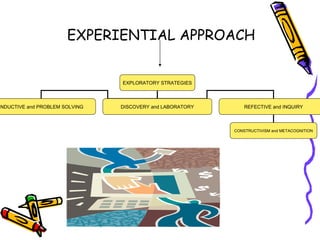
EXPERIENTIAL APPROACH
EXPLORATORY STRATEGIES
INDUCTIVE and PROBLEM SOLVING DISCOVERY and LABORATORY REFECTIVE and INQUIRY
CONSTRUCTIVISM and METACOGNITION
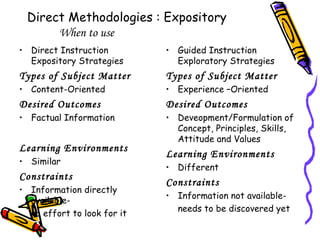
Direct Methodologies : Expository
When to use
• Direct Instruction
Expository Strategies
Types of Subject Matter
• Content-Oriented
Desired Outcomes
• Factual Information
Learning Environments
• Similar
Constraints
• Information directly
available-
no effort to look for it
• Guided Instruction
Exploratory Strategies
Types of Subject Matter
• Experience –Oriented
Desired Outcomes
• Deveopment/Formulation of
Concept, Principles, Skills,
Attitude and Values
Learning Environments
• Different
Constraints
• Information not available-
needs to be discovered yet
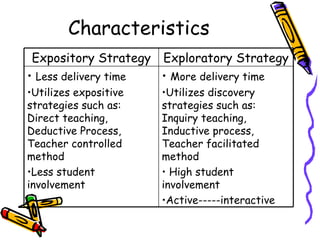
Characteristics
• More delivery time
•Utilizes discovery
strategies such as:
Inquiry teaching,
Inductive process,
Teacher facilitated
method
• High student
involvement
•Active-----interactive
• Less delivery time
•Utilizes expositive
strategies such as:
Direct teaching,
Deductive Process,
Teacher controlled
method
•Less student
involvement
Exploratory StrategyExpository Strategy
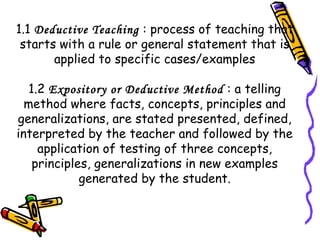
1.1 Deductive Teaching : process of teaching that
starts with a rule or general statement that is
applied to specific cases/examples
1.2 Expository or Deductive Method : a telling
method where facts, concepts, principles and
generalizations, are stated presented, defined,
interpreted by the teacher and followed by the
application of testing of three concepts,
principles, generalizations in new examples
generated by the student.
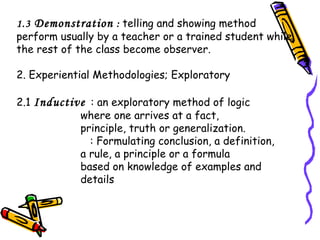
1.3 Demonstration : telling and showing method
perform usually by a teacher or a trained student while
the rest of the class become observer.
2. Experiential Methodologies; Exploratory
2.1 Inductive : an exploratory method of logic
where one arrives at a fact,
principle, truth or generalization.
: Formulating conclusion, a definition,
a rule, a principle or a formula
based on knowledge of examples and
details
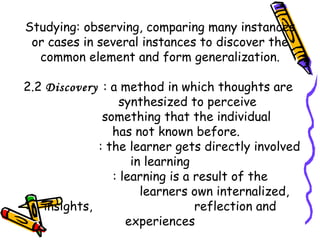
Studying: observing, comparing many instances
or cases in several instances to discover the
common element and form generalization.
2.2 Discovery : a method in which thoughts are
synthesized to perceive
something that the individual
has not known before.
: the learner gets directly involved
in learning
: learning is a result of the
learners own internalized,
insights, reflection and
experiences
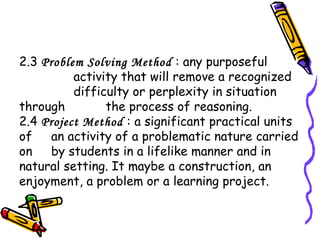
2.3 Problem Solving Method : any purposeful
activity that will remove a recognized
difficulty or perplexity in situation
through the process of reasoning.
2.4 Project Method : a significant practical units
of an activity of a problematic nature carried
on by students in a lifelike manner and in
natural setting. It maybe a construction, an
enjoyment, a problem or a learning project.
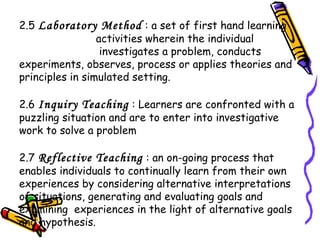
2.5 Laboratory Method : a set of first hand learning
activities wherein the individual
investigates a problem, conducts
experiments, observes, process or applies theories and
principles in simulated setting.
2.6 Inquiry Teaching : Learners are confronted with a
puzzling situation and are to enter into investigative
work to solve a problem
2.7 Reflective Teaching : an on-going process that
enables individuals to continually learn from their own
experiences by considering alternative interpretations
of situations, generating and evaluating goals and
examining experiences in the light of alternative goals
and hypothesis.
-A teaching approach that brings the individual
to continually learn from their experiences
through analysis of their own experiences,
actions, decisions, beliefs in the light of
alternative goals and hypothesis.
- The act of teaching that focuses thought on
certain phenomenon through inspection and
analysis.
2.8 Metacognitive Teaching : a teaching
approach
where learners are trained to become aware of
and exert control over their own learning by
using metacognitive processes.
2.8.1 Cooperative Learning Strategy : a type of
group work in which two or more students
interact with the common goal of mastering
specific academic materials, sample approaches.
SAMPLE APPROACHES
1. STAD – Student Teams
Achievement Approach (Slavin)
• Academic information are presented each week
through verbal text.
• Students are divided into learning teams of four
members (heterogeneous)
• Team members help one another to master the
academic materials using worksheets, tutoring
quizzing, one another, and team discussion.
• Quizzes are administered weekly/biweekly and
scored and each student is given improvement
score.
• Improvement score is recorded, based on the
degree to which the scores exceed the student’s
past averages.
• Individual improvement scores are added to
give a team score.
• Team success is acknowledged through short
newsletter containing the learning outcomes.
2. JIGSAW I (Dronson, etc.)
• Student is assigned to heterogeneous study
home teams.
• Academic materials divided into clearly
defined sections presented to the students in
text form.
• Within each team, one student is responsible
for mastering each section.
Thank You Very Much !

innovative methods of teaching

  • 1.
    GENERAL METHODSGENERAL METHODS ANDTECHNIQUES OFAND TECHNIQUES OF TEACHINGTEACHING
  • 2.
    Basic Concepts: • Approach- one’s viewpoint toward teaching • Method - a series of related and progressive acts performed by a teacher and students to achieve the objective of the lesson. • Technique – the personal art and style of the teacher in carrying out the procedure of teaching. • Strategy – set of decisions to achieve an objective that results in plan.
  • 3.
    METHODS OF TEACHING TwoTypes of Teaching Methods
  • 4.
  • 5.
    EXPERIENTIAL APPROACH EXPLORATORY STRATEGIES INDUCTIVEand PROBLEM SOLVING DISCOVERY and LABORATORY REFECTIVE and INQUIRY CONSTRUCTIVISM and METACOGNITION
  • 6.
    Direct Methodologies :Expository When to use • Direct Instruction Expository Strategies Types of Subject Matter • Content-Oriented Desired Outcomes • Factual Information Learning Environments • Similar Constraints • Information directly available- no effort to look for it • Guided Instruction Exploratory Strategies Types of Subject Matter • Experience –Oriented Desired Outcomes • Deveopment/Formulation of Concept, Principles, Skills, Attitude and Values Learning Environments • Different Constraints • Information not available- needs to be discovered yet
  • 7.
    Characteristics • More deliverytime •Utilizes discovery strategies such as: Inquiry teaching, Inductive process, Teacher facilitated method • High student involvement •Active-----interactive • Less delivery time •Utilizes expositive strategies such as: Direct teaching, Deductive Process, Teacher controlled method •Less student involvement Exploratory StrategyExpository Strategy
  • 8.
    1.1 Deductive Teaching: process of teaching that starts with a rule or general statement that is applied to specific cases/examples 1.2 Expository or Deductive Method : a telling method where facts, concepts, principles and generalizations, are stated presented, defined, interpreted by the teacher and followed by the application of testing of three concepts, principles, generalizations in new examples generated by the student.
  • 9.
    1.3 Demonstration :telling and showing method perform usually by a teacher or a trained student while the rest of the class become observer. 2. Experiential Methodologies; Exploratory 2.1 Inductive : an exploratory method of logic where one arrives at a fact, principle, truth or generalization. : Formulating conclusion, a definition, a rule, a principle or a formula based on knowledge of examples and details
  • 10.
    Studying: observing, comparingmany instances or cases in several instances to discover the common element and form generalization. 2.2 Discovery : a method in which thoughts are synthesized to perceive something that the individual has not known before. : the learner gets directly involved in learning : learning is a result of the learners own internalized, insights, reflection and experiences
  • 11.
    2.3 Problem SolvingMethod : any purposeful activity that will remove a recognized difficulty or perplexity in situation through the process of reasoning. 2.4 Project Method : a significant practical units of an activity of a problematic nature carried on by students in a lifelike manner and in natural setting. It maybe a construction, an enjoyment, a problem or a learning project.
  • 12.
    2.5 Laboratory Method: a set of first hand learning activities wherein the individual investigates a problem, conducts experiments, observes, process or applies theories and principles in simulated setting. 2.6 Inquiry Teaching : Learners are confronted with a puzzling situation and are to enter into investigative work to solve a problem 2.7 Reflective Teaching : an on-going process that enables individuals to continually learn from their own experiences by considering alternative interpretations of situations, generating and evaluating goals and examining experiences in the light of alternative goals and hypothesis.
  • 13.
    -A teaching approachthat brings the individual to continually learn from their experiences through analysis of their own experiences, actions, decisions, beliefs in the light of alternative goals and hypothesis. - The act of teaching that focuses thought on certain phenomenon through inspection and analysis.
  • 14.
    2.8 Metacognitive Teaching: a teaching approach where learners are trained to become aware of and exert control over their own learning by using metacognitive processes. 2.8.1 Cooperative Learning Strategy : a type of group work in which two or more students interact with the common goal of mastering specific academic materials, sample approaches.
  • 15.
    SAMPLE APPROACHES 1. STAD– Student Teams Achievement Approach (Slavin) • Academic information are presented each week through verbal text. • Students are divided into learning teams of four members (heterogeneous) • Team members help one another to master the academic materials using worksheets, tutoring quizzing, one another, and team discussion. • Quizzes are administered weekly/biweekly and scored and each student is given improvement score. • Improvement score is recorded, based on the degree to which the scores exceed the student’s past averages.
  • 16.
    • Individual improvementscores are added to give a team score. • Team success is acknowledged through short newsletter containing the learning outcomes. 2. JIGSAW I (Dronson, etc.) • Student is assigned to heterogeneous study home teams. • Academic materials divided into clearly defined sections presented to the students in text form. • Within each team, one student is responsible for mastering each section.
  • 17.