Why training ..…
Justification:
Learningis a lifelong process.
to perform our responsibilities effectively and
efficiently throughout our professional life
We teachers must remain up-to-date,
(knowledge, skill and attitudes)
to maintain and develop our competencies
(knowledge, skills and attitudes)
5.
The Concept ofTeaching
• What is teaching?
• What is Learning?
• What are the Factors that
Affect Teaching and Learning?
M-6=Think-pair-share A=Think Independently, B=Share
To Your Friends
Application M=9 and10 Pair discussion, Brainstorming
6.
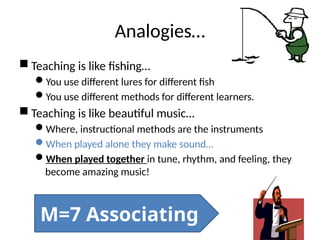
Analogies…
Teaching islike fishing…
You use different lures for different fish
You use different methods for different learners.
Teaching is like beautiful music…
Where, instructional methods are the instruments
When played alone they make sound…
When played together in tune, rhythm, and feeling, they
become amazing music!
M=7 Associating
7.
Teaching is definedas:
• "… any form of interpersonal influence
aimed at changing the ways in which other
persons can or will behave" (Gagne :1963)
• ".... an interactive process, primarily
involving classroom talk, which takes place
between teacher and pupils & occurs
during certain definable activities"( Amidon
& Hunter :1967)
Application M=8
Lecture
8.
Con`t
•………….there is noone
outstanding definition
that explicates the
concept teaching.
Application M=8
Lecture
9.
Common attributes ofteaching;
• An activity or action. Taken by teacher
and student
• A process. It involves a series of
actions and decisions of the teacher.
• An interpersonal activity and/or
process.
• Intentional. There is some purpose.
Application M=8
Lecture
10.
Different scholars definedlearning differently.
• Morgan and his associates
(1981) , Wiles and Bondi (1998)
defined learning as a relatively
permanent change in behavior
that occurs as a result of
experience and practice.
11.
The main characteristicsof learning include:
1. Learning is growth…..through experience.
2. Learning is adjustment…..to new situations.
3. Learning is organizing experience.
4. Learning is goal oriented.
5. Learning is intelligent/needs techniques/.
6. Learning is active.
7. Learning's both individual and social.
8. Learning is the product of nature and nurture.
12.
Factors that AffectTeaching and Learning
1. The nature of the subject to be taught; If the subject to
be taught has difficult content areas which demand
prerequisite knowledge, skills, exposure,
2. The school facilities
3. The learners’ negative attitudes, misconception, lack of
interests, earlier experience, low level of maturity, lack
of incentives/reinforcements, dislike to school in
general and hostility to a particular teacher;
4. Teachers’ failure to present subject matter contents to
the level of students, to use appropriate instructional
materials and to involve students in the process,
5. The time allocated for the practice
6. the sequence of materials and wrong organization
13.
Activity
• What isa “Method”?
• Write the Principles of
Teaching?
Exchange your writing and
comment each other
Application M=11 and 12
Peer assessment
Peer feedback
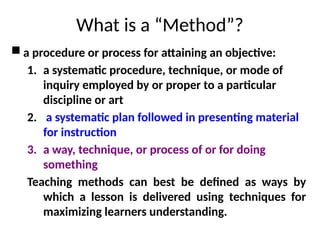
What is a“Method”?
a procedure or process for attaining an objective:
1. a systematic procedure, technique, or mode of
inquiry employed by or proper to a particular
discipline or art
2. a systematic plan followed in presenting material
for instruction
3. a way, technique, or process of or for doing
something
Teaching methods can best be defined as ways by
which a lesson is delivered using techniques for
maximizing learners understanding.
16.
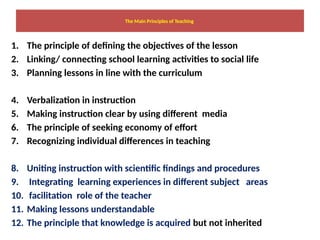
The Main Principlesof Teaching
1. The principle of defining the objectives of the lesson
2. Linking/ connecting school learning activities to social life
3. Planning lessons in line with the curriculum
4. Verbalization in instruction
5. Making instruction clear by using different media
6. The principle of seeking economy of effort
7. Recognizing individual differences in teaching
8. Uniting instruction with scientific findings and procedures
9. Integrating learning experiences in different subject areas
10. facilitation role of the teacher
11. Making lessons understandable
12. The principle that knowledge is acquired but not inherited
17.
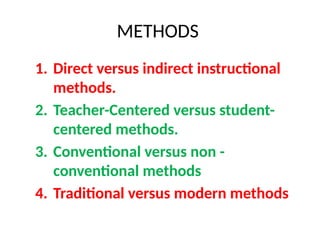
METHODS
1. Direct versusindirect instructional
methods.
2. Teacher-Centered versus student-
centered methods.
3. Conventional versus non -
conventional methods
4. Traditional versus modern methods
18.
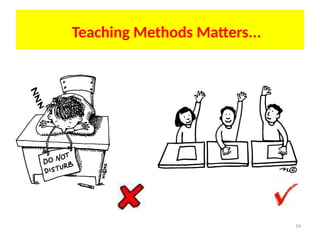
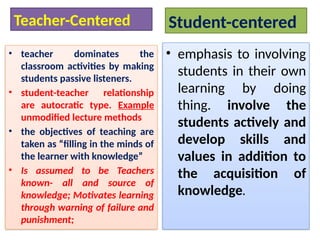
Teacher-Centered
• teacher dominatesthe
classroom activities by making
students passive listeners.
• student-teacher relationship
are autocratic type. Example
unmodified lecture methods
• the objectives of teaching are
taken as “filling in the minds of
the learner with knowledge”
• Is assumed to be Teachers
known- all and source of
knowledge; Motivates learning
through warning of failure and
punishment;
Student-centered
• emphasis to involving
students in their own
learning by doing
thing. involve the
students actively and
develop skills and
values in addition to
the acquisition of
knowledge.
19.
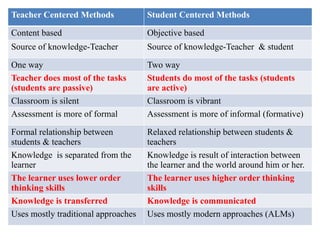
Teacher Centered MethodsStudent Centered Methods
Content based Objective based
Source of knowledge-Teacher Source of knowledge-Teacher & student
One way Two way
Teacher does most of the tasks
(students are passive)
Students do most of the tasks (students
are active)
Classroom is silent Classroom is vibrant
Assessment is more of formal Assessment is more of informal (formative)
Formal relationship between
students & teachers
Relaxed relationship between students &
teachers
Knowledge is separated from the
learner
Knowledge is result of interaction between
the learner and the world around him or her.
The learner uses lower order
thinking skills
The learner uses higher order thinking
skills
Knowledge is transferred Knowledge is communicated
Uses mostly traditional approaches Uses mostly modern approaches (ALMs)
20.
1. What isthe concept of active
learning methods
2. What is the importance of
making learning active?
Application M=14
Generating ideas
21.
Active learning
• Activelearning is a model of instruction that focuses the
responsibility of learning on learners.
• Students must do more than just listen: They must read,
write, discuss, or be engaged in solving problems.
• It relates to the three learning domains referred to as
knowledge, skills and attitudes (Bloom, 1956).
• Active Learning is an effort to make learning authentic
(Carson 1995).
• Active learning refers to the level of engagement by the
student in the instructional process (Fern.et. al. 1993).
21
22.
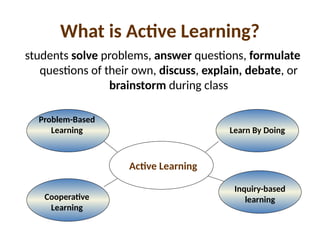
What is ActiveLearning?
students solve problems, answer questions, formulate
questions of their own, discuss, explain, debate, or
brainstorm during class
Active Learning
Problem-Based
Learning
Cooperative
Learning
Learn By Doing
Inquiry-based
learning
23.
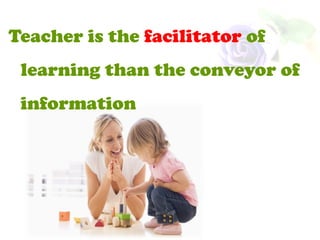
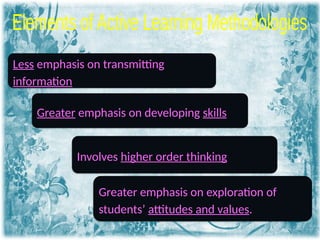
Teacher is thefacilitator of
learning than the conveyor of
information
Less emphasis ontransmitting
information
Greater emphasis on developing skills
Involves higher order thinking
Greater emphasis on exploration of
students’ attitudes and values.
26.
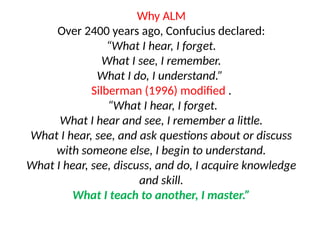
Why ALM
Over 2400years ago, Confucius declared:
“What I hear, I forget.
What I see, I remember.
What I do, I understand.”
Silberman (1996) modified .
“What I hear, I forget.
What I hear and see, I remember a little.
What I hear, see, and ask questions about or discuss
with someone else, I begin to understand.
What I hear, see, discuss, and do, I acquire knowledge
and skill.
What I teach to another, I master.”
27.
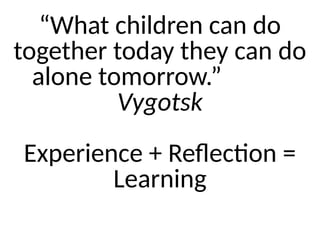
“What children cando
together today they can do
alone tomorrow.”
Vygotsk
Experience + Reflection =
Learning
Why active learning?
30
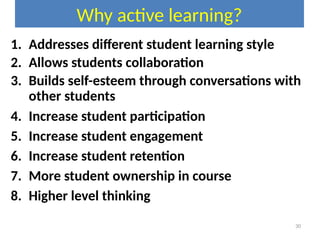
1.Addresses different student learning style
2. Allows students collaboration
3. Builds self-esteem through conversations with
other students
4. Increase student participation
5. Increase student engagement
6. Increase student retention
7. More student ownership in course
8. Higher level thinking
31.
31
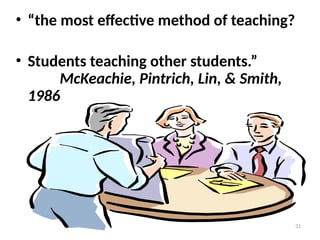
• “the mosteffective method of teaching?
• Students teaching other students.”
McKeachie, Pintrich, Lin, & Smith,
1986
Con`t
• No onemethods is
best/right for all students,
objectives, teachers,
contents and conditions.
34.
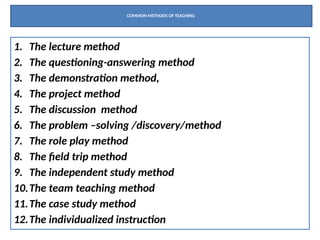
COMMON METHODS OFTEACHING
1. The lecture method
2. The questioning-answering method
3. The demonstration method,
4. The project method
5. The discussion method
6. The problem –solving /discovery/method
7. The role play method
8. The field trip method
9. The independent study method
10.The team teaching method
11.The case study method
12.The individualized instruction
35.
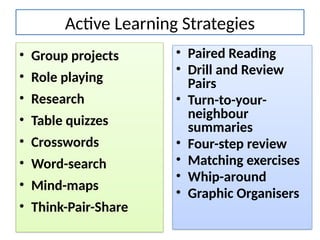
Active Learning Strategies
35
•Group projects
• Role playing
• Research
• Table quizzes
• Crosswords
• Word-search
• Mind-maps
• Think-Pair-Share
• Paired Reading
• Drill and Review
Pairs
• Turn-to-your-
neighbour
summaries
• Four-step review
• Matching exercises
• Whip-around
• Graphic Organisers
36.
ACTIVITY
• What factorswould you take in to
consideration in selecting teaching
methods to your subject? (list not less
than three factors)
• List the major challenges in the
application of ALM
Application M=15
Listing
37.
What Factors dowe consider when selecting an
instructional method?
The intended specific outcome or purpose
/objective of the lesson
Size of group/number of student
Learners’ preference for learning/motivation and
interest
The content sometimes dictates the method
Required preparation/skill and ability of the
teacher
38.
The Merits ofmodern methods of teaching
• Involves students in the actual activities and
makes them learn from their own practice;
• Motivates students when performed well;
• Links theory and practice and fosters creative
thinking;
• Different views and opinions are forwarded.
• Develop their skills of listening and speaking:
• It allows students a chance to develop their ideas.
• Students develop their communication skills,
attitude and intellectual abilities.
39.
The demerits oftraditional methods of teaching
• It is less effective in stimulating students’
interests;
• It is sometimes a boring approach for it doesn’t
combine mental and physical activities;
• It gives no real social experience
• skill learning is so minimal;
• It doesn’t encourage students’ activities
• It doesn’t promote creativity
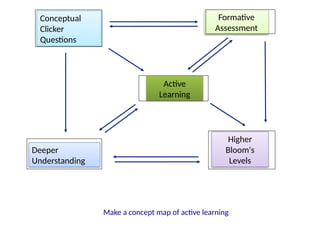
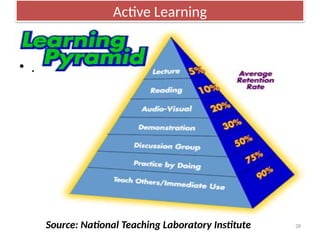
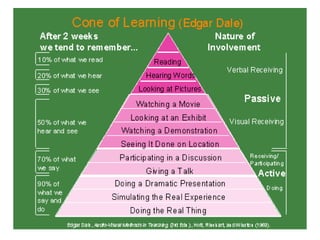
#28 Active learning happens when students are given the opportunity to take a more interactive relationship with the subject matter of a course, encouraging them to generate rather than simply to receive knowledge. In an active learning environment, teachers facilitate rather than dictate the students’ learning.
Students will only remember:
10% of what they read, either in class or at home
20% of audio-visual, which refers to videos or site visits
75% of what they do, or write, e.g. completing worksheets or workbooks
90% of what they teach other students, or practice immediately
Research has shown that active learning is an exceptionally effective teaching technique. Regardless of the subject matter, when active learning is compared to traditional teaching methods (such as lecture), students learn more material, retain the information longer, and enjoy the class more. Active learning allows students to learn in the classroom with the help of theinstructor and other students, rather than on their own.
#30 As teachers, we are all familiar with the feeling of coming out of classes drained. The recent mid-term was a very welcome chance to recharge our batteries. However many of us are doing far too much for our students and our students are doing far too little – the concept of “spoon-feeding” which I’m sure most of us are familiar with.
A former colleague used a video in her classroom in an effort to improve her teaching. When watching it back she realised that she was doing too much and her students were not sufficiently involved.
Change is difficult, but is worth it, not only for our students, but also for our own well-being and health.
#35 Group work allows every participant the chance to speak, share personal views, and develop the skill of working with others. Cooperative group work requires all group members to work together to complete a given task. Break the class into groups of 2-4 students. Give each group articles to read, questions to answer and discuss, information to share, subjects to teach
to other groups, etc.
Games related to the subject can easily be incorporated into the classroom to foster active learning and participation. Games can include matching, mysteries, group competitions, solving puzzles, pictionary, etc.




![Preschool Classroom Management and Learning Environment [Repaired].pptx](https://cdn.slidesharecdn.com/ss_thumbnails/preschoolclassroommanagementandlearningenvironmentrepaired-250609125337-70d4e362-thumbnail.jpg?width=640&height=640&fit=bounds)


