ENGLISH GRAMMAR

 Ma. Martha Manette A. Madrid, Ed.D.
                          Professor
                   Institute of Graduate Studies
         Panpacific University North Philippines
                      Urdaneta City, Philippines
                            September 22, 2012
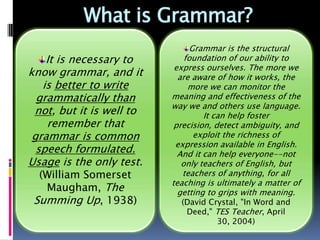
What is Grammar?
                                Grammar is the structural
    It is necessary to        foundation of our ability to
                           express ourselves. The more we
know grammar, and it        are aware of how it works, the
   is better to write           more we can monitor the
  grammatically than      meaning and effectiveness of the
                          way we and others use language.
 not, but it is well to       It can help foster precision,
    remember that         detect ambiguity, and exploit the
 grammar is common         richness of expression available
                               in English. And it can help
  speech formulated.       everyone--not only teachers of
Usage is the only test.   English, but teachers of anything,
  (William Somerset         for all teaching is ultimately a
                            matter of getting to grips with
   Maugham, The                         meaning.
 Summing Up, 1938)          (David Crystal, "In Word and
                            Deed," TES Teacher, April 30,
                                       2004)
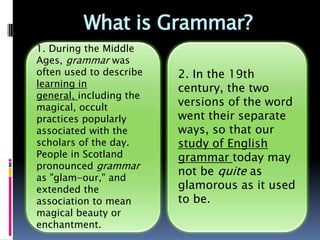
What is Grammar?
1. During the Middle
Ages, grammar was
often used to describe     2. In the 19th
learning in general,       century, the two
including the magical,     versions of the word
occult practices           went their separate
popularly associated
                           ways, so that our
with the scholars of the
day. People in Scotland    study of English
pronounced grammar         grammar today may
as "glam-our," and         not be quite as
extended the               glamorous as it used
association to mean        to be.
magical beauty or
enchantment.
What is Grammar?

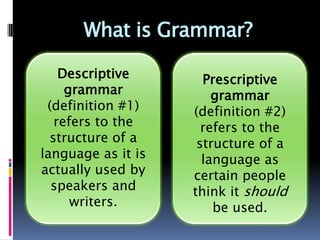
    Descriptive       Prescriptive
     grammar            grammar
 (definition #1)    (definition #2)
   refers to the      refers to the
  structure of a     structure of a
language as it is     language as
actually used by    certain people
  speakers and      think it should
      writers.          be used.
What is Grammar?
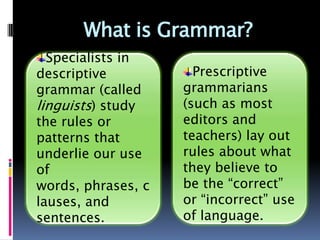
  Specialists in      Prescriptive
descriptive         grammarians
grammar (called     (such as most
linguists) study    editors and
the rules or        teachers) lay out
patterns that       rules about what
underlie our use    they believe to
of words,           be the “correct”
phrases, clauses,   or “incorrect” use
and sentences.      of language.
“Interface”
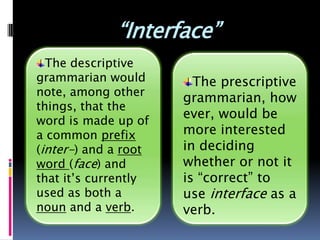
  The descriptive
grammarian would        The prescriptive
note, among other     grammarian,
things, that the      however, would
word is made up of    be more
a common prefix       interested in
(inter-) and a root   deciding whether
word (face) and
                      or not it is
that it’s currently
used as both a
                      “correct” to use
noun and a verb.      interface as a
                      verb.
The Value of Studying Grammar

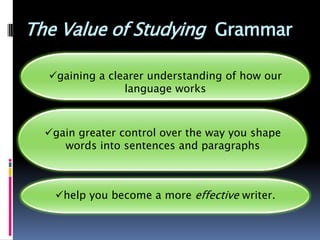
  gaining a clearer understanding of how our
                language works


  gain greater control over the way you shape
     words into sentences and paragraphs


   help you become a more effective writer.
Descriptive vs Prescriptive
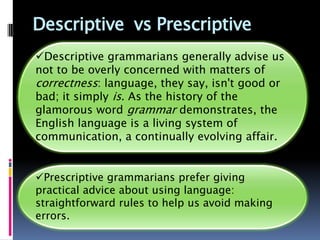
Descriptive grammarians generally advise us
not to be overly concerned with matters of
correctness: language, they say, isn't good or
bad; it simply is. As the history of the
glamorous word grammar demonstrates, the
English language is a living system of
communication, a continually evolving affair.


Prescriptive grammarians prefer giving
practical advice about using language:
straightforward rules to help us avoid making
errors.
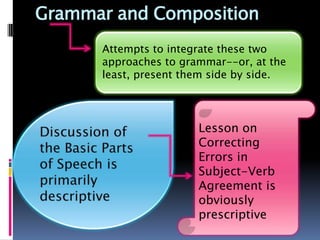
Grammar and Composition
      Attempts to integrate these two
      approaches to grammar--or, at the
      least, present them side by side.


                       Lesson on
                       Correcting
                       Errors in
                       Subject-Verb
                       Agreement is
                       obviously
                       prescriptive
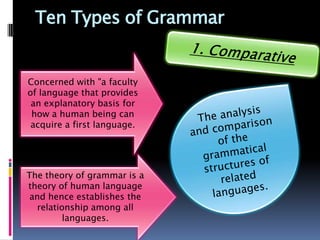
Ten Types of Grammar


Concerned with "a faculty
of language that provides
 an explanatory basis for
 how a human being can
 acquire a first language.


The theory of grammar is a
theory of human language
 and hence establishes the
  relationship among all
         languages.
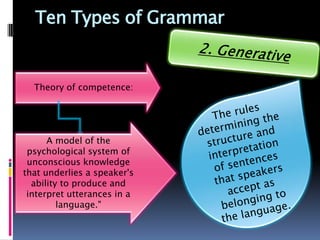
Ten Types of Grammar


  Theory of competence:


      A model of the
 psychological system of
 unconscious knowledge
that underlies a speaker's
  ability to produce and
 interpret utterances in a
         language."
Ten Types of Grammar
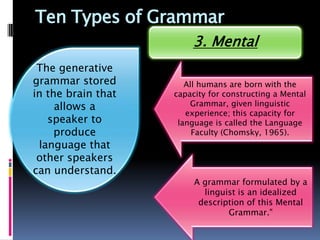
                        3. Mental
 The generative
grammar stored         All humans are born with the
in the brain that   capacity for constructing a Mental
     allows a           Grammar, given linguistic
                       experience; this capacity for
   speaker to        language is called the Language
     produce             Faculty (Chomsky, 1965).
 language that
 other speakers
can understand.
                         A grammar formulated by a
                           linguist is an idealized
                          description of this Mental
                                 Grammar."
Ten Types of Grammar
                4. Pedagogical
 Grammatical
 analysis and
  instruction   (1) pedagogical process--
 designed for   the explicit treatment of
                elements of the target
    second-
                language systems as (part of)
   language     language teaching
   students.    methodology;
                (2) pedagogical content--
                reference sources of one kind
                or another that present
                information about the target
                language system; and
                (3) combinations of process
                and content."
Ten Types of Grammar
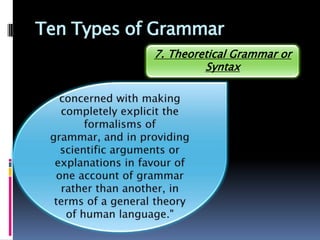
            7. Theoretical Grammar or
                     Syntax
Ten Types of Grammar


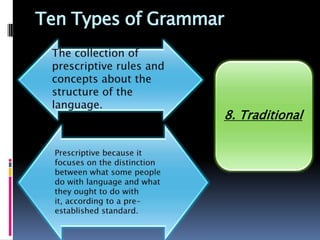
                   8. Traditional
Ten Types of Grammar
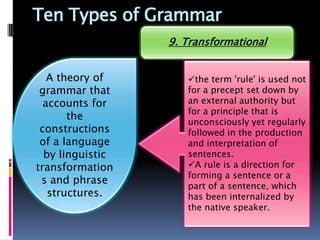
                  9. Transformational


   A theory of       the term 'rule' is used not
 grammar that        for a precept set down by
  accounts for       an external authority but
                     for a principle that is
       the
                     unconsciously yet regularly
 constructions       followed in the production
 of a language       and interpretation of
  by linguistic      sentences.
transformation       A rule is a direction for
                     forming a sentence or a
 s and phrase
                     part of a sentence, which
   structures.       has been internalized by
                     the native speaker.
Ten Types of Grammar
                  10. Universal


The system of        "Taken together, the
                   linguistic principles of
categories,
                      Universal Grammar
operations, and     constitute a theory of
languages to be       the organization of
innate.             the initial state of the
                       mind/brain of the
                      language learner--
                   that is, a theory of the
                       human faculty for
                           language.
References:
English grammar - Wikipedia, the free
encyclopedia
en.wikipedia.org/wiki/English_grammar
Ten Types of Grammar - Grammar and
Composition - About.com
grammar.about.com/.../basicsentence
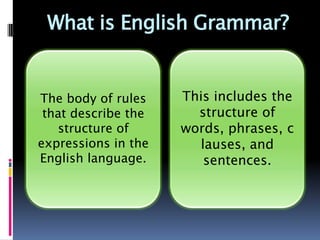
What is English Grammar?


The body of rules    This includes the
 that describe the     structure of
   structure of      words, phrases,
expressions in the     clauses, and
English language.       sentences.
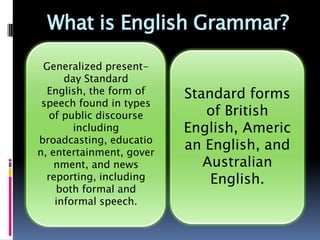
What is English Grammar?

  Generalized present-
 day Standard English,
   the form of speech      Standard forms
found in types of public      of British
   discourse including         English,
      broadcasting,
        education,            American
      entertainment,         English, and
 government, and news
  reporting, including        Australian
     both formal and           English.
    informal speech.
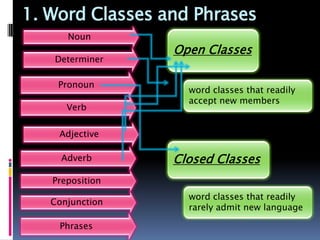
1. Word Classes and Phrases
      Noun
                 Open Classes
   Determiner

    Pronoun
                   word classes that readily
                   accept new members
      Verb

    Adjective

     Adverb      Closed Classes
   Preposition
                   word classes that readily
   Conjunction
                   rarely admit new language

    Phrases
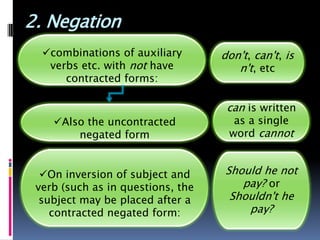
2. Negation
  combinations of auxiliary       don't, can't,
   verbs etc. with not have         isn't, etc
      contracted forms:

                                   can is written
    Also the uncontracted          as a single
        negated form               word cannot


  On inversion of subject and     Should he not
 verb (such as in questions, the      pay? or
  subject may be placed after a     Shouldn't he
    contracted negated form:           pay?
2. Negation
  Other elements, such as            not the right
   noun phrases, adjectives,           answer, not
     adverbs, infinitive and        interesting, not
participial phrases, etc., can be     to enter, not
 negated by placing the word          noticing the
        not before them:                train, etc.

                                    I saw nothing or
 When other negating words            I didn't see
  such as never, nobody, etc.       anything, but not
   appear in a sentence, the         (except in non-
negating not is omitted (unlike     standard speech)
    its equivalents in many            *I didn't see
          languages):                    nothing.
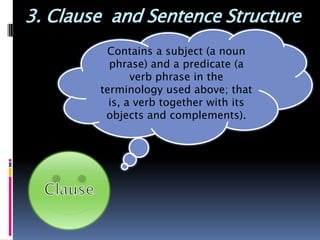
3. Clause and Sentence Structure
         Contains a subject (a noun
          phrase) and a predicate (a
               verb phrase in the
        terminology used above; that
          is, a verb together with its
         objects and complements).
3. Clause and Sentence Structure
        Contains one independent clause
            and possibly one or more
        dependent clauses, although it is
          also possible to link together
           sentences of this form into
             longer sentences, using
            coordinating conjunctions
To learn more about the Eight
Word Classes, please see also
      Parts of a Speech
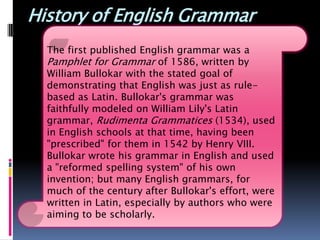
History of English Grammar
  The first published English grammar was a
  Pamphlet for Grammar of 1586, written by
  William Bullokar with the stated goal of
  demonstrating that English was just as rule-
  based as Latin. Bullokar's grammar was
  faithfully modeled on William Lily's Latin
  grammar, Rudimenta Grammatices (1534), used
  in English schools at that time, having been
  "prescribed" for them in 1542 by Henry VIII.
  Bullokar wrote his grammar in English and used
  a "reformed spelling system" of his own
  invention; but many English grammars, for
  much of the century after Bullokar's effort, were
  written in Latin, especially by authors who were
  aiming to be scholarly.
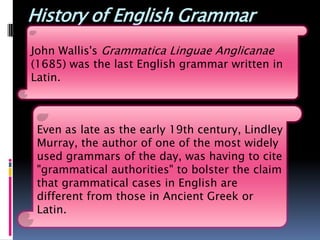
History of English Grammar
John Wallis's Grammatica Linguae Anglicanae
(1685) was the last English grammar written in
Latin.


 Even as late as the early 19th century, Lindley
 Murray, the author of one of the most widely
 used grammars of the day, was having to cite
 "grammatical authorities" to bolster the claim
 that grammatical cases in English are
 different from those in Ancient Greek or
 Latin.
Reference:
English grammar - Wikipedia, the
free encyclopedia
en.wikipedia.org/wiki/English_grammar
THE END

English Grammar

  • 1.
    ENGLISH GRAMMAR Ma.Martha Manette A. Madrid, Ed.D. Professor Institute of Graduate Studies Panpacific University North Philippines Urdaneta City, Philippines September 22, 2012
  • 2.
    What is Grammar? Grammar is the structural It is necessary to foundation of our ability to express ourselves. The more we know grammar, and it are aware of how it works, the is better to write more we can monitor the grammatically than meaning and effectiveness of the way we and others use language. not, but it is well to It can help foster precision, remember that detect ambiguity, and exploit the grammar is common richness of expression available in English. And it can help speech formulated. everyone--not only teachers of Usage is the only test. English, but teachers of anything, (William Somerset for all teaching is ultimately a matter of getting to grips with Maugham, The meaning. Summing Up, 1938) (David Crystal, "In Word and Deed," TES Teacher, April 30, 2004)
  • 3.
    What is Grammar? 1.During the Middle Ages, grammar was often used to describe 2. In the 19th learning in general, century, the two including the magical, versions of the word occult practices went their separate popularly associated ways, so that our with the scholars of the day. People in Scotland study of English pronounced grammar grammar today may as "glam-our," and not be quite as extended the glamorous as it used association to mean to be. magical beauty or enchantment.
  • 4.
    What is Grammar? Descriptive Prescriptive grammar grammar (definition #1) (definition #2) refers to the refers to the structure of a structure of a language as it is language as actually used by certain people speakers and think it should writers. be used.
  • 5.
    What is Grammar? Specialists in Prescriptive descriptive grammarians grammar (called (such as most linguists) study editors and the rules or teachers) lay out patterns that rules about what underlie our use they believe to of words, be the “correct” phrases, clauses, or “incorrect” use and sentences. of language.
  • 6.
    “Interface” Thedescriptive grammarian would The prescriptive note, among other grammarian, things, that the however, would word is made up of be more a common prefix interested in (inter-) and a root deciding whether word (face) and or not it is that it’s currently used as both a “correct” to use noun and a verb. interface as a verb.
  • 7.
    The Value ofStudying Grammar gaining a clearer understanding of how our language works gain greater control over the way you shape words into sentences and paragraphs help you become a more effective writer.
  • 8.
    Descriptive vs Prescriptive Descriptivegrammarians generally advise us not to be overly concerned with matters of correctness: language, they say, isn't good or bad; it simply is. As the history of the glamorous word grammar demonstrates, the English language is a living system of communication, a continually evolving affair. Prescriptive grammarians prefer giving practical advice about using language: straightforward rules to help us avoid making errors.
  • 9.
    Grammar and Composition Attempts to integrate these two approaches to grammar--or, at the least, present them side by side. Lesson on Correcting Errors in Subject-Verb Agreement is obviously prescriptive
  • 10.
    Ten Types ofGrammar Concerned with "a faculty of language that provides an explanatory basis for how a human being can acquire a first language. The theory of grammar is a theory of human language and hence establishes the relationship among all languages.
  • 11.
    Ten Types ofGrammar Theory of competence: A model of the psychological system of unconscious knowledge that underlies a speaker's ability to produce and interpret utterances in a language."
  • 12.
    Ten Types ofGrammar 3. Mental The generative grammar stored All humans are born with the in the brain that capacity for constructing a Mental allows a Grammar, given linguistic experience; this capacity for speaker to language is called the Language produce Faculty (Chomsky, 1965). language that other speakers can understand. A grammar formulated by a linguist is an idealized description of this Mental Grammar."
  • 13.
    Ten Types ofGrammar 4. Pedagogical Grammatical analysis and instruction (1) pedagogical process-- designed for the explicit treatment of elements of the target second- language systems as (part of) language language teaching students. methodology; (2) pedagogical content-- reference sources of one kind or another that present information about the target language system; and (3) combinations of process and content."
  • 14.
    Ten Types ofGrammar
  • 15.
    Ten Types ofGrammar
  • 16.
    Ten Types ofGrammar 7. Theoretical Grammar or Syntax
  • 17.
    Ten Types ofGrammar 8. Traditional
  • 18.
    Ten Types ofGrammar 9. Transformational A theory of the term 'rule' is used not grammar that for a precept set down by accounts for an external authority but for a principle that is the unconsciously yet regularly constructions followed in the production of a language and interpretation of by linguistic sentences. transformation A rule is a direction for forming a sentence or a s and phrase part of a sentence, which structures. has been internalized by the native speaker.
  • 19.
    Ten Types ofGrammar 10. Universal The system of "Taken together, the linguistic principles of categories, Universal Grammar operations, and constitute a theory of languages to be the organization of innate. the initial state of the mind/brain of the language learner-- that is, a theory of the human faculty for language.
  • 20.
    References: English grammar -Wikipedia, the free encyclopedia en.wikipedia.org/wiki/English_grammar Ten Types of Grammar - Grammar and Composition - About.com grammar.about.com/.../basicsentence
  • 21.
    What is EnglishGrammar? The body of rules This includes the that describe the structure of structure of words, phrases, expressions in the clauses, and English language. sentences.
  • 22.
    What is EnglishGrammar? Generalized present- day Standard English, the form of speech Standard forms found in types of public of British discourse including English, broadcasting, education, American entertainment, English, and government, and news reporting, including Australian both formal and English. informal speech.
  • 23.
    1. Word Classesand Phrases Noun Open Classes Determiner Pronoun word classes that readily accept new members Verb Adjective Adverb Closed Classes Preposition word classes that readily Conjunction rarely admit new language Phrases
  • 24.
    2. Negation combinations of auxiliary don't, can't, verbs etc. with not have isn't, etc contracted forms: can is written Also the uncontracted as a single negated form word cannot On inversion of subject and Should he not verb (such as in questions, the pay? or subject may be placed after a Shouldn't he contracted negated form: pay?
  • 25.
    2. Negation Other elements, such as not the right noun phrases, adjectives, answer, not adverbs, infinitive and interesting, not participial phrases, etc., can be to enter, not negated by placing the word noticing the not before them: train, etc. I saw nothing or When other negating words I didn't see such as never, nobody, etc. anything, but not appear in a sentence, the (except in non- negating not is omitted (unlike standard speech) its equivalents in many *I didn't see languages): nothing.
  • 26.
    3. Clause andSentence Structure Contains a subject (a noun phrase) and a predicate (a verb phrase in the terminology used above; that is, a verb together with its objects and complements).
  • 27.
    3. Clause andSentence Structure Contains one independent clause and possibly one or more dependent clauses, although it is also possible to link together sentences of this form into longer sentences, using coordinating conjunctions
  • 28.
    To learn moreabout the Eight Word Classes, please see also Parts of a Speech
  • 29.
    History of EnglishGrammar The first published English grammar was a Pamphlet for Grammar of 1586, written by William Bullokar with the stated goal of demonstrating that English was just as rule- based as Latin. Bullokar's grammar was faithfully modeled on William Lily's Latin grammar, Rudimenta Grammatices (1534), used in English schools at that time, having been "prescribed" for them in 1542 by Henry VIII. Bullokar wrote his grammar in English and used a "reformed spelling system" of his own invention; but many English grammars, for much of the century after Bullokar's effort, were written in Latin, especially by authors who were aiming to be scholarly.
  • 30.
    History of EnglishGrammar John Wallis's Grammatica Linguae Anglicanae (1685) was the last English grammar written in Latin. Even as late as the early 19th century, Lindley Murray, the author of one of the most widely used grammars of the day, was having to cite "grammatical authorities" to bolster the claim that grammatical cases in English are different from those in Ancient Greek or Latin.
  • 31.
    Reference: English grammar -Wikipedia, the free encyclopedia en.wikipedia.org/wiki/English_grammar
  • 32.