Prepared by
Ma. Martha Manette A. Madrid, Ed.D.
                          Bachelor of Law
   Panpacific University North Philippines
               Urdaneta City, Pangasinan
                               Philippines
                           November 2010
Something tells me
           It’s all happening at the zoo.
                    I do believe it,
                I do believe it’s true.

        The monkeys stand for honesty,
             Giraffes are insincere,
 And the elephants are kindly but they’re dumb.
Orangutans are skeptical of changes in their cages,
     And the zookeeper is very fond of rum.

           Zebras are reactionaries,
            Antelope plot in secrecy,
        And hamsters turn on frequently.
       What a gas! You gotta come and see
                   At the zoo.
                          -Paul Simon-
What is Humanitarian Aid?
is a response to a crisis or emergency and is material,
     food, water, clothing, etc. assistance for saving
     lives, alleviating suffering, and maintaining human
     dignity, and does not address the underlying
     socioeconomic factors which lead to the crisis or
     emergency.

 Internationally, this is invoked two ways:
   Peacetime- Human Rights Law
   Armed conflict- International Humanitarian Law
International Humanitarian Law
or Armed conflict is also considered accepted
    Customary Law and a universal codification
    standard. The United Nations (UN) has the UN
    office for the Coordination of Humanitarian Affairs
    (UNOCHA), formed in 1991 by the General
    Assembly Resolution 46/182 & the Department of
    Humanitarian Affairs (DHA) replacing the Office
    of the United Nations Disaster Relief Coordinator
    formed in 1972.
 Humanitarian Aid is also called:
   International Relief and
   Development Aid
Seven Conventions and Nine Protocols that
include International Humanitarian Law
 The Four Geneva Conventions of 1949.
 Additional Protocols of 1977, protection of victims of armed
    conflicts.
   The 1954 Convention, protection of cultural property in the
    event of armed conflict plus its two protocols.
   The 1972 Biological Weapons Convention.
   The 1980 Conventional Weapons Convention and its five
    protocols.
   The 1993 Chemical Weapons Convention.
   The 1997Ottawa convention on anti-personnel mines.
   The 2000 Optional Protocol to the convention on the
    Rights of child on the involvement of children in armed
    conflict.
International Humanitarian Law (Armed
conflict) is used:
 only for armed conflict,
 once the conflict has begun, and
 equally applied to both sides regardless of who started the
  fighting.
    Note:
        International armed conflicts are those in which at least two states are
         involved, the use of the word states for these purposes implies the word
         country is included or synonymous.
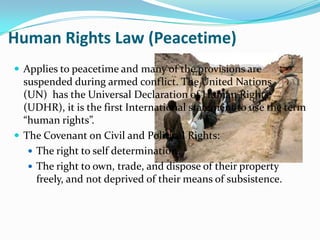
Human Rights Law (Peacetime)
 Applies to peacetime and many of the provisions are
  suspended during armed conflict. The United Nations
  (UN) has the Universal Declaration of Human Rights
  (UDHR), it is the first International statement to use the term
  “human rights”.
 The Covenant on Civil and Political Rights:
    The right to self determination.
    The right to own, trade, and dispose of their property
     freely, and not deprived of their means of subsistence.
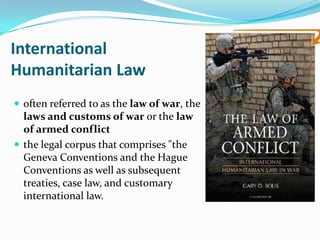
International
Humanitarian Law
 often referred to as the law of war, the
  laws and customs of war or the law
  of armed conflict
 the legal corpus that comprises "the
  Geneva Conventions and the Hague
  Conventions as well as subsequent
  treaties, case law, and customary
  international law.
 defines the conduct and responsibilities of
  belligerent ( an individual, group, country or other
  entity which acts in a hostile manner, such as
  engaging in combat), nations, neutral nations and
  individuals engaged in warfare, in relation to each
  other and to protected persons, usually meaning
  civilians.
Two Historical Streams
 the law of The Hague referred to in the past as
  the law of war proper; and
 the law of Geneva or humanitarian law.
The Law of The Hague, or the Laws of War
 a body of law concerning acceptable justifications to engage
  in war (jus ad bellum) and the limits to acceptable wartime
  conduct (jus in bello).
 considered an aspect of public international law (the law of
  nations) and is distinguished from other bodies of law, such
  as the domestic law of a particular belligerent to a conflict,
  that may also provide legal limits to the conduct or
  justification of war.
 modern laws of war address declarations of war, acceptance
  of surrender and the treatment of prisoners of war, military
  necessity along with distinction and proportionality, and the
  prohibition of certain weapons that may cause unnecessary
  suffering.
Historical Background:
 The Hague Conventions were two international treaties
  negotiated at international peace conferences at The Hague in
  the Netherlands: The First Hague Conference in 1899 and
  the Second Hague Conference in 1907.
 Along with the Geneva Conventions, the Hague Conventions
  were among the first formal statements of the laws of war and
  war crimes in the nascent body of secular international law.
 A third conference was planned for 1914 and later rescheduled
  for 1915, but never took place due to the start of World War
  I.The German international law scholar and neo-Kantian
  pacifist Walther Schücking called the assemblies the
  "international union of Hague conferences
Historical Background:
 A major effort in both the conferences was to create a binding
  international court for compulsory arbitration to settle
  international disputes, which was considered necessary to
  replace the institution of war.
 Most of the great powers, including the United States, Britain,
  Russia, France, China, and Persia, favored a binding
  international arbitration, but the condition was that the vote
  should be unanimous, and a few countries, led by Germany,
  vetoed the idea.
The Hague Convention of 1899 consisted
of four main sections and three additional
declarations
 I - Pacific Settlement of International Disputes
 II- Laws and Customs of War on Land
 III- Adaptation to Maritime Warfare of Principles of Geneva Convention of
    1864
   IV - Prohibiting Launching of Projectiles and Explosives from Balloons
   Declaration I - On the Launching of Projectiles and Explosives from
    Balloons
   Declaration II - On the Use of Projectiles the Object of Which is the
    Diffusion of Asphyxiating or Deleterious Gases
   Declaration III - On the Use of Bullets Which Expand or Flatten Easily in
    the Human Body
The Final Agreement was signed on October 18, 1907,
and entered into force on January 26, 1910. It consisted
of thirteen sections, of which twelve were ratified and
entered into force:
  I— The Pacific Settlement of International Disputes
  II — The Limitation of Employment of Force for Recovery of Contract Debts
  III — The Opening of Hostilities
  IV — The Laws and Customs of War on Land
  V— The Rights and Duties of Neutral Powers and Persons in Case of War on Land
  VI — The Status of Enemy Merchant Ships at the Outbreak of Hostilities
  VII — The Conversion of Merchant Ships into War-Ships
  I— The Pacific Settlement of International Disputes
  II — The Limitation of Employment of Force for Recovery of Contract Debts
  III — The Opening of Hostilities
  IV — The Laws and Customs of War on Land
  V— The Rights and Duties of Neutral Powers and Persons in Case of War on Land
  VI— The Status of Enemy Merchant Ships at the Outbreak of Hostilities
 VII — The Conversion of Merchant Ships into War-Ships
 VIII — The Laying of Automatic Submarine Contact Mines
 IX— Bombardment by Naval Forces in Time of War
 X— Adaptation to Maritime War of the Principles of the Geneva Convention
 XI — Certain Restrictions with Regard to the Exercise of the Right of Capture in
  Naval War
 XII — The Creation of an International Prize Court [Not Ratified]
 XIII - The Rights and Duties of Neutral Powers in Naval War
Two declarations were signed as well:
   Declaration I — extending Declaration II from
   the 1899 Conference to other types of aircraft[

   Declaration II—- on the obligatory arbitration
The law of war:
   Determine the rights and duties of belligerents in the
    conduct of operations and limits the choice of means in
    doing harm.
   Concerns itself with the definition of combatants,
    establishes rules relating to the means and methods of
    warfare, and examines the issue of military objectives
The modern law of war is derived from two
principal sources:
 Lawmaking treaties (or conventions)
 Not all the law of war derives from or has been
  incorporated in such treaties, which can refer to the
  continuing importance of customary law.
Purposes of the laws
 Wars should be limited to achieving the political
  goals that started the war (e.g., territorial control)
  and should not include unnecessary destruction;
 Wars should be brought to an end as quickly as
  possible;
 People and property that do not contribute to the
  war effort should be protected against unnecessary
  destruction and hardship;
Applicability to states and individuals
 The law of war is binding not only upon States as
  such but also upon individuals and, in particular, the
  members of their armed forces.
 Parties are bound by the laws of war to the extent
  that such compliance does not interfere with
  achieving legitimate military goals.
Remedies for violations
   Soldiers who break specific provisions of the laws of war
    lose the protections and status afforded as prisoners of
    war, but only after facing a "competent tribunal".
   Spies and terrorists may be subject to civilian law or
    military tribunal for their acts and in practice have been
    subjected to torture and/or execution. The laws of war
    neither approve nor condemn such acts, which fall outside
    their scope.
   citizens and soldiers of nations which have not signed and
    do not abide by the Third and Fourth Geneva Conventions
    are not protected by them.
Remedies for violations
   If someone is (or is suspected to be) a citizen or soldier of a
    nation which has signed or abides by the Fourth Geneva
    Convention , or is (or is suspected to be) a "prisoner of
    war" (POW) per the definitions of such "protected persons"
    in the Third Geneva Convention, the following applies: A
    POW who breaks specific provisions of the laws of war
    may be penalized, but not penalized worse than the
    tribunal would penalize its own soldiers for the same
    offense (and usually a disciplinary, not judicial,
    punishment if its own soldiers normally wouldn't be
    brought to trial for a particular offense)
Remedies for violations
   After a conflict has ended, persons who have committed or
    ordered any breach of the laws of war, especially atrocities,
    may be held individually accountable for war crimes
    through process of law. Also, nations which signed the
    Geneva Conventions are required to search for, then try
    and punish, anyone who has committed or ordered certain
    "grave breaches" of the laws of war.
   Soldiers who break specific provisions of the laws of war
    lose the protections and status afforded as prisoners of war
    but only after facing a "competent tribunal“.
Remedies for violations
   Spies and terrorists may be subject to civilian law or
    military tribunal for their acts and in practice have been
    subjected to torture and/or execution. The laws of war
    neither approve nor condemn such acts, which fall outside
    their scope.
   citizens and soldiers of nations which have not signed and
    do not abide by the Third and Fourth Geneva Conventions
    are not protected by them.
Remedies for violations
   If someone is (or is suspected to be) a citizen or soldier of a
    nation which has signed or abides by the Fourth Geneva
    Convention , or is (or is suspected to be) a "prisoner of
    war" (POW) per the definitions of such "protected persons"
    in the Third Geneva Convention, the following applies: A
    POW who breaks specific provisions of the laws of war
    may be penalized, but not penalized worse than the
    tribunal would penalize its own soldiers for the same
    offense (and usually a disciplinary, not judicial,
    punishment if its own soldiers normally wouldn't be
    brought to trial for a particular offense)
International treaties on the laws
of war

List of declarations, conventions,
treaties and judgments and on the
laws of war
 (pls refer to your photo copies)
The Geneva Conventions
 are the result of a process that developed in a number of
  stages between 1864 and 1949 which focused on the
  protection of civilians and those who can no longer fight in
  an armed conflict. As a result of World War II, all four
  conventions were revised based on previous revisions and
  partly on some of the 1907 Hague Conventions and
  readopted by the international community in 1949. Later
  conferences have added provisions prohibiting certain
  methods of warfare and addressing issues of civil wars.
 comprise four treaties and three additional protocols that
  set the standards in international law for humanitarian
  treatment of the victims of war.
The Geneva Conventions are:
 First Geneva Convention "for the Amelioration of the
  Condition of the Wounded and Sick in Armed Forces in the
  Field" (first adopted in 1864, last revision in 1949)
 Second Geneva Convention "for the Amelioration of the
  Condition of Wounded, Sick and Shipwrecked Members of
  Armed Forces at Sea" (first adopted in 1949, successor of the
  1907 Hague Convention X)
 Third Geneva Convention "relative to the Treatment of
  Prisoners of War" ( first adopted in 1929, last revision in 1949)
 Fourth Geneva Convention "relative to the Protection of
  Civilian Persons in Time of War" (first adopted in 1949, based
  on parts of the 1907 Hague Convention IV)
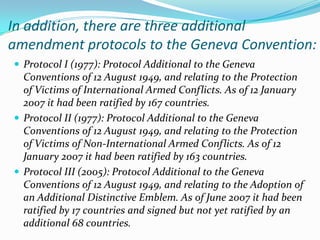
In addition, there are three additional
amendment protocols to the Geneva Convention:
 Protocol I (1977): Protocol Additional to the Geneva
  Conventions of 12 August 1949, and relating to the Protection
  of Victims of International Armed Conflicts. As of 12 January
  2007 it had been ratified by 167 countries.
 Protocol II (1977): Protocol Additional to the Geneva
  Conventions of 12 August 1949, and relating to the Protection
  of Victims of Non-International Armed Conflicts. As of 12
  January 2007 it had been ratified by 163 countries.
 Protocol III (2005): Protocol Additional to the Geneva
  Conventions of 12 August 1949, and relating to the Adoption of
  an Additional Distinctive Emblem. As of June 2007 it had been
  ratified by 17 countries and signed but not yet ratified by an
  additional 68 countries.
The conventions and their agreements

 The Geneva Conventions comprise rules that apply in times of
   armed conflict and seek to protect people who are not or are
   no longer taking part in hostilities, for example:
  wounded or sick fighters
  prisoners of war
  civilians
  medical and religious personnel
To this end, laws of war are intended to mitigate the
  evils of war by:
 Protecting both combatants and noncombatants
  from unnecessary suffering;
 Safeguarding certain fundamental human rights of
  persons who fall into the hands of the enemy,
  particularly prisoners of war, the wounded and sick,
  and civilians;
 Facilitating the restoration of peace.
Fundamental principles of humanitarian law
 limit the suffering caused by war by forcing parties engaged
    in a conflict to:
   engage in limited methods and means of warfare;
    differentiate between civilian population and combatants,
    and work to spare civilian population and property;
    abstain from harming or killing an adversary who surrenders
    or who can no longer take part in the fighting;
    abstain from physically or mentally torturing or performing
    cruel punishments on adversaries.
Basic rules of IHL
 Persons hors de combat and those not taking part
  in hostilities shall be protected and treated
  humanely.
 It is forbidden to kill or injure an enemy who
  surrenders or who is hors de combat.
 The wounded and sick shall be cared for and
  protected by the party to the conflict which has
  them in its power. The emblem of the "Red
  Cross," or of the "Red Crescent," shall be required
  to be respected as the sign of protection.
Basic rules of IHL
 Captured combatants and civilians must be
  protected against acts of violence and
  reprisals. They shall have the right to
  correspond with their families and to receive
  relief.
 No one shall be subjected to torture, corporal
  punishment or cruel or degrading treatment.
Basic rules of IHL
 Parties to a conflict shall at all times distinguish
  between the civilian population and combatants.
  Attacks shall be directed solely against military
  objectives.
 Parties to a conflict shall at all times distinguish
  between the civilian population and combatants.
  Attacks shall be directed solely against military
  objectives.
Basic rules of IHL
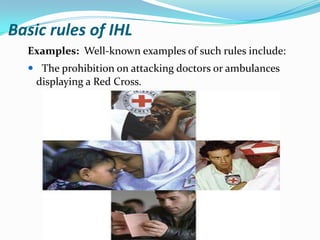
  Examples: Well-known examples of such rules include:
   The prohibition on attacking doctors or ambulances
   displaying a Red Cross.
Basic rules of IHL
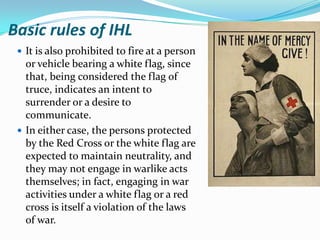
  It is also prohibited to fire at a person
   or vehicle bearing a white flag, since
   that, being considered the flag of
   truce, indicates an intent to
   surrender or a desire to
   communicate.
  In either case, the persons protected
   by the Red Cross or the white flag are
   expected to maintain neutrality, and
   they may not engage in warlike acts
   themselves; in fact, engaging in war
   activities under a white flag or a red
   cross is itself a violation of the laws
   of war.
In Conclusion
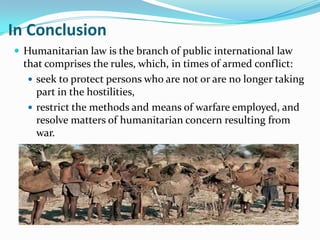
 Humanitarian law is the branch of public international law
  that comprises the rules, which, in times of armed conflict:
    seek to protect persons who are not or are no longer taking
     part in the hostilities,
    restrict the methods and means of warfare employed, and
     resolve matters of humanitarian concern resulting from
     war.
In Conclusion
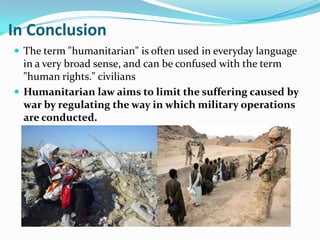
 The term "humanitarian" is often used in everyday language
  in a very broad sense, and can be confused with the term
  "human rights." civilians
 Humanitarian law aims to limit the suffering caused by
  war by regulating the way in which military operations
  are conducted.
In Conclusion
 International humanitarian law is the
  law of armed conflict or law of war and
  their effects.
 The goal of international humanitarian law
  is to limit the effects of war on people and
  property and to protect particularly
  vulnerable persons.
Reaction:
 States have always been limited in the ways
  in which they conduct armed conflicts, from
  the adherence to national laws and bilateral
  treaties, to the observance of time-honored
  customary rules. However, throughout
  history these limitations on warfare varied
  greatly among conflicts and were ultimately
  dependant on time, place, and the countries
  involved.
The final word is yours!

International Humanitarian Law

  • 1.
    Prepared by Ma. MarthaManette A. Madrid, Ed.D. Bachelor of Law Panpacific University North Philippines Urdaneta City, Pangasinan Philippines November 2010
  • 2.
    Something tells me It’s all happening at the zoo. I do believe it, I do believe it’s true. The monkeys stand for honesty, Giraffes are insincere, And the elephants are kindly but they’re dumb. Orangutans are skeptical of changes in their cages, And the zookeeper is very fond of rum. Zebras are reactionaries, Antelope plot in secrecy, And hamsters turn on frequently. What a gas! You gotta come and see At the zoo. -Paul Simon-
  • 3.
    What is HumanitarianAid? is a response to a crisis or emergency and is material, food, water, clothing, etc. assistance for saving lives, alleviating suffering, and maintaining human dignity, and does not address the underlying socioeconomic factors which lead to the crisis or emergency.  Internationally, this is invoked two ways:  Peacetime- Human Rights Law  Armed conflict- International Humanitarian Law
  • 4.
    International Humanitarian Law orArmed conflict is also considered accepted Customary Law and a universal codification standard. The United Nations (UN) has the UN office for the Coordination of Humanitarian Affairs (UNOCHA), formed in 1991 by the General Assembly Resolution 46/182 & the Department of Humanitarian Affairs (DHA) replacing the Office of the United Nations Disaster Relief Coordinator formed in 1972.  Humanitarian Aid is also called:  International Relief and  Development Aid
  • 5.
    Seven Conventions andNine Protocols that include International Humanitarian Law  The Four Geneva Conventions of 1949.  Additional Protocols of 1977, protection of victims of armed conflicts.  The 1954 Convention, protection of cultural property in the event of armed conflict plus its two protocols.  The 1972 Biological Weapons Convention.  The 1980 Conventional Weapons Convention and its five protocols.  The 1993 Chemical Weapons Convention.  The 1997Ottawa convention on anti-personnel mines.  The 2000 Optional Protocol to the convention on the Rights of child on the involvement of children in armed conflict.
  • 6.
    International Humanitarian Law(Armed conflict) is used:  only for armed conflict,  once the conflict has begun, and  equally applied to both sides regardless of who started the fighting.  Note:  International armed conflicts are those in which at least two states are involved, the use of the word states for these purposes implies the word country is included or synonymous.
  • 7.
    Human Rights Law(Peacetime)  Applies to peacetime and many of the provisions are suspended during armed conflict. The United Nations (UN) has the Universal Declaration of Human Rights (UDHR), it is the first International statement to use the term “human rights”.  The Covenant on Civil and Political Rights:  The right to self determination.  The right to own, trade, and dispose of their property freely, and not deprived of their means of subsistence.
  • 8.
    International Humanitarian Law  oftenreferred to as the law of war, the laws and customs of war or the law of armed conflict  the legal corpus that comprises "the Geneva Conventions and the Hague Conventions as well as subsequent treaties, case law, and customary international law.
  • 9.
     defines theconduct and responsibilities of belligerent ( an individual, group, country or other entity which acts in a hostile manner, such as engaging in combat), nations, neutral nations and individuals engaged in warfare, in relation to each other and to protected persons, usually meaning civilians.
  • 10.
    Two Historical Streams the law of The Hague referred to in the past as the law of war proper; and  the law of Geneva or humanitarian law.
  • 11.
    The Law ofThe Hague, or the Laws of War  a body of law concerning acceptable justifications to engage in war (jus ad bellum) and the limits to acceptable wartime conduct (jus in bello).  considered an aspect of public international law (the law of nations) and is distinguished from other bodies of law, such as the domestic law of a particular belligerent to a conflict, that may also provide legal limits to the conduct or justification of war.  modern laws of war address declarations of war, acceptance of surrender and the treatment of prisoners of war, military necessity along with distinction and proportionality, and the prohibition of certain weapons that may cause unnecessary suffering.
  • 12.
    Historical Background:  TheHague Conventions were two international treaties negotiated at international peace conferences at The Hague in the Netherlands: The First Hague Conference in 1899 and the Second Hague Conference in 1907.  Along with the Geneva Conventions, the Hague Conventions were among the first formal statements of the laws of war and war crimes in the nascent body of secular international law.  A third conference was planned for 1914 and later rescheduled for 1915, but never took place due to the start of World War I.The German international law scholar and neo-Kantian pacifist Walther Schücking called the assemblies the "international union of Hague conferences
  • 13.
    Historical Background:  Amajor effort in both the conferences was to create a binding international court for compulsory arbitration to settle international disputes, which was considered necessary to replace the institution of war.  Most of the great powers, including the United States, Britain, Russia, France, China, and Persia, favored a binding international arbitration, but the condition was that the vote should be unanimous, and a few countries, led by Germany, vetoed the idea.
  • 14.
    The Hague Conventionof 1899 consisted of four main sections and three additional declarations  I - Pacific Settlement of International Disputes  II- Laws and Customs of War on Land  III- Adaptation to Maritime Warfare of Principles of Geneva Convention of 1864  IV - Prohibiting Launching of Projectiles and Explosives from Balloons  Declaration I - On the Launching of Projectiles and Explosives from Balloons  Declaration II - On the Use of Projectiles the Object of Which is the Diffusion of Asphyxiating or Deleterious Gases  Declaration III - On the Use of Bullets Which Expand or Flatten Easily in the Human Body
  • 15.
    The Final Agreementwas signed on October 18, 1907, and entered into force on January 26, 1910. It consisted of thirteen sections, of which twelve were ratified and entered into force:  I— The Pacific Settlement of International Disputes  II — The Limitation of Employment of Force for Recovery of Contract Debts  III — The Opening of Hostilities  IV — The Laws and Customs of War on Land  V— The Rights and Duties of Neutral Powers and Persons in Case of War on Land  VI — The Status of Enemy Merchant Ships at the Outbreak of Hostilities  VII — The Conversion of Merchant Ships into War-Ships  I— The Pacific Settlement of International Disputes  II — The Limitation of Employment of Force for Recovery of Contract Debts  III — The Opening of Hostilities  IV — The Laws and Customs of War on Land  V— The Rights and Duties of Neutral Powers and Persons in Case of War on Land  VI— The Status of Enemy Merchant Ships at the Outbreak of Hostilities
  • 16.
     VII —The Conversion of Merchant Ships into War-Ships  VIII — The Laying of Automatic Submarine Contact Mines  IX— Bombardment by Naval Forces in Time of War  X— Adaptation to Maritime War of the Principles of the Geneva Convention  XI — Certain Restrictions with Regard to the Exercise of the Right of Capture in Naval War  XII — The Creation of an International Prize Court [Not Ratified]  XIII - The Rights and Duties of Neutral Powers in Naval War
  • 17.
    Two declarations weresigned as well:  Declaration I — extending Declaration II from the 1899 Conference to other types of aircraft[  Declaration II—- on the obligatory arbitration
  • 18.
    The law ofwar:  Determine the rights and duties of belligerents in the conduct of operations and limits the choice of means in doing harm.  Concerns itself with the definition of combatants, establishes rules relating to the means and methods of warfare, and examines the issue of military objectives
  • 19.
    The modern lawof war is derived from two principal sources:  Lawmaking treaties (or conventions)  Not all the law of war derives from or has been incorporated in such treaties, which can refer to the continuing importance of customary law.
  • 20.
    Purposes of thelaws  Wars should be limited to achieving the political goals that started the war (e.g., territorial control) and should not include unnecessary destruction;  Wars should be brought to an end as quickly as possible;  People and property that do not contribute to the war effort should be protected against unnecessary destruction and hardship;
  • 21.
    Applicability to statesand individuals  The law of war is binding not only upon States as such but also upon individuals and, in particular, the members of their armed forces.  Parties are bound by the laws of war to the extent that such compliance does not interfere with achieving legitimate military goals.
  • 22.
    Remedies for violations  Soldiers who break specific provisions of the laws of war lose the protections and status afforded as prisoners of war, but only after facing a "competent tribunal".  Spies and terrorists may be subject to civilian law or military tribunal for their acts and in practice have been subjected to torture and/or execution. The laws of war neither approve nor condemn such acts, which fall outside their scope.  citizens and soldiers of nations which have not signed and do not abide by the Third and Fourth Geneva Conventions are not protected by them.
  • 23.
    Remedies for violations  If someone is (or is suspected to be) a citizen or soldier of a nation which has signed or abides by the Fourth Geneva Convention , or is (or is suspected to be) a "prisoner of war" (POW) per the definitions of such "protected persons" in the Third Geneva Convention, the following applies: A POW who breaks specific provisions of the laws of war may be penalized, but not penalized worse than the tribunal would penalize its own soldiers for the same offense (and usually a disciplinary, not judicial, punishment if its own soldiers normally wouldn't be brought to trial for a particular offense)
  • 24.
    Remedies for violations  After a conflict has ended, persons who have committed or ordered any breach of the laws of war, especially atrocities, may be held individually accountable for war crimes through process of law. Also, nations which signed the Geneva Conventions are required to search for, then try and punish, anyone who has committed or ordered certain "grave breaches" of the laws of war.  Soldiers who break specific provisions of the laws of war lose the protections and status afforded as prisoners of war but only after facing a "competent tribunal“.
  • 25.
    Remedies for violations  Spies and terrorists may be subject to civilian law or military tribunal for their acts and in practice have been subjected to torture and/or execution. The laws of war neither approve nor condemn such acts, which fall outside their scope.  citizens and soldiers of nations which have not signed and do not abide by the Third and Fourth Geneva Conventions are not protected by them.
  • 26.
    Remedies for violations  If someone is (or is suspected to be) a citizen or soldier of a nation which has signed or abides by the Fourth Geneva Convention , or is (or is suspected to be) a "prisoner of war" (POW) per the definitions of such "protected persons" in the Third Geneva Convention, the following applies: A POW who breaks specific provisions of the laws of war may be penalized, but not penalized worse than the tribunal would penalize its own soldiers for the same offense (and usually a disciplinary, not judicial, punishment if its own soldiers normally wouldn't be brought to trial for a particular offense)
  • 27.
    International treaties onthe laws of war List of declarations, conventions, treaties and judgments and on the laws of war (pls refer to your photo copies)
  • 28.
    The Geneva Conventions are the result of a process that developed in a number of stages between 1864 and 1949 which focused on the protection of civilians and those who can no longer fight in an armed conflict. As a result of World War II, all four conventions were revised based on previous revisions and partly on some of the 1907 Hague Conventions and readopted by the international community in 1949. Later conferences have added provisions prohibiting certain methods of warfare and addressing issues of civil wars.  comprise four treaties and three additional protocols that set the standards in international law for humanitarian treatment of the victims of war.
  • 29.
    The Geneva Conventionsare:  First Geneva Convention "for the Amelioration of the Condition of the Wounded and Sick in Armed Forces in the Field" (first adopted in 1864, last revision in 1949)  Second Geneva Convention "for the Amelioration of the Condition of Wounded, Sick and Shipwrecked Members of Armed Forces at Sea" (first adopted in 1949, successor of the 1907 Hague Convention X)  Third Geneva Convention "relative to the Treatment of Prisoners of War" ( first adopted in 1929, last revision in 1949)  Fourth Geneva Convention "relative to the Protection of Civilian Persons in Time of War" (first adopted in 1949, based on parts of the 1907 Hague Convention IV)
  • 30.
    In addition, thereare three additional amendment protocols to the Geneva Convention:  Protocol I (1977): Protocol Additional to the Geneva Conventions of 12 August 1949, and relating to the Protection of Victims of International Armed Conflicts. As of 12 January 2007 it had been ratified by 167 countries.  Protocol II (1977): Protocol Additional to the Geneva Conventions of 12 August 1949, and relating to the Protection of Victims of Non-International Armed Conflicts. As of 12 January 2007 it had been ratified by 163 countries.  Protocol III (2005): Protocol Additional to the Geneva Conventions of 12 August 1949, and relating to the Adoption of an Additional Distinctive Emblem. As of June 2007 it had been ratified by 17 countries and signed but not yet ratified by an additional 68 countries.
  • 31.
    The conventions andtheir agreements The Geneva Conventions comprise rules that apply in times of armed conflict and seek to protect people who are not or are no longer taking part in hostilities, for example:  wounded or sick fighters  prisoners of war  civilians  medical and religious personnel
  • 32.
    To this end,laws of war are intended to mitigate the evils of war by:  Protecting both combatants and noncombatants from unnecessary suffering;  Safeguarding certain fundamental human rights of persons who fall into the hands of the enemy, particularly prisoners of war, the wounded and sick, and civilians;  Facilitating the restoration of peace.
  • 33.
    Fundamental principles ofhumanitarian law  limit the suffering caused by war by forcing parties engaged in a conflict to:  engage in limited methods and means of warfare;  differentiate between civilian population and combatants, and work to spare civilian population and property;  abstain from harming or killing an adversary who surrenders or who can no longer take part in the fighting;  abstain from physically or mentally torturing or performing cruel punishments on adversaries.
  • 34.
    Basic rules ofIHL  Persons hors de combat and those not taking part in hostilities shall be protected and treated humanely.  It is forbidden to kill or injure an enemy who surrenders or who is hors de combat.  The wounded and sick shall be cared for and protected by the party to the conflict which has them in its power. The emblem of the "Red Cross," or of the "Red Crescent," shall be required to be respected as the sign of protection.
  • 35.
    Basic rules ofIHL  Captured combatants and civilians must be protected against acts of violence and reprisals. They shall have the right to correspond with their families and to receive relief.  No one shall be subjected to torture, corporal punishment or cruel or degrading treatment.
  • 36.
    Basic rules ofIHL  Parties to a conflict shall at all times distinguish between the civilian population and combatants. Attacks shall be directed solely against military objectives.  Parties to a conflict shall at all times distinguish between the civilian population and combatants. Attacks shall be directed solely against military objectives.
  • 37.
    Basic rules ofIHL Examples: Well-known examples of such rules include:  The prohibition on attacking doctors or ambulances displaying a Red Cross.
  • 38.
    Basic rules ofIHL  It is also prohibited to fire at a person or vehicle bearing a white flag, since that, being considered the flag of truce, indicates an intent to surrender or a desire to communicate.  In either case, the persons protected by the Red Cross or the white flag are expected to maintain neutrality, and they may not engage in warlike acts themselves; in fact, engaging in war activities under a white flag or a red cross is itself a violation of the laws of war.
  • 39.
    In Conclusion  Humanitarianlaw is the branch of public international law that comprises the rules, which, in times of armed conflict:  seek to protect persons who are not or are no longer taking part in the hostilities,  restrict the methods and means of warfare employed, and resolve matters of humanitarian concern resulting from war.
  • 40.
    In Conclusion  Theterm "humanitarian" is often used in everyday language in a very broad sense, and can be confused with the term "human rights." civilians  Humanitarian law aims to limit the suffering caused by war by regulating the way in which military operations are conducted.
  • 41.
    In Conclusion  Internationalhumanitarian law is the law of armed conflict or law of war and their effects.  The goal of international humanitarian law is to limit the effects of war on people and property and to protect particularly vulnerable persons.
  • 42.
    Reaction:  States havealways been limited in the ways in which they conduct armed conflicts, from the adherence to national laws and bilateral treaties, to the observance of time-honored customary rules. However, throughout history these limitations on warfare varied greatly among conflicts and were ultimately dependant on time, place, and the countries involved.
  • 43.
    The final wordis yours!