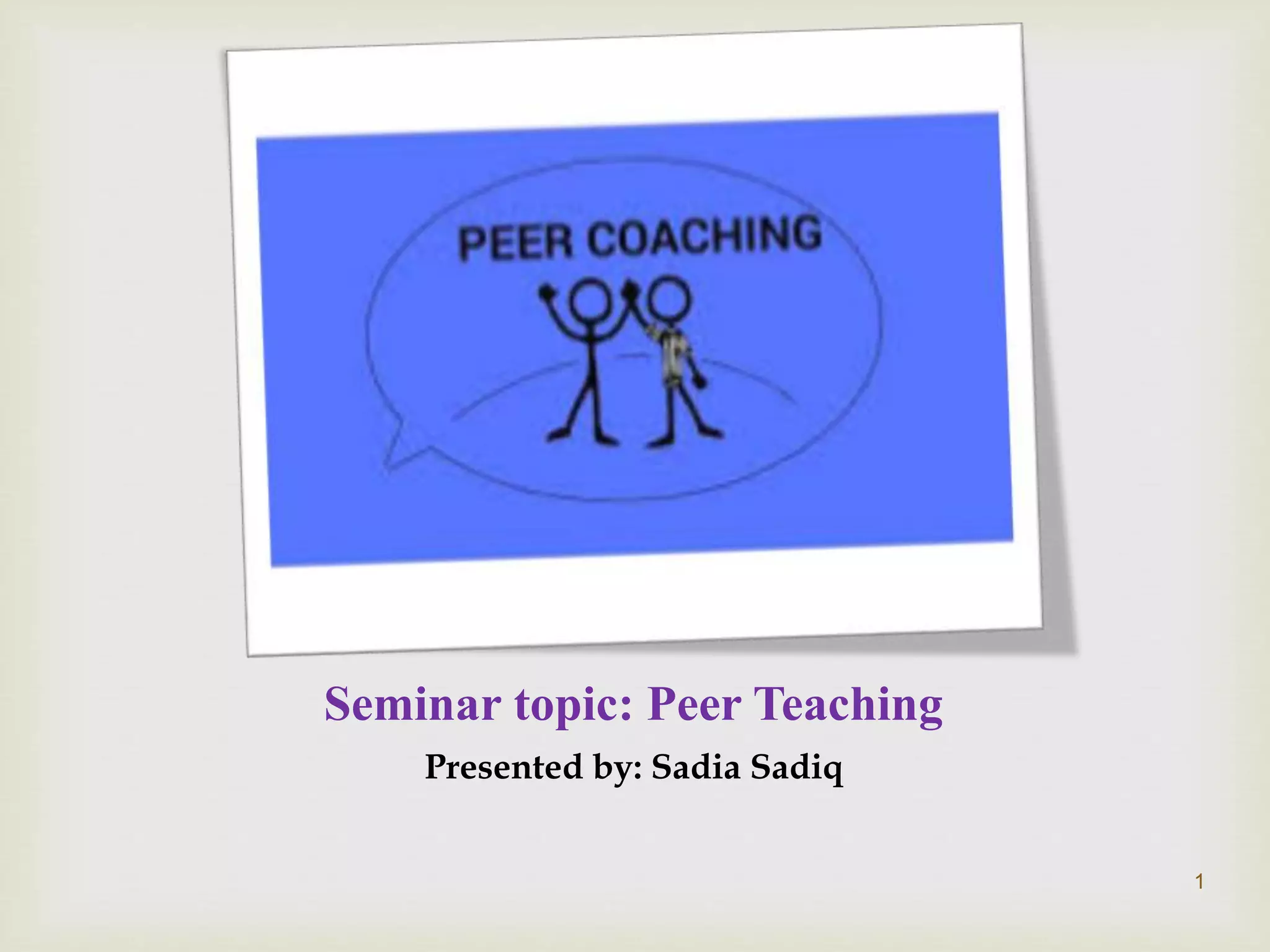
Seminar topic: Peer Teaching
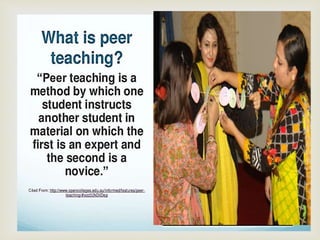
Presented by: Sadia Sadiq
1

 Introduction
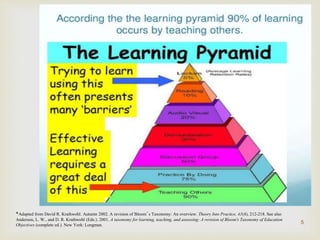
 Learning pyramids
 Types of peer teaching
 Purpose of peer teaching
 Structure of peer teaching
 Component of peer teaching
 Instructional implications
 Limitations
 Suggestions
2
Sequence of the Content
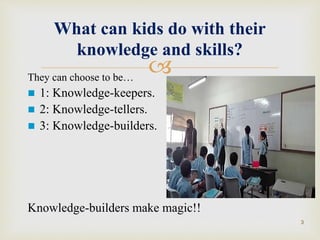
They can choose to be…
 1: Knowledge-keepers.
 2: Knowledge-tellers.
 3: Knowledge-builders.
Knowledge-builders make magic!!
What can kids do with their
knowledge and skills?
3
4
*Adapted from David R. Krathwohl. Autumn 2002. A revision of Bloom’s Taxonomy: An overview. Theory Into Practice, 41(4), 212-218. See also
Anderson, L. W., and D. R. Krathwohl (Eds.). 2001. A taxonomy for learning, teaching, and assessing: A revision of Bloom's Taxonomy of Education
Objectives (complete ed.). New York: Longman.
5

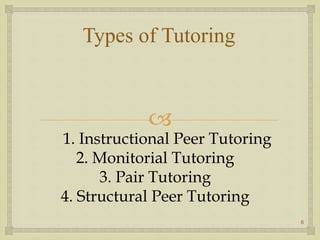
1. Instructional Peer Tutoring
2. Monitorial Tutoring
3. Pair Tutoring
4. Structural Peer Tutoring
Types of Tutoring
6

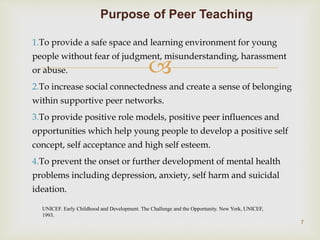
1.To provide a safe space and learning environment for young
people without fear of judgment, misunderstanding, harassment
or abuse.
2.To increase social connectedness and create a sense of belonging
within supportive peer networks.
3.To provide positive role models, positive peer influences and
opportunities which help young people to develop a positive self
concept, self acceptance and high self esteem.
4.To prevent the onset or further development of mental health
problems including depression, anxiety, self harm and suicidal
ideation.
Purpose of Peer Teaching
UNICEF. Early Childhood and Development. The Challenge and the Opportunity. New York, UNICEF,
1993.
7
22-11-2019 8
9
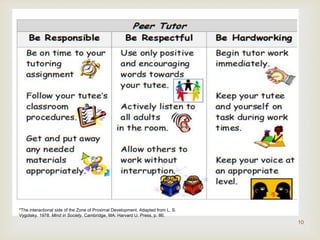
*The interactional side of the Zone of Proximal Development. Adapted from L. S.
Vygotsky. 1978. Mind in Society. Cambridge, MA: Harvard U. Press, p. 86.
10
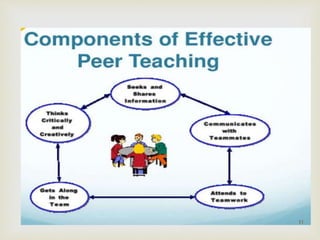
11

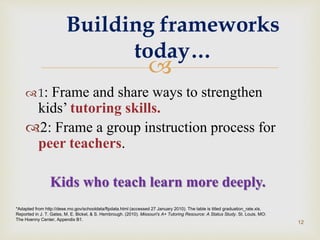
1: Frame and share ways to strengthen
kids’ tutoring skills.
2: Frame a group instruction process for
peer teachers.
Kids who teach learn more deeply.
Building frameworks
today…
*Adapted from http://dese.mo.gov/schooldata/ftpdata.html (accessed 27 January 2010). The table is titled graduation_rate.xls.
Reported in J. T. Gates, M. E. Bickel, & S. Hembrough. (2010). Missouri's A+ Tutoring Resource: A Status Study. St. Louis, MO:
The Hoenny Center, Appendix B1.
12
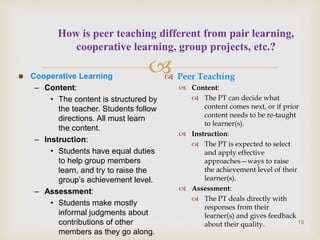
 Peer Teaching
 Content:
 The PT can decide what
content comes next, or if prior
content needs to be re-taught
to learner(s).
 Instruction:
 The PT is expected to select
and apply effective
approaches—ways to raise
the achievement level of their
learner(s).
 Assessment:
 The PT deals directly with
responses from their
learner(s) and gives feedback
about their quality.
How is peer teaching different from pair learning,
cooperative learning, group projects, etc.?
 Cooperative Learning
– Content:
• The content is structured by
the teacher. Students follow
directions. All must learn
the content.
– Instruction:
• Students have equal duties
to help group members
learn, and try to raise the
group’s achievement level.
– Assessment:
• Students make mostly
informal judgments about
contributions of other
members as they go along.
13

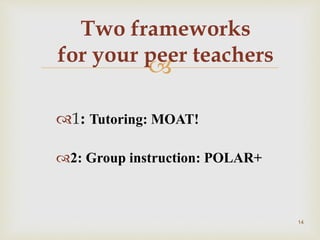
1: Tutoring: MOAT!
2: Group instruction: POLAR+
Two frameworks
for your peer teachers
14

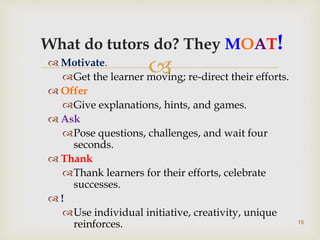
What do tutors do? They MOAT!
 Motivate.
Get the learner moving; re-direct their efforts.
 Offer
Give explanations, hints, and games.
 Ask
Pose questions, challenges, and wait four
seconds.
 Thank
Thank learners for their efforts, celebrate
successes.
 !
Use individual initiative, creativity, unique
reinforces. 15
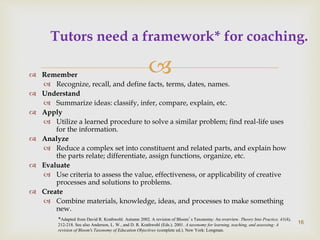
 Remember
 Recognize, recall, and define facts, terms, dates, names.
 Understand
 Summarize ideas: classify, infer, compare, explain, etc.
 Apply
 Utilize a learned procedure to solve a similar problem; find real-life uses
for the information.
 Analyze
 Reduce a complex set into constituent and related parts, and explain how
the parts relate; differentiate, assign functions, organize, etc.
 Evaluate
 Use criteria to assess the value, effectiveness, or applicability of creative
processes and solutions to problems.
 Create
 Combine materials, knowledge, ideas, and processes to make something
new.
Tutors need a framework* for coaching.
*Adapted from David R. Krathwohl. Autumn 2002. A revision of Bloom’s Taxonomy: An overview. Theory Into Practice, 41(4),
212-218. See also Anderson, L. W., and D. R. Krathwohl (Eds.). 2001. A taxonomy for learning, teaching, and assessing: A
revision of Bloom's Taxonomy of Education Objectives (complete ed.). New York: Longman.
16

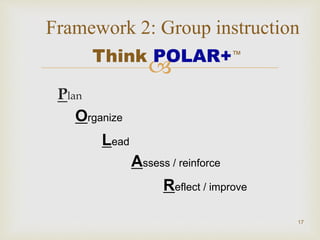
Plan
Think POLAR+™
Organize
Lead
Assess / reinforce
Reflect / improve
Framework 2: Group instruction
17

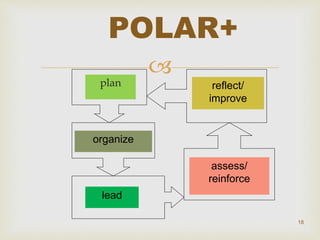
plan
POLAR+
organize
lead
assess/
reinforce
reflect/
improve
18

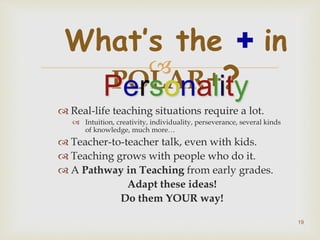
 Real-life teaching situations require a lot.
 Intuition, creativity, individuality, perseverance, several kinds
of knowledge, much more…
 Teacher-to-teacher talk, even with kids.
 Teaching grows with people who do it.
 A Pathway in Teaching from early grades.
Adapt these ideas!
Do them YOUR way!
What’s the + in
POLAR+?Personality
19

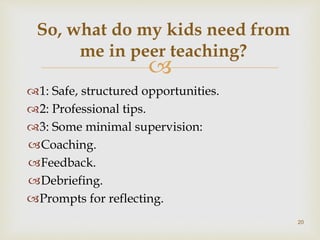
1: Safe, structured opportunities.
2: Professional tips.
3: Some minimal supervision:
Coaching.
Feedback.
Debriefing.
Prompts for reflecting.
So, what do my kids need from
me in peer teaching?
20

 1. Tutees receive individualized instruction, as through
their own teacher.
 Immediately, errors are corrected and rewards for good
performance is awarded.
 2. Careful selection of tutors afford better interactions that
facilitate
 learning since they are older, skilled and knowledgeable.
 3. Interests, tastes and nonverbal cues are easily
ascertained by tutors, then, monitoring is more enjoyable
and fulfilling.
INSTRUCTIONAL
CHARACTERISTICS
(Barna,1994.)
21
 4. Values of cooperation, respect for one another and
reciprocal attitudes are inculcated.
 5. Working in smaller groups with monitors around
minimizes discipline
 problems or indifference to get actively involved.
 6. Since tutors are ready to share assistance, they are
afforded the
 motivation to move themselves in intellectual and social
traits.
 7. Since tutors are a little order and better equipped,
tutees feel more
 secure in their presence be it in a social or academic
setting.
22
LIMITATIONS
1. If left to themselves “over tutoring”
might create a negative situation instead.
2. Unclear roles can lead to questions on
credibility of tutors.
3. Favouritism in choice of tutors must be
avoided. This could result in overdomineering
and all-knowing reactions of others.
Bernard van Leer Foundation, 1996
. 23

SUGGESTIONS/RECOMMENDATION
S
1. Care in choosing the tutor is the key to a successful peer
tutoring methodology. Domineering and all-knowing tutors make the
members feel inferior.
2. Teacher should be around to observe how the tutoring is
progressing. Immediate feedback could be shared with the tutors to
improve or undertake instant revision of
procedures when necessary.
3. Assign students who passes leadership qualities in addition
to being knowledgeable and older.
4. Development of positive values such as a sharing
attitude, cooperation and respect for one another should be
carefully observed and given due recognitions. 24
5. Nature and extent of assistance requested must be clear
among tutees and tutor in order to avoid negative
interactions.
6. Request peers who have been earlier notified to discuss the
topics included in the day’s lesson. Confer with the teacher
regarding the nature and extent of assistance they are
expected to provide.
7. Individual or group tutoring may be considered depending
on the level of difficulty of the lesson.
8. Creative tutors are more able to try effective strategies
according to their interests, skills and work habits.
25
9.After a tutoring activity, an evaluation of
both parties’ performance should be
undertaken in order to guide future
tutoring events.
26
27
Bernard van Leer Foundation.Why Children Matter. Investing in Early Childhood
Care and Development.The Hague, Bernard van Leer Foundation, 1994.
Building on People’s Strengths: Early Childhood in Africa. The Hague,
Bernard van Leer Foundation, 1994.
Covey, S. R.The Seven Habits of Highly Effective People. Powerful
Lessons in Personal Change.New York, Simon & Schuster, 1
989.Development Education Centre.Us and the Kids: Ideas and
Resources for Parent Groups.Birmingham, Development Education
Centre, 1991.
Fugelsang,A. Child Advocacy in Community Development.Sri Lanka, Redd
Barna,1989.
Fugelsang, A.; Chandler, D.Basket of Ideas for Trainers.Norway, Redd
Barna,1994.
References:
28
Hope, A.; Timmel, S.Training for Transformation: A Handbook for Community
Workers.Rev. ed. Zimbabwe, Mambo Press, 1984.
Landers, C.Off to a Good Start; A Time of Adventure: From One to Three Years;
Pathways to Learning; Ready for School.New York, UNICEF, 1996. (Videos and
facilitators’ resource guides.)
Torkington, K.The Rationale for Experiential/Participatory Learning.The Hague,
Bernard van Leer Foundation, 1996
.
Torkington, K.; Landers, C. Enhancing the Skills of Early Childhood Trainers.
The Hague/Paris, Bernard van Leer Foundation/UNESCO,
1995.UNICEF. Early Childhood and Development. The Challenge and the
Opportunity. New York, UNICEF, 1993.
Van der Eycken, W. Introducing Evaluation. The Hague, Bernard van Leer
Foundation, 1992.
Vella, J.Learning to Teach: Training of Trainers for Community Development. Save
the Children/OEF International, 1989.
J. T. Gates, M. E. Bickel, & S. Hembrough. (2010). Missouri's A+ Tutoring Resource: A
Status Study. St. Louis, MO: The Hoenny Center, Appendix B1.

Peer teaching

  • 1.
    Seminar topic: PeerTeaching Presented by: Sadia Sadiq 1
  • 2.
      Introduction  Learningpyramids  Types of peer teaching  Purpose of peer teaching  Structure of peer teaching  Component of peer teaching  Instructional implications  Limitations  Suggestions 2 Sequence of the Content
  • 3.
    They can chooseto be…  1: Knowledge-keepers.  2: Knowledge-tellers.  3: Knowledge-builders. Knowledge-builders make magic!! What can kids do with their knowledge and skills? 3
  • 4.
  • 5.
    *Adapted from DavidR. Krathwohl. Autumn 2002. A revision of Bloom’s Taxonomy: An overview. Theory Into Practice, 41(4), 212-218. See also Anderson, L. W., and D. R. Krathwohl (Eds.). 2001. A taxonomy for learning, teaching, and assessing: A revision of Bloom's Taxonomy of Education Objectives (complete ed.). New York: Longman. 5
  • 6.
     1. Instructional PeerTutoring 2. Monitorial Tutoring 3. Pair Tutoring 4. Structural Peer Tutoring Types of Tutoring 6
  • 7.
     1.To provide asafe space and learning environment for young people without fear of judgment, misunderstanding, harassment or abuse. 2.To increase social connectedness and create a sense of belonging within supportive peer networks. 3.To provide positive role models, positive peer influences and opportunities which help young people to develop a positive self concept, self acceptance and high self esteem. 4.To prevent the onset or further development of mental health problems including depression, anxiety, self harm and suicidal ideation. Purpose of Peer Teaching UNICEF. Early Childhood and Development. The Challenge and the Opportunity. New York, UNICEF, 1993. 7
  • 8.
  • 9.
  • 10.
    *The interactional sideof the Zone of Proximal Development. Adapted from L. S. Vygotsky. 1978. Mind in Society. Cambridge, MA: Harvard U. Press, p. 86. 10
  • 11.
  • 12.
     1: Frame andshare ways to strengthen kids’ tutoring skills. 2: Frame a group instruction process for peer teachers. Kids who teach learn more deeply. Building frameworks today… *Adapted from http://dese.mo.gov/schooldata/ftpdata.html (accessed 27 January 2010). The table is titled graduation_rate.xls. Reported in J. T. Gates, M. E. Bickel, & S. Hembrough. (2010). Missouri's A+ Tutoring Resource: A Status Study. St. Louis, MO: The Hoenny Center, Appendix B1. 12
  • 13.
     Peer Teaching Content:  The PT can decide what content comes next, or if prior content needs to be re-taught to learner(s).  Instruction:  The PT is expected to select and apply effective approaches—ways to raise the achievement level of their learner(s).  Assessment:  The PT deals directly with responses from their learner(s) and gives feedback about their quality. How is peer teaching different from pair learning, cooperative learning, group projects, etc.?  Cooperative Learning – Content: • The content is structured by the teacher. Students follow directions. All must learn the content. – Instruction: • Students have equal duties to help group members learn, and try to raise the group’s achievement level. – Assessment: • Students make mostly informal judgments about contributions of other members as they go along. 13
  • 14.
     1: Tutoring: MOAT! 2:Group instruction: POLAR+ Two frameworks for your peer teachers 14
  • 15.
     What do tutorsdo? They MOAT!  Motivate. Get the learner moving; re-direct their efforts.  Offer Give explanations, hints, and games.  Ask Pose questions, challenges, and wait four seconds.  Thank Thank learners for their efforts, celebrate successes.  ! Use individual initiative, creativity, unique reinforces. 15
  • 16.
     Remember  Recognize,recall, and define facts, terms, dates, names.  Understand  Summarize ideas: classify, infer, compare, explain, etc.  Apply  Utilize a learned procedure to solve a similar problem; find real-life uses for the information.  Analyze  Reduce a complex set into constituent and related parts, and explain how the parts relate; differentiate, assign functions, organize, etc.  Evaluate  Use criteria to assess the value, effectiveness, or applicability of creative processes and solutions to problems.  Create  Combine materials, knowledge, ideas, and processes to make something new. Tutors need a framework* for coaching. *Adapted from David R. Krathwohl. Autumn 2002. A revision of Bloom’s Taxonomy: An overview. Theory Into Practice, 41(4), 212-218. See also Anderson, L. W., and D. R. Krathwohl (Eds.). 2001. A taxonomy for learning, teaching, and assessing: A revision of Bloom's Taxonomy of Education Objectives (complete ed.). New York: Longman. 16
  • 17.
     Plan Think POLAR+™ Organize Lead Assess /reinforce Reflect / improve Framework 2: Group instruction 17
  • 18.
  • 19.
      Real-life teachingsituations require a lot.  Intuition, creativity, individuality, perseverance, several kinds of knowledge, much more…  Teacher-to-teacher talk, even with kids.  Teaching grows with people who do it.  A Pathway in Teaching from early grades. Adapt these ideas! Do them YOUR way! What’s the + in POLAR+?Personality 19
  • 20.
     1: Safe, structuredopportunities. 2: Professional tips. 3: Some minimal supervision: Coaching. Feedback. Debriefing. Prompts for reflecting. So, what do my kids need from me in peer teaching? 20
  • 21.
      1. Tuteesreceive individualized instruction, as through their own teacher.  Immediately, errors are corrected and rewards for good performance is awarded.  2. Careful selection of tutors afford better interactions that facilitate  learning since they are older, skilled and knowledgeable.  3. Interests, tastes and nonverbal cues are easily ascertained by tutors, then, monitoring is more enjoyable and fulfilling. INSTRUCTIONAL CHARACTERISTICS (Barna,1994.) 21
  • 22.
     4. Valuesof cooperation, respect for one another and reciprocal attitudes are inculcated.  5. Working in smaller groups with monitors around minimizes discipline  problems or indifference to get actively involved.  6. Since tutors are ready to share assistance, they are afforded the  motivation to move themselves in intellectual and social traits.  7. Since tutors are a little order and better equipped, tutees feel more  secure in their presence be it in a social or academic setting. 22
  • 23.
    LIMITATIONS 1. If leftto themselves “over tutoring” might create a negative situation instead. 2. Unclear roles can lead to questions on credibility of tutors. 3. Favouritism in choice of tutors must be avoided. This could result in overdomineering and all-knowing reactions of others. Bernard van Leer Foundation, 1996 . 23
  • 24.
     SUGGESTIONS/RECOMMENDATION S 1. Care inchoosing the tutor is the key to a successful peer tutoring methodology. Domineering and all-knowing tutors make the members feel inferior. 2. Teacher should be around to observe how the tutoring is progressing. Immediate feedback could be shared with the tutors to improve or undertake instant revision of procedures when necessary. 3. Assign students who passes leadership qualities in addition to being knowledgeable and older. 4. Development of positive values such as a sharing attitude, cooperation and respect for one another should be carefully observed and given due recognitions. 24
  • 25.
    5. Nature andextent of assistance requested must be clear among tutees and tutor in order to avoid negative interactions. 6. Request peers who have been earlier notified to discuss the topics included in the day’s lesson. Confer with the teacher regarding the nature and extent of assistance they are expected to provide. 7. Individual or group tutoring may be considered depending on the level of difficulty of the lesson. 8. Creative tutors are more able to try effective strategies according to their interests, skills and work habits. 25
  • 26.
    9.After a tutoringactivity, an evaluation of both parties’ performance should be undertaken in order to guide future tutoring events. 26
  • 27.
    27 Bernard van LeerFoundation.Why Children Matter. Investing in Early Childhood Care and Development.The Hague, Bernard van Leer Foundation, 1994. Building on People’s Strengths: Early Childhood in Africa. The Hague, Bernard van Leer Foundation, 1994. Covey, S. R.The Seven Habits of Highly Effective People. Powerful Lessons in Personal Change.New York, Simon & Schuster, 1 989.Development Education Centre.Us and the Kids: Ideas and Resources for Parent Groups.Birmingham, Development Education Centre, 1991. Fugelsang,A. Child Advocacy in Community Development.Sri Lanka, Redd Barna,1989. Fugelsang, A.; Chandler, D.Basket of Ideas for Trainers.Norway, Redd Barna,1994. References:
  • 28.
    28 Hope, A.; Timmel,S.Training for Transformation: A Handbook for Community Workers.Rev. ed. Zimbabwe, Mambo Press, 1984. Landers, C.Off to a Good Start; A Time of Adventure: From One to Three Years; Pathways to Learning; Ready for School.New York, UNICEF, 1996. (Videos and facilitators’ resource guides.) Torkington, K.The Rationale for Experiential/Participatory Learning.The Hague, Bernard van Leer Foundation, 1996 . Torkington, K.; Landers, C. Enhancing the Skills of Early Childhood Trainers. The Hague/Paris, Bernard van Leer Foundation/UNESCO, 1995.UNICEF. Early Childhood and Development. The Challenge and the Opportunity. New York, UNICEF, 1993. Van der Eycken, W. Introducing Evaluation. The Hague, Bernard van Leer Foundation, 1992. Vella, J.Learning to Teach: Training of Trainers for Community Development. Save the Children/OEF International, 1989. J. T. Gates, M. E. Bickel, & S. Hembrough. (2010). Missouri's A+ Tutoring Resource: A Status Study. St. Louis, MO: The Hoenny Center, Appendix B1.