
Sound Description
by Meibis M. González
Consonants and vowel sounds are
described in the same way they are
classified. Because of this, the following
information deals with both vowel and
consonant sounds.
Vowels and Consonants
• Humans produce speech sounds that are
either vowels or consonants.
• Vowels and consonants have a different form of
obstruction. That is, vowels are relatively
unobstructed in the oral cavity, whereas
consonants are produced with a complete or
partial obstruction of the airstream in
the oral cavity.
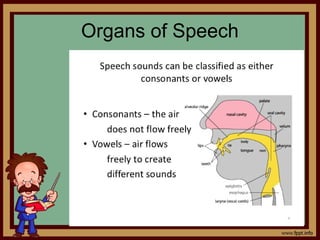
Organs of Speech
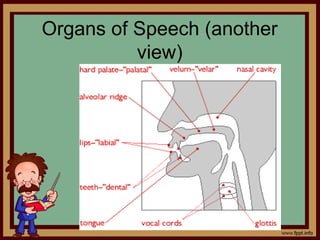
Organs of Speech (another
view)
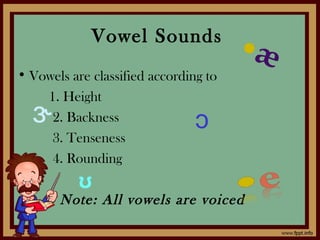
Vowel Sounds
• Vowels are classified according to
1. Height
2. Backness
3. Tenseness
4. Rounding
Note: All vowels are voiced
Description of Vowel Sounds
1. Height (high, mid, and low)
2. Backness (front, central, and back)
3. Tenseness (tense or lax)
4. Rounding (round or spread-
unround)
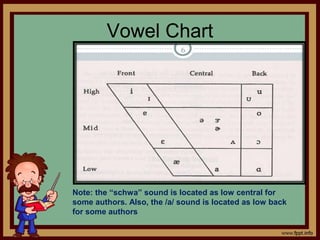
Vowel Chart
Note: the “schwa” sound is located as low central for
some authors. Also, the /a/ sound is located as low back
for some authors
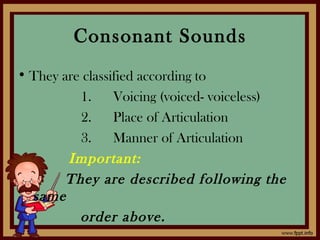
Consonant Sounds
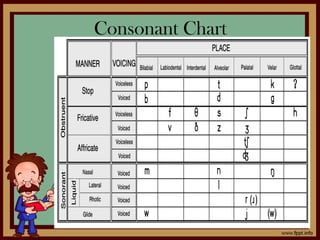
• They are classified according to
1. Voicing (voiced- voiceless)
2. Place of Articulation
3. Manner of Articulation
Important:
They are described following the
same
order above.
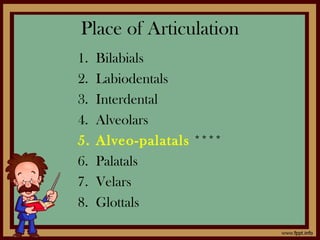
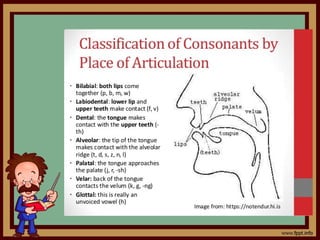
Place of Articulation
1. Bilabials
2. Labiodentals
3. Interdental
4. Alveolars
5. Alveo-palatals ****
6. Palatals
7. Velars
8. Glottals
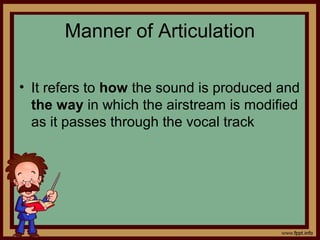
Manner of Articulation
• It refers to how the sound is produced and
the way in which the airstream is modified
as it passes through the vocal track
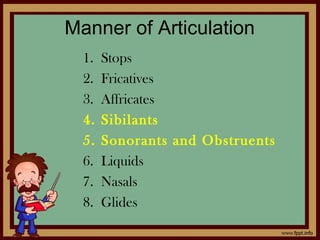
Manner of Articulation
1. Stops
2. Fricatives
3. Affricates
4. Sibilants
5. Sonorants and Obstruents
6. Liquids
7. Nasals
8. Glides
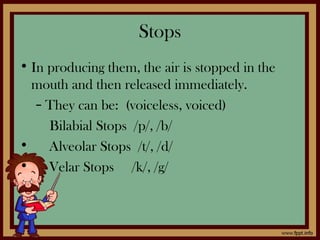
Stops
• In producing them, the air is stopped in the
mouth and then released immediately.
– They can be: (voiceless, voiced)
Bilabial Stops /p/, /b/
• Alveolar Stops /t/, /d/
• Velar Stops /k/, /g/
Fricatives
• Sounds produced by allowing the air
to pass through a small passage,
thereby producing friction.
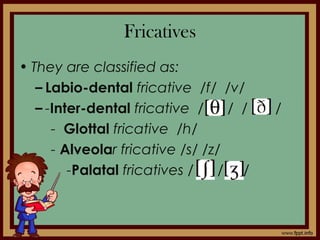
Fricatives
• They are classified as:
– Labio-dental fricative /f/ /v/
– -Inter-dental fricative / / / /
- Glottal fricative /h/
- Alveolar fricative /s/ /z/
-Palatal fricatives / / /
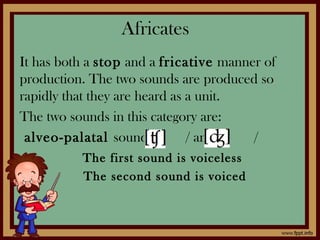
Africates
It has both a stop and a fricative manner of
production. The two sounds are produced so
rapidly that they are heard as a unit.
The two sounds in this category are:
alveo-palatal sounds / / and / /
The first sound is voiceless
The second sound is voiced
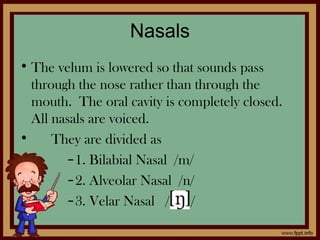
Nasals
• The velum is lowered so that sounds pass
through the nose rather than through the
mouth. The oral cavity is completely closed.
All nasals are voiced.
• They are divided as
–1. Bilabial Nasal /m/
–2. Alveolar Nasal /n/
–3. Velar Nasal / /
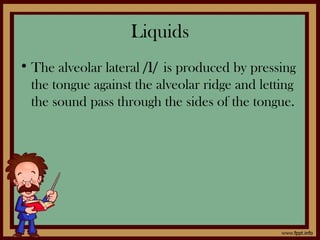
Liquids
• The alveolar lateral /l/ is produced by pressing
the tongue against the alveolar ridge and letting
the sound pass through the sides of the tongue.
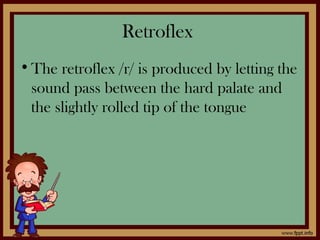
Retroflex
•The retroflex /r/ is produced by letting the
sound pass between the hard palate and
the slightly rolled tip of the tongue
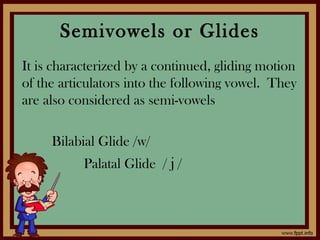
Semivowels or Glides
It is characterized by a continued, gliding motion
of the articulators into the following vowel. They
are also considered as semi-vowels
Bilabial Glide /w/
Palatal Glide / j /
Consonant Chart
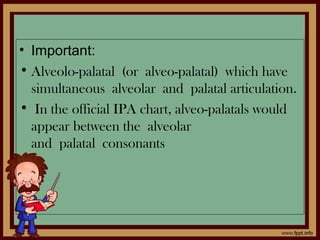
• Important:
• Alveolo-palatal (or alveo-palatal) which have
simultaneous alveolar and palatal articulation.
• In the official IPA chart, alveo-palatals would
appear between the alveolar
and palatal consonants
For instance, in describing /l/, the
feature lateral is enough to
describe this sound because /l/
is the only lateral sound
existing in English
When describing a sound
or a group of sounds, you
should only include the
features that are required to
describe that particular sound
or that particular group of
sounds
Description of sounds

Description of sounds

  • 1.
  • 2.
    Consonants and vowelsounds are described in the same way they are classified. Because of this, the following information deals with both vowel and consonant sounds.
  • 3.
    Vowels and Consonants •Humans produce speech sounds that are either vowels or consonants. • Vowels and consonants have a different form of obstruction. That is, vowels are relatively unobstructed in the oral cavity, whereas consonants are produced with a complete or partial obstruction of the airstream in the oral cavity.
  • 4.
  • 5.
    Organs of Speech(another view)
  • 6.
    Vowel Sounds • Vowelsare classified according to 1. Height 2. Backness 3. Tenseness 4. Rounding Note: All vowels are voiced
  • 7.
    Description of VowelSounds 1. Height (high, mid, and low) 2. Backness (front, central, and back) 3. Tenseness (tense or lax) 4. Rounding (round or spread- unround)
  • 8.
    Vowel Chart Note: the“schwa” sound is located as low central for some authors. Also, the /a/ sound is located as low back for some authors
  • 9.
    Consonant Sounds • Theyare classified according to 1. Voicing (voiced- voiceless) 2. Place of Articulation 3. Manner of Articulation Important: They are described following the same order above.
  • 10.
    Place of Articulation 1.Bilabials 2. Labiodentals 3. Interdental 4. Alveolars 5. Alveo-palatals **** 6. Palatals 7. Velars 8. Glottals
  • 12.
    Manner of Articulation •It refers to how the sound is produced and the way in which the airstream is modified as it passes through the vocal track
  • 13.
    Manner of Articulation 1.Stops 2. Fricatives 3. Affricates 4. Sibilants 5. Sonorants and Obstruents 6. Liquids 7. Nasals 8. Glides
  • 14.
    Stops • In producingthem, the air is stopped in the mouth and then released immediately. – They can be: (voiceless, voiced) Bilabial Stops /p/, /b/ • Alveolar Stops /t/, /d/ • Velar Stops /k/, /g/
  • 15.
    Fricatives • Sounds producedby allowing the air to pass through a small passage, thereby producing friction.
  • 16.
    Fricatives • They areclassified as: – Labio-dental fricative /f/ /v/ – -Inter-dental fricative / / / / - Glottal fricative /h/ - Alveolar fricative /s/ /z/ -Palatal fricatives / / /
  • 17.
    Africates It has botha stop and a fricative manner of production. The two sounds are produced so rapidly that they are heard as a unit. The two sounds in this category are: alveo-palatal sounds / / and / / The first sound is voiceless The second sound is voiced
  • 18.
    Nasals • The velumis lowered so that sounds pass through the nose rather than through the mouth. The oral cavity is completely closed. All nasals are voiced. • They are divided as –1. Bilabial Nasal /m/ –2. Alveolar Nasal /n/ –3. Velar Nasal / /
  • 19.
    Liquids • The alveolarlateral /l/ is produced by pressing the tongue against the alveolar ridge and letting the sound pass through the sides of the tongue.
  • 20.
    Retroflex •The retroflex /r/is produced by letting the sound pass between the hard palate and the slightly rolled tip of the tongue
  • 21.
    Semivowels or Glides Itis characterized by a continued, gliding motion of the articulators into the following vowel. They are also considered as semi-vowels Bilabial Glide /w/ Palatal Glide / j /
  • 22.
  • 23.
    • Important: • Alveolo-palatal (or alveo-palatal) whichhave simultaneous alveolar and palatal articulation. • In the official IPA chart, alveo-palatals would appear between the alveolar and palatal consonants
  • 24.
    For instance, indescribing /l/, the feature lateral is enough to describe this sound because /l/ is the only lateral sound existing in English When describing a sound or a group of sounds, you should only include the features that are required to describe that particular sound or that particular group of sounds