A Functional- Notional
Approach to Language Learning
MARMARA UNIVERSITY
DEPARTMANT OF ELT
MA PROGRAMME
YDIO 703 APPROACHES AND
METHODS IN LANGUAGE TEACHING

Submitted by Buket Demirbüken
Fall 2013, İstanbul
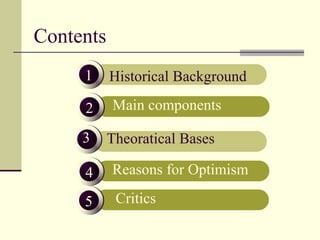
Contents
1

2

1

33

Historical Background
Main components

3

Merits
Theoratical Bases

4

Drawbacks Optimism
Reasons for

5

Critics
Historical Background
 In 1972, British linguist D.A. Wilkims published a

document to describe language to an analysis of the
communicative meanings.
 In 1976 Notional Syllabuses work followed it.
 Wilkins‟ work was used by Council of Europe in

drawing up a communicative language syllabus.
 In 1970s, first books based on functional syllabuses

began to appear.
BASIC CLAIMS
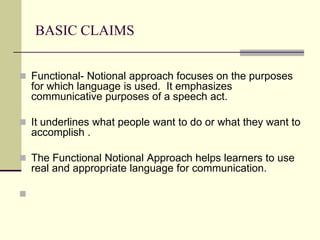
 Functional- Notional approach focuses on the purposes

for which language is used. It emphasizes
communicative purposes of a speech act.
 It underlines what people want to do or what they want to

accomplish .
 The Functional Notional Approach helps learners to use

real and appropriate language for communication.

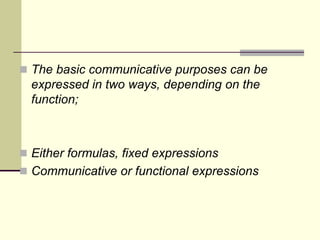
 The basic communicative purposes can be

expressed in two ways, depending on the
function;

 Either formulas, fixed expressions

 Communicative or functional expressions
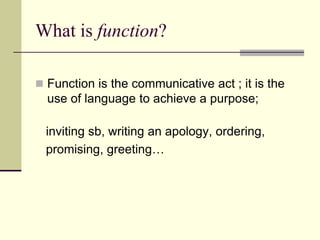
What is function?
 Function is the communicative act ; it is the

use of language to achieve a purpose;
inviting sb, writing an apology, ordering,
promising, greeting…
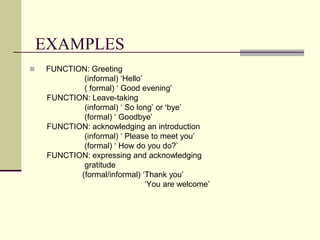
EXAMPLES


FUNCTION: Greeting
(informal) „Hello‟
( formal) „ Good evening‟
FUNCTION: Leave-taking
(informal) „ So long‟ or „bye‟
(formal) „ Goodbye‟
FUNCTION: acknowledging an introduction
(informal) „ Please to meet you‟
(formal) „ How do you do?‟
FUNCTION: expressing and acknowledging
gratitude
(formal/informal) „Thank you‟
„You are welcome‟
 In English , formulas are fixed. In other

languages fixed formulas also exist but not
necessarily in the same social situation.
For example; Italian and Turkish
What is NOTION ?
 It is important that functional language must also incorporate with specific

notions ;
vocabulary, nouns,verbs, adjectives, adverbs, structure
verbs, miscellaneous words.
 The words following the functional expression would be considered

notions.
 A notion is a concept, or idea and it may be quite specific, such as a

vocabulary (dog, house, for example); or it may be very general – size,
emotion, movement,place

 A notion may be “time past”; this may include past tenses, phrases like a

month ago, in 1990, last week, and utterances using temporal clauses
beginning with when….., before…., after…. and so on;


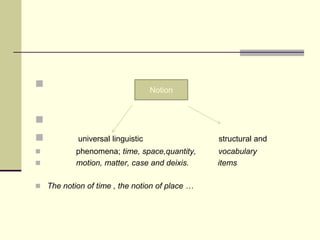
Notion







universal linguistic

structural and

phenomena; time, space,quantity,
motion, matter, case and deixis.

vocabulary
items

 The notion of time , the notion of place …
 For example; „ I‟d like to invite your son to come to

my club for lunch on Saturday.‟
 Specific notions depend on three major factors;

 a. the function
 b. the elements in the situation
 c. the topic which is being discussed
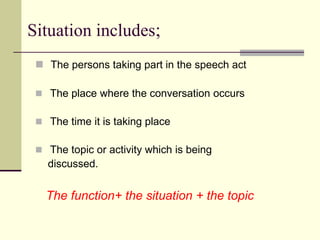
Situation includes;
 The persons taking part in the speech act
 The place where the conversation occurs
 The time it is taking place
 The topic or activity which is being

discussed.

The function+ the situation + the topic
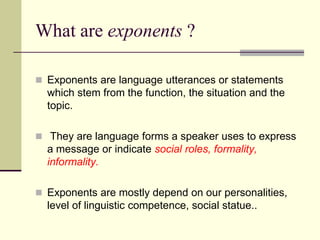
What are exponents ?
 Exponents are language utterances or statements

which stem from the function, the situation and the
topic.
 They are language forms a speaker uses to express

a message or indicate social roles, formality,
informality.
 Exponents are mostly depend on our personalities,

level of linguistic competence, social statue..
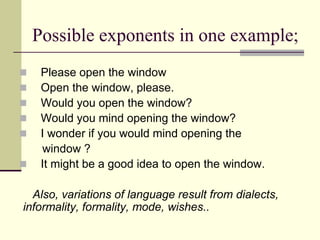
Possible exponents in one example;







Please open the window
Open the window, please.
Would you open the window?
Would you mind opening the window?
I wonder if you would mind opening the
window ?
It might be a good idea to open the window.

Also, variations of language result from dialects,
informality, formality, mode, wishes..


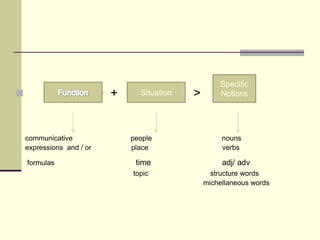
+ +

communicative
expressions and / or
formulas

Situation

people
place

time
topic

>

Specific
Notions

nouns
verbs

adj/ adv
structure words
michellaneous words
Unit-Credit System ( How are topics
organized? )
Functions are classified and put into units or
modules.
2. Units can be limited to specific duties such as serve
as a receptionist in a doctor‟s office.
3. They are specific as global content but free as to
internal organization and mode of presentation
1.

4. Units will specificy general grammatical,

lexical, notional-semantic items; that is ,
meaningful and appropriate use in context or
social situations.
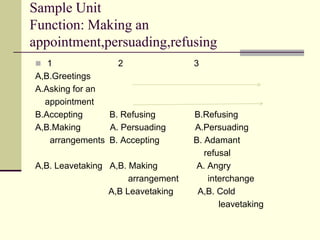
Sample Unit
Function: Making an
appointment,persuading,refusing
 1

2

A,B.Greetings
A.Asking for an
appointment
B.Accepting
B. Refusing
A,B.Making
A. Persuading
arrangements B. Accepting
A,B. Leavetaking A,B. Making
arrangement
A,B Leavetaking

3

B.Refusing
A.Persuading
B. Adamant
refusal
A. Angry
interchange
A,B. Cold
leavetaking
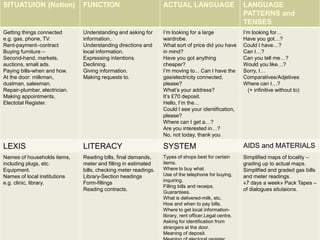
SITUATUION (Notion)

FUNCTION

ACTUAL LANGUAGE

LANGUAGE
PATTERNS and
TENSES

Getting things connected
e.g. gas, phone, TV.
Rent-payment–contract
Buying furniture –
Second-hand, markets,
auctions, small ads.
Paying bills-when and how.
At the door: milkman,
dustman, salesman.
Repair-plumber, electrician.
Making appointments,
Electotal Register.

Understanding and asking for
information..
Understanding directions and
local information.
Expressing intentions.
Declining.
Giving information.
Making requests to.

I‟m looking for a large
wardrobe.
What sort of price did you have
in mind?
Have you got anything
cheaper?
I‟m moving to... Can I have the
gas/electricity connected,
please?
What‟s your address?
It‟s £70 deposit.
Hello, I‟m the…
Could I see your identification,
please?
Where can I get a…?
Are you interested in…?
No, not today, thank you

I‟m looking for…
Have you got…?
Could I have…?
Can I…?
Can you tell me…?
Would you like…?
Sorry, I…
Comparatives/Adjetives
Where can I…?
(+ infinitive without to)

LEXIS

LITERACY

SYSTEM

AIDS and MATERIALS

Names of households items,
including plugs, etc.
Equipment.
Names of local institutions
e.g. clinic, library.

Reading bills, final demands,
meter and filling in estimated
bills, checking meter readings.
Library-Section headings
Form-fillings
Reading contracts.

Types of shops best for certain
items.
Where to buy what.
Use of the telephone for buying,
inquiring.
Filling bills and receips.
Guarantees.
What is delivered-milk, etc.
How and when to pay bills.
Where to get local informationlibrary, rent officer,Legal centre.
Asking for identification from
strangers at the door.
Meaning of deposit.

Simplified maps of locality –
grading up to actual maps.
Simplified and graded gas bills
and meter readings.
«7 days a week» Pack Tapes –
of dialogues situtaions.
 The same function may repeatedly occur in different

situations at succeeding units so there is a cyclical
order.
 Grading is very difficult so it is expected that

performance tests are used instead of achievement
test.
Theoretical Bases
 F-N approach combines „communicative

grammar‟ with cognitivisim and humanism.
 The primary focus is the learner and the
function or functions of language- the
communicative purpose s/he wishes to
express and to understand.
 Varied sociolinguistic situations are taken into
considerations.
 Social roles, psychological attitudes of
participants, the place, time, the activity, topic
are all discussed .
 Communicative behaviour is always situationally

conditioned. On that point, there are three factors
underlie speech acts;
 a. the functions
 b. the varieties of language
 c. the shared sociocultural allusions - presupposition-
Categories of Functions
 Personal
 Interpersonal
 Directive

 Referential
 Imaginative
Varieties of Language
 Geographical factors
 Social factors
 Status in the community or nation
 Differences related to social classes
 Educational background

 Register; a.) formality, informality b.) the topic,

activity, work or profession c.) the mode-oral or
written-of the course.
 Code-switching ; a person‟s individual use of the
language or dialect.
Ex: A doctor use a casual, informal register at home while
using a formal register at a professional dinner.
Cultural Knowledge
 F-N curriculum provides implicit and explicit

information for learning of culture .
radio broadcasts, television, tapes, cassettes,
documentaries, films, pictures, short
illustrated dialogues, real-life situations.
 Curriculum set realistic objectives as
paralinguistic feature of languages , gestures,
convey meaning to listeners.
Ex: cultural insights for immigrants
 cultural immersion – explicit information
Psycholinguistic Components
F-N curriculum takes cognizance;
 Basic needs of learners ; need for survival

Threshold Level, self-realization, general
competency or advanced.
 Self – motivating; social, vocational, cultural
needs of learners
 Individual differences: varying abilities:
cyclical or spiral approach.
Linguistics
 F-N approach will provide learner to acquire

a reasonable, basic knowledge of the
phonological, grammatical and lexical
subsystems of the language and the use of
language in actual communication.
 Encoding and decoding a message;
appropriateness, acceptability
 Oral or written communication
 Gestures and other paralinguistic features
Pyschological Bases
 Related material with needs and experiences

of the learners
 Student motivation
 Meaningful material through their use in real
life
 Active participation of learner depending on
learning strategies
 Make a realitionship among the elements in
language, situation and culture.
 Different learning styles and rates of learning
 Time for transfer of learning
Educational Principles
 Transfer of learning is not always automatic
 A spiral and cyclical approach is recommended.
 The curriculum is divided into units and modules
 The starting point is the communicative function and

the social situation in which situation or purpose is
being expressed.
 The title of the units is expressed in functional terms
 The same function may be presented in different
situations
 The grammar and vocabulary to be taught in each
unit result from the integration of function and
situation.
 In F-N curriculum ,a number of different functions

may be clustered in one unit.
 In the F-N approach grammatical structure and
function do not overlap. The same structure may be
used to express more than one function of language.
 Concepts and language needed in social studies,
geography, mathematics, art, music and literature are
integrated into the curriculum.
 Units contain linguistics and cultural materials the
learners will need for sociocultural and
sociovocational purposes
Reasons for Optimism
 It sets realistic learning tasks.
 It provides everyday, real world language in a variety

of sociocultural situations.
 It emphasizes the need for numerous, varied and
receptive activities.
 The language used should be based on a situation or
setting. The speaker must have a real purpose to talk
about.
 The act of communication is motivating as it
expresses basic, universal communicative functions
of language.
 It enables teachers refer to psycholinguistic,

sociolinguistic, linguistic and educational principles
 It does not insist upon mastery of any body material

presented.
 It makes provision through a unit and module system
for admission to certain programs at any time during
the year.
 In F-N approach grammatical structure and function
do not overlap. There is no obligatory one to one
relationship.
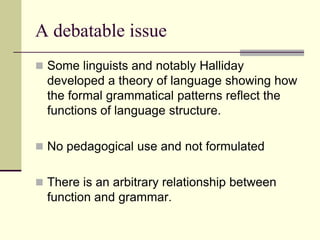
A debatable issue
 Some linguists and notably Halliday

developed a theory of language showing how
the formal grammatical patterns reflect the
functions of language structure.
 No pedagogical use and not formulated
 There is an arbitrary relationship between

function and grammar.
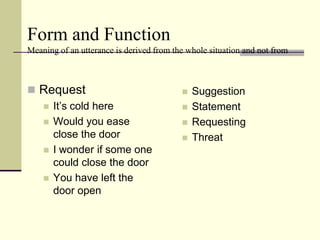
Form and Function
Meaning of an utterance is derived from the whole situation and not from
words and sentences used in isolation

 Request
 It‟s cold here
 Would you ease
close the door
 I wonder if some one
could close the door
 You have left the
door open







Suggestion
Statement
Requesting
Threat
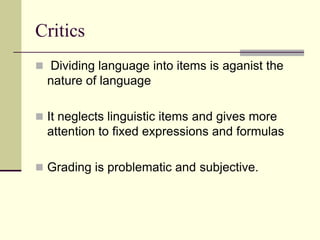
Critics
 Dividing language into items is aganist the

nature of language
 It neglects linguistic items and gives more

attention to fixed expressions and formulas
 Grading is problematic and subjective.
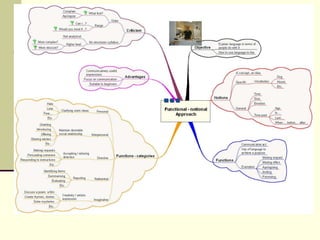
Functional - Notional Approach

Functional - Notional Approach

  • 1.
    A Functional- Notional Approachto Language Learning MARMARA UNIVERSITY DEPARTMANT OF ELT MA PROGRAMME YDIO 703 APPROACHES AND METHODS IN LANGUAGE TEACHING Submitted by Buket Demirbüken Fall 2013, İstanbul
  • 2.
  • 3.
    Historical Background  In1972, British linguist D.A. Wilkims published a document to describe language to an analysis of the communicative meanings.  In 1976 Notional Syllabuses work followed it.  Wilkins‟ work was used by Council of Europe in drawing up a communicative language syllabus.  In 1970s, first books based on functional syllabuses began to appear.
  • 4.
    BASIC CLAIMS  Functional-Notional approach focuses on the purposes for which language is used. It emphasizes communicative purposes of a speech act.  It underlines what people want to do or what they want to accomplish .  The Functional Notional Approach helps learners to use real and appropriate language for communication. 
  • 5.
     The basiccommunicative purposes can be expressed in two ways, depending on the function;  Either formulas, fixed expressions  Communicative or functional expressions
  • 6.
    What is function? Function is the communicative act ; it is the use of language to achieve a purpose; inviting sb, writing an apology, ordering, promising, greeting…
  • 7.
    EXAMPLES  FUNCTION: Greeting (informal) „Hello‟ (formal) „ Good evening‟ FUNCTION: Leave-taking (informal) „ So long‟ or „bye‟ (formal) „ Goodbye‟ FUNCTION: acknowledging an introduction (informal) „ Please to meet you‟ (formal) „ How do you do?‟ FUNCTION: expressing and acknowledging gratitude (formal/informal) „Thank you‟ „You are welcome‟
  • 8.
     In English, formulas are fixed. In other languages fixed formulas also exist but not necessarily in the same social situation. For example; Italian and Turkish
  • 9.
    What is NOTION?  It is important that functional language must also incorporate with specific notions ; vocabulary, nouns,verbs, adjectives, adverbs, structure verbs, miscellaneous words.  The words following the functional expression would be considered notions.  A notion is a concept, or idea and it may be quite specific, such as a vocabulary (dog, house, for example); or it may be very general – size, emotion, movement,place  A notion may be “time past”; this may include past tenses, phrases like a month ago, in 1990, last week, and utterances using temporal clauses beginning with when….., before…., after…. and so on;
  • 10.
     Notion     universal linguistic structural and phenomena;time, space,quantity, motion, matter, case and deixis. vocabulary items  The notion of time , the notion of place …
  • 11.
     For example;„ I‟d like to invite your son to come to my club for lunch on Saturday.‟  Specific notions depend on three major factors;  a. the function  b. the elements in the situation  c. the topic which is being discussed
  • 12.
    Situation includes;  Thepersons taking part in the speech act  The place where the conversation occurs  The time it is taking place  The topic or activity which is being discussed. The function+ the situation + the topic
  • 13.
    What are exponents?  Exponents are language utterances or statements which stem from the function, the situation and the topic.  They are language forms a speaker uses to express a message or indicate social roles, formality, informality.  Exponents are mostly depend on our personalities, level of linguistic competence, social statue..
  • 14.
    Possible exponents inone example;       Please open the window Open the window, please. Would you open the window? Would you mind opening the window? I wonder if you would mind opening the window ? It might be a good idea to open the window. Also, variations of language result from dialects, informality, formality, mode, wishes..
  • 15.
     + + communicative expressions and/ or formulas Situation people place time topic > Specific Notions nouns verbs adj/ adv structure words michellaneous words
  • 16.
    Unit-Credit System (How are topics organized? ) Functions are classified and put into units or modules. 2. Units can be limited to specific duties such as serve as a receptionist in a doctor‟s office. 3. They are specific as global content but free as to internal organization and mode of presentation 1. 4. Units will specificy general grammatical, lexical, notional-semantic items; that is , meaningful and appropriate use in context or social situations.
  • 17.
    Sample Unit Function: Makingan appointment,persuading,refusing  1 2 A,B.Greetings A.Asking for an appointment B.Accepting B. Refusing A,B.Making A. Persuading arrangements B. Accepting A,B. Leavetaking A,B. Making arrangement A,B Leavetaking 3 B.Refusing A.Persuading B. Adamant refusal A. Angry interchange A,B. Cold leavetaking
  • 18.
    SITUATUION (Notion) FUNCTION ACTUAL LANGUAGE LANGUAGE PATTERNSand TENSES Getting things connected e.g. gas, phone, TV. Rent-payment–contract Buying furniture – Second-hand, markets, auctions, small ads. Paying bills-when and how. At the door: milkman, dustman, salesman. Repair-plumber, electrician. Making appointments, Electotal Register. Understanding and asking for information.. Understanding directions and local information. Expressing intentions. Declining. Giving information. Making requests to. I‟m looking for a large wardrobe. What sort of price did you have in mind? Have you got anything cheaper? I‟m moving to... Can I have the gas/electricity connected, please? What‟s your address? It‟s £70 deposit. Hello, I‟m the… Could I see your identification, please? Where can I get a…? Are you interested in…? No, not today, thank you I‟m looking for… Have you got…? Could I have…? Can I…? Can you tell me…? Would you like…? Sorry, I… Comparatives/Adjetives Where can I…? (+ infinitive without to) LEXIS LITERACY SYSTEM AIDS and MATERIALS Names of households items, including plugs, etc. Equipment. Names of local institutions e.g. clinic, library. Reading bills, final demands, meter and filling in estimated bills, checking meter readings. Library-Section headings Form-fillings Reading contracts. Types of shops best for certain items. Where to buy what. Use of the telephone for buying, inquiring. Filling bills and receips. Guarantees. What is delivered-milk, etc. How and when to pay bills. Where to get local informationlibrary, rent officer,Legal centre. Asking for identification from strangers at the door. Meaning of deposit. Simplified maps of locality – grading up to actual maps. Simplified and graded gas bills and meter readings. «7 days a week» Pack Tapes – of dialogues situtaions.
  • 19.
     The samefunction may repeatedly occur in different situations at succeeding units so there is a cyclical order.  Grading is very difficult so it is expected that performance tests are used instead of achievement test.
  • 20.
    Theoretical Bases  F-Napproach combines „communicative grammar‟ with cognitivisim and humanism.  The primary focus is the learner and the function or functions of language- the communicative purpose s/he wishes to express and to understand.  Varied sociolinguistic situations are taken into considerations.  Social roles, psychological attitudes of participants, the place, time, the activity, topic are all discussed .
  • 21.
     Communicative behaviouris always situationally conditioned. On that point, there are three factors underlie speech acts;  a. the functions  b. the varieties of language  c. the shared sociocultural allusions - presupposition-
  • 22.
    Categories of Functions Personal  Interpersonal  Directive  Referential  Imaginative
  • 23.
    Varieties of Language Geographical factors  Social factors  Status in the community or nation  Differences related to social classes  Educational background  Register; a.) formality, informality b.) the topic, activity, work or profession c.) the mode-oral or written-of the course.  Code-switching ; a person‟s individual use of the language or dialect. Ex: A doctor use a casual, informal register at home while using a formal register at a professional dinner.
  • 24.
    Cultural Knowledge  F-Ncurriculum provides implicit and explicit information for learning of culture . radio broadcasts, television, tapes, cassettes, documentaries, films, pictures, short illustrated dialogues, real-life situations.  Curriculum set realistic objectives as paralinguistic feature of languages , gestures, convey meaning to listeners. Ex: cultural insights for immigrants  cultural immersion – explicit information
  • 25.
    Psycholinguistic Components F-N curriculumtakes cognizance;  Basic needs of learners ; need for survival Threshold Level, self-realization, general competency or advanced.  Self – motivating; social, vocational, cultural needs of learners  Individual differences: varying abilities: cyclical or spiral approach.
  • 26.
    Linguistics  F-N approachwill provide learner to acquire a reasonable, basic knowledge of the phonological, grammatical and lexical subsystems of the language and the use of language in actual communication.  Encoding and decoding a message; appropriateness, acceptability  Oral or written communication  Gestures and other paralinguistic features
  • 27.
    Pyschological Bases  Relatedmaterial with needs and experiences of the learners  Student motivation  Meaningful material through their use in real life  Active participation of learner depending on learning strategies  Make a realitionship among the elements in language, situation and culture.  Different learning styles and rates of learning  Time for transfer of learning
  • 28.
    Educational Principles  Transferof learning is not always automatic  A spiral and cyclical approach is recommended.  The curriculum is divided into units and modules  The starting point is the communicative function and the social situation in which situation or purpose is being expressed.  The title of the units is expressed in functional terms  The same function may be presented in different situations  The grammar and vocabulary to be taught in each unit result from the integration of function and situation.
  • 29.
     In F-Ncurriculum ,a number of different functions may be clustered in one unit.  In the F-N approach grammatical structure and function do not overlap. The same structure may be used to express more than one function of language.  Concepts and language needed in social studies, geography, mathematics, art, music and literature are integrated into the curriculum.  Units contain linguistics and cultural materials the learners will need for sociocultural and sociovocational purposes
  • 30.
    Reasons for Optimism It sets realistic learning tasks.  It provides everyday, real world language in a variety of sociocultural situations.  It emphasizes the need for numerous, varied and receptive activities.  The language used should be based on a situation or setting. The speaker must have a real purpose to talk about.  The act of communication is motivating as it expresses basic, universal communicative functions of language.
  • 31.
     It enablesteachers refer to psycholinguistic, sociolinguistic, linguistic and educational principles  It does not insist upon mastery of any body material presented.  It makes provision through a unit and module system for admission to certain programs at any time during the year.  In F-N approach grammatical structure and function do not overlap. There is no obligatory one to one relationship.
  • 32.
    A debatable issue Some linguists and notably Halliday developed a theory of language showing how the formal grammatical patterns reflect the functions of language structure.  No pedagogical use and not formulated  There is an arbitrary relationship between function and grammar.
  • 33.
    Form and Function Meaningof an utterance is derived from the whole situation and not from words and sentences used in isolation  Request  It‟s cold here  Would you ease close the door  I wonder if some one could close the door  You have left the door open     Suggestion Statement Requesting Threat
  • 34.
    Critics  Dividing languageinto items is aganist the nature of language  It neglects linguistic items and gives more attention to fixed expressions and formulas  Grading is problematic and subjective.