By: Elizabeth González, Meibis Nazareth
González, and Abdiel Rodríguez
Unit 3 Could I leave a message?
Unit 4 Good to hear from you again!
Unit 5 Unfortunately there's a problem.
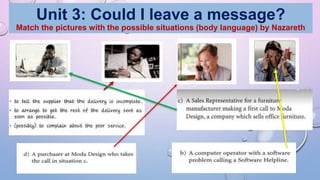
Unit 3: Could I leave a message?
Match the pictures with the possible situations (body language) by Nazareth
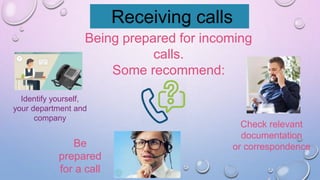
Receiving calls
Being prepared for incoming
calls.
Some recommend:
Be
prepared
for a call
Identify yourself,
your department and
company
Check relevant
documentation
or correspondence
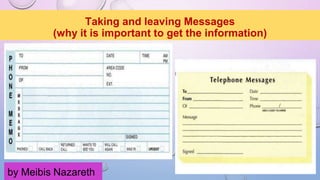
Taking and leaving Messages
(why it is important to get the information)
by Meibis Nazareth
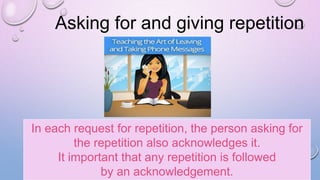
Asking for and giving repetition
In each request for repetition, the person asking for
the repetition also acknowledges it.
It important that any repetition is followed
by an acknowledgement.
take and leave a message (sample
conversation)
Let´s Practice taking and leaving a message (listen carefully)
by Meibis Nazaeth
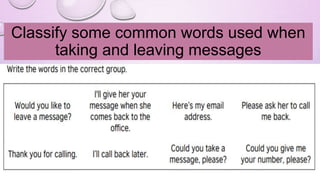
Classify some common words used when
taking and leaving messages
Unit 4 Good to hear from you again !
► Cross- cultural communication on the
telephone.
► Setting up appointments.
► Changing appointments.
► Ending a call.
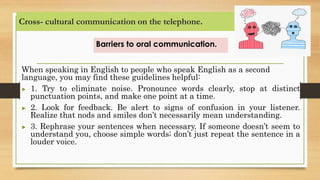
Cross- cultural communication on the telephone.
When speaking in English to people who speak English as a second
language, you may find these guidelines helpful:
► 1. Try to eliminate noise. Pronounce words clearly, stop at distinct
punctuation points, and make one point at a time.
► 2. Look for feedback. Be alert to signs of confusion in your listener.
Realize that nods and smiles don’t necessarily mean understanding.
► 3. Rephrase your sentences when necessary. If someone doesn’t seem to
understand you, choose simple words; don’t just repeat the sentence in a
louder voice.
Barriers to oral communication.
► 4. Don’t talk down to the other person. Try not to over
enunciate, and don’t blame the listener for not understanding.
Use phrases such as “Am I going too fast?” rather than “Is this
too difficult for you?”
► 5. Use objective, accurate language. Avoid throwing around
adjectives such as “fantastic”, and “fabulous” which people from
other cultures might consider unreal and overly dramatic.
► 6. Let other people finish what they have to say. If you
interrupt, you may miss something important. You’ll also show
a lack of respect.
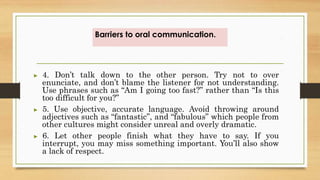
Barriers to oral communication.
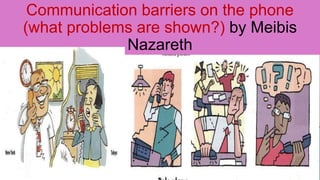
Communication barriers on the phone
(what problems are shown?) by Meibis
Nazareth
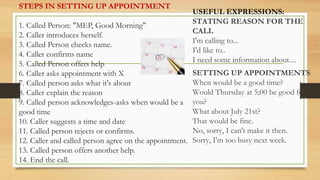
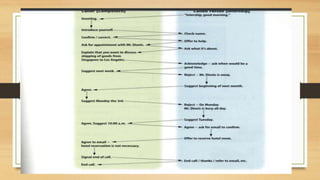
STEPS IN SETTING UP APPOINTMENT
1. Called Person: "MEP, Good Morning"
2. Caller introduces herself.
3. Called Person checks name.
4. Caller confirms name
5. Called Person offers help
6. Caller asks appointment with X
7. Called person asks what it's about
8. Caller explain the reason
9. Called person acknowledges-asks when would be a
good time
10. Caller suggests a time and date
11. Called person rejects or confirms.
12. Caller and called person agree on the appointment.
13. Called person offers another help.
14. End the call.
USEFUL EXPRESSIONS:
STATING REASON FOR THE
CALL
I'm calling to...
I'd like to..
I need some information about....
SETTING UP APPOINTMENTS
When would be a good time?
Would Thursday at 5;00 be good for
you?
What about July 21st?
That would be fine.
No, sorry, I can't make it then.
Sorry, I'm too busy next week.
Changing appointments
1. Reference to original appointment
2. Statement of problem/Need for the change of
appointment
3. Making new appointment
4. Confirmation
USEFUL EXPRESSIONS:
We have an appointment for next month, but...
I'm afraid I can't come on that day...
Could we reschedule it?
https://youtu.be/zmuRyKBn12w
How to make an appointment on the phone
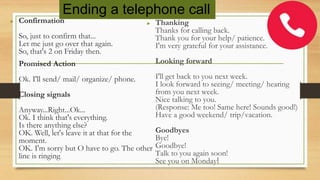
► Confirmation
So, just to confirm that...
Let me just go over that again.
So, that's 2 on Friday then.
Promised Action
Ok. I'll send/ mail/ organize/ phone.
Closing signals
Anyway...Right...Ok...
Ok. I think that's everything.
Is there anything else?
OK. Well, let's leave it at that for the
moment.
OK. I'm sorry but O have to go. The other
line is ringing.
► Thanking
Thanks for calling back.
Thank you for your help/ patience.
I'm very grateful for your assistance.
Looking forward
I'll get back to you next week.
I look forward to seeing/ meeting/ hearing
from you next week.
Nice talking to you.
(Response: Me too! Same here! Sounds good!)
Have a good weekend/ trip/vacation.
Goodbyes
Bye!
Goodbye!
Talk to you again soon!
See you on Monday!
Ending a telephone call
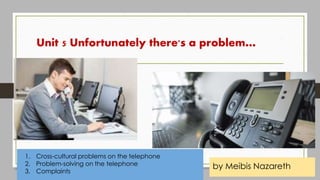
Unit 5 Unfortunately there's a problem…
1. Cross-cultural problems on the telephone
2. Problem-solving on the telephone
3. Complaints
by Meibis Nazareth
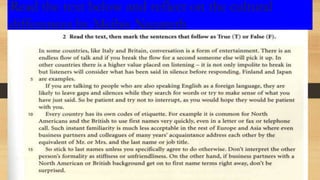
Read the text below and reflect on the cultural
differences by Meibis Nazareth
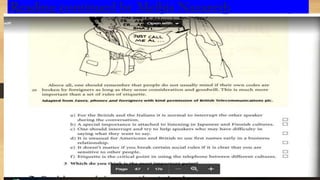
Reading continued by Meibis Nazareth
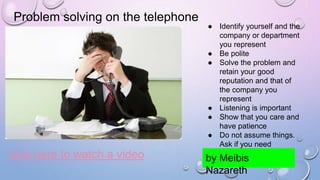
Problem solving on the telephone
click here to watch a video
● Identify yourself and the
company or department
you represent
● Be polite
● Solve the problem and
retain your good
reputation and that of
the company you
represent
● Listening is important
● Show that you care and
have patience
● Do not assume things.
Ask if you need
information.
by Meibis
Nazareth
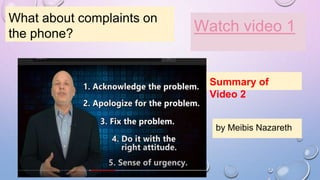
What about complaints on
the phone? Watch video 1
Summary of
Video 2
by Meibis Nazareth
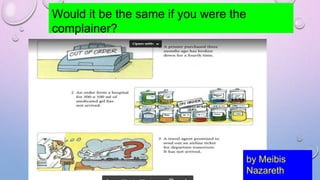
Would it be the same if you were the
complainer?
by Meibis
Nazareth
Bibliography
Simon Sweeney. English for Business Communication. Cambridge
University. Ninth edition. 0’l
Using the telephone

Using the telephone

  • 1.
    By: Elizabeth González,Meibis Nazareth González, and Abdiel Rodríguez Unit 3 Could I leave a message? Unit 4 Good to hear from you again! Unit 5 Unfortunately there's a problem.
  • 2.
    Unit 3: CouldI leave a message? Match the pictures with the possible situations (body language) by Nazareth
  • 3.
    Receiving calls Being preparedfor incoming calls. Some recommend: Be prepared for a call Identify yourself, your department and company Check relevant documentation or correspondence
  • 4.
    Taking and leavingMessages (why it is important to get the information) by Meibis Nazareth
  • 5.
    Asking for andgiving repetition In each request for repetition, the person asking for the repetition also acknowledges it. It important that any repetition is followed by an acknowledgement.
  • 6.
    take and leavea message (sample conversation) Let´s Practice taking and leaving a message (listen carefully) by Meibis Nazaeth
  • 7.
    Classify some commonwords used when taking and leaving messages
  • 8.
    Unit 4 Goodto hear from you again ! ► Cross- cultural communication on the telephone. ► Setting up appointments. ► Changing appointments. ► Ending a call.
  • 9.
    Cross- cultural communicationon the telephone. When speaking in English to people who speak English as a second language, you may find these guidelines helpful: ► 1. Try to eliminate noise. Pronounce words clearly, stop at distinct punctuation points, and make one point at a time. ► 2. Look for feedback. Be alert to signs of confusion in your listener. Realize that nods and smiles don’t necessarily mean understanding. ► 3. Rephrase your sentences when necessary. If someone doesn’t seem to understand you, choose simple words; don’t just repeat the sentence in a louder voice. Barriers to oral communication.
  • 10.
    ► 4. Don’ttalk down to the other person. Try not to over enunciate, and don’t blame the listener for not understanding. Use phrases such as “Am I going too fast?” rather than “Is this too difficult for you?” ► 5. Use objective, accurate language. Avoid throwing around adjectives such as “fantastic”, and “fabulous” which people from other cultures might consider unreal and overly dramatic. ► 6. Let other people finish what they have to say. If you interrupt, you may miss something important. You’ll also show a lack of respect. Barriers to oral communication.
  • 11.
    Communication barriers onthe phone (what problems are shown?) by Meibis Nazareth
  • 12.
    STEPS IN SETTINGUP APPOINTMENT 1. Called Person: "MEP, Good Morning" 2. Caller introduces herself. 3. Called Person checks name. 4. Caller confirms name 5. Called Person offers help 6. Caller asks appointment with X 7. Called person asks what it's about 8. Caller explain the reason 9. Called person acknowledges-asks when would be a good time 10. Caller suggests a time and date 11. Called person rejects or confirms. 12. Caller and called person agree on the appointment. 13. Called person offers another help. 14. End the call. USEFUL EXPRESSIONS: STATING REASON FOR THE CALL I'm calling to... I'd like to.. I need some information about.... SETTING UP APPOINTMENTS When would be a good time? Would Thursday at 5;00 be good for you? What about July 21st? That would be fine. No, sorry, I can't make it then. Sorry, I'm too busy next week.
  • 14.
    Changing appointments 1. Referenceto original appointment 2. Statement of problem/Need for the change of appointment 3. Making new appointment 4. Confirmation USEFUL EXPRESSIONS: We have an appointment for next month, but... I'm afraid I can't come on that day... Could we reschedule it?
  • 15.
    https://youtu.be/zmuRyKBn12w How to makean appointment on the phone
  • 16.
    ► Confirmation So, justto confirm that... Let me just go over that again. So, that's 2 on Friday then. Promised Action Ok. I'll send/ mail/ organize/ phone. Closing signals Anyway...Right...Ok... Ok. I think that's everything. Is there anything else? OK. Well, let's leave it at that for the moment. OK. I'm sorry but O have to go. The other line is ringing. ► Thanking Thanks for calling back. Thank you for your help/ patience. I'm very grateful for your assistance. Looking forward I'll get back to you next week. I look forward to seeing/ meeting/ hearing from you next week. Nice talking to you. (Response: Me too! Same here! Sounds good!) Have a good weekend/ trip/vacation. Goodbyes Bye! Goodbye! Talk to you again soon! See you on Monday! Ending a telephone call
  • 17.
    Unit 5 Unfortunatelythere's a problem… 1. Cross-cultural problems on the telephone 2. Problem-solving on the telephone 3. Complaints by Meibis Nazareth
  • 18.
    Read the textbelow and reflect on the cultural differences by Meibis Nazareth
  • 19.
    Reading continued byMeibis Nazareth
  • 20.
    Problem solving onthe telephone click here to watch a video ● Identify yourself and the company or department you represent ● Be polite ● Solve the problem and retain your good reputation and that of the company you represent ● Listening is important ● Show that you care and have patience ● Do not assume things. Ask if you need information. by Meibis Nazareth
  • 21.
    What about complaintson the phone? Watch video 1 Summary of Video 2 by Meibis Nazareth
  • 22.
    Would it bethe same if you were the complainer? by Meibis Nazareth
  • 23.
    Bibliography Simon Sweeney. Englishfor Business Communication. Cambridge University. Ninth edition. 0’l