How to have an effective discipline plan
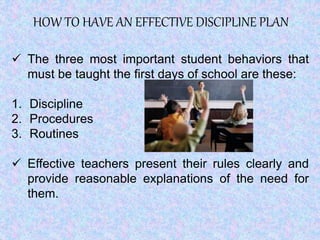
HOW TO HAVE AN EFFECTIVE DISCIPLINE PLAN
 The three most important student behaviors that
must be taught the first days of school are these:
1. Discipline
2. Procedures
3. Routines
 Effective teachers present their rules clearly and
provide reasonable explanations of the need for
them.
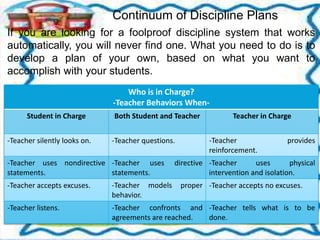
Continuum of Discipline Plans
If you are looking for a foolproof discipline system that works
automatically, you will never find one. What you need to do is to
develop a plan of your own, based on what you want to
accomplish with your students.
Who is in Charge?
-Teacher Behaviors When-
Student in Charge Both Student and Teacher Teacher in Charge
-Teacher silently looks on. -Teacher questions. -Teacher provides
reinforcement.
-Teacher uses nondirective
statements.
-Teacher uses directive
statements.
-Teacher uses physical
intervention and isolation.
-Teacher accepts excuses. -Teacher models proper
behavior.
-Teacher accepts no excuses.
-Teacher listens. -Teacher confronts and
agreements are reached.
-Teacher tells what is to be
done.
WHY YOU SHOULD HAVE RULES
 Teaching discipline and procedures require you
to invest time practicing and rehearsing.
 You, not the administration or the counselors,
are primarily responsible for communicating and
maintaining behavior.
 In a successful classroom, both teachers and
students know what is expected from them.
Expectations can be stated as rules
 Decide on your rules and write them.
 Clearly communicate in both verbal
and written form to your students.
 It is easier to maintain good behavior
than to change inappropriate
behavior that has become
established.
 Rules create a work-oriented
atmosphere.
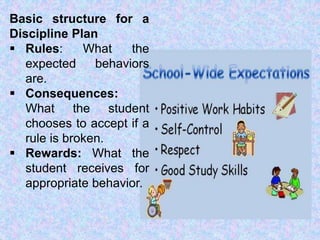
Basic structure for a
Discipline Plan
 Rules: What the
expected behaviors
are.
 Consequences:
What the student
chooses to accept if a
rule is broken.
 Rewards: What the
student receives for
appropriate behavior.
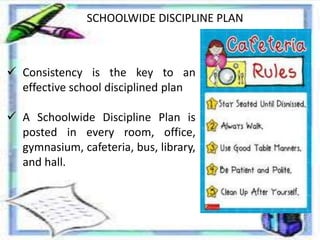
SCHOOLWIDE DISCIPLINE PLAN
 Consistency is the key to an
effective school disciplined plan
 A Schoolwide Discipline Plan is
posted in every room, office,
gymnasium, cafeteria, bus, library,
and hall.
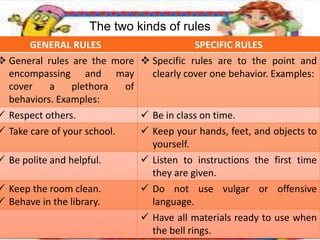
The two kinds of rules
GENERAL RULES SPECIFIC RULES
 General rules are the more
encompassing and may
cover a plethora of
behaviors. Examples:
 Specific rules are to the point and
clearly cover one behavior. Examples:
 Respect others.  Be in class on time.
 Take care of your school.  Keep your hands, feet, and objects to
yourself.
 Be polite and helpful.  Listen to instructions the first time
they are given.
 Keep the room clean.
 Behave in the library.
 Do not use vulgar or offensive
language.
 Have all materials ready to use when
the bell rings.
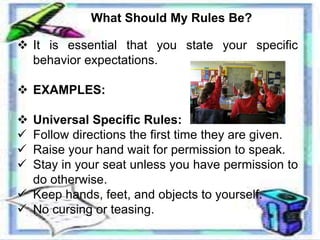
What Should My Rules Be?
 It is essential that you state your specific
behavior expectations.
 EXAMPLES:
 Universal Specific Rules:
 Follow directions the first time they are given.
 Raise your hand wait for permission to speak.
 Stay in your seat unless you have permission to
do otherwise.
 Keep hands, feet, and objects to yourself.
 No cursing or teasing.
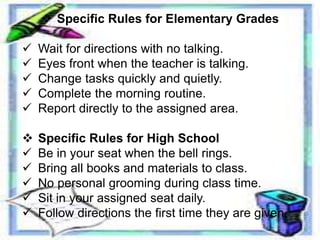
 Specific Rules for Elementary Grades
 Wait for directions with no talking.
 Eyes front when the teacher is talking.
 Change tasks quickly and quietly.
 Complete the morning routine.
 Report directly to the assigned area.
 Specific Rules for High School
 Be in your seat when the bell rings.
 Bring all books and materials to class.
 No personal grooming during class time.
 Sit in your assigned seat daily.
 Follow directions the first time they are given.
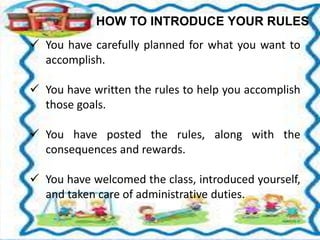
HOW TO INTRODUCE YOUR RULES
 You have carefully planned for what you want to
accomplish.
 You have written the rules to help you accomplish
those goals.
 You have posted the rules, along with the
consequences and rewards.
 You have welcomed the class, introduced yourself,
and taken care of administrative duties.
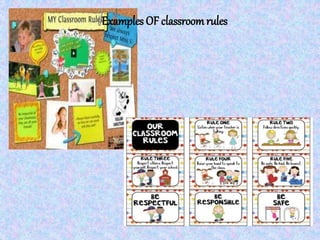
Examples OF classroomrules

How to have an effective discipline plan

  • 1.
    How to havean effective discipline plan
  • 2.
    HOW TO HAVEAN EFFECTIVE DISCIPLINE PLAN  The three most important student behaviors that must be taught the first days of school are these: 1. Discipline 2. Procedures 3. Routines  Effective teachers present their rules clearly and provide reasonable explanations of the need for them.
  • 3.
    Continuum of DisciplinePlans If you are looking for a foolproof discipline system that works automatically, you will never find one. What you need to do is to develop a plan of your own, based on what you want to accomplish with your students. Who is in Charge? -Teacher Behaviors When- Student in Charge Both Student and Teacher Teacher in Charge -Teacher silently looks on. -Teacher questions. -Teacher provides reinforcement. -Teacher uses nondirective statements. -Teacher uses directive statements. -Teacher uses physical intervention and isolation. -Teacher accepts excuses. -Teacher models proper behavior. -Teacher accepts no excuses. -Teacher listens. -Teacher confronts and agreements are reached. -Teacher tells what is to be done.
  • 4.
    WHY YOU SHOULDHAVE RULES  Teaching discipline and procedures require you to invest time practicing and rehearsing.  You, not the administration or the counselors, are primarily responsible for communicating and maintaining behavior.  In a successful classroom, both teachers and students know what is expected from them.
  • 5.
    Expectations can bestated as rules  Decide on your rules and write them.  Clearly communicate in both verbal and written form to your students.  It is easier to maintain good behavior than to change inappropriate behavior that has become established.  Rules create a work-oriented atmosphere.
  • 6.
    Basic structure fora Discipline Plan  Rules: What the expected behaviors are.  Consequences: What the student chooses to accept if a rule is broken.  Rewards: What the student receives for appropriate behavior.
  • 7.
    SCHOOLWIDE DISCIPLINE PLAN Consistency is the key to an effective school disciplined plan  A Schoolwide Discipline Plan is posted in every room, office, gymnasium, cafeteria, bus, library, and hall.
  • 8.
    The two kindsof rules GENERAL RULES SPECIFIC RULES  General rules are the more encompassing and may cover a plethora of behaviors. Examples:  Specific rules are to the point and clearly cover one behavior. Examples:  Respect others.  Be in class on time.  Take care of your school.  Keep your hands, feet, and objects to yourself.  Be polite and helpful.  Listen to instructions the first time they are given.  Keep the room clean.  Behave in the library.  Do not use vulgar or offensive language.  Have all materials ready to use when the bell rings.
  • 9.
    What Should MyRules Be?  It is essential that you state your specific behavior expectations.  EXAMPLES:  Universal Specific Rules:  Follow directions the first time they are given.  Raise your hand wait for permission to speak.  Stay in your seat unless you have permission to do otherwise.  Keep hands, feet, and objects to yourself.  No cursing or teasing.
  • 10.
     Specific Rulesfor Elementary Grades  Wait for directions with no talking.  Eyes front when the teacher is talking.  Change tasks quickly and quietly.  Complete the morning routine.  Report directly to the assigned area.  Specific Rules for High School  Be in your seat when the bell rings.  Bring all books and materials to class.  No personal grooming during class time.  Sit in your assigned seat daily.  Follow directions the first time they are given.
  • 11.
    HOW TO INTRODUCEYOUR RULES  You have carefully planned for what you want to accomplish.  You have written the rules to help you accomplish those goals.  You have posted the rules, along with the consequences and rewards.  You have welcomed the class, introduced yourself, and taken care of administrative duties.
  • 12.