Prepared by: M’barek EL-farhaoui
Content
• What is a standard?
• Types of standards
• The 5 C’s
• Teacher and Learner Roles
• Performance-based assessment
• Some characteristics of Standards-based classroom
• Claims in favor of the SBA
• Criticism
What is a standard?
A statement of what students should know and be able
to do and demonstrate at the end of the process of the
language study.
Synonyms:
learning outcomes, learning objectives,
learning targets, competencies
Standards should be clear, straightforward, observable,
measurable, and well-articulated.
Types of standards:
are statements about what
learners should know and be able to do with English.
show us how the learners
have achieved the standards targeted. They refer to
how learners are meeting a standard and show the
learner’s progress towards meeting a standard.
These standards tell us
how well learners should perform
Content standards :
Performance standards:
Proficiency Standards:
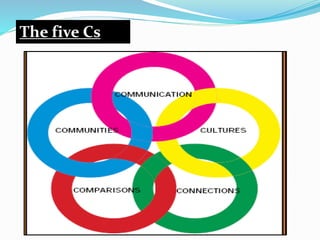
The five Cs
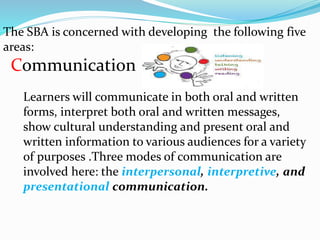
The SBA is concerned with developing the following five
areas:
Communication
Learners will communicate in both oral and written
forms, interpret both oral and written messages,
show cultural understanding and present oral and
written information to various audiences for a variety
of purposes .Three modes of communication are
involved here: the interpersonal, interpretive, and
presentational communication.
Culture
Learners will gain deeper understanding of
their culture(s) and other cultures in terms
of their perspectives (e.g. values, ideas,
attitudes, etc.), practices (pattern of social
interactions), and products (e.g. books,
laws, music, etc).
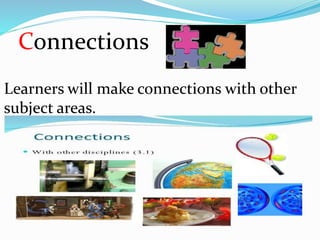
Connections
Learners will make connections with other
subject areas.
Comparison
Learners will gain awareness of cross-
cultural similarities and differences (in
terms of both languages and culture).
Communities
Learners will extend their learning
experiences from the EFL classroom to
the outside world through activities
such as the use of the internet. They
will therefore be made aware that they
live in a global world..
To help learners attain the prescribed standards in the five
Cs areas, teachers should provide opportunities to:
1 - develop the ability to think through:
• Problem-solving;
• decision-making;
• critical, creative, and analytical thinking;
• imagining places, times, and situations different from
their own;
• developing and testing hypotheses;
• transferring their English language learning
competencies to other learning situations.
2 - develop communication skills through:
• constructing and defending an argument;
• working effectively in duos/-groups;
• communicating plans and processes for reaching goals;
3- foster their connections with their community
through:
• being able to recognize their responsibilities and
rights as citizens and acting accordingly;
• being willing to work hard and being long-life
learners;
• contributing to the aesthetic and cultural life of their
community in any way they can;
Teacher and Learner Roles
There is a radical shift of the roles both teachers and learners should play in the
classroom:
 The learners should be active partners in the learning operation.
 the teacher is no longer considered as a purveyor of knowledge or
wielder of power, his or her status does not emanate from his
hierarchical authority, but from the good relationship with his/her
learners.
The teacher’s roles:
Agent of change
 facilitator of learning
 Diagnostician
 Learner trainer
Collaborator/coach
Coordinator of the learners
 Classroom researcher
 Consultant/adviser
 Language learner
PERFORMANCE BASED ASSESSMENT
The standards-based approach to the teaching of English requires
performance based assessment.
 A measure of assessment based on authentic tasks that
necessitate that learners demonstrate what they can do with
English.
 A measure of how learners activate their knowledge
and skills to solve problems.
 It requires that learners demonstrate specific competencies and
apply them in simulated real-life situations according to specific
standards.
 It is criterion-referenced; that is, scores on criterion-referenced
tests provide information on what testees know and can do with
English. It does not determine who is the best, but it helps learners
do their best.
 It involves regular and continuous assessment. Therefore, it can
occur whenever the teacher needs information about the adequacy of
the learner’s present learning for subsequent teaching.
 Parents and teachers can see which standards students have
mastered and which ones they need more remedial work on.
 It is more valid than conventional assessment in that it is
authentic; it replicates situations that the testees may encounter in
real life,
 Grades reflect the level of proficiency on specific standards for
each subject area.
 As performance goes up, the grades reflect the new level of
mastery. Thus, teachers, students, and parents are able to see a
student’s growth over time.
Some characteristics of Standards-based classroom
 Classroom climate is characterized by respectful behaviors, routines,
and discourse.
 Classroom practices and instruction honor the diversity of interests,
needs, and strengths of all learners.
 The teacher ensures that all components of the lesson (e.g., learning
activities, assessment, homework) contribute to the lesson objectives
and to student mastery of the standard(s).
 Learning time is maximized for all students.
 Instruction activates students’ prior knowledge and experience, and
supplies background knowledge.
 Students respond to opportunities provided by the teacher to make
connections between the lesson and personal experience.
CLAIMS IN FAVOR OF SBA
 SBA proponents endorse measuring outputs rather than inputs and
requiring that student demonstrate learning rather than just showing up.
 The adoption of measurable standards is seen as a means of ensuring that
the content and skills covered by the standards will be a high priority in the
education of students.
 The standards-based education approach rejects the inevitability of
inferior performance by disadvantaged groups; it rejects the idea that only
a few can succeed. All students are capable of continuous improvement.
 All students will complete rigorous academic coursework so that they
leave high school prepared for university or technical training, without
remedial courses.
 Students should be measured against a fixed yardstick, a finish line,
rather than against other students.
CRITCISM
I- Inappropriate outcomes
• Standards can be set too low: SBA’s opponents fear that the focus on achievement
by all students will result in "dumbing down" the definition of academic competence
to a level that is achievable by even the weakest students.
• Standards can be set too high: Others object that the standards are too high, and
thus inappropriate or too challenging for all but the brightest students, to the extent
that even good students would perform significantly below the stated standard and be
held back or required to take additional instruction.
II- Extra burden on instructors and educational institutions
III- Relegating the learners’ cognitive skills by focusing solely on
their observable performance/behavior
Thanks for resisting 
ANY ADDITIONS..
COMMENTS..
QUESTIONS..
THE BALL IS YOURS

Standards based approach

  • 1.
  • 2.
    Content • What isa standard? • Types of standards • The 5 C’s • Teacher and Learner Roles • Performance-based assessment • Some characteristics of Standards-based classroom • Claims in favor of the SBA • Criticism
  • 3.
    What is astandard? A statement of what students should know and be able to do and demonstrate at the end of the process of the language study. Synonyms: learning outcomes, learning objectives, learning targets, competencies Standards should be clear, straightforward, observable, measurable, and well-articulated.
  • 5.
    Types of standards: arestatements about what learners should know and be able to do with English. show us how the learners have achieved the standards targeted. They refer to how learners are meeting a standard and show the learner’s progress towards meeting a standard. These standards tell us how well learners should perform Content standards : Performance standards: Proficiency Standards:
  • 6.
  • 7.
    The SBA isconcerned with developing the following five areas: Communication Learners will communicate in both oral and written forms, interpret both oral and written messages, show cultural understanding and present oral and written information to various audiences for a variety of purposes .Three modes of communication are involved here: the interpersonal, interpretive, and presentational communication.
  • 8.
    Culture Learners will gaindeeper understanding of their culture(s) and other cultures in terms of their perspectives (e.g. values, ideas, attitudes, etc.), practices (pattern of social interactions), and products (e.g. books, laws, music, etc).
  • 10.
    Connections Learners will makeconnections with other subject areas.
  • 11.
    Comparison Learners will gainawareness of cross- cultural similarities and differences (in terms of both languages and culture).
  • 12.
    Communities Learners will extendtheir learning experiences from the EFL classroom to the outside world through activities such as the use of the internet. They will therefore be made aware that they live in a global world..
  • 13.
    To help learnersattain the prescribed standards in the five Cs areas, teachers should provide opportunities to: 1 - develop the ability to think through: • Problem-solving; • decision-making; • critical, creative, and analytical thinking; • imagining places, times, and situations different from their own; • developing and testing hypotheses; • transferring their English language learning competencies to other learning situations.
  • 14.
    2 - developcommunication skills through: • constructing and defending an argument; • working effectively in duos/-groups; • communicating plans and processes for reaching goals;
  • 15.
    3- foster theirconnections with their community through: • being able to recognize their responsibilities and rights as citizens and acting accordingly; • being willing to work hard and being long-life learners; • contributing to the aesthetic and cultural life of their community in any way they can;
  • 16.
    Teacher and LearnerRoles There is a radical shift of the roles both teachers and learners should play in the classroom:  The learners should be active partners in the learning operation.  the teacher is no longer considered as a purveyor of knowledge or wielder of power, his or her status does not emanate from his hierarchical authority, but from the good relationship with his/her learners. The teacher’s roles: Agent of change  facilitator of learning  Diagnostician  Learner trainer Collaborator/coach Coordinator of the learners  Classroom researcher  Consultant/adviser  Language learner
  • 17.
    PERFORMANCE BASED ASSESSMENT Thestandards-based approach to the teaching of English requires performance based assessment.  A measure of assessment based on authentic tasks that necessitate that learners demonstrate what they can do with English.  A measure of how learners activate their knowledge and skills to solve problems.
  • 18.
     It requiresthat learners demonstrate specific competencies and apply them in simulated real-life situations according to specific standards.  It is criterion-referenced; that is, scores on criterion-referenced tests provide information on what testees know and can do with English. It does not determine who is the best, but it helps learners do their best.  It involves regular and continuous assessment. Therefore, it can occur whenever the teacher needs information about the adequacy of the learner’s present learning for subsequent teaching.
  • 19.
     Parents andteachers can see which standards students have mastered and which ones they need more remedial work on.  It is more valid than conventional assessment in that it is authentic; it replicates situations that the testees may encounter in real life,  Grades reflect the level of proficiency on specific standards for each subject area.  As performance goes up, the grades reflect the new level of mastery. Thus, teachers, students, and parents are able to see a student’s growth over time.
  • 20.
    Some characteristics ofStandards-based classroom  Classroom climate is characterized by respectful behaviors, routines, and discourse.  Classroom practices and instruction honor the diversity of interests, needs, and strengths of all learners.  The teacher ensures that all components of the lesson (e.g., learning activities, assessment, homework) contribute to the lesson objectives and to student mastery of the standard(s).  Learning time is maximized for all students.  Instruction activates students’ prior knowledge and experience, and supplies background knowledge.  Students respond to opportunities provided by the teacher to make connections between the lesson and personal experience.
  • 21.
    CLAIMS IN FAVOROF SBA  SBA proponents endorse measuring outputs rather than inputs and requiring that student demonstrate learning rather than just showing up.  The adoption of measurable standards is seen as a means of ensuring that the content and skills covered by the standards will be a high priority in the education of students.  The standards-based education approach rejects the inevitability of inferior performance by disadvantaged groups; it rejects the idea that only a few can succeed. All students are capable of continuous improvement.  All students will complete rigorous academic coursework so that they leave high school prepared for university or technical training, without remedial courses.  Students should be measured against a fixed yardstick, a finish line, rather than against other students.
  • 22.
    CRITCISM I- Inappropriate outcomes •Standards can be set too low: SBA’s opponents fear that the focus on achievement by all students will result in "dumbing down" the definition of academic competence to a level that is achievable by even the weakest students. • Standards can be set too high: Others object that the standards are too high, and thus inappropriate or too challenging for all but the brightest students, to the extent that even good students would perform significantly below the stated standard and be held back or required to take additional instruction. II- Extra burden on instructors and educational institutions III- Relegating the learners’ cognitive skills by focusing solely on their observable performance/behavior
  • 23.
    Thanks for resisting ANY ADDITIONS.. COMMENTS.. QUESTIONS.. THE BALL IS YOURS