



SELF-CONFIDENCE.
teachers have as challenge to increase this self-
confidence by creating an adequate learning
atmosphere where we can use tools such as
Neuro-linguistic Programming in order to
promote self-confidence in classroom; teacher
Jose Gonzalez, (Oaxaca, Mexico) has a slogan
which names his project: "Speak English. Learning
English is fun". In my class I use "I like English"
and, in fact, the legend is on a rubber stamp
posted on cards which are used as rewards for
working in class.
Activities have to be from easy to difficult ones; if
activities are too difficult, students rapidly will get
frustrated. It is common in secondary that after seeing
something as very difficult, the student "builds" the
defensive wall and, unfortunately, this energy sells and
becomes contagious among students. Our lesson plan
has to be carefully done step by step, from easy to
complex, and always having in mind the purpose of the
function, and the differences of our students.
THE AFFECT.
Public schools, and even some private
schools, spend valuable classroom time
engaged in "cooperative" learning (group
learning) encounter sessions and discussion
groups that employ pop psychology. These
programs are designed for a very specific
purpose -- to change the attitudes, values and
beliefs of children in order to prepare them
for be good citizens
PROGRAM GOALS FOR SELF CONFIDENCE.

 Almost all claim positive outcomes such as:
• Enhancement of self-esteem
• Promotion of good decision-making
• Reduction of stress
• Improvement of academic performance
• Improvement of a student's sensitivity to others
Affective education employs a number of
    psychological and pedagogic principles as primary
    to their success. The most significant of these
    principles includes beliefs such as:
•   The meaning of life lies in subjective experience.
•   Self-Interest is and should be the foundation for
    all moral decisions.
•   The teacher should be child advocate and
    therapist.
•   Problem-solving through the application of moral
    relativism.
•   Children are capable of making sophisticated
    judgments.
The following are some of the more popular
  Affective Education Programs:
Project Self-Esteem
Project Self-Esteem is an elementary level program
  which purports to enhance self-esteem, improve
  memory, improve communication skills, stress
  individuality, increase sensitivity to others, and
  improve self responsibility.
Quest
Quest was originally published as a Humanistic
  Values Curriculum in 1975. The Quest program is
  divided into two main curricula: Skills for Living --
  High school level; and Skills for Adolescence for
  grades 6-8
CANFIELD´S THEORY.
Canfield's theory of self-esteem is based on a
  distinction between the left and right brain.
  He claims the brain has two hemispheres. The
  left hemisphere controls the logical thinking
  while the right hemisphere controls feelings
  and impulses.
WORKSHOP WAY
The foremost goal in Workshop Way is
1) protect each child's dignity.
2) Growing a positive self-concept is feasible for all
   students because the self-concept is never associated
   with knowledge, skills or right answers.
The program clearly states that one of the major goals is
   to lead pupils toward "higher levels of consciousness
   and deepening awareness in students by leading them
   to self-discovery."
PUMSY in Pursuit of Excellence
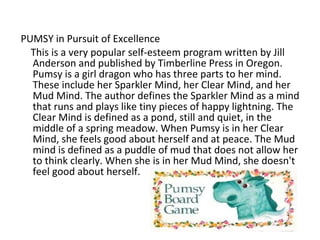
  This is a very popular self-esteem program written by Jill
  Anderson and published by Timberline Press in Oregon.
  Pumsy is a girl dragon who has three parts to her mind.
  These include her Sparkler Mind, her Clear Mind, and her
  Mud Mind. The author defines the Sparkler Mind as a mind
  that runs and plays like tiny pieces of happy lightning. The
  Clear Mind is defined as a pond, still and quiet, in the
  middle of a spring meadow. When Pumsy is in her Clear
  Mind, she feels good about herself and at peace. The Mud
  mind is defined as a puddle of mud that does not allow her
  to think clearly. When she is in her Mud Mind, she doesn't
  feel good about herself.
Risk-Taking
This affective principle is about the
importance of getting learners to take risks in
attempting to use language-both productively
and receptively.
Successful language learners, in their realistic
appraisal of themselves as vulnerable beings
yet capable of accomplishing tasks, must be
willing to become “gamblers” in the game of
language, t attempt to produce and to
interpret language that is a bit beyond their
absolute certainty.
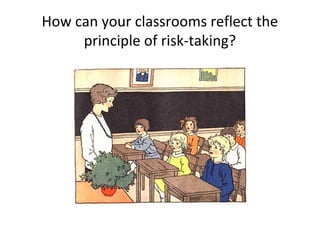
How can your classrooms reflect the
     principle of risk-taking?
• Create an atmosphere in the classroom that
  encourages students to try out language, to
  venture a response, and not to wait for
  someone else to volunteer language.
• Provide reasonable challenges in your
  techniques – make them neither too easy nor
  too hard.
• Help your students to understand what
  calculated risk-taking is, lest some feel that
  they must blurt out any old response.
• Respond to students’ risky attempts with
  positive affirmation, praising them for trying
  while at the same time warmly but firmly
  attending to their language.
Language-Culture Connection
Language and culture are
intricately related. Any
time you successfully
learn a language, you will
also learn something of
the culture of the
speakers of that
language.
¨Whenever you teach a
language, you also teach a
complex system of cultural
customs, values, and ways of
thinking, feeling, and acting¨
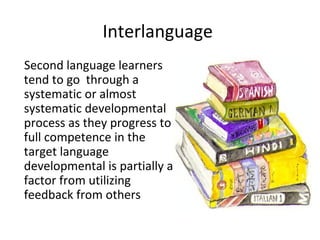
Interlanguage
Second language learners
tend to go through a
systematic or almost
systematic developmental
process as they progress to
full competence in the
target language
developmental is partially a
factor from utilizing
feedback from others
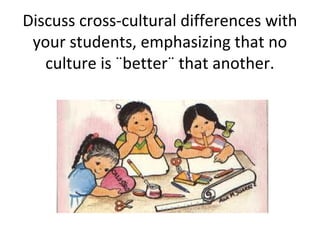
Discuss cross-cultural differences with
 your students, emphasizing that no
   culture is ¨better¨ that another.
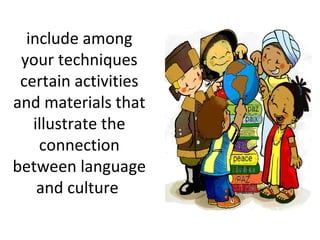
include among
 your techniques
 certain activities
and materials that
   illustrate the
    connection
between language
    and culture
Teach your students the cultural
connotations, specially sociolinguistic
       aspects, of languages.
Screen your
 techniques for
  material that
may be culturally
   offensive
Make explicit to your students what
you may take for granted in your own
                culture
Acculturation
euphoria
• Excitement,
  enthusiasm and
  optimist for
  everything in the
  host culture.
Culture shock
• negativity ranging from irrability to hostility,
  from anxiety to outright panic
Anomie
• gradually recovery of
  equilibrium and
  objetivity.
• Acknowledgement of
  positive and negative
  aspects of both culture
Assimilation or Adoption
• Acceptance of the new culture
• Recovery of self-confidence and identity
¨Especially in ¨second¨ language
learning contexts, the success with
   learners adapt to new cultural
   uamilieu will affect their langa
Help students to be aware of
acculturation and its stages.
Stress the importance of the second
   language as a powerful tool for
   adjustment in the new culture.
Be specially sensitive to any students who
 appear to be discouraged, then do what
         you can to assist them.

Self confidence

  • 1.
    SELF-CONFIDENCE. teachers have aschallenge to increase this self- confidence by creating an adequate learning atmosphere where we can use tools such as Neuro-linguistic Programming in order to promote self-confidence in classroom; teacher Jose Gonzalez, (Oaxaca, Mexico) has a slogan which names his project: "Speak English. Learning English is fun". In my class I use "I like English" and, in fact, the legend is on a rubber stamp posted on cards which are used as rewards for working in class.
  • 2.
    Activities have tobe from easy to difficult ones; if activities are too difficult, students rapidly will get frustrated. It is common in secondary that after seeing something as very difficult, the student "builds" the defensive wall and, unfortunately, this energy sells and becomes contagious among students. Our lesson plan has to be carefully done step by step, from easy to complex, and always having in mind the purpose of the function, and the differences of our students.
  • 3.
    THE AFFECT. Public schools,and even some private schools, spend valuable classroom time engaged in "cooperative" learning (group learning) encounter sessions and discussion groups that employ pop psychology. These programs are designed for a very specific purpose -- to change the attitudes, values and beliefs of children in order to prepare them for be good citizens
  • 4.
    PROGRAM GOALS FORSELF CONFIDENCE. Almost all claim positive outcomes such as: • Enhancement of self-esteem • Promotion of good decision-making • Reduction of stress • Improvement of academic performance • Improvement of a student's sensitivity to others
  • 5.
    Affective education employsa number of psychological and pedagogic principles as primary to their success. The most significant of these principles includes beliefs such as: • The meaning of life lies in subjective experience. • Self-Interest is and should be the foundation for all moral decisions. • The teacher should be child advocate and therapist. • Problem-solving through the application of moral relativism. • Children are capable of making sophisticated judgments.
  • 6.
    The following aresome of the more popular Affective Education Programs: Project Self-Esteem Project Self-Esteem is an elementary level program which purports to enhance self-esteem, improve memory, improve communication skills, stress individuality, increase sensitivity to others, and improve self responsibility. Quest Quest was originally published as a Humanistic Values Curriculum in 1975. The Quest program is divided into two main curricula: Skills for Living -- High school level; and Skills for Adolescence for grades 6-8
  • 7.
    CANFIELD´S THEORY. Canfield's theoryof self-esteem is based on a distinction between the left and right brain. He claims the brain has two hemispheres. The left hemisphere controls the logical thinking while the right hemisphere controls feelings and impulses.
  • 8.
    WORKSHOP WAY The foremostgoal in Workshop Way is 1) protect each child's dignity. 2) Growing a positive self-concept is feasible for all students because the self-concept is never associated with knowledge, skills or right answers. The program clearly states that one of the major goals is to lead pupils toward "higher levels of consciousness and deepening awareness in students by leading them to self-discovery."
  • 9.
    PUMSY in Pursuitof Excellence This is a very popular self-esteem program written by Jill Anderson and published by Timberline Press in Oregon. Pumsy is a girl dragon who has three parts to her mind. These include her Sparkler Mind, her Clear Mind, and her Mud Mind. The author defines the Sparkler Mind as a mind that runs and plays like tiny pieces of happy lightning. The Clear Mind is defined as a pond, still and quiet, in the middle of a spring meadow. When Pumsy is in her Clear Mind, she feels good about herself and at peace. The Mud mind is defined as a puddle of mud that does not allow her to think clearly. When she is in her Mud Mind, she doesn't feel good about herself.
  • 10.
  • 11.
    This affective principleis about the importance of getting learners to take risks in attempting to use language-both productively and receptively.
  • 12.
    Successful language learners,in their realistic appraisal of themselves as vulnerable beings yet capable of accomplishing tasks, must be willing to become “gamblers” in the game of language, t attempt to produce and to interpret language that is a bit beyond their absolute certainty.
  • 13.
    How can yourclassrooms reflect the principle of risk-taking?
  • 14.
    • Create anatmosphere in the classroom that encourages students to try out language, to venture a response, and not to wait for someone else to volunteer language. • Provide reasonable challenges in your techniques – make them neither too easy nor too hard.
  • 15.
    • Help yourstudents to understand what calculated risk-taking is, lest some feel that they must blurt out any old response. • Respond to students’ risky attempts with positive affirmation, praising them for trying while at the same time warmly but firmly attending to their language.
  • 16.
    Language-Culture Connection Language andculture are intricately related. Any time you successfully learn a language, you will also learn something of the culture of the speakers of that language.
  • 17.
    ¨Whenever you teacha language, you also teach a complex system of cultural customs, values, and ways of thinking, feeling, and acting¨
  • 18.
    Interlanguage Second language learners tendto go through a systematic or almost systematic developmental process as they progress to full competence in the target language developmental is partially a factor from utilizing feedback from others
  • 19.
    Discuss cross-cultural differenceswith your students, emphasizing that no culture is ¨better¨ that another.
  • 20.
    include among yourtechniques certain activities and materials that illustrate the connection between language and culture
  • 21.
    Teach your studentsthe cultural connotations, specially sociolinguistic aspects, of languages.
  • 22.
    Screen your techniquesfor material that may be culturally offensive
  • 23.
    Make explicit toyour students what you may take for granted in your own culture
  • 24.
  • 25.
    euphoria • Excitement, enthusiasm and optimist for everything in the host culture.
  • 26.
    Culture shock • negativityranging from irrability to hostility, from anxiety to outright panic
  • 27.
    Anomie • gradually recoveryof equilibrium and objetivity. • Acknowledgement of positive and negative aspects of both culture
  • 28.
    Assimilation or Adoption •Acceptance of the new culture • Recovery of self-confidence and identity
  • 29.
    ¨Especially in ¨second¨language learning contexts, the success with learners adapt to new cultural uamilieu will affect their langa
  • 30.
    Help students tobe aware of acculturation and its stages.
  • 31.
    Stress the importanceof the second language as a powerful tool for adjustment in the new culture.
  • 32.
    Be specially sensitiveto any students who appear to be discouraged, then do what you can to assist them.