Communicative Language
Teaching
Set of Principles about:
•Goals of Language Teaching
•How Learners Learn a Language
•Classroom Activities that best Facilitate
Learning
•Roles of Teachers and Learners.
Goal of Language Teaching
• Develop Communicative Competence
• Communicative Competence Contrasted with
Linguistic Competence
• Rules for creating grammatically correct
sentences
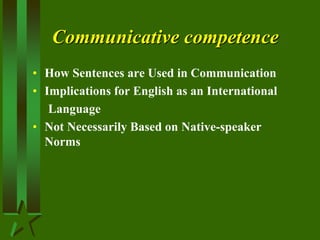
Communicative competence
• How Sentences are Used in Communication
• Implications for English as an International
Language
• Not Necessarily Based on Native-speaker
Norms
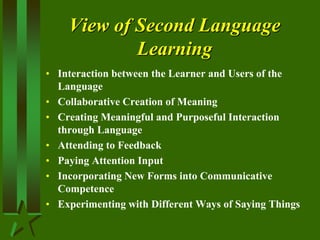
View of Second Language
Learning
• Interaction between the Learner and Users of the
Language
• Collaborative Creation of Meaning
• Creating Meaningful and Purposeful Interaction
through Language
• Attending to Feedback
• Paying Attention Input
• Incorporating New Forms into Communicative
Competence
• Experimenting with Different Ways of Saying Things
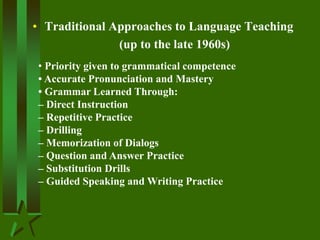
• Traditional Approaches to Language Teaching
(up to the late 1960s)
• Priority given to grammatical competence
• Accurate Pronunciation and Mastery
• Grammar Learned Through:
– Direct Instruction
– Repetitive Practice
– Drilling
– Memorization of Dialogs
– Question and Answer Practice
– Substitution Drills
– Guided Speaking and Writing Practice
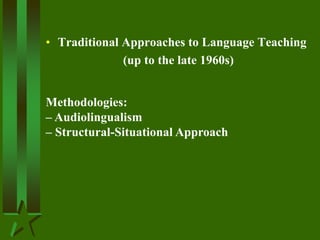
• Traditional Approaches to Language Teaching
(up to the late 1960s)
Methodologies:
– Audiolingualism
– Structural-Situational Approach
Communicative Language Teaching
(1970s to 1990s)
• Alternative Model of a Syllabuses to
Replace Grammar Syllabuses
– Functional Syllabus
– Skills Syllabus
– ESP Approach
• • Alternative Classroom Procedures
Implications for Classroom
Methodology
• Real communication the Focus of
Language Learning
• Opportunities to Experiment
• Tolerant of Errors
– Building Communicative Competence
• Opportunities to Develop Accuracy and
Fluency
Implications for Classroom
Methodology
• Link Different Skills Together
• – Speaking, Reading, Listening and Writing
• Students Induce or Discover Grammar Rules
• Emphasis on Pair Work and Group Work
• Push for Authenticity
Typical Classroom Activities in
CLT
• Fluency Activities:
• – Information-gap Activities
• – jig-Saw Activities
• – Task-Completion Activities
• – Information-Gathering Activities
• – Opinion-Sharing Activities
• – Information-Transfer Activities
• – Reasoning-Gap Activities
• – Role plays
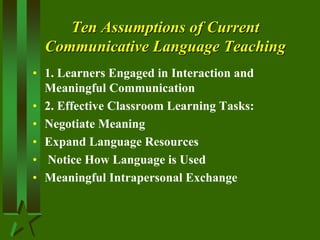
Ten Assumptions of Current
Communicative Language Teaching
• 1. Learners Engaged in Interaction and
Meaningful Communication
• 2. Effective Classroom Learning Tasks:
• Negotiate Meaning
• Expand Language Resources
• Notice How Language is Used
• Meaningful Intrapersonal Exchange
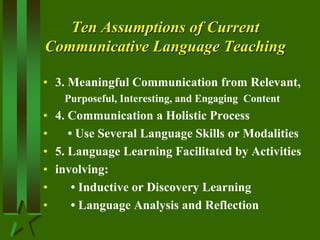
Ten Assumptions of Current
Communicative Language Teaching
• 3. Meaningful Communication from Relevant,
Purposeful, Interesting, and Engaging Content
• 4. Communication a Holistic Process
• • Use Several Language Skills or Modalities
• 5. Language Learning Facilitated by Activities
• involving:
• • Inductive or Discovery Learning
• • Language Analysis and Reflection
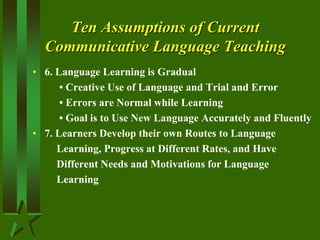
Ten Assumptions of Current
Communicative Language Teaching
• 6. Language Learning is Gradual
• Creative Use of Language and Trial and Error
• Errors are Normal while Learning
• Goal is to Use New Language Accurately and Fluently
• 7. Learners Develop their own Routes to Language
Learning, Progress at Different Rates, and Have
Different Needs and Motivations for Language
Learning
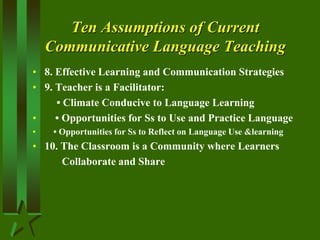
Ten Assumptions of Current
Communicative Language Teaching
• 8. Effective Learning and Communication Strategies
• 9. Teacher is a Facilitator:
• Climate Conducive to Language Learning
• • Opportunities for Ss to Use and Practice Language
• • Opportunities for Ss to Reflect on Language Use &learning
• 10. The Classroom is a Community where Learners
Collaborate and Share
Two Directions in Current
Methodology
• Processed-based Approaches
– Content-based Instruction
– Task-based Instruction
• • Product-based Approaches
• – Text-based Instruction
• – Competency-based Instruction
Two Directions in Current
Methodology
• Processed-based Approaches
– Focus on Creating Classroom Processes that Facilitate
language learning
• • Product-based Approaches
– Focus on Learning Outcomes
Content-based Instruction
• Use Language as a Means of Acquiring
• Information, rather than as an End in Itself
• • Better Reflects Learners’ Needs
• • Provides a Coherent Framework to link
and Develop Language Skills
• • Content Can be from School Curriculum
or Related to Learners’ Interests and Needs
Content-based instruction
• Language is integrated into the broad curriculum.
• • Learning is improved through motivation and the
• study of natural language in context.
• • CLIL is based on language acquisition rather than
• enforced learning.
• • Language is seen in real-life situations.
• • CLIL is long-term learning.
• • Fluency is more important than accuracy.
• • Reading is essential.
Task-based instruction
• a) Key Characteristics of a Task:
• – Something Learners Do Using Existing Language
• Resources
• – Outcome Not Simply Linked to Learning Language
• Language Acquisition May Occur
• – Focus on Meaning
• – Use Communication Strategies and Interactional Skills
Task-based instruction
• b) Two Kinds of Tasks:
• – Pedagogical Tasks
• – Real-world Tasks
Task-based instruction
• c) Learning Claims
• – Grammatical Syllabus not Needed
• – Grammatical Knowledge Built around Task
• Performance
• – Reverses the Standard P-P-P Lesson Format and
• Replaces it With one Consisting of:
• Task - Language Awareness - Follow Up Activity
Task-based instruction
• a) TBI is Based on an Approach to Teaching
• Language that Involves:
• – Teaching the Structures and Grammatical
Features of Spoken and Written Texts
• – Linking Spoken and Written Texts to the Cultural
• Context of their Use
• – Designing Units of Work that Focus on Developing
Skills in Relation to Whole Texts
• – Providing Students with Guided Practice
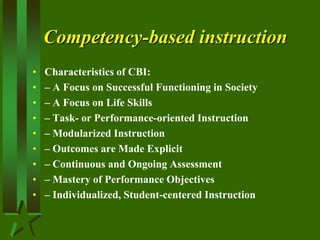
Competency-based instruction
• Characteristics of CBI:
• – A Focus on Successful Functioning in Society
• – A Focus on Life Skills
• – Task- or Performance-oriented Instruction
• – Modularized Instruction
• – Outcomes are Made Explicit
• – Continuous and Ongoing Assessment
• – Mastery of Performance Objectives
• – Individualized, Student-centered Instruction

Communicative language teaching/ Principles of Language Teaching

  • 1.
    Communicative Language Teaching Set ofPrinciples about: •Goals of Language Teaching •How Learners Learn a Language •Classroom Activities that best Facilitate Learning •Roles of Teachers and Learners.
  • 2.
    Goal of LanguageTeaching • Develop Communicative Competence • Communicative Competence Contrasted with Linguistic Competence
  • 3.
    Linguistic Competence • Rulesfor creating grammatically correct sentences
  • 4.
    Communicative competence • HowSentences are Used in Communication • Implications for English as an International Language • Not Necessarily Based on Native-speaker Norms
  • 5.
    View of SecondLanguage Learning • Interaction between the Learner and Users of the Language • Collaborative Creation of Meaning • Creating Meaningful and Purposeful Interaction through Language • Attending to Feedback • Paying Attention Input • Incorporating New Forms into Communicative Competence • Experimenting with Different Ways of Saying Things
  • 6.
    • Traditional Approachesto Language Teaching (up to the late 1960s) • Priority given to grammatical competence • Accurate Pronunciation and Mastery • Grammar Learned Through: – Direct Instruction – Repetitive Practice – Drilling – Memorization of Dialogs – Question and Answer Practice – Substitution Drills – Guided Speaking and Writing Practice
  • 7.
    • Traditional Approachesto Language Teaching (up to the late 1960s) Methodologies: – Audiolingualism – Structural-Situational Approach
  • 8.
    Communicative Language Teaching (1970sto 1990s) • Alternative Model of a Syllabuses to Replace Grammar Syllabuses – Functional Syllabus – Skills Syllabus – ESP Approach • • Alternative Classroom Procedures
  • 9.
    Implications for Classroom Methodology •Real communication the Focus of Language Learning • Opportunities to Experiment • Tolerant of Errors – Building Communicative Competence • Opportunities to Develop Accuracy and Fluency
  • 10.
    Implications for Classroom Methodology •Link Different Skills Together • – Speaking, Reading, Listening and Writing • Students Induce or Discover Grammar Rules • Emphasis on Pair Work and Group Work • Push for Authenticity
  • 11.
    Typical Classroom Activitiesin CLT • Fluency Activities: • – Information-gap Activities • – jig-Saw Activities • – Task-Completion Activities • – Information-Gathering Activities • – Opinion-Sharing Activities • – Information-Transfer Activities • – Reasoning-Gap Activities • – Role plays
  • 12.
    Ten Assumptions ofCurrent Communicative Language Teaching • 1. Learners Engaged in Interaction and Meaningful Communication • 2. Effective Classroom Learning Tasks: • Negotiate Meaning • Expand Language Resources • Notice How Language is Used • Meaningful Intrapersonal Exchange
  • 13.
    Ten Assumptions ofCurrent Communicative Language Teaching • 3. Meaningful Communication from Relevant, Purposeful, Interesting, and Engaging Content • 4. Communication a Holistic Process • • Use Several Language Skills or Modalities • 5. Language Learning Facilitated by Activities • involving: • • Inductive or Discovery Learning • • Language Analysis and Reflection
  • 14.
    Ten Assumptions ofCurrent Communicative Language Teaching • 6. Language Learning is Gradual • Creative Use of Language and Trial and Error • Errors are Normal while Learning • Goal is to Use New Language Accurately and Fluently • 7. Learners Develop their own Routes to Language Learning, Progress at Different Rates, and Have Different Needs and Motivations for Language Learning
  • 15.
    Ten Assumptions ofCurrent Communicative Language Teaching • 8. Effective Learning and Communication Strategies • 9. Teacher is a Facilitator: • Climate Conducive to Language Learning • • Opportunities for Ss to Use and Practice Language • • Opportunities for Ss to Reflect on Language Use &learning • 10. The Classroom is a Community where Learners Collaborate and Share
  • 16.
    Two Directions inCurrent Methodology • Processed-based Approaches – Content-based Instruction – Task-based Instruction • • Product-based Approaches • – Text-based Instruction • – Competency-based Instruction
  • 17.
    Two Directions inCurrent Methodology • Processed-based Approaches – Focus on Creating Classroom Processes that Facilitate language learning • • Product-based Approaches – Focus on Learning Outcomes
  • 18.
    Content-based Instruction • UseLanguage as a Means of Acquiring • Information, rather than as an End in Itself • • Better Reflects Learners’ Needs • • Provides a Coherent Framework to link and Develop Language Skills • • Content Can be from School Curriculum or Related to Learners’ Interests and Needs
  • 19.
    Content-based instruction • Languageis integrated into the broad curriculum. • • Learning is improved through motivation and the • study of natural language in context. • • CLIL is based on language acquisition rather than • enforced learning. • • Language is seen in real-life situations. • • CLIL is long-term learning. • • Fluency is more important than accuracy. • • Reading is essential.
  • 20.
    Task-based instruction • a)Key Characteristics of a Task: • – Something Learners Do Using Existing Language • Resources • – Outcome Not Simply Linked to Learning Language • Language Acquisition May Occur • – Focus on Meaning • – Use Communication Strategies and Interactional Skills
  • 21.
    Task-based instruction • b)Two Kinds of Tasks: • – Pedagogical Tasks • – Real-world Tasks
  • 22.
    Task-based instruction • c)Learning Claims • – Grammatical Syllabus not Needed • – Grammatical Knowledge Built around Task • Performance • – Reverses the Standard P-P-P Lesson Format and • Replaces it With one Consisting of: • Task - Language Awareness - Follow Up Activity
  • 23.
    Task-based instruction • a)TBI is Based on an Approach to Teaching • Language that Involves: • – Teaching the Structures and Grammatical Features of Spoken and Written Texts • – Linking Spoken and Written Texts to the Cultural • Context of their Use • – Designing Units of Work that Focus on Developing Skills in Relation to Whole Texts • – Providing Students with Guided Practice
  • 24.
    Competency-based instruction • Characteristicsof CBI: • – A Focus on Successful Functioning in Society • – A Focus on Life Skills • – Task- or Performance-oriented Instruction • – Modularized Instruction • – Outcomes are Made Explicit • – Continuous and Ongoing Assessment • – Mastery of Performance Objectives • – Individualized, Student-centered Instruction