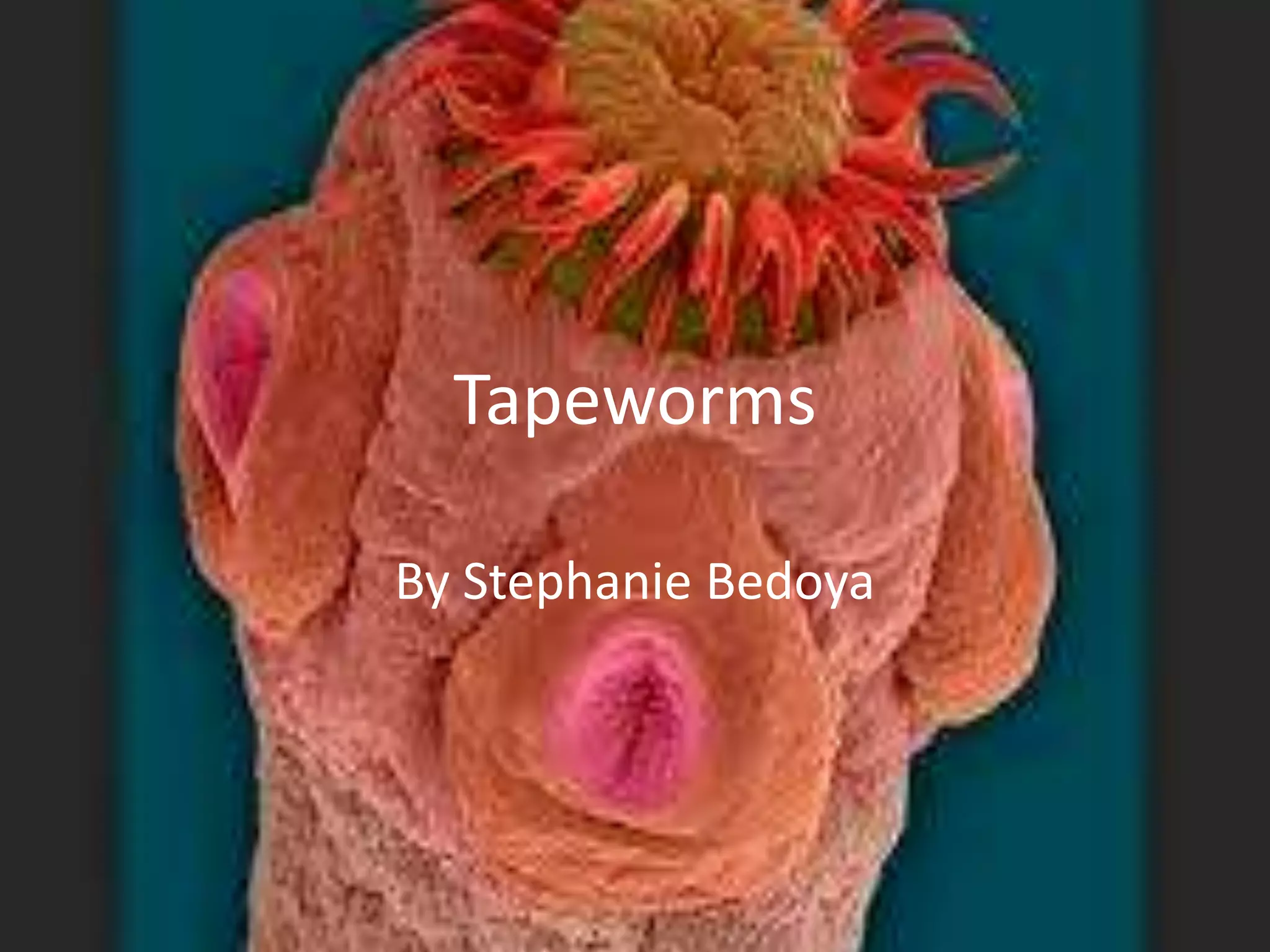
Tapeworms

By Stephanie Bedoya
Tapeworm Facts
The tapeworm eats whatever the host eats. It lives in the internal
organs of the host. In addition, tapeworms can be less than 1 inch but
they can grow up to 16 feet!

Fun Facts:
o All tapeworms have male and female segments.
o The pork tapeworm lays its eggs in the host’s face.
o Tapeworms lay their eggs in the meat of the animal you would eat.
o Most of the invasions happen in poor countries.
o A tapeworm can live in a host for over 10 years without the host
  knowing.
o Hosts become infected by eating undercooked meat that has cysts
  in it.
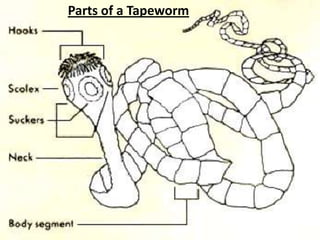
Parts of a Tapeworm
Taenia Saginata
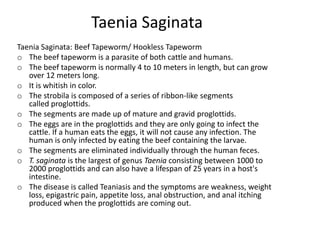
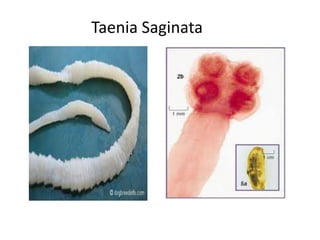
Taenia Saginata: Beef Tapeworm/ Hookless Tapeworm
o The beef tapeworm is a parasite of both cattle and humans.
o The beef tapeworm is normally 4 to 10 meters in length, but can grow
   over 12 meters long.
o It is whitish in color.
o The strobila is composed of a series of ribbon-like segments
   called proglottids.
o The segments are made up of mature and gravid proglottids.
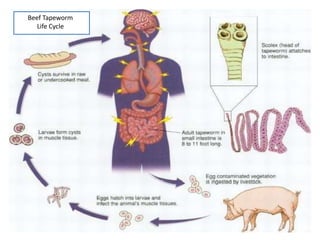
o The eggs are in the proglottids and they are only going to infect the
   cattle. If a human eats the eggs, it will not cause any infection. The
   human is only infected by eating the beef containing the larvae.
o The segments are eliminated individually through the human feces.
o T. saginata is the largest of genus Taenia consisting between 1000 to
   2000 proglottids and can also have a lifespan of 25 years in a host's
   intestine.
o The disease is called Teaniasis and the symptoms are weakness, weight
   loss, epigastric pain, appetite loss, anal obstruction, and anal itching
   produced when the proglottids are coming out.
Taenia Saginata
Beef Tapeworm
   Life Cycle
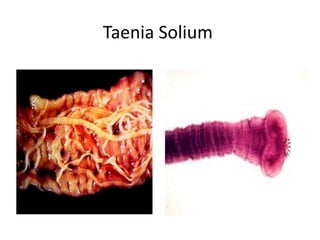
Taenia Solium
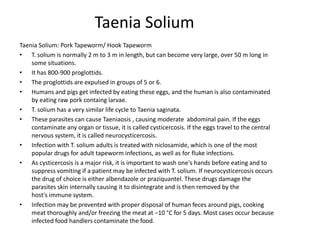
Taenia Solium: Pork Tapeworm/ Hook Tapeworm
• T. solium is normally 2 m to 3 m in length, but can become very large, over 50 m long in
    some situations.
• It has 800-900 proglottids.
• The proglottids are expulsed in groups of 5 or 6.
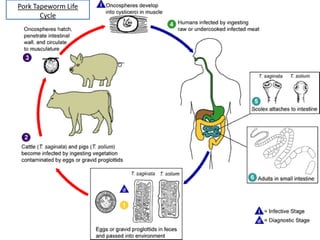
• Humans and pigs get infected by eating these eggs, and the human is also contaminated
    by eating raw pork containg larvae.
• T. solium has a very similar life cycle to Taenia saginata.
• These parasites can cause Taeniaosis , causing moderate abdominal pain. If the eggs
    contaminate any organ or tissue, it is called cysticercosis. If the eggs travel to the central
    nervous system, it is called neurocysticercosis.
• Infection with T. solium adults is treated with niclosamide, which is one of the most
    popular drugs for adult tapeworm infections, as well as for fluke infections.
• As cysticercosis is a major risk, it is important to wash one's hands before eating and to
    suppress vomiting if a patient may be infected with T. solium. If neurocysticercosis occurs
    the drug of choice is either albendazole or praziquantel. These drugs damage the
    parasites skin internally causing it to disintegrate and is then removed by the
    host's immune system.
• Infection may be prevented with proper disposal of human feces around pigs, cooking
    meat thoroughly and/or freezing the meat at −10 °C for 5 days. Most cases occur because
    infected food handlers contaminate the food.
Taenia Solium
Pork Tapeworm Life
       Cycle
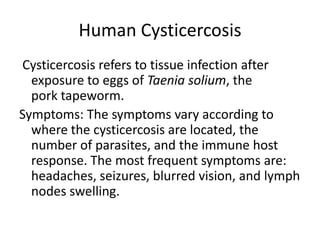
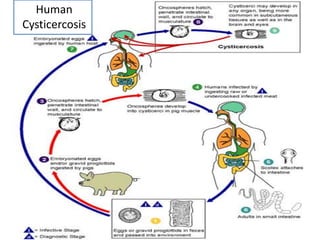
Human Cysticercosis
Cysticercosis refers to tissue infection after
  exposure to eggs of Taenia solium, the
  pork tapeworm.
Symptoms: The symptoms vary according to
  where the cysticercosis are located, the
  number of parasites, and the immune host
  response. The most frequent symptoms are:
  headaches, seizures, blurred vision, and lymph
  nodes swelling.
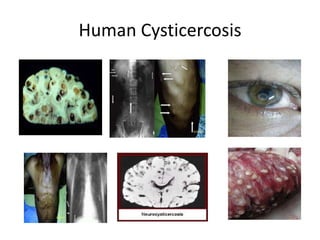
Human Cysticercosis
Human
Cysticercosis
Hymenolepsis Nana
Hymenolepsis Nana: Dwarf Tapeworm
• Dwarf tapeworm (Hymenolepis nana, previously known as Vampirolepis
   nana, Hymenolepis fraterna, and Taenia nana) is a cosmopolitan species that is one of
   the most common cestodes of humans in the world, especially among children.
• It can be found throughout the world, but is usually most common in temperate zones.
• It is the most common cestode of humans and is found wherever there are human
   inhabitants.
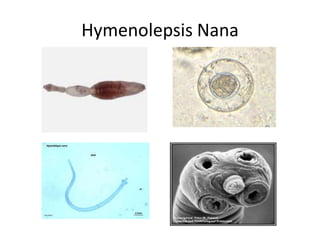
• As its name implies, it is a small species, exceeding 40 mm long and 1 mm wide.
• The scolex bears a retractable rostellum armed with a single circle of 20 to 30 hooks.
   The scolex also has four suckers, or a tetrad.
• The neck is long and slender, and the segments are wider than long.
• This is the only cestode that can complete its life cycle in one host: a human.
• The human can store the not only the adult, but larvae parasites.
• It has about 200 proglottides.
• The scolex has 4 suckers with a crown that has 20-30 hooks.
• The eggs are round and similar to Taenia Saginata.
Hymenolepsis Nana
Developement:
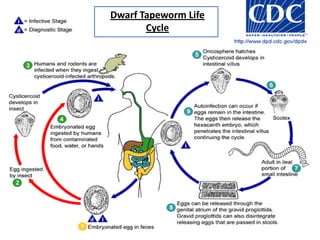
Infection can be direct or indirect.
 Direct is infection is acquired most commonly from eggs in the feces of another
    infected individual, which are transferred in food, by contamination. Eggs hatch in
    the duodenum, releasing oncospheres, which penetrate the mucosa and come to
    lie in lymph channels of the villi. Oncospheres develops into a cysticercoid which
    has a tail and a well formed scolex.

The indirect life cycle is doubtless a recent modification of the ancestral two-host life
   cycle, found in other species of hymenolepidids, because cysticercoids of H.
   nana can still develop normally within larval fleas and beetles.

Direct contaminative infection by eggs is probably the most common route in human
    cases, but accidental ingestion of an infected grain beetle or flea cannot be ruled
    out.
The direct infectiousness of the eggs frees the parasite from its former dependence
    upon an insect intermediate host, making rapid infection and person-to-person
    spread possible. The short life span and rapid course of development also facilitate
    the spread and ready availability of this worm.
Hymenolepsis Nana
Dwarf Tapeworm Life
       Cycle
The End

Tapeworms

  • 1.
  • 2.
    Tapeworm Facts The tapewormeats whatever the host eats. It lives in the internal organs of the host. In addition, tapeworms can be less than 1 inch but they can grow up to 16 feet! Fun Facts: o All tapeworms have male and female segments. o The pork tapeworm lays its eggs in the host’s face. o Tapeworms lay their eggs in the meat of the animal you would eat. o Most of the invasions happen in poor countries. o A tapeworm can live in a host for over 10 years without the host knowing. o Hosts become infected by eating undercooked meat that has cysts in it.
  • 3.
    Parts of aTapeworm
  • 4.
    Taenia Saginata Taenia Saginata:Beef Tapeworm/ Hookless Tapeworm o The beef tapeworm is a parasite of both cattle and humans. o The beef tapeworm is normally 4 to 10 meters in length, but can grow over 12 meters long. o It is whitish in color. o The strobila is composed of a series of ribbon-like segments called proglottids. o The segments are made up of mature and gravid proglottids. o The eggs are in the proglottids and they are only going to infect the cattle. If a human eats the eggs, it will not cause any infection. The human is only infected by eating the beef containing the larvae. o The segments are eliminated individually through the human feces. o T. saginata is the largest of genus Taenia consisting between 1000 to 2000 proglottids and can also have a lifespan of 25 years in a host's intestine. o The disease is called Teaniasis and the symptoms are weakness, weight loss, epigastric pain, appetite loss, anal obstruction, and anal itching produced when the proglottids are coming out.
  • 5.
  • 6.
    Beef Tapeworm Life Cycle
  • 7.
    Taenia Solium Taenia Solium:Pork Tapeworm/ Hook Tapeworm • T. solium is normally 2 m to 3 m in length, but can become very large, over 50 m long in some situations. • It has 800-900 proglottids. • The proglottids are expulsed in groups of 5 or 6. • Humans and pigs get infected by eating these eggs, and the human is also contaminated by eating raw pork containg larvae. • T. solium has a very similar life cycle to Taenia saginata. • These parasites can cause Taeniaosis , causing moderate abdominal pain. If the eggs contaminate any organ or tissue, it is called cysticercosis. If the eggs travel to the central nervous system, it is called neurocysticercosis. • Infection with T. solium adults is treated with niclosamide, which is one of the most popular drugs for adult tapeworm infections, as well as for fluke infections. • As cysticercosis is a major risk, it is important to wash one's hands before eating and to suppress vomiting if a patient may be infected with T. solium. If neurocysticercosis occurs the drug of choice is either albendazole or praziquantel. These drugs damage the parasites skin internally causing it to disintegrate and is then removed by the host's immune system. • Infection may be prevented with proper disposal of human feces around pigs, cooking meat thoroughly and/or freezing the meat at −10 °C for 5 days. Most cases occur because infected food handlers contaminate the food.
  • 8.
  • 9.
  • 10.
    Human Cysticercosis Cysticercosis refersto tissue infection after exposure to eggs of Taenia solium, the pork tapeworm. Symptoms: The symptoms vary according to where the cysticercosis are located, the number of parasites, and the immune host response. The most frequent symptoms are: headaches, seizures, blurred vision, and lymph nodes swelling.
  • 11.
  • 12.
  • 13.
    Hymenolepsis Nana Hymenolepsis Nana:Dwarf Tapeworm • Dwarf tapeworm (Hymenolepis nana, previously known as Vampirolepis nana, Hymenolepis fraterna, and Taenia nana) is a cosmopolitan species that is one of the most common cestodes of humans in the world, especially among children. • It can be found throughout the world, but is usually most common in temperate zones. • It is the most common cestode of humans and is found wherever there are human inhabitants. • As its name implies, it is a small species, exceeding 40 mm long and 1 mm wide. • The scolex bears a retractable rostellum armed with a single circle of 20 to 30 hooks. The scolex also has four suckers, or a tetrad. • The neck is long and slender, and the segments are wider than long. • This is the only cestode that can complete its life cycle in one host: a human. • The human can store the not only the adult, but larvae parasites. • It has about 200 proglottides. • The scolex has 4 suckers with a crown that has 20-30 hooks. • The eggs are round and similar to Taenia Saginata.
  • 14.
    Hymenolepsis Nana Developement: Infection canbe direct or indirect. Direct is infection is acquired most commonly from eggs in the feces of another infected individual, which are transferred in food, by contamination. Eggs hatch in the duodenum, releasing oncospheres, which penetrate the mucosa and come to lie in lymph channels of the villi. Oncospheres develops into a cysticercoid which has a tail and a well formed scolex. The indirect life cycle is doubtless a recent modification of the ancestral two-host life cycle, found in other species of hymenolepidids, because cysticercoids of H. nana can still develop normally within larval fleas and beetles. Direct contaminative infection by eggs is probably the most common route in human cases, but accidental ingestion of an infected grain beetle or flea cannot be ruled out. The direct infectiousness of the eggs frees the parasite from its former dependence upon an insect intermediate host, making rapid infection and person-to-person spread possible. The short life span and rapid course of development also facilitate the spread and ready availability of this worm.
  • 15.
  • 16.
  • 17.