NEMATODA
Prepared by : MALAK SALAM
GENERAL CHARACTERISTICS OF
NEMATODES
They are un-segmented.
 Elongated and cylindrical.
They have separate sexes with separate appearances.
They have a tough protective covering or cuticle.
They have a complete digestive tract with both oral and
anal openings.
The nematodes are free living (Majority) or parasites of
humans, plants or animals.
They assume three basic morphologic forms: Egg, Larvae
and Adult worms.
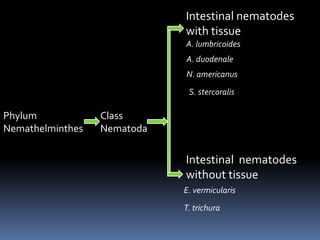
Phylum
Nemathelminthes
Class
Nematoda
Intestinal nematodes
with tissue
E. vermicularis
T. trichura
N. americanus
A. duodenale
A. lumbricoides
S. stercoralis
Intestinal nematodes
without tissue
Ascaris lumbricoides
Morphology:
 Male adult worm measures 15-20 cm in length.
The posterior end is curved ventrally.
The female worm measures 20-40 cm in length.
 Its posterior end is straight.
Intestinal nematodes with tissue
Common Name Abdomine snake
Infective Stage Embryonated Egg
Habitat Small Intestine
Mode ofTransmission Ingestion of contaminated food/ water
Diagnostic Specimen Feces
Life cycle of Ascaris lumbricoides
Pathogenecity and clinical features
 Adult worms in the intestine cause abdominal pain and
may cause intestinal obstruction especially in children.
 Larvae in the lungs may cause inflammation of the lungs
(Loeffler’s syndrome) – pneumonia-like symptoms.
1. Examination of stool for eggs by direct saline smear method.
Diagnosis
2. Demonstration of adult worms .
HOOKWORMS
There are two species of hookworm:
1. Ancylostoma duodenale
2. Necator americanus
Ancylostoma duodenale
GENERAL CHARACTERISTICS
 Grayish-white in color.
The body is slightly ventrally curved.
The anterior end follows the body curvature.
The buccal cavity is provided ventrally with pairs of teeth and dorsally
with a notched dental plate.
Distribution:This species is found in the northern part of
the world including China, Japan, Europe, North Africa and
Ethiopia.
Morphology
Male: The male measures 10 Mm in length. The posterior
end is broadened into a membraneous copulatory bursa
that is provided with two long spicules.
Female: The female measures 12 Mm in length. The
posterior end is straight.
Necator americanus
This species, so called American hookworm.
The anterior end is hooked against the
body curvature.
The mouth is provided ventrally and dorsally with
cutting plate.
Morphology
Male: The male measures 8 Mm in length.The posterior
end is broadened into a membraneous copulatory bursa,
which is provided with two long spicules fused
distally.
Female: The female measures 10 Mm in length. The
posterior end is straight.
Life cycle
 Adult male and female worms live in the small intestine.
The female lays eggs which contain immature embryo in
the 4 cell stage.
When the eggs pass in the stool to the soil and under
favorable conditions
 they hatch into larvae, which molt twice and become
infective.
When the filariform larvae penetrate the skin, they circulate
in the blood, reach the lungs, ascend to the trachea, descend
to esophagus to reach the small intestine and become adults.
Life cycle of hookworms
Pathogenecity
Adult worms in the intestine feed on blood causing iron
deficiency anemia.The larvae may cause inflammation of the
lungs.
Diagnosis:
Examination of stool by direct saline smear to detect
the eggs.
Egg of hookworm
LARVA MIGRANS
1. Cutaneous larva migrans (Creeping eruption)
2.Visceral larva migrans
3. Intestinal larva migrans
Cutaneous larva migrans (Creeping eruption)
1. Ancylostoma braziliens: infects both dogs and cats.
2. Ancylostoma caninum: infects only dogs.
 Both of these are common in the tropics and subtropical
regions where human hookworms can best complete their
life cycles.
 If man comes in contact with infective larvae, penetration
of the skin may take place; but the larvae are then unable to
complete their migratory cycle .
Trapped larvae may survive for weeks or even months,
migrating through the subcutaneous tissues.
They may evoke a fairly severe reaction - pruritus and
dermatitis .The dermatitis leads to scratching and then
bacterial superinfection.
Visceral larva migrans
A syndrome caused by the migration of
parasitic larvae in the viscera of a host for
months or years. It may be caused by transient
larval migration in the life cycles of several
parasites such as hookworm, Ascaris
lumbricoides,T.spiralis, S. strecoralis and other
filarial worms.
Toxocariasis
This is a kind of visceral larva migrans caused by :
♦ Toxocara canis (Dog ascarid).
♦ Toxocara catis (Cat ascarid).
These cause persistent larval migration and thus the visceral
larva migrans is called toxocariasis.
Morphology
♦The larvae of Toxocara canis andToxocara catis measure
about 400 μm in length.
♦The life cycle of these parasites in their respective hosts is
similar to that of A.lumbricoides in humans.
Epidemiology
Visceral larva migrans is cosmopolitan in distribution.
Transmission
Ingestion of eggs ofToxocara species in contaminated food
or soil or direct contact with infected patients. Children are
more at risk.
Clinical features:
♦ Majority are asymptomatic.
♦ Eosinophilia
♦ Cerebral, myocardial and pulmonary involvement may
cause death.
Intestinal larva migrans
This is an extremely rare kind of larva migrans.
Diagnosis - Identification of larvae in tissue.
STRONGYLOIDES STERCORALIS
The worms may be present as parasitic in the host or free
living in the soil.
Morphology:
Male:The male measures1 mm in length with curved
posterior end and carries two spicules
Female:The female measures 2.5 mm in length with
straight posterior end.
Infection: follows skin penetration by filariform larvae.
Life cycle
 Adult male and female worms live in the small intestine.
After fertilization, the female penetrates the mucosa of the
small intestine and lay eggs in the submucosa.
The eggs hatch and the larvae penetrate the mucosa back
to the lumen.
If the environmental conditions are favorable
the larvae will come out with the stool to the soil.They
transform into adults, which lay eggs, and hatching larvae
get transformed to adults and so on.
If the environmental conditions are not favorable
the larvae in the stool will moult and transform into
infective filariform larvae, which pierce the intestine (auto-
infection).
Larvae penetrating the skin from the soil or by autoinfection
are carried by the blood to the lungs, ascend to the trachea,
descend to the esophagus and mature in the small intestine.
Life cycle of Strongyloides stercoralis
Clinical presentation
The patient complains of mucoid diarrhea. Larvae in the
lungs may cause pneumonia.
Diagnosis- Detection of rhabditiform larvae of
strongyloides in stool.
Larva of S. stercoralis
INTESTINAL NEMATODESWITHOUTTISSUE
STAGE
ENTEROBIUSVERMICULARIS (PIN WORM ORTHREAD WORM)
Enterobius vermicularis is a small white worm with thread-
like appearance.
the worm causes enterobiasis. Infection is common in
children.
Morphology
Male:The male measures 0.5 cm in length. The posterior
end is curved and carries a single copulatory spicule.
Female:The female measures 1.3 cm in length. The
posterior end is straight.
Infective stage
Infection is by ingestion of eggs containing larvae with
contaminated raw vegetables.
Mode of infection
 By direct infection from a patient (Fecal-oral route).
 Autoinfection: the eggs are infective as soon as they are
passed by the female worm. If the hands of the patient get
contaminated with these eggs, he/she will infect him/herself
again and again.
 Aerosol inhalation from contaminated sheets and dust.
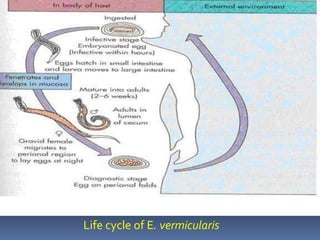
Life cycle
Adult worm lives in the large intestine.
After fertilization, the male dies and the female moves out
through the anus to glue its eggs on the peri-anal skin.
This takes place by night.
The egg is 50x25 microns, plano-convex and
contains larva.
When the eggs are swallowed, they hatch in the small
intestine and the larvae migrate to the large intestine to
become adult.
Life cycle of E. vermicularis
TRICHURISTRICHIURA (WHIP WORM)
The worm is divided into a thin whip-like anterior part
measuring 3/5 of the worm and a thick fleshy posterior part
of 2/5 the length.
Male:The male measures 3-4.5 cm in length. Its posterior
end is coiled and possesses a single cubicle.
Female:The female measures 4-5 cm in length. Its
posterior end is straight
Infective stage and mode of infection
Infection is by ingestion of eggs containing larvae with
contaminated raw vegetables.
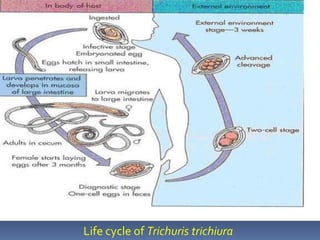
Life cycle:
Ingested eggs hatch in the small intestine and the larvae
migrate to the large intestine to become adult.
After mating, the female lays immature eggs, which pass
with the stool to the soil and mature in 2 weeks.
Life cycle of Trichuris trichiura
Symptoms
The patient complains of dysentery (blood and mucus in
stool together with tenesmus). Rectal prolapse is also
possible.
Diagnosis
Finding of characteristic eggs.The egg of trichuris is barrel-
shaped, 50x25 microns.The shell is thick with a one mucoid
plug at each pole.
Egg of Trichuris trichiura
Nematode

Nematode

  • 1.
  • 2.
    GENERAL CHARACTERISTICS OF NEMATODES Theyare un-segmented.  Elongated and cylindrical. They have separate sexes with separate appearances. They have a tough protective covering or cuticle. They have a complete digestive tract with both oral and anal openings. The nematodes are free living (Majority) or parasites of humans, plants or animals. They assume three basic morphologic forms: Egg, Larvae and Adult worms.
  • 3.
    Phylum Nemathelminthes Class Nematoda Intestinal nematodes with tissue E.vermicularis T. trichura N. americanus A. duodenale A. lumbricoides S. stercoralis Intestinal nematodes without tissue
  • 4.
    Ascaris lumbricoides Morphology:  Maleadult worm measures 15-20 cm in length. The posterior end is curved ventrally. The female worm measures 20-40 cm in length.  Its posterior end is straight. Intestinal nematodes with tissue
  • 5.
    Common Name Abdominesnake Infective Stage Embryonated Egg Habitat Small Intestine Mode ofTransmission Ingestion of contaminated food/ water Diagnostic Specimen Feces
  • 6.
    Life cycle ofAscaris lumbricoides
  • 7.
    Pathogenecity and clinicalfeatures  Adult worms in the intestine cause abdominal pain and may cause intestinal obstruction especially in children.  Larvae in the lungs may cause inflammation of the lungs (Loeffler’s syndrome) – pneumonia-like symptoms. 1. Examination of stool for eggs by direct saline smear method. Diagnosis 2. Demonstration of adult worms .
  • 10.
    HOOKWORMS There are twospecies of hookworm: 1. Ancylostoma duodenale 2. Necator americanus
  • 11.
    Ancylostoma duodenale GENERAL CHARACTERISTICS Grayish-white in color. The body is slightly ventrally curved. The anterior end follows the body curvature. The buccal cavity is provided ventrally with pairs of teeth and dorsally with a notched dental plate. Distribution:This species is found in the northern part of the world including China, Japan, Europe, North Africa and Ethiopia.
  • 12.
    Morphology Male: The malemeasures 10 Mm in length. The posterior end is broadened into a membraneous copulatory bursa that is provided with two long spicules. Female: The female measures 12 Mm in length. The posterior end is straight.
  • 13.
    Necator americanus This species,so called American hookworm. The anterior end is hooked against the body curvature. The mouth is provided ventrally and dorsally with cutting plate.
  • 14.
    Morphology Male: The malemeasures 8 Mm in length.The posterior end is broadened into a membraneous copulatory bursa, which is provided with two long spicules fused distally. Female: The female measures 10 Mm in length. The posterior end is straight.
  • 15.
    Life cycle  Adultmale and female worms live in the small intestine. The female lays eggs which contain immature embryo in the 4 cell stage. When the eggs pass in the stool to the soil and under favorable conditions  they hatch into larvae, which molt twice and become infective. When the filariform larvae penetrate the skin, they circulate in the blood, reach the lungs, ascend to the trachea, descend to esophagus to reach the small intestine and become adults.
  • 16.
    Life cycle ofhookworms
  • 17.
    Pathogenecity Adult worms inthe intestine feed on blood causing iron deficiency anemia.The larvae may cause inflammation of the lungs. Diagnosis: Examination of stool by direct saline smear to detect the eggs.
  • 18.
  • 19.
    LARVA MIGRANS 1. Cutaneouslarva migrans (Creeping eruption) 2.Visceral larva migrans 3. Intestinal larva migrans
  • 20.
    Cutaneous larva migrans(Creeping eruption) 1. Ancylostoma braziliens: infects both dogs and cats. 2. Ancylostoma caninum: infects only dogs.
  • 21.
     Both ofthese are common in the tropics and subtropical regions where human hookworms can best complete their life cycles.  If man comes in contact with infective larvae, penetration of the skin may take place; but the larvae are then unable to complete their migratory cycle . Trapped larvae may survive for weeks or even months, migrating through the subcutaneous tissues. They may evoke a fairly severe reaction - pruritus and dermatitis .The dermatitis leads to scratching and then bacterial superinfection.
  • 22.
    Visceral larva migrans Asyndrome caused by the migration of parasitic larvae in the viscera of a host for months or years. It may be caused by transient larval migration in the life cycles of several parasites such as hookworm, Ascaris lumbricoides,T.spiralis, S. strecoralis and other filarial worms.
  • 23.
    Toxocariasis This is akind of visceral larva migrans caused by : ♦ Toxocara canis (Dog ascarid). ♦ Toxocara catis (Cat ascarid). These cause persistent larval migration and thus the visceral larva migrans is called toxocariasis.
  • 24.
    Morphology ♦The larvae ofToxocara canis andToxocara catis measure about 400 μm in length. ♦The life cycle of these parasites in their respective hosts is similar to that of A.lumbricoides in humans. Epidemiology Visceral larva migrans is cosmopolitan in distribution.
  • 25.
    Transmission Ingestion of eggsofToxocara species in contaminated food or soil or direct contact with infected patients. Children are more at risk. Clinical features: ♦ Majority are asymptomatic. ♦ Eosinophilia ♦ Cerebral, myocardial and pulmonary involvement may cause death.
  • 26.
    Intestinal larva migrans Thisis an extremely rare kind of larva migrans. Diagnosis - Identification of larvae in tissue.
  • 27.
    STRONGYLOIDES STERCORALIS The wormsmay be present as parasitic in the host or free living in the soil. Morphology: Male:The male measures1 mm in length with curved posterior end and carries two spicules Female:The female measures 2.5 mm in length with straight posterior end. Infection: follows skin penetration by filariform larvae.
  • 28.
    Life cycle  Adultmale and female worms live in the small intestine. After fertilization, the female penetrates the mucosa of the small intestine and lay eggs in the submucosa. The eggs hatch and the larvae penetrate the mucosa back to the lumen. If the environmental conditions are favorable the larvae will come out with the stool to the soil.They transform into adults, which lay eggs, and hatching larvae get transformed to adults and so on.
  • 29.
    If the environmentalconditions are not favorable the larvae in the stool will moult and transform into infective filariform larvae, which pierce the intestine (auto- infection). Larvae penetrating the skin from the soil or by autoinfection are carried by the blood to the lungs, ascend to the trachea, descend to the esophagus and mature in the small intestine.
  • 30.
    Life cycle ofStrongyloides stercoralis
  • 31.
    Clinical presentation The patientcomplains of mucoid diarrhea. Larvae in the lungs may cause pneumonia. Diagnosis- Detection of rhabditiform larvae of strongyloides in stool.
  • 32.
    Larva of S.stercoralis
  • 33.
    INTESTINAL NEMATODESWITHOUTTISSUE STAGE ENTEROBIUSVERMICULARIS (PINWORM ORTHREAD WORM) Enterobius vermicularis is a small white worm with thread- like appearance. the worm causes enterobiasis. Infection is common in children.
  • 34.
    Morphology Male:The male measures0.5 cm in length. The posterior end is curved and carries a single copulatory spicule. Female:The female measures 1.3 cm in length. The posterior end is straight. Infective stage Infection is by ingestion of eggs containing larvae with contaminated raw vegetables.
  • 35.
    Mode of infection By direct infection from a patient (Fecal-oral route).  Autoinfection: the eggs are infective as soon as they are passed by the female worm. If the hands of the patient get contaminated with these eggs, he/she will infect him/herself again and again.  Aerosol inhalation from contaminated sheets and dust.
  • 36.
    Life cycle Adult wormlives in the large intestine. After fertilization, the male dies and the female moves out through the anus to glue its eggs on the peri-anal skin. This takes place by night. The egg is 50x25 microns, plano-convex and contains larva. When the eggs are swallowed, they hatch in the small intestine and the larvae migrate to the large intestine to become adult.
  • 37.
    Life cycle ofE. vermicularis
  • 38.
    TRICHURISTRICHIURA (WHIP WORM) Theworm is divided into a thin whip-like anterior part measuring 3/5 of the worm and a thick fleshy posterior part of 2/5 the length. Male:The male measures 3-4.5 cm in length. Its posterior end is coiled and possesses a single cubicle. Female:The female measures 4-5 cm in length. Its posterior end is straight
  • 39.
    Infective stage andmode of infection Infection is by ingestion of eggs containing larvae with contaminated raw vegetables. Life cycle: Ingested eggs hatch in the small intestine and the larvae migrate to the large intestine to become adult. After mating, the female lays immature eggs, which pass with the stool to the soil and mature in 2 weeks.
  • 40.
    Life cycle ofTrichuris trichiura
  • 41.
    Symptoms The patient complainsof dysentery (blood and mucus in stool together with tenesmus). Rectal prolapse is also possible. Diagnosis Finding of characteristic eggs.The egg of trichuris is barrel- shaped, 50x25 microns.The shell is thick with a one mucoid plug at each pole.
  • 42.