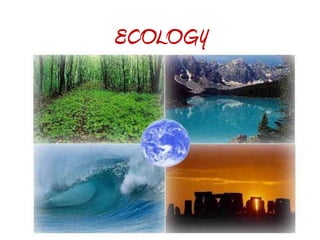
ECOLOGY
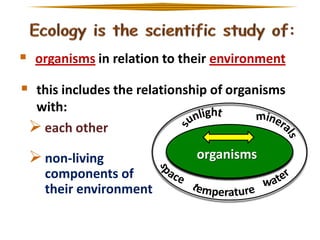
 organisms in relation to their environment
 this includes the relationship of organisms
with:
 each other

 non-living
components of
their environment

organisms
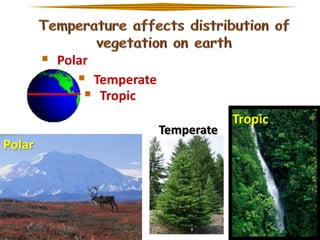
 Polar
 Temperate
 Tropic
Temperate

Polar

Tropic
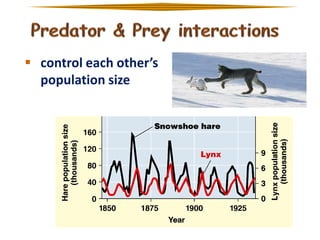
 control each other’s
population size
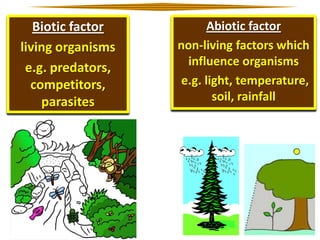
Biotic factor
living organisms
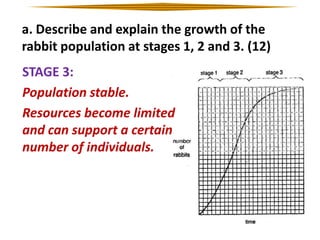
e.g. predators,
competitors,
parasites

Abiotic factor
non-living factors which
influence organisms
e.g. light, temperature,
soil, rainfall
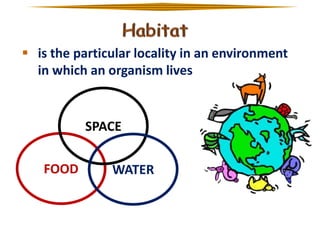
 is the particular locality in an environment
in which an organism lives

SPACE
FOOD

WATER
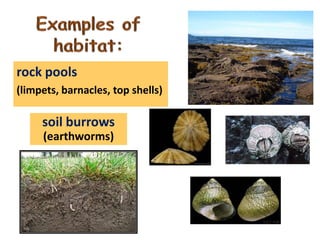
rock pools
(limpets, barnacles, top shells)

soil burrows
(earthworms)
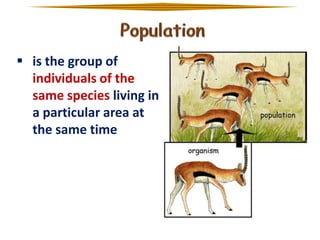
 is the group of
individuals of the
same species living in
a particular area at
the same time
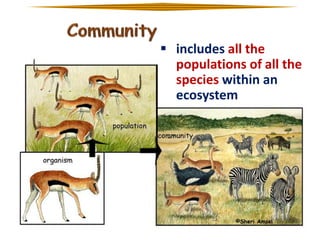
 includes all the
populations of all the
species within an
ecosystem
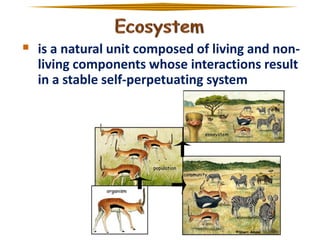
 is a natural unit composed of living and nonliving components whose interactions result
in a stable self-perpetuating system
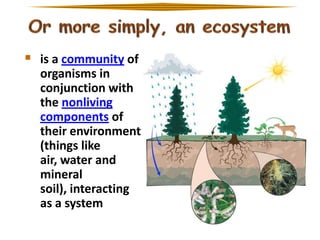
 is a community of
organisms in
conjunction with
the nonliving
components of
their environment
(things like
air, water and
mineral
soil), interacting
as a system
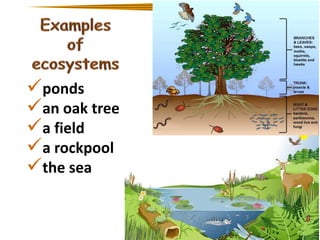
ponds
an oak tree
a field
a rockpool
the sea
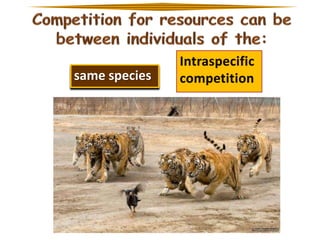
same species
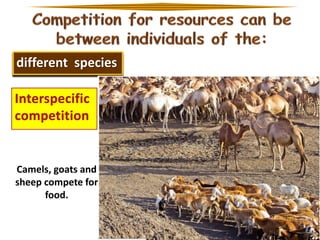
different species

Camels, goats and
sheep compete for
food.
a) Distinguish between intraspecific and
interspecific competition. (2)
b) Explain why intraspecific competition is
likely to be more intense than interspecific
competition. (1)
Members of a species use the same resources
but different species use different resources.
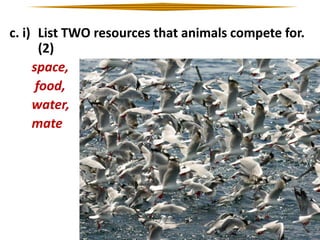
c. i) List TWO resources that animals compete for.
(2)
space,
food,
water,
mate
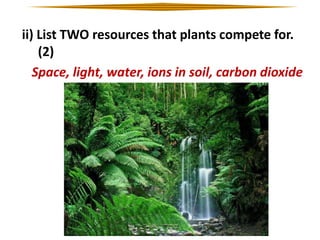
ii) List TWO resources that plants compete for.
(2)
Space, light, water, ions in soil, carbon dioxide
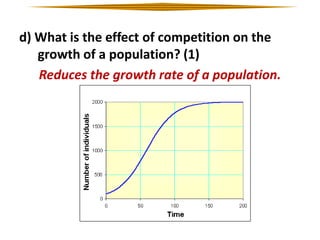
d) What is the effect of competition on the
growth of a population? (1)
Reduces the growth rate of a population.
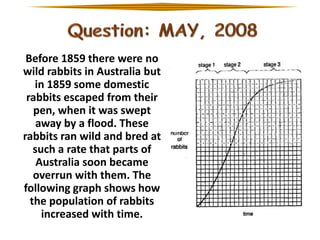
Before 1859 there were no
wild rabbits in Australia but
in 1859 some domestic
rabbits escaped from their
pen, when it was swept
away by a flood. These
rabbits ran wild and bred at
such a rate that parts of
Australia soon became
overrun with them. The
following graph shows how
the population of rabbits
increased with time.
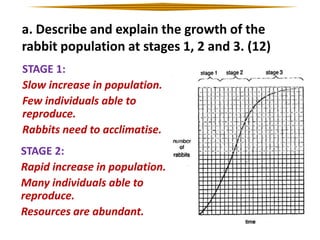
a. Describe and explain the growth of the
rabbit population at stages 1, 2 and 3. (12)
STAGE 1:
Slow increase in population.
Few individuals able to
reproduce.
Rabbits need to acclimatise.
STAGE 2:
Rapid increase in population.
Many individuals able to
reproduce.
Resources are abundant.
a. Describe and explain the growth of the
rabbit population at stages 1, 2 and 3. (12)
STAGE 3:
Population stable.
Resources become limited
and can support a certain
number of individuals.
b. Discuss the effect of the observed growth rate
of rabbits on agricultural activity in Australia. (2)
Rabbits fed upon crops and caused damage to
agriculture.
c. Suggest how the observed growth rate of
rabbits affected the natural ecosystem in
Australia. (2)
Many wild plants were eaten leading to loss of
plant species, more soil erosion as soil was no
longer covered by vegetation.
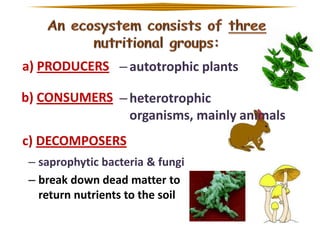
a) PRODUCERS – autotrophic plants
b) CONSUMERS – heterotrophic
organisms, mainly animals
c) DECOMPOSERS
– saprophytic bacteria & fungi
– break down dead matter to
return nutrients to the soil
Distinguish between a community of plants and
a population of plants. (2)

Distinguish between producers and consumers.
(4)
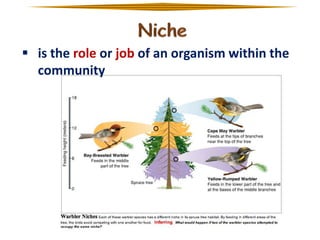
 is the role or job of an organism within the
community
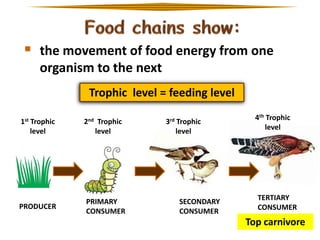
 the movement of food energy from one
organism to the next
Trophic level = feeding level
1st Trophic
level

2nd Trophic
level

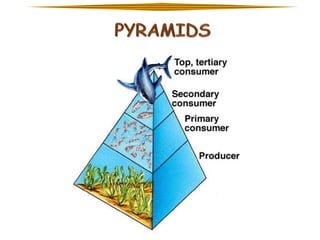
PRODUCER

PRIMARY
CONSUMER

3rd Trophic
level

SECONDARY
CONSUMER

4th Trophic
level

TERTIARY
CONSUMER

Top carnivore
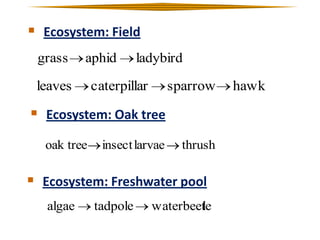
 Ecosystem: Field
grass

aphid

leaves

ladybird

caterpillar

sparrow

 Ecosystem: Oak tree
oak tree

insect larvae

thrush

 Ecosystem: Freshwater pool
algae

tadpole

waterbeet
le

hawk
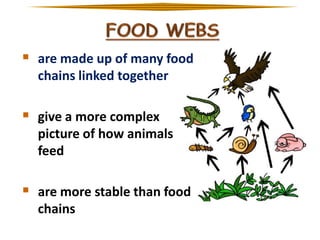
 are made up of many food
chains linked together

 give a more complex
picture of how animals
feed

 are more stable than food
chains
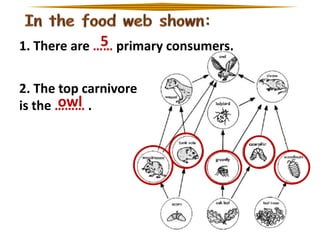
5
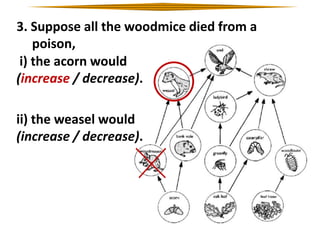
1. There are …… primary consumers.
2. The top carnivore
owl
is the ……… .
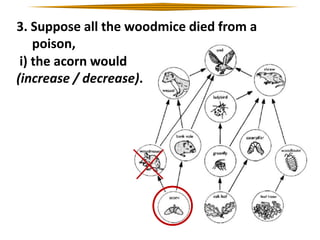
3. Suppose all the woodmice died from a
poison,
i) the acorn would
(increase / decrease).
3. Suppose all the woodmice died from a
poison,
i) the acorn would
(increase / decrease).
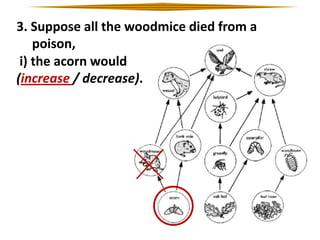
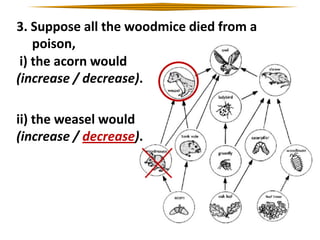
3. Suppose all the woodmice died from a
poison,
i) the acorn would
(increase / decrease).
ii) the weasel would
(increase / decrease).
3. Suppose all the woodmice died from a
poison,
i) the acorn would
(increase / decrease).
ii) the weasel would
(increase / decrease).
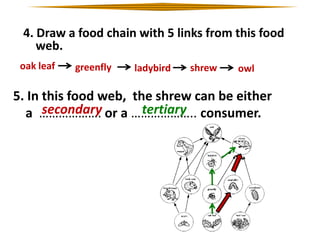
4. Draw a food chain with 5 links from this food
web.
oak leaf

greenfly

ladybird

shrew

owl

5. In this food web, the shrew can be either
secondary
tertiary
a ………………. or a ……………….. consumer.
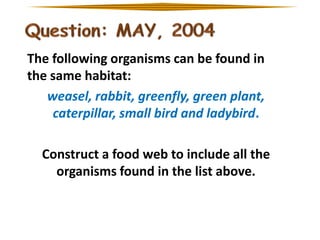
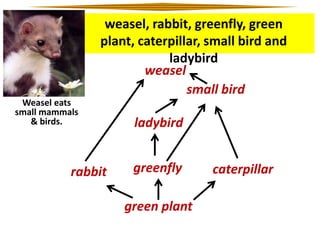
The following organisms can be found in
the same habitat:
weasel, rabbit, greenfly, green plant,
caterpillar, small bird and ladybird.
Construct a food web to include all the
organisms found in the list above.
weasel, rabbit, greenfly, green
plant, caterpillar, small bird and
ladybird
weasel
small bird
Weasel eats
small mammals
& birds.

rabbit

ladybird
greenfly

green plant

caterpillar
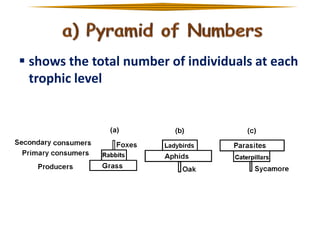
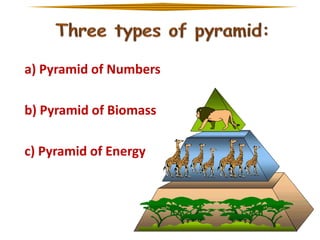
a) Pyramid of Numbers
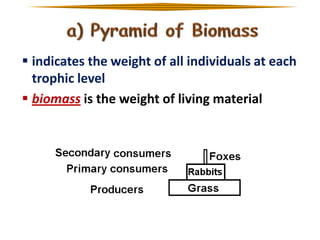
b) Pyramid of Biomass
c) Pyramid of Energy
 shows the total number of individuals at each
trophic level
 indicates the weight of all individuals at each
trophic level
 biomass is the weight of living material
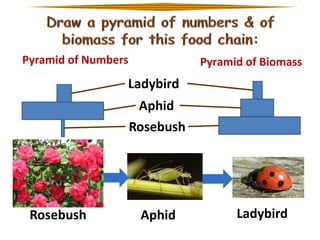
Pyramid of Numbers

Pyramid of Biomass

Ladybird

Aphid
Rosebush

Rosebush

Aphid

Ladybird
From the food
web write a food
chain including
four trophic
levels. (2)
[Any food chain as
long as 4 trophic
levels are present]
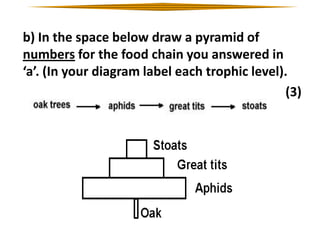
b) In the space below draw a pyramid of
numbers for the food chain you answered in
‘a’. (In your diagram label each trophic level).
(3)
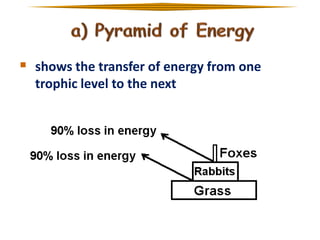
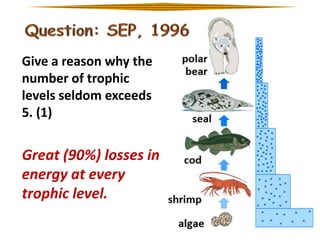
 shows the transfer of energy from one
trophic level to the next
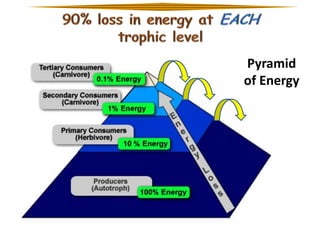
Pyramid
of Energy
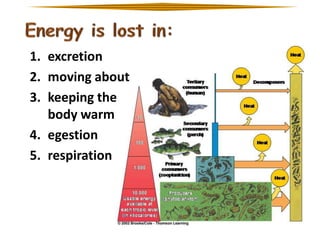
1. excretion
2. moving about
3. keeping the
body warm
4. egestion
5. respiration
Give a reason why the
number of trophic
levels seldom exceeds
5. (1)

Great (90%) losses in
energy at every
trophic level.
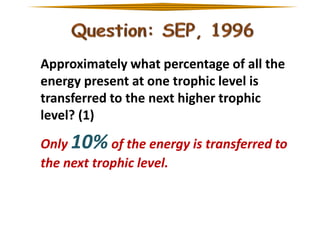
Approximately what percentage of all the
energy present at one trophic level is
transferred to the next higher trophic
level? (1)

Only 10% of the energy is transferred to
the next trophic level.
Why is energy not recycled in ecosystems?
(1)
Lost as heat to the surrounding
environment.
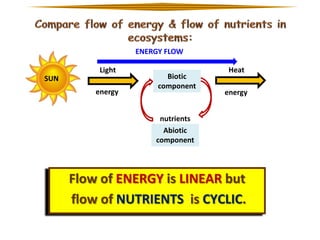
ENERGY FLOW
Light
SUN
energy

Biotic
component

Heat
energy

nutrients
Abiotic
component

Flow of ENERGY is LINEAR but
flow of NUTRIENTS is CYCLIC.
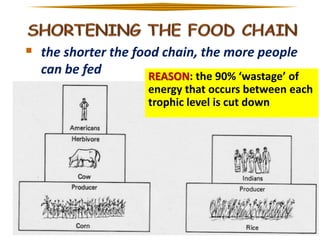
 the shorter the food chain, the more people
can be fed

REASON: the 90% ‘wastage’ of
energy that occurs between each
trophic level is cut down
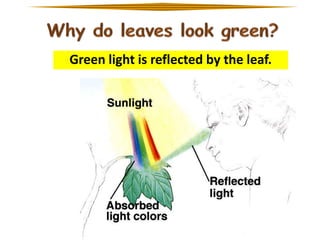
Green light is reflected by the leaf.
Only 1% of the light falling on a leaf is used in
photosynthesis. What happens to the rest?
30% evaporates water from plant
20% is reflected
from plant

40% warms up soil, air and
vegetation [transmitted]
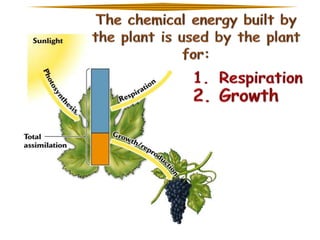
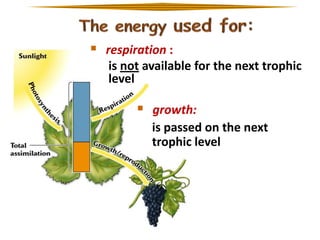
 respiration :
is not available for the next trophic
level

 growth:
is passed on the next
trophic level
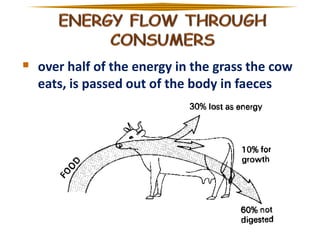
 over half of the energy in the grass the cow
eats, is passed out of the body in faeces
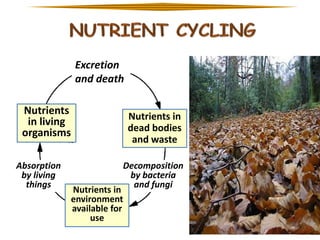
Excretion
and death
Nutrients
in living
organisms
Absorption
by living
things

Nutrients in
dead bodies
and waste
Decomposition
by bacteria
and fungi
Nutrients in
environment
available for
use
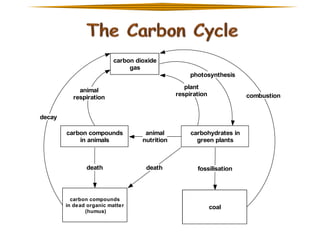
 all living things need carbon to make:
 carbohydrates
 fats
 proteins
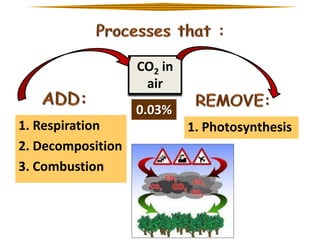
CO2 in
air
0.03%
1. Respiration
2. Decomposition
3. Combustion

1. Photosynthesis
carbon dioxide
gas
photosynthesis
plant
respiration

animal
respiration

combustion

decay
carbon compounds
in animals

animal
nutrition

carbohydrates in
green plants

death

death

fossilisation

carbon compounds
in dead organic matter
(humus)

coal
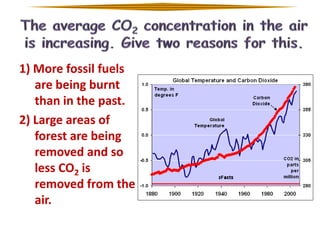
1) More fossil fuels
are being burnt
than in the past.
2) Large areas of
forest are being
removed and so
less CO2 is
removed from the
air.
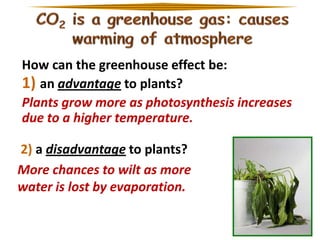
How can the greenhouse effect be:
1) an advantage to plants?
Plants grow more as photosynthesis increases
due to a higher temperature.
2) a disadvantage to plants?
More chances to wilt as more
water is lost by evaporation.
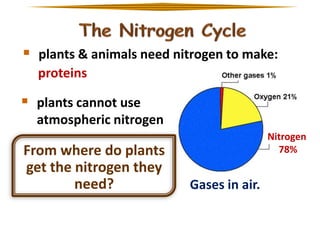
 plants & animals need nitrogen to make:
proteins

 plants cannot use
atmospheric nitrogen

From where do plants
get the nitrogen they
need?

Nitrogen
78%

Gases in air.
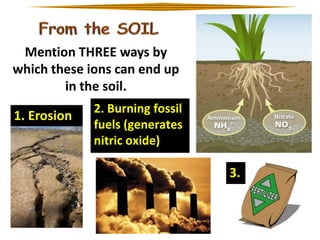
Mention THREE ways by
which these ions can end up
in the soil.
1. Erosion

2. Burning fossil
fuels (generates
nitric oxide)

3.
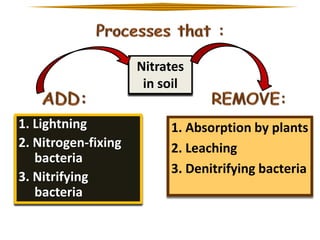
Nitrates
in soil
1. Lightning
2. Nitrogen-fixing
bacteria
3. Nitrifying
bacteria

1. Absorption by plants
2. Leaching
3. Denitrifying bacteria
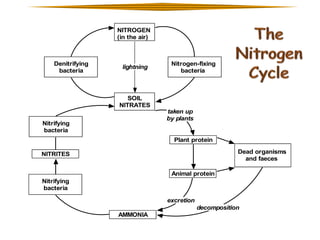
NITROGEN
(in the air)

Denitrifying
bacteria

lightning

Nitrogen-fixing
bacteria

SOIL
NITRATES
taken up
by plants

Nitrifying
bacteria

Plant protein
Dead organisms
and faeces

NITRITES
Animal protein
Nitrifying
bacteria
excretion

decomposition
AMMONIA
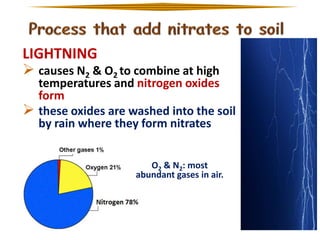
LIGHTNING
 causes N2 & O2 to combine at high

temperatures and nitrogen oxides
form
 these oxides are washed into the soil
by rain where they form nitrates
O2 & N2: most
abundant gases in air.
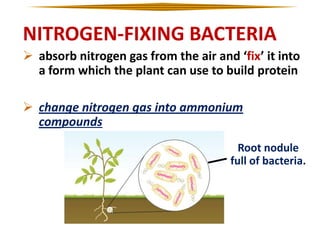
NITROGEN-FIXING BACTERIA
 absorb nitrogen gas from the air and ‘fix’ it into
a form which the plant can use to build protein
 change nitrogen gas into ammonium
compounds
Root nodule
full of bacteria.
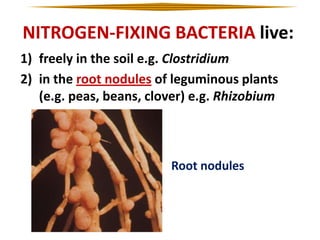
NITROGEN-FIXING BACTERIA live:
1) freely in the soil e.g. Clostridium
2) in the root nodules of leguminous plants
(e.g. peas, beans, clover) e.g. Rhizobium

Root nodules
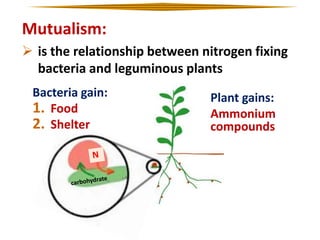
Mutualism:
 is the relationship between nitrogen fixing
bacteria and leguminous plants
Bacteria gain:
1. Food
2. Shelter

Plant gains:
Ammonium
compounds
SYMBIOSIS:
 is a relationship between two organisms

MUTUALISM:
 is a type of symbiosis
 is a close relationship between two different
organisms where both benefit from each other
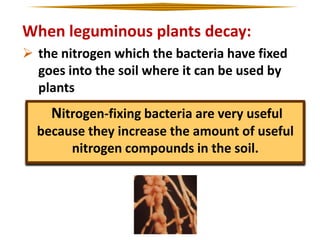
When leguminous plants decay:
 the nitrogen which the bacteria have fixed
goes into the soil where it can be used by
plants

Nitrogen-fixing bacteria are very useful
because they increase the amount of useful
nitrogen compounds in the soil.
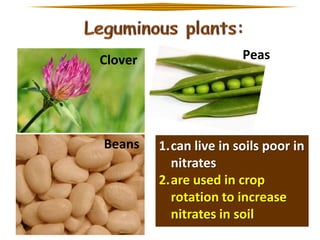
Clover

Beans

Peas

1.can live in soils poor in
nitrates
2.are used in crop
rotation to increase
nitrates in soil
NITRIFYING BACTERIA
 change ammonia into nitrites and then into
nitrates
 this is called nitrification
 ammonia is present in:
 dead remains
 animal waste
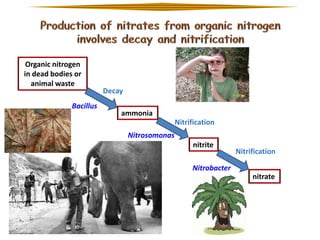
Organic nitrogen
in dead bodies or
animal waste

Bacillus

Decay
ammonia
Nitrification
Nitrosomonas
nitrite

Nitrification

Nitrobacter
nitrate
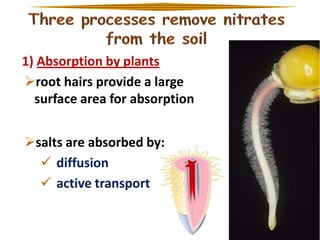
1) Absorption by plants
root hairs provide a large
surface area for absorption

salts are absorbed by:
 diffusion
 active transport
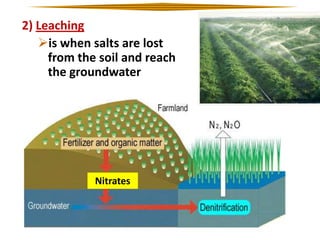
2) Leaching
is when salts are lost
from the soil and reach
the groundwater

Nitrates
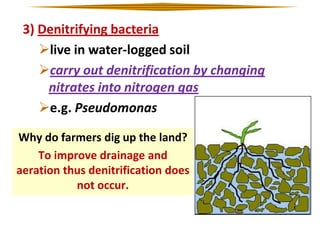
3) Denitrifying bacteria
live in water-logged soil
carry out denitrification by changing
nitrates into nitrogen gas
e.g. Pseudomonas
Why do farmers dig up the land?
To improve drainage and
aeration thus denitrification does
not occur.
Distinguish between nitrification and
denitrification. (5)
Nitrification is carried out under aerobic
conditions but denitrification under anaerobic
conditions.
In the process of nitrification, ammonia is
converted into nitrites and then into nitrates.
In denitrification, nitrates are converted into
nitrogen gas.
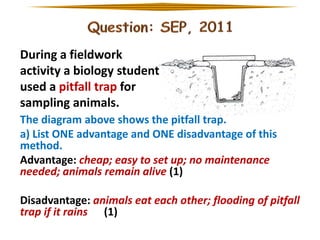
During a fieldwork
activity a biology student
used a pitfall trap for
sampling animals.
The diagram above shows the pitfall trap.
a) List ONE advantage and ONE disadvantage of this
method.
Advantage: cheap; easy to set up; no maintenance
needed; animals remain alive (1)

Disadvantage: animals eat each other; flooding of pitfall
trap if it rains (1)
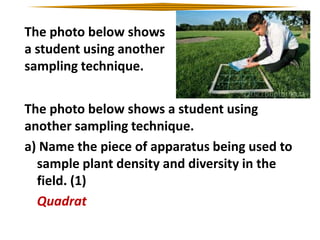
The photo below shows
a student using another
sampling technique.
The photo below shows a student using
another sampling technique.
a) Name the piece of apparatus being used to
sample plant density and diversity in the
field. (1)
Quadrat
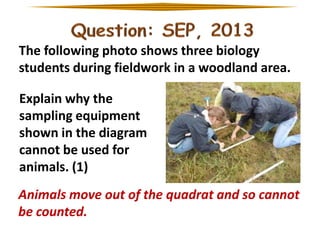
The following photo shows three biology
students during fieldwork in a woodland area.
Explain why the
sampling equipment
shown in the diagram
cannot be used for
animals. (1)

Animals move out of the quadrat and so cannot
be counted.
Ecology

Ecology

  • 1.
  • 2.
     organisms inrelation to their environment  this includes the relationship of organisms with:  each other  non-living components of their environment organisms
  • 3.
     Polar  Temperate Tropic Temperate Polar Tropic
  • 4.
     control eachother’s population size
  • 5.
    Biotic factor living organisms e.g.predators, competitors, parasites Abiotic factor non-living factors which influence organisms e.g. light, temperature, soil, rainfall
  • 6.
     is theparticular locality in an environment in which an organism lives SPACE FOOD WATER
  • 7.
    rock pools (limpets, barnacles,top shells) soil burrows (earthworms)
  • 8.
     is thegroup of individuals of the same species living in a particular area at the same time
  • 9.
     includes allthe populations of all the species within an ecosystem
  • 10.
     is anatural unit composed of living and nonliving components whose interactions result in a stable self-perpetuating system
  • 11.
     is acommunity of organisms in conjunction with the nonliving components of their environment (things like air, water and mineral soil), interacting as a system
  • 12.
    ponds an oak tree afield a rockpool the sea
  • 13.
  • 14.
    different species Camels, goatsand sheep compete for food.
  • 15.
    a) Distinguish betweenintraspecific and interspecific competition. (2) b) Explain why intraspecific competition is likely to be more intense than interspecific competition. (1) Members of a species use the same resources but different species use different resources.
  • 16.
    c. i) ListTWO resources that animals compete for. (2) space, food, water, mate
  • 17.
    ii) List TWOresources that plants compete for. (2) Space, light, water, ions in soil, carbon dioxide
  • 18.
    d) What isthe effect of competition on the growth of a population? (1) Reduces the growth rate of a population.
  • 19.
    Before 1859 therewere no wild rabbits in Australia but in 1859 some domestic rabbits escaped from their pen, when it was swept away by a flood. These rabbits ran wild and bred at such a rate that parts of Australia soon became overrun with them. The following graph shows how the population of rabbits increased with time.
  • 20.
    a. Describe andexplain the growth of the rabbit population at stages 1, 2 and 3. (12) STAGE 1: Slow increase in population. Few individuals able to reproduce. Rabbits need to acclimatise. STAGE 2: Rapid increase in population. Many individuals able to reproduce. Resources are abundant.
  • 21.
    a. Describe andexplain the growth of the rabbit population at stages 1, 2 and 3. (12) STAGE 3: Population stable. Resources become limited and can support a certain number of individuals.
  • 22.
    b. Discuss theeffect of the observed growth rate of rabbits on agricultural activity in Australia. (2) Rabbits fed upon crops and caused damage to agriculture. c. Suggest how the observed growth rate of rabbits affected the natural ecosystem in Australia. (2) Many wild plants were eaten leading to loss of plant species, more soil erosion as soil was no longer covered by vegetation.
  • 23.
    a) PRODUCERS –autotrophic plants b) CONSUMERS – heterotrophic organisms, mainly animals c) DECOMPOSERS – saprophytic bacteria & fungi – break down dead matter to return nutrients to the soil
  • 24.
    Distinguish between acommunity of plants and a population of plants. (2) Distinguish between producers and consumers. (4)
  • 25.
     is therole or job of an organism within the community
  • 27.
     the movementof food energy from one organism to the next Trophic level = feeding level 1st Trophic level 2nd Trophic level PRODUCER PRIMARY CONSUMER 3rd Trophic level SECONDARY CONSUMER 4th Trophic level TERTIARY CONSUMER Top carnivore
  • 28.
     Ecosystem: Field grass aphid leaves ladybird caterpillar sparrow Ecosystem: Oak tree oak tree insect larvae thrush  Ecosystem: Freshwater pool algae tadpole waterbeet le hawk
  • 29.
     are madeup of many food chains linked together  give a more complex picture of how animals feed  are more stable than food chains
  • 30.
    5 1. There are…… primary consumers. 2. The top carnivore owl is the ……… .
  • 31.
    3. Suppose allthe woodmice died from a poison, i) the acorn would (increase / decrease).
  • 32.
    3. Suppose allthe woodmice died from a poison, i) the acorn would (increase / decrease).
  • 33.
    3. Suppose allthe woodmice died from a poison, i) the acorn would (increase / decrease). ii) the weasel would (increase / decrease).
  • 34.
    3. Suppose allthe woodmice died from a poison, i) the acorn would (increase / decrease). ii) the weasel would (increase / decrease).
  • 35.
    4. Draw afood chain with 5 links from this food web. oak leaf greenfly ladybird shrew owl 5. In this food web, the shrew can be either secondary tertiary a ………………. or a ……………….. consumer.
  • 36.
    The following organismscan be found in the same habitat: weasel, rabbit, greenfly, green plant, caterpillar, small bird and ladybird. Construct a food web to include all the organisms found in the list above.
  • 37.
    weasel, rabbit, greenfly,green plant, caterpillar, small bird and ladybird weasel small bird Weasel eats small mammals & birds. rabbit ladybird greenfly green plant caterpillar
  • 39.
    a) Pyramid ofNumbers b) Pyramid of Biomass c) Pyramid of Energy
  • 40.
     shows thetotal number of individuals at each trophic level
  • 41.
     indicates theweight of all individuals at each trophic level  biomass is the weight of living material
  • 42.
    Pyramid of Numbers Pyramidof Biomass Ladybird Aphid Rosebush Rosebush Aphid Ladybird
  • 43.
    From the food webwrite a food chain including four trophic levels. (2) [Any food chain as long as 4 trophic levels are present]
  • 44.
    b) In thespace below draw a pyramid of numbers for the food chain you answered in ‘a’. (In your diagram label each trophic level). (3)
  • 45.
     shows thetransfer of energy from one trophic level to the next
  • 46.
  • 47.
    1. excretion 2. movingabout 3. keeping the body warm 4. egestion 5. respiration
  • 48.
    Give a reasonwhy the number of trophic levels seldom exceeds 5. (1) Great (90%) losses in energy at every trophic level.
  • 49.
    Approximately what percentageof all the energy present at one trophic level is transferred to the next higher trophic level? (1) Only 10% of the energy is transferred to the next trophic level.
  • 50.
    Why is energynot recycled in ecosystems? (1) Lost as heat to the surrounding environment.
  • 51.
  • 52.
     the shorterthe food chain, the more people can be fed REASON: the 90% ‘wastage’ of energy that occurs between each trophic level is cut down
  • 53.
    Green light isreflected by the leaf.
  • 54.
    Only 1% ofthe light falling on a leaf is used in photosynthesis. What happens to the rest? 30% evaporates water from plant 20% is reflected from plant 40% warms up soil, air and vegetation [transmitted]
  • 56.
     respiration : isnot available for the next trophic level  growth: is passed on the next trophic level
  • 57.
     over halfof the energy in the grass the cow eats, is passed out of the body in faeces
  • 58.
    Excretion and death Nutrients in living organisms Absorption byliving things Nutrients in dead bodies and waste Decomposition by bacteria and fungi Nutrients in environment available for use
  • 59.
     all livingthings need carbon to make:  carbohydrates  fats  proteins
  • 60.
    CO2 in air 0.03% 1. Respiration 2.Decomposition 3. Combustion 1. Photosynthesis
  • 61.
    carbon dioxide gas photosynthesis plant respiration animal respiration combustion decay carbon compounds inanimals animal nutrition carbohydrates in green plants death death fossilisation carbon compounds in dead organic matter (humus) coal
  • 62.
    1) More fossilfuels are being burnt than in the past. 2) Large areas of forest are being removed and so less CO2 is removed from the air.
  • 63.
    How can thegreenhouse effect be: 1) an advantage to plants? Plants grow more as photosynthesis increases due to a higher temperature. 2) a disadvantage to plants? More chances to wilt as more water is lost by evaporation.
  • 64.
     plants &animals need nitrogen to make: proteins  plants cannot use atmospheric nitrogen From where do plants get the nitrogen they need? Nitrogen 78% Gases in air.
  • 65.
    Mention THREE waysby which these ions can end up in the soil. 1. Erosion 2. Burning fossil fuels (generates nitric oxide) 3.
  • 66.
    Nitrates in soil 1. Lightning 2.Nitrogen-fixing bacteria 3. Nitrifying bacteria 1. Absorption by plants 2. Leaching 3. Denitrifying bacteria
  • 67.
    NITROGEN (in the air) Denitrifying bacteria lightning Nitrogen-fixing bacteria SOIL NITRATES takenup by plants Nitrifying bacteria Plant protein Dead organisms and faeces NITRITES Animal protein Nitrifying bacteria excretion decomposition AMMONIA
  • 68.
    LIGHTNING  causes N2& O2 to combine at high temperatures and nitrogen oxides form  these oxides are washed into the soil by rain where they form nitrates O2 & N2: most abundant gases in air.
  • 69.
    NITROGEN-FIXING BACTERIA  absorbnitrogen gas from the air and ‘fix’ it into a form which the plant can use to build protein  change nitrogen gas into ammonium compounds Root nodule full of bacteria.
  • 70.
    NITROGEN-FIXING BACTERIA live: 1)freely in the soil e.g. Clostridium 2) in the root nodules of leguminous plants (e.g. peas, beans, clover) e.g. Rhizobium Root nodules
  • 71.
    Mutualism:  is therelationship between nitrogen fixing bacteria and leguminous plants Bacteria gain: 1. Food 2. Shelter Plant gains: Ammonium compounds
  • 72.
    SYMBIOSIS:  is arelationship between two organisms MUTUALISM:  is a type of symbiosis  is a close relationship between two different organisms where both benefit from each other
  • 73.
    When leguminous plantsdecay:  the nitrogen which the bacteria have fixed goes into the soil where it can be used by plants Nitrogen-fixing bacteria are very useful because they increase the amount of useful nitrogen compounds in the soil.
  • 74.
    Clover Beans Peas 1.can live insoils poor in nitrates 2.are used in crop rotation to increase nitrates in soil
  • 75.
    NITRIFYING BACTERIA  changeammonia into nitrites and then into nitrates  this is called nitrification  ammonia is present in:  dead remains  animal waste
  • 76.
    Organic nitrogen in deadbodies or animal waste Bacillus Decay ammonia Nitrification Nitrosomonas nitrite Nitrification Nitrobacter nitrate
  • 77.
    1) Absorption byplants root hairs provide a large surface area for absorption salts are absorbed by:  diffusion  active transport
  • 78.
    2) Leaching is whensalts are lost from the soil and reach the groundwater Nitrates
  • 79.
    3) Denitrifying bacteria livein water-logged soil carry out denitrification by changing nitrates into nitrogen gas e.g. Pseudomonas Why do farmers dig up the land? To improve drainage and aeration thus denitrification does not occur.
  • 80.
    Distinguish between nitrificationand denitrification. (5) Nitrification is carried out under aerobic conditions but denitrification under anaerobic conditions. In the process of nitrification, ammonia is converted into nitrites and then into nitrates. In denitrification, nitrates are converted into nitrogen gas.
  • 82.
    During a fieldwork activitya biology student used a pitfall trap for sampling animals. The diagram above shows the pitfall trap. a) List ONE advantage and ONE disadvantage of this method. Advantage: cheap; easy to set up; no maintenance needed; animals remain alive (1) Disadvantage: animals eat each other; flooding of pitfall trap if it rains (1)
  • 83.
    The photo belowshows a student using another sampling technique. The photo below shows a student using another sampling technique. a) Name the piece of apparatus being used to sample plant density and diversity in the field. (1) Quadrat
  • 84.
    The following photoshows three biology students during fieldwork in a woodland area. Explain why the sampling equipment shown in the diagram cannot be used for animals. (1) Animals move out of the quadrat and so cannot be counted.