Downloaded 56 times







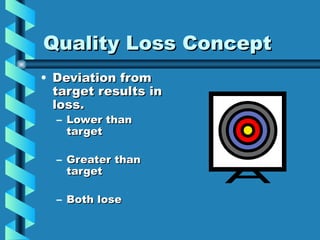

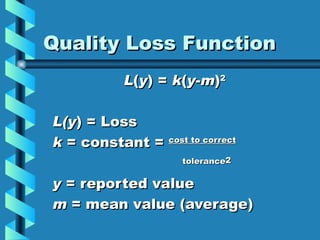

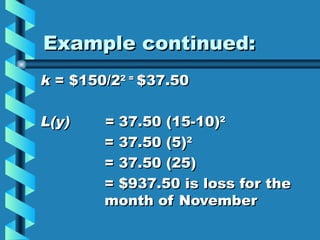

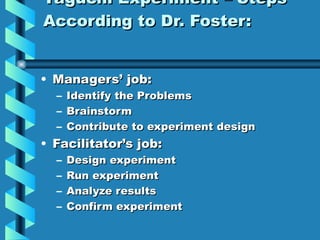



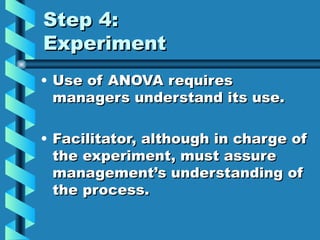





The document provides an overview of the Taguchi Method, which was developed by Genichi Taguchi in the 1950s to help improve quality in manufacturing. Some key points: - Taguchi focused on designing products and processes to be robust to sources of variation, eliminating non-random errors upfront to reduce quality losses. - Quality is defined as how well a product meets customer needs. Variation from the optimal target results in losses that can be quantified using a quality loss function. - The Taguchi Method uses designed experiments to determine which factors most impact quality and find ways to control variation. A 6-step process is outlined for identifying problems, designing and running the experiment, and validating results.


![Ch03 evans mcq_aise[1]](https://cdn.slidesharecdn.com/ss_thumbnails/ch03evansmcqaise1-160126040247-thumbnail.jpg?width=640&height=640&fit=bounds)


