This document discusses non-conformance reporting (NCR) as part of an integrated management system. It defines an NCR as a report issued when a product, process, or procedure does not comply with set standards. NCRs are used to record audit findings that require addressing, such as work that does not meet specifications, uses unapproved methods, or fails inspection and testing plans. The document stresses the importance of NCRs through an example about how small issues can snowball and impact larger outcomes, and outlines ISO requirements for corrective and preventive actions in response to non-conformities.
In this document
Powered by AI
Introduction to Non-Conformance Reporting (NCR), its definition, significance, and conditions under which it is issued.
Emphasizes the critical importance of NCR in quality management through storytelling about the consequences of neglecting small errors.
Introduction to the 5 Whys technique as a method for deep analysis into the root causes of issues leading to non-conformance.
Describes different types of non-conformity associated with project activities including material and service deviations.
Outlines requirements for corrective actions under BS EN ISO 9001:2008 to eliminate causes of non-conformities.
Discusses the complexities of root cause analysis, expectations for control, and learning from events.
Highlights that closure for NCRs is contingent upon adequate evidence and actions to prevent recurrence.
Thanks the audience, concluding the presentation on non-conformance reporting.
WHAT IS ANNCR ?
• A report issued when a product, process or
procedure does not comply with the set
standards for a product, process or
procedure under inspection.
• An NCR is any significant deficiency.
• A means of tracking actions.
• A tool to put right things that are going
wrong.
• A means of stopping repeated errors.
3.
WHAT IS ANNCR ?
• NCR’s are used to record findings from
internal and external audits that
require addressing.
• Work that was not built as indicated in
approved drawings
• Work that fails to meet specified
tolerances as established in project
specifications.
4.
WHAT IS ANNCR ?
• Work that is being performed using non-
approved methods or standards
• When the testing and inspection plan is not
followed as agreed
• When testing results demonstrate that the
product does not meet established and
approved standards
• When a material is used and has not been
approved as a substitute (equal or similar)
5.
When design isnot accurate and
does not represents actual field
conditions
When the approved procedure was
not followed and quality defects
have been identify by the project
team.
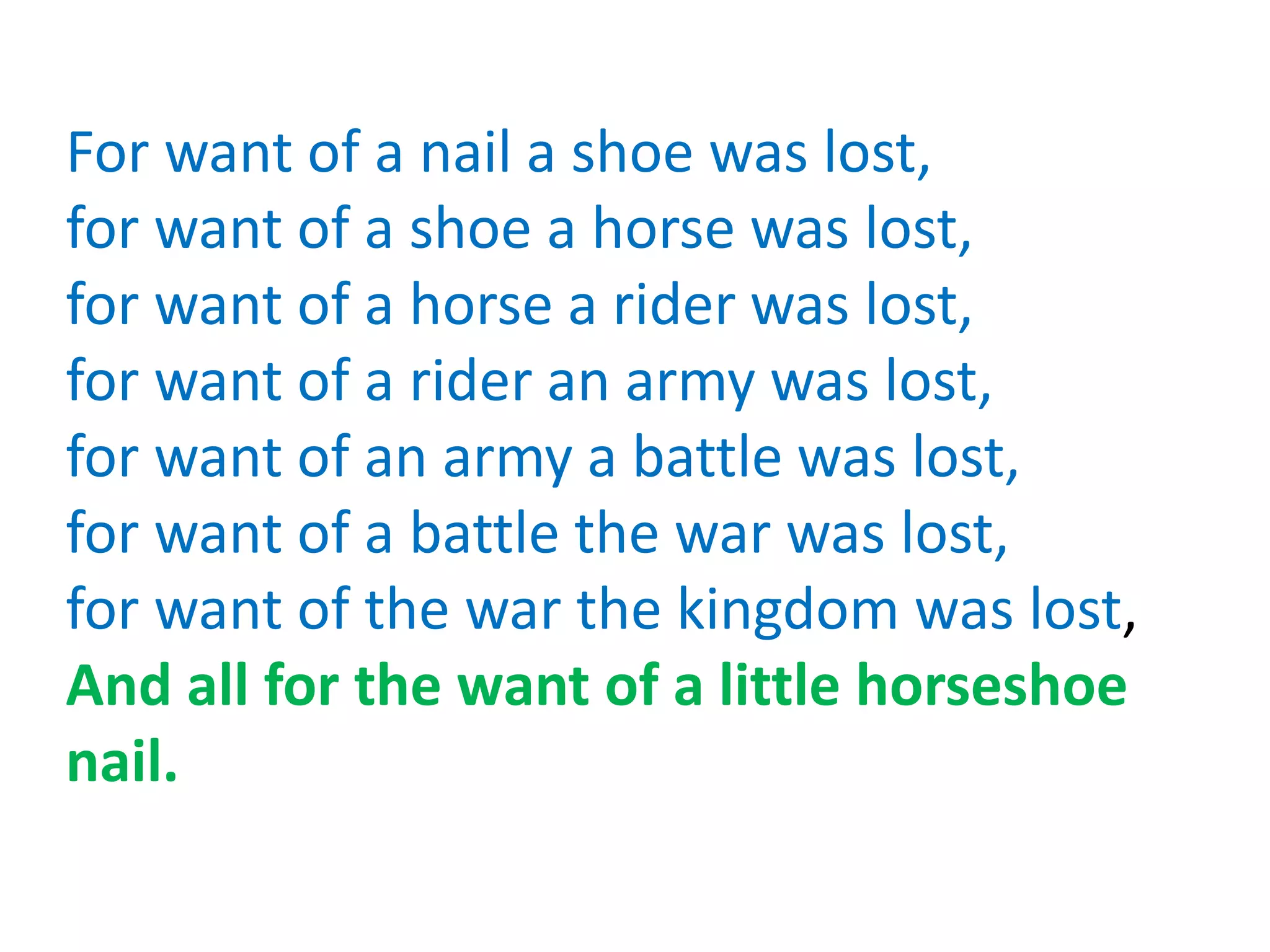
For want ofa nail a shoe was lost,
for want of a shoe a horse was lost,
for want of a horse a rider was lost,
for want of a rider an army was lost,
for want of an army a battle was lost,
for want of a battle the war was lost,
for want of the war the kingdom was lost,
And all for the want of a little horseshoe
nail.
Why was theKingdom lost?
Because the war was lost.
Why was the war lost?
Because the battle was lost.
Why was the battle lost?
Because the army was lost.
Why was the army lost?
Because the rider was lost.
10.
Why was therider lost?
Because the horse was lost.
Why was the horse lost?
Because the shoe was lost.
Why was the shoe lost?
Because the nail was lost
Why was the nail of the shoe
lost?
.............................?
11.
PCD-QSC-SOP-05
DIFFERENT TYPES OFNON CONFORMITY
IDENTIFIED IN CPD ACTIVITIES
• NON CONFORIMITY RELATED TO PROJECT
PROCURED MATERIAL.
• NON CONFORMITY RELATED TO SERVICE
CONTRACT DEVIATIONS.
• NON CONFORMITY RELATED TO END USER
(CUSTOMER)COMPLAINTS.
14.
BS EN ISO9001:2008
8.5.2 Corrective action
The organization shall take action to eliminate the causes of
nonconformities in order to prevent recurrence.
Corrective actions shall be appropriate to the effects of the
nonconformities encountered.
A documented procedure shall be established to define
requirements for
a) reviewing nonconformities (including customer complaints),
b) determining the causes of nonconformities,
c) evaluating the need for action to ensure that nonconformities do
not recur,
d) determining and implementing action needed,
e) records of the results of action taken , and
f) reviewing the effectiveness of the corrective action taken.
15.
BS EN ISO9001:2008
8.5.3 Preventive action
The organization shall determine action to eliminate the causes of
potential nonconformities in order to prevent their occurrence.
Preventive actions shall be appropriate to the effects of the
potential problems.
A documented procedure shall be established to define
requirements for
a) determining potential nonconformities and their causes,
b) evaluating the need for action to prevent occurrence of
nonconformities,
c) determining and implementing action needed,
d) records of results of action taken , and
e) reviewing the effectiveness of the preventive action taken.
16.
Root Cause Analysis
Difficultiesin tracking down the root causes
Where do you draw the line?
At the Joint Venture?
At the Parent Company?
At the Client?
At the Regulator?
At the Big Bang – creation of the universe?
What are the stop rules?
There are no natural break-points, only artificially imposed ones.
The goal is to establish what happened and how to stop it
happening again.
The logical stop point would seem to be where managers might
reasonably be expected to exercise control
A sad story will help to illustrate this point
17.
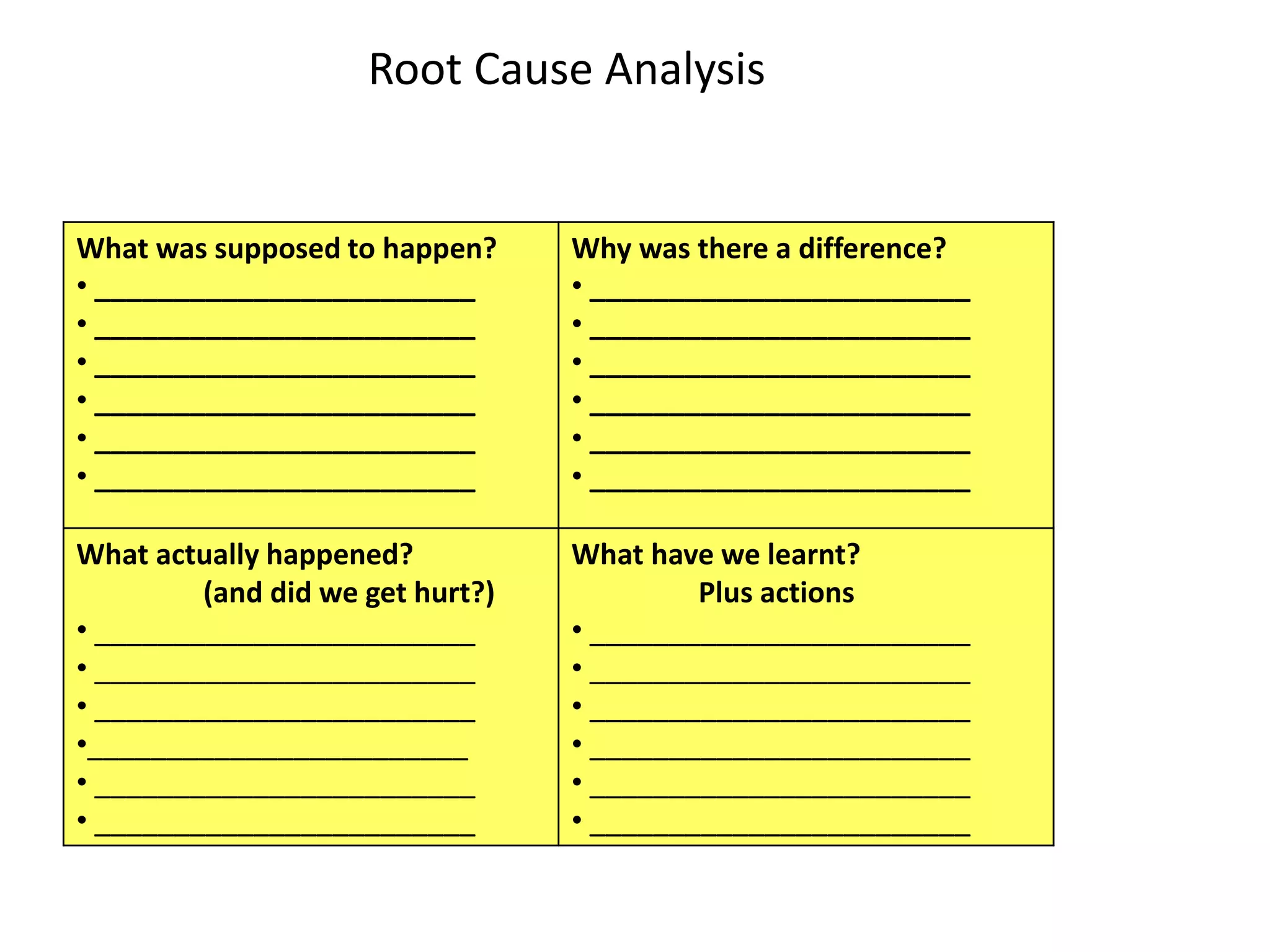
What was supposedto happen?
• ________________________
• ________________________
• ________________________
• ________________________
• ________________________
• ________________________
Why was there a difference?
• ________________________
• ________________________
• ________________________
• ________________________
• ________________________
• ________________________
What actually happened?
(and did we get hurt?)
• ________________________
• ________________________
• ________________________
•________________________
• ________________________
• ________________________
What have we learnt?
Plus actions
• ________________________
• ________________________
• ________________________
• ________________________
• ________________________
• ________________________
Root Cause Analysis
18.
I will notclose out the NCR if the
evidence is not provided or the
action to prevent recurrence is
not adequate.
Closure Approval:
Closure:
The Closure must be completed
in full With all the evidence.