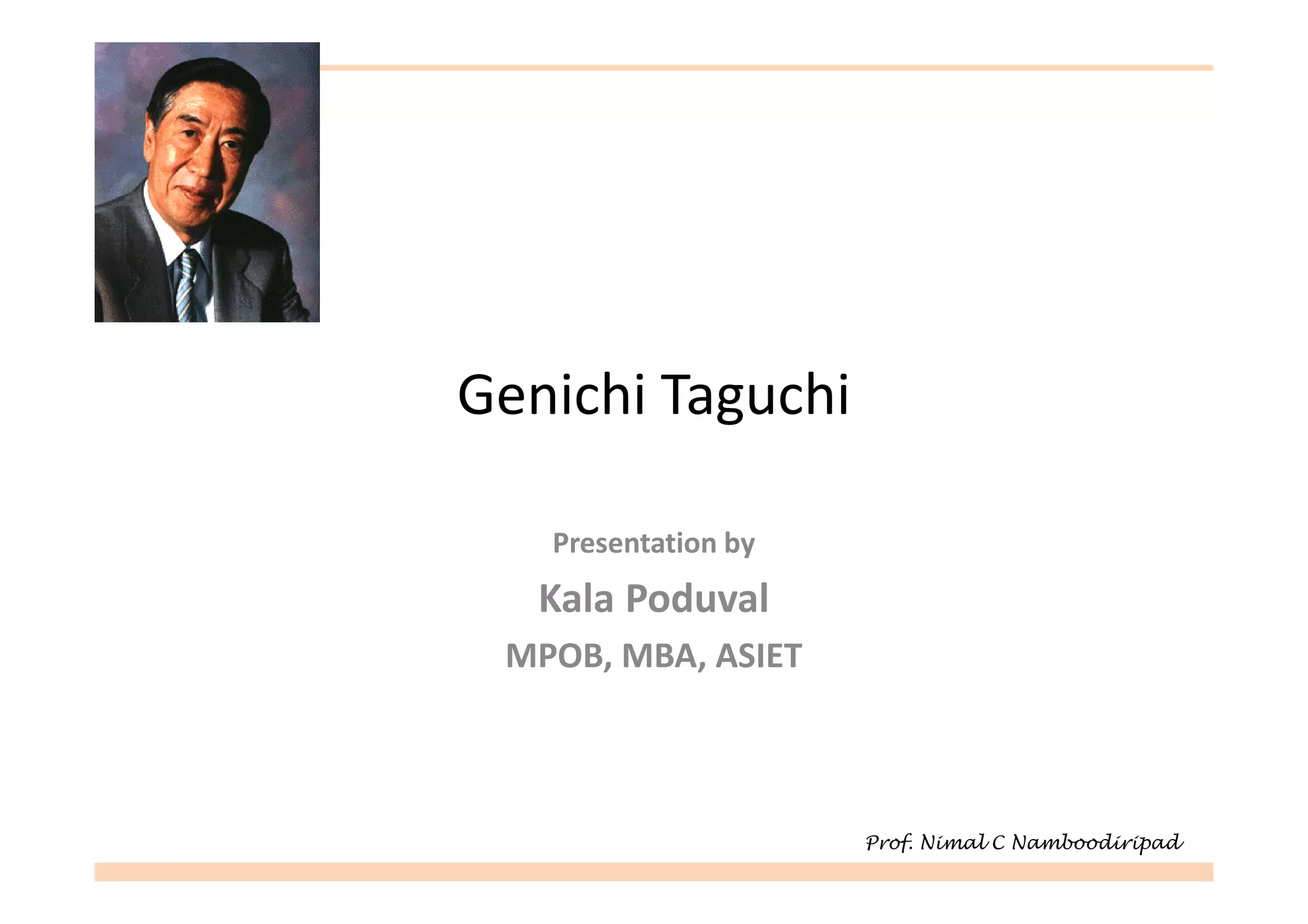
Genichi Taguchi

   Presentation by
   Kala Poduval
 MPOB, MBA, ASIET


                     Prof. Nimal C Namboodiripad
Genichi Taguchi Profile
• Was born January 1, 1924, in Tokamachi, in Japan’s Niigata
  prefecture
• An Engineer and Statistician, was known for his contribution
  to Japanese Quality Movement
• After WWII Japan had limited resources – he revolutionised
  manufacturing processes through cost savings
• Although his concepts influenced fields beyond product
  design and manufacturing, such as sales process engineering
  his unique methodology for applying statistics to implement
  quality in manufactured goods has not been readily accepted
  in the west
Genichi Taguchi Profile
• Initially studied textile engineering at Kiryu Technical College
  with the intention of entering the family kimono business.
• During World War II, in 1942, he was drafted into the
  Astronomical Department of the Navigation Institute of the
  Imperial Japanese Navy.
• After the war, in 1948 he joined the Ministry of Public Health
  and Welfare, where he came under the influence of eminent
  statistician Matosaburo Masuyama, who kindled his interest
  in design of experiments.
• He also worked at the Institute of Statistical Mathematics and
  supported experimental work on production of Pencilin at
  Morinaga Pharmaceuticals, a Morinaga Seika company.
Genichi Taguchi Profile
• In 1950, he joined the Electrical Communications Laboratory
  (ECL) of the Nippon Telegraph and Telephone Corporation.
• Taguchi spent his twelve years in ECL enhancing quality and
  reliability of cross bar and telephone switching systems.
• He was a widely accepted consultant in Japanese industry,
  with Toyota being an early adopter of his ideas.
• In middle 1950s was visiting professor at the Indian Statistical
  Institute, where he worked with CR Rao, Ronald Fisher and
  Walter Shewhart.
• While working at the SQC Unit of ISI, he was introduced to the
  orthogonal arrays of CR Rao – which enabled him to develop
  the foundation blocks of the Taguchi methods.
Genichi Taguchi Profile
• On completing his doctorate at Kyushu University in 1962, he
  left ECL, though he maintained a consulting relationship.
• In the same year he visited Princeton University with the help
  of John Tukey, who arranged a spell at Bell Labs, his old ECL
  rivals where his ideas made little impact.
• In 1964 he became professor of engineering at Aoyama
  Gakuin University, Tokyo.
• In 1966 he began a collaboration with Yuin Wu, who later
  emigrated to the US and, in 1980, invited Taguchi to lecture.
• During the 1980 visit Taguchi himself financed a return to Bell
  Labs and began a collaboration with Madhav Phadke resulting
  in a growing enthusiasm for his ideas.
Genichi Taguchi Profile
• His methodologies were accepted not only in Bell Labs but
  also companies like Ford Motor Company, Boeing, Xerox and
  ITT.
• After 1982, Genichi Taguchi became an advisor to the
  Japanese Standards Institute and executive director of the
  American Supplier Institute, an international consulting
  organisation.
Genichi Taguchi - Contributions
• Taguchi has made very influential contributions to industrial
  statistics. Some of them are:
    – Loss Function – he devised an equation to help managers find how
      much revenue they are losing because of variability in production
      process and resultant poor quality – which in turn leads to lost
      customers as well as financial loss to society
    – The philosophy of off-line quality control, which he broke down down
      to three stages – system design, parameter design and tolerance
      design
    – Robustness - designing products and processes so that they are
      insensitive to parameters (‘noises’) outside the design engineer's
      control
   • Innovations in the statistical design of experiments, notably the use
      Orthogonal Arrays and Linear Graphs to isolate the outside noise
      factors that affect manufacturing in a cost effective way
Genichi Taguchi - Honours
• Honorary member of the Japanese Society of Quality Control
  and of the American Society for Quality
• Indigo Ribbon from the Emperor of Japan
• Walter A Shewhart Medal of the American Society for Quality
  (1995)
• Honoured as Quality Guru by British Department of Trade and
  Industry (1990)
• Willard F. Rockwell Medal of the International Technology
  Institute
Thank You


Source: http://en.wikipedia.org/wiki/Genichi_Taguchi

Genichi Taguchi

  • 1.
    Genichi Taguchi Presentation by Kala Poduval MPOB, MBA, ASIET Prof. Nimal C Namboodiripad
  • 2.
    Genichi Taguchi Profile •Was born January 1, 1924, in Tokamachi, in Japan’s Niigata prefecture • An Engineer and Statistician, was known for his contribution to Japanese Quality Movement • After WWII Japan had limited resources – he revolutionised manufacturing processes through cost savings • Although his concepts influenced fields beyond product design and manufacturing, such as sales process engineering his unique methodology for applying statistics to implement quality in manufactured goods has not been readily accepted in the west
  • 3.
    Genichi Taguchi Profile •Initially studied textile engineering at Kiryu Technical College with the intention of entering the family kimono business. • During World War II, in 1942, he was drafted into the Astronomical Department of the Navigation Institute of the Imperial Japanese Navy. • After the war, in 1948 he joined the Ministry of Public Health and Welfare, where he came under the influence of eminent statistician Matosaburo Masuyama, who kindled his interest in design of experiments. • He also worked at the Institute of Statistical Mathematics and supported experimental work on production of Pencilin at Morinaga Pharmaceuticals, a Morinaga Seika company.
  • 4.
    Genichi Taguchi Profile •In 1950, he joined the Electrical Communications Laboratory (ECL) of the Nippon Telegraph and Telephone Corporation. • Taguchi spent his twelve years in ECL enhancing quality and reliability of cross bar and telephone switching systems. • He was a widely accepted consultant in Japanese industry, with Toyota being an early adopter of his ideas. • In middle 1950s was visiting professor at the Indian Statistical Institute, where he worked with CR Rao, Ronald Fisher and Walter Shewhart. • While working at the SQC Unit of ISI, he was introduced to the orthogonal arrays of CR Rao – which enabled him to develop the foundation blocks of the Taguchi methods.
  • 5.
    Genichi Taguchi Profile •On completing his doctorate at Kyushu University in 1962, he left ECL, though he maintained a consulting relationship. • In the same year he visited Princeton University with the help of John Tukey, who arranged a spell at Bell Labs, his old ECL rivals where his ideas made little impact. • In 1964 he became professor of engineering at Aoyama Gakuin University, Tokyo. • In 1966 he began a collaboration with Yuin Wu, who later emigrated to the US and, in 1980, invited Taguchi to lecture. • During the 1980 visit Taguchi himself financed a return to Bell Labs and began a collaboration with Madhav Phadke resulting in a growing enthusiasm for his ideas.
  • 6.
    Genichi Taguchi Profile •His methodologies were accepted not only in Bell Labs but also companies like Ford Motor Company, Boeing, Xerox and ITT. • After 1982, Genichi Taguchi became an advisor to the Japanese Standards Institute and executive director of the American Supplier Institute, an international consulting organisation.
  • 7.
    Genichi Taguchi -Contributions • Taguchi has made very influential contributions to industrial statistics. Some of them are: – Loss Function – he devised an equation to help managers find how much revenue they are losing because of variability in production process and resultant poor quality – which in turn leads to lost customers as well as financial loss to society – The philosophy of off-line quality control, which he broke down down to three stages – system design, parameter design and tolerance design – Robustness - designing products and processes so that they are insensitive to parameters (‘noises’) outside the design engineer's control • Innovations in the statistical design of experiments, notably the use Orthogonal Arrays and Linear Graphs to isolate the outside noise factors that affect manufacturing in a cost effective way
  • 8.
    Genichi Taguchi -Honours • Honorary member of the Japanese Society of Quality Control and of the American Society for Quality • Indigo Ribbon from the Emperor of Japan • Walter A Shewhart Medal of the American Society for Quality (1995) • Honoured as Quality Guru by British Department of Trade and Industry (1990) • Willard F. Rockwell Medal of the International Technology Institute
  • 9.