TAGUCHI’S QUALITY ENGINEERING &
ANALYSIS
Presentation Given By
Vishal Sachdeva
3611758
Submitted To
Er.Rahul Singla
A.P DME
BIBLIOGRAPHY
TAGUCHI’SLOSSFUNCTION
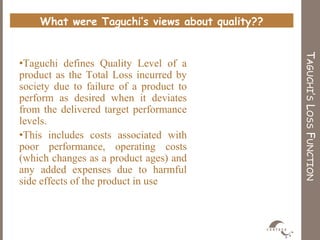
What were Taguchi’s views about quality??
•Taguchi defines Quality Level of a
product as the Total Loss incurred by
society due to failure of a product to
perform as desired when it deviates
from the delivered target performance
levels.
•This includes costs associated with
poor performance, operating costs
(which changes as a product ages) and
any added expenses due to harmful
side effects of the product in use
EXPLORINGTHETAGUCHIMETHOD
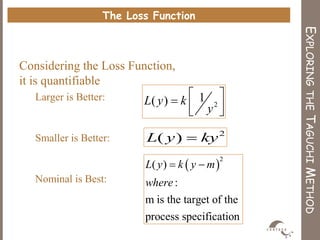
The Loss Function
Considering the Loss Function,
it is quantifiable
Larger is Better:
Smaller is Better:
Nominal is Best:
2
1( )L y k
y
    
2
( )L y ky
 
2
( )
:
m is the target of the
process specification
L y k y m
where
 
0
2
0
0
0
is cost of repair or replace
a product and must include
loss due to unavailability
during repair
is the functional limit on
y of a product where it would
fail to perform its function
half the
A
k
A



time
THECOSTOFLOSS
Considering The Cost Of Loss (K)
k in the L(y) equation is found from:
LOSSFUNCTIONEXAMPLE
Nominal Is Best
We can define a processes average loss as:
s is process (product) Standard Deviation
y(with bar) is process (product) mean
 
2
2
L k s y m   
  
EXAMPLECONT.
•A0 is $2 (a very low number of this type!) found by
estimating that the loss is 10% of the $20 product cost
when a part is exactly 8.55 or 8.45 units
•Process specification is: 8.5+.05 units
•Historically: ybar = 8.492 and s = 0.016
EXAMPLECONT.
•Average Loss:
•If we make 250,000 units a year
•Annual Loss is $64,000
     
2 2
2
2 0.016 8.492 8.500
.05
800 .00032 $0.256
L
L
   
 
  
FIXINGIT
Shift the Mean to
nominal
Reduce variation
(s = 0.01)
Fix Both!
 
22
800 .016 0 $0.2048
Annual Loss is $51200 about 20% reduction
L    
 
 
22
800 .010 .008 $0.1312
Annual Loss is $32800 about 50% reduction
L    
 
 
22
800 .010 0 $0.08
Annual Loss is $20000 about 66% reduction
L    
 
TAGUCHIMETHODS
Benefits To Companies
•Help companies to perform the Quality Fix!
Quality problems are due to Noises in the product or
process system
Noise is any undesirable effect that increases variability
•Conduct extensive Problem Analyses
•Employ Inter-disciplinary Teams
•Perform Designed Experimental Analyses
•Evaluate Experiments using ANOVA and Signal-to
noise techniques.
TAGUCHIAPPROACH
Defining The Taguchi Approach
•The Point Then Is To Produce Processes
Or Products The Are ROBUST AGAINST
NOISES
• Don’t spend the money to eliminate all noise,
build designs (product and process) that can
perform as desired – low variability – in the
presence of noise!
Here:
ROBUSTNESS = HIGH QUALITY
TAGUCHIAPPROACH
Defining The Taguchi Approach
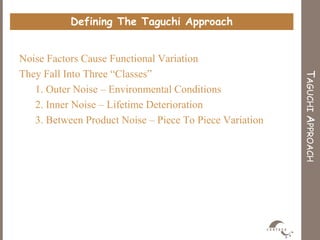
Noise Factors Cause Functional Variation
They Fall Into Three “Classes”
1. Outer Noise – Environmental Conditions
2. Inner Noise – Lifetime Deterioration
3. Between Product Noise – Piece To Piece Variation
STEPBYSTEPTAGUCHIMETHOD
TAGUCHIAPPROACH
Defining the Taguchi Approach
•TO RELIABLY MEET OUR DESIGN GOALS
MEANS: DESIGNING QUALITY IN!
•We find that Taguchi considered THREE
LEVELS OF DESIGN:
level 1: SYSTEM DESIGN
level 2: PARAMETER DESIGN
level 3: TOLERANCE DESIGN
TAGUCHIAPPROACH
SYSTEM DESIGN
•All About Innovation – New Ideas,
Techniques, Philosophies
•Application Of Science And
Engineering Knowledge
•Includes Selection Of:
Materials
Processes
Tentative Parameter Values
TAGUCHIAPPROACH
Parameter Design
•Tests For Levels Of Parameter Values
•Selects "Best Levels" For Operating Parameters
to be Least Sensitive to Noises
•Develops Processes Or Products That Are
Robust
•A Key Step To Increasing Quality Without
Increased Cost
TAGUCHIAPPROACH
Tolerance Design
•A "Last Resort" Improvement Step
•Identifies Parameters Having the greatest Influence
On Output Variation
•Tightens Tolerances On These Parameters
•Typically Means Increases In Cost
OVERALLCONCLUSION
Taguchi methods summary
•Taguchi methods (TM) are product or process improvement
techniques that use DOE methods for improvements
•A set of cookbook designs are available – and they can be
modified to build a rich set of studies (beyond what we have
seen in MP labs!)
•TM requires a commitment to complete studies and the
discipline to continue in the face of setbacks (as do all quality
improvement methods!)
Thank You

Taguchi’s quality engineering & analysis

  • 1.
    TAGUCHI’S QUALITY ENGINEERING& ANALYSIS Presentation Given By Vishal Sachdeva 3611758 Submitted To Er.Rahul Singla A.P DME
  • 2.
  • 3.
    TAGUCHI’SLOSSFUNCTION What were Taguchi’sviews about quality?? •Taguchi defines Quality Level of a product as the Total Loss incurred by society due to failure of a product to perform as desired when it deviates from the delivered target performance levels. •This includes costs associated with poor performance, operating costs (which changes as a product ages) and any added expenses due to harmful side effects of the product in use
  • 4.
    EXPLORINGTHETAGUCHIMETHOD The Loss Function Consideringthe Loss Function, it is quantifiable Larger is Better: Smaller is Better: Nominal is Best: 2 1( )L y k y      2 ( )L y ky   2 ( ) : m is the target of the process specification L y k y m where  
  • 5.
    0 2 0 0 0 is cost ofrepair or replace a product and must include loss due to unavailability during repair is the functional limit on y of a product where it would fail to perform its function half the A k A    time THECOSTOFLOSS Considering The Cost Of Loss (K) k in the L(y) equation is found from:
  • 6.
    LOSSFUNCTIONEXAMPLE Nominal Is Best Wecan define a processes average loss as: s is process (product) Standard Deviation y(with bar) is process (product) mean   2 2 L k s y m      
  • 7.
    EXAMPLECONT. •A0 is $2(a very low number of this type!) found by estimating that the loss is 10% of the $20 product cost when a part is exactly 8.55 or 8.45 units •Process specification is: 8.5+.05 units •Historically: ybar = 8.492 and s = 0.016
  • 8.
    EXAMPLECONT. •Average Loss: •If wemake 250,000 units a year •Annual Loss is $64,000       2 2 2 2 0.016 8.492 8.500 .05 800 .00032 $0.256 L L         
  • 9.
    FIXINGIT Shift the Meanto nominal Reduce variation (s = 0.01) Fix Both!   22 800 .016 0 $0.2048 Annual Loss is $51200 about 20% reduction L         22 800 .010 .008 $0.1312 Annual Loss is $32800 about 50% reduction L         22 800 .010 0 $0.08 Annual Loss is $20000 about 66% reduction L      
  • 10.
    TAGUCHIMETHODS Benefits To Companies •Helpcompanies to perform the Quality Fix! Quality problems are due to Noises in the product or process system Noise is any undesirable effect that increases variability •Conduct extensive Problem Analyses •Employ Inter-disciplinary Teams •Perform Designed Experimental Analyses •Evaluate Experiments using ANOVA and Signal-to noise techniques.
  • 11.
    TAGUCHIAPPROACH Defining The TaguchiApproach •The Point Then Is To Produce Processes Or Products The Are ROBUST AGAINST NOISES • Don’t spend the money to eliminate all noise, build designs (product and process) that can perform as desired – low variability – in the presence of noise! Here: ROBUSTNESS = HIGH QUALITY
  • 12.
    TAGUCHIAPPROACH Defining The TaguchiApproach Noise Factors Cause Functional Variation They Fall Into Three “Classes” 1. Outer Noise – Environmental Conditions 2. Inner Noise – Lifetime Deterioration 3. Between Product Noise – Piece To Piece Variation
  • 13.
  • 14.
    TAGUCHIAPPROACH Defining the TaguchiApproach •TO RELIABLY MEET OUR DESIGN GOALS MEANS: DESIGNING QUALITY IN! •We find that Taguchi considered THREE LEVELS OF DESIGN: level 1: SYSTEM DESIGN level 2: PARAMETER DESIGN level 3: TOLERANCE DESIGN
  • 16.
    TAGUCHIAPPROACH SYSTEM DESIGN •All AboutInnovation – New Ideas, Techniques, Philosophies •Application Of Science And Engineering Knowledge •Includes Selection Of: Materials Processes Tentative Parameter Values
  • 18.
    TAGUCHIAPPROACH Parameter Design •Tests ForLevels Of Parameter Values •Selects "Best Levels" For Operating Parameters to be Least Sensitive to Noises •Develops Processes Or Products That Are Robust •A Key Step To Increasing Quality Without Increased Cost
  • 20.
    TAGUCHIAPPROACH Tolerance Design •A "LastResort" Improvement Step •Identifies Parameters Having the greatest Influence On Output Variation •Tightens Tolerances On These Parameters •Typically Means Increases In Cost
  • 21.
    OVERALLCONCLUSION Taguchi methods summary •Taguchimethods (TM) are product or process improvement techniques that use DOE methods for improvements •A set of cookbook designs are available – and they can be modified to build a rich set of studies (beyond what we have seen in MP labs!) •TM requires a commitment to complete studies and the discipline to continue in the face of setbacks (as do all quality improvement methods!)
  • 22.