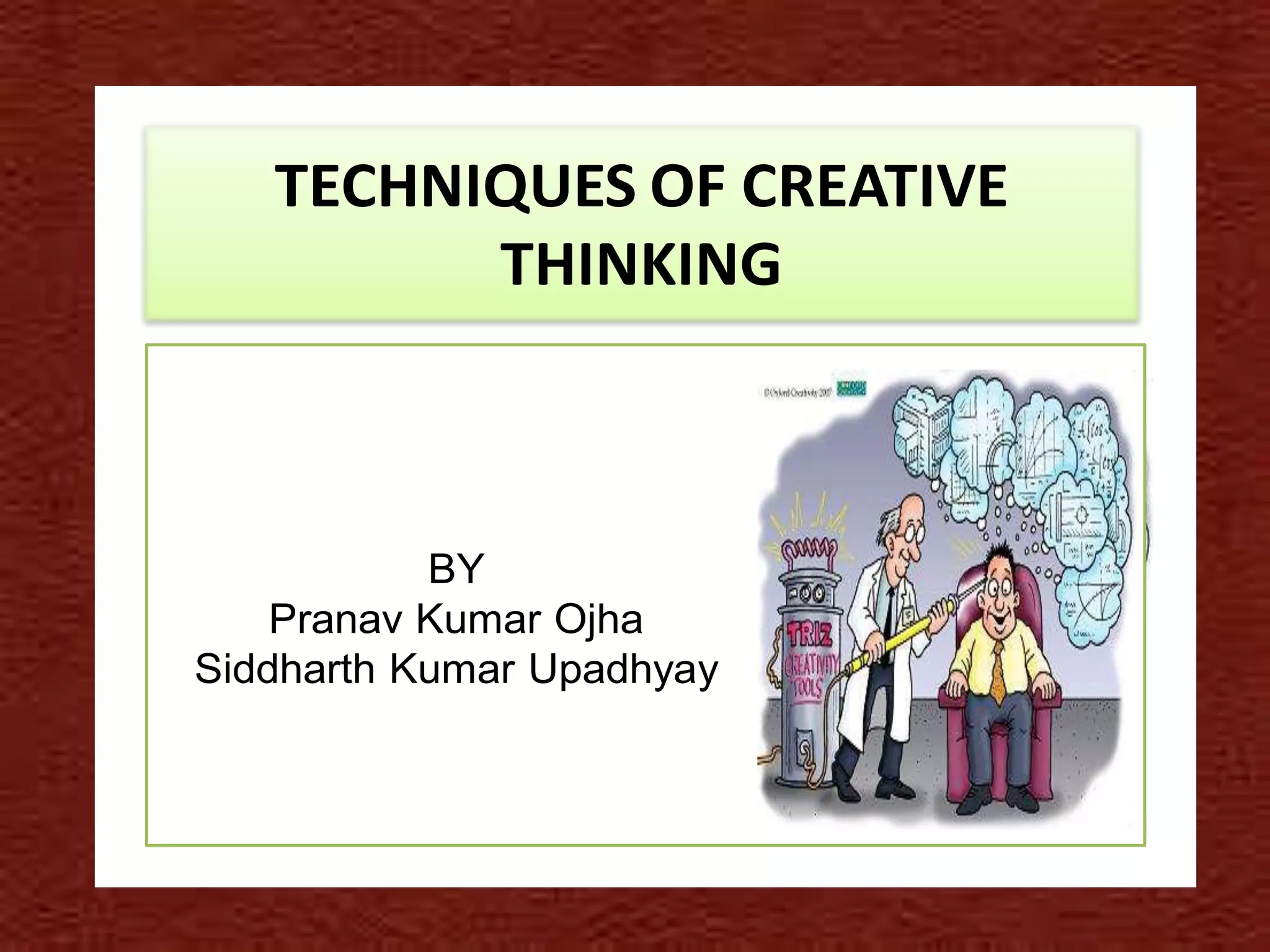
TECHNIQUES OF CREATIVE
         THINKING


           BY
    Pranav Kumar Ojha
Siddharth Kumar Upadhyay
Contents
• Introduction
• Different techniques of creative thinking.
  – Focus Groups
  – Brainstorming
  – Attribute Analysis
  – Synectics
  – Checklist of questions
• Conclusion
• Reference
Thank You
Introduction
• Techniques which are used in developing
  creativity or resolving problems by creative
  thinking come under the techniques of
  creative thinking.
Different techniques of creative
                thinking
•   Focus Groups
•   Brainstorming
•   Attribute Analysis
•   Synectics
•   Checklist of questions
FOCUS GROUPS
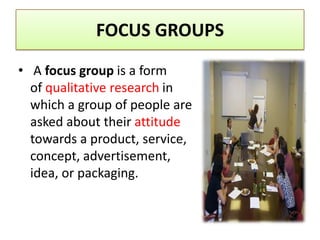
• A focus group is a form
  of qualitative research in
  which a group of people are
  asked about their attitude
  towards a product, service,
  concept, advertisement,
  idea, or packaging.
FOCUS GROUPS

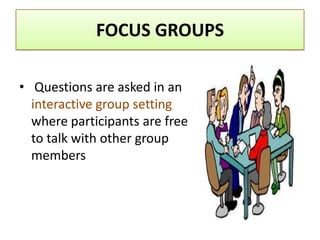
• Questions are asked in an
  interactive group setting
  where participants are free
  to talk with other group
  members
FOCUS GROUPS
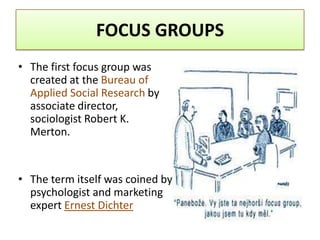
• The first focus group was
  created at the Bureau of
  Applied Social Research by
  associate director,
  sociologist Robert K.
  Merton.


• The term itself was coined by
  psychologist and marketing
  expert Ernest Dichter
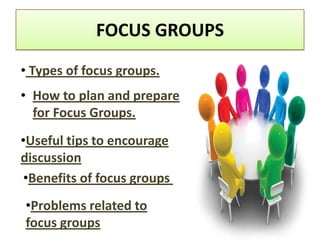
FOCUS GROUPS
• Types of focus groups.
• How to plan and prepare
  for Focus Groups.
•Useful tips to encourage
discussion
•Benefits of focus groups
•Problems related to
focus groups
Types of focus groups

• Two-way focus group - one focus group
  watches another focus group and discusses
  the observed interactions and conclusion.

• Dual moderator focus group - one moderator
  ensures the session progresses smoothly,
  while another ensures that all the topics are
  covered.
Types of focus groups

• Dueling moderator focus group - Two
  moderators deliberately take opposite sides
  on the issue under discussion.

• Respondent moderator focus group - one or
  more of the respondents are asked to act as
  the moderator temporarily.
Types of focus groups

•Client participant focus groups - One or more
client representatives participate in the
discussion, either covertly or overtly.

•Mini focus groups - Groups are composed of
four or five members rather than 6 to 12.
Types of Focus Group

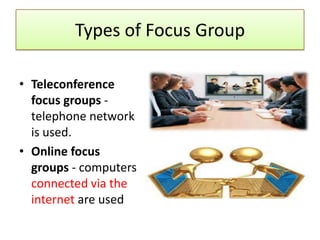
• Teleconference
  focus groups -
  telephone network
  is used.
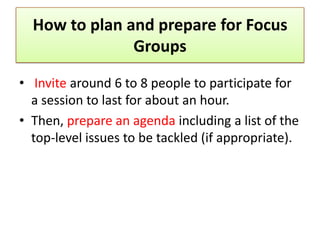
• Online focus
  groups - computers
  connected via the
  internet are used
How to plan and prepare for Focus
               Groups

• Invite around 6 to 8 people to participate for
  a session to last for about an hour.
• Then, prepare an agenda including a list of the
  top-level issues to be tackled (if appropriate).
How to plan and prepare for focus
               groups

• Prepare an introduction script explaining the
  purpose of the day and how the day will be
  run.
• Be sure to always use a quiet room
  and arrange people in a circle (possibly around
  a table).
Useful tips to encourage discussion
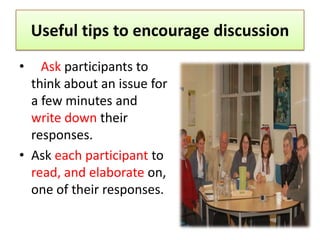
•   Ask participants to
  think about an issue for
  a few minutes and
  write down their
  responses.
• Ask each participant to
  read, and elaborate on,
  one of their responses.
Useful tips to encourage discussion


• Note the responses on a flipchart/whiteboard
• Once everyone has given a response,
  participants will be asked for a second or third
  response, until all of their answers have been
  noted.
• These responses can then be discussed.
Benefits of focus groups
• Group discussion produces data and insights
  that would be less accessible without
  interaction.
• Group members discover a common language
  to describe similar experiences. This enables
  the capture of a form of “native language” or
  “vernacular speech” to understand the
  situation.
Benefits of focus groups
• Focus groups also provide an opportunity for
  disclosure among similar others in a setting
  where participants are validated.
Problems related to focus groups
• The researcher has less control over a group than
  a one-on-one interview, and thus time can be lost
  on issues irrelevant to the topic.

• The number of members of a focus group is not
  large enough to be a representative sample of a
  population; thus, the data obtained from the
  groups is not necessarily representative of the
  whole population, unlike the data of opinion
  polls.
BRAINSTORMING

•     Brainstorming is
    the way of making of
    a group of people all
    think about
    samething at same
    time, often in order to
    solve a problem or to
    create a good idea
    (oxford dictionary).
BRAINSTORMING

• Brainstorming is a group
  creativity
  technique designed to
  generate a large number
  of ideas for the solution of
  a problem.

• In 1953 the method was
  popularized by Alex
  Faickney Osborn in a book
  called Applied Imagination.
BRAINSTORMING


• Rules of Brainstorming
• Methods of Brainstorming
• Types of Brainstorming
Rules of Brainstorming

• Focus on quantity: This rule is a means of
  enhancing divergent production, aiming to
  facilitate problem solving through the maxim-
   quantity breeds quality.
Rules of Brainstorming

• Withhold criticism: In brainstorming, criticism
  of ideas generated should be put 'on hold'.
• By suspending judgment, participants will feel
  free to generate unusual ideas.
Rules of Brainstorming

• Welcome unusual ideas: To get a good and
  long list of ideas, unusual ideas are welcomed.
Rules of Brainstorming

• Combine and improve ideas: Good ideas may
  be combined to form a single better good
  idea, It is believed to stimulate the building of
  ideas by a process of association.
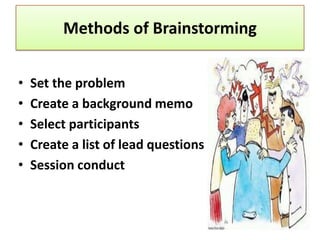
Methods of Brainstorming


•   Set the problem
•   Create a background memo
•   Select participants
•   Create a list of lead questions
•   Session conduct
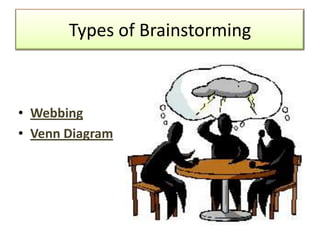
Types of Brainstorming


• Webbing
• Venn Diagram
Types of Brainstorming


Webbing-
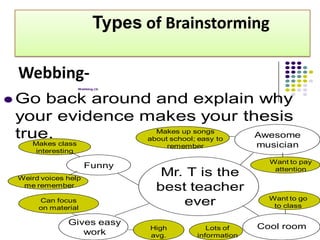
• Webbing is a way to see what you know about
  a topic.
Types of Brainstorming


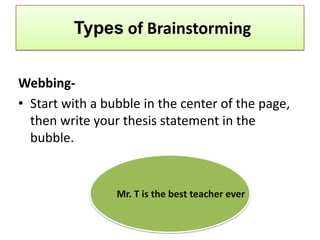
Webbing-
• Start with a bubble in the center of the page,
  then write your thesis statement in the
  bubble.


                 Mr. T is the best teacher ever
Types of Brainstorming


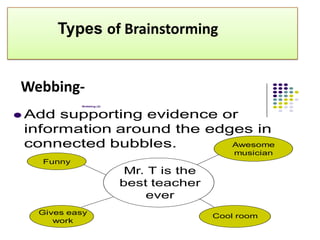
Webbing-
           Webbing (2)


 Add supporting evidence or
 information around the edges in
 connected bubbles.        Awesome
                                             musician
   Funny
                          Mr. T is the
                         best teacher
                             ever
   Gives easy                            Cool room
      work
Types of Brainstorming

 Webbing-
                   Webbing (3)


 Go back around and explain why
 your evidence makes your thesis
 true.            Makes up songs
                about school; easy to
                                      Awesome
    Makes class                     remember            musician
     interesting
                                                          Want to pay
                      Funny                                attention
 Weird voices help
                                   Mr. T is the
  me remember
                                  best teacher
                                                          Want to go
      Can focus
      on material
                                      ever                 to class

              Gives easy                                Cool room
                                 High        Lots of
                 work            avg.     information
Venn Diagram


A  Venn diagram is used to
  help visualize the similarities
  and differences between two
  subjects.
 Venn diagrams are very useful
  when brainstorming a
  compare/contrast essay
Venn Diagram


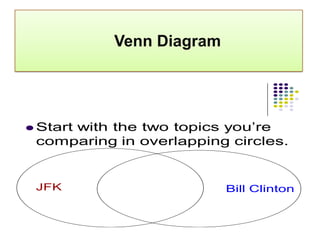
 Start
     with the two topics you’re
 comparing in overlapping circles.


 JFK                      Bill Clinton
Venn Diagram


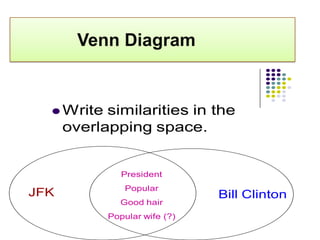
   Write   similarities in the
      overlapping space.


               President
                Popular
JFK                            Bill Clinton
              Good hair
            Popular wife (?)
Venn Diagram


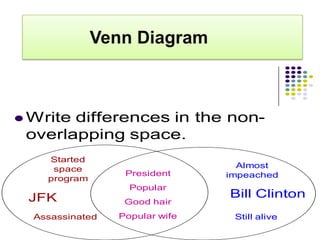
 Writedifferences in the non-
 overlapping space.
    Started
     space                        Almost
                  President     impeached
    program
                   Popular
 JFK                            Bill Clinton
                  Good hair
  Assassinated   Popular wife    Still alive
ATTRIBUTE ANALYSIS
•     Attribute analysis is the process of breaking
    down a problem, idea, or thing into attributes
    or component parts and then thinking about
    the attributes rather than the thing itself.
Steps in attribute analysis

Identification of major attributes

Generation of alternatives

Evaluation of alternatives
Principles of Attribute Listing
• Creativity deals with
  inspiration

• Product A + Product B =
  New Creation

• Search concrete and closely
  related substitutes of an
  existing or current attribute
Principles contd..

• Now it can be upgraded to more and more far-
  out alternatives

• Creation is a continuing stream of
  modification
Procedures of Attribute Listing
• Listing of all obvious attributes of an object or
  activity. e.g.- color, shape, size etc.

• Identifying those attributes that can be
  altered without destroying the main function
  of the object
Steps in attribute listing
• Listing of basic but modifiable attributes

• Generating alternatives to the current
  attribute

• Listing abstract or generic attributes of the
  object or activity
SYNECTICS
Synectics is a problem solving method that
stimulates thought processes of which the
subject may be unaware. This method was
developed by George M. Prince and William J. J.
Gordon, originating in the Arthur D. Little
Invention Design Unit in the 1950s.

Synectics is a technique of problem solving by
using a variety of analogies.
Major Analogies
1. Direct analogy

2. Personal analogy

3. Fantasy analogy

4. Symbolic analogy
Checklist of Questions
• Questions are the creative acts of intelligence,
  for that they could be so designed as to force
  a dramatic shift of perspective.
CONCLUSION
Creative thinking techniques are very much
useful to generating new ideas in every
organization . The new way of thinking should
always be encouraged and creativity should
always be welcomed.
Reference
• Creativity and Entrepreneurship
                           By- Dafna Karif
• Entrepreneurship and Small Business Management
                            By- M.B.Shukla
• www.creativecommons.org
• www. expertise.ac .in
• www.nbcindia.com
• www.egyankosh.com (Oxford Dictionary)
• WWW.gogle.com
• WWW.wikipeadia.org
• www.slideshare.com
• IGNOU study Materials.
Link

• To become a successful entrepreneur, one
  must be creative , because creative thinking
  yields idea, plan, technology and most
  importantly solution of many problems. And
  for being creative , one should learn the
  techniques of creative thinking. So
  friends………….

• John fitzgerald Kannedy 35th US president

Techniques of creative thinking

  • 1.
    TECHNIQUES OF CREATIVE THINKING BY Pranav Kumar Ojha Siddharth Kumar Upadhyay
  • 2.
    Contents • Introduction • Differenttechniques of creative thinking. – Focus Groups – Brainstorming – Attribute Analysis – Synectics – Checklist of questions • Conclusion • Reference
  • 3.
  • 4.
    Introduction • Techniques whichare used in developing creativity or resolving problems by creative thinking come under the techniques of creative thinking.
  • 5.
    Different techniques ofcreative thinking • Focus Groups • Brainstorming • Attribute Analysis • Synectics • Checklist of questions
  • 6.
    FOCUS GROUPS • Afocus group is a form of qualitative research in which a group of people are asked about their attitude towards a product, service, concept, advertisement, idea, or packaging.
  • 7.
    FOCUS GROUPS • Questionsare asked in an interactive group setting where participants are free to talk with other group members
  • 8.
    FOCUS GROUPS • Thefirst focus group was created at the Bureau of Applied Social Research by associate director, sociologist Robert K. Merton. • The term itself was coined by psychologist and marketing expert Ernest Dichter
  • 9.
    FOCUS GROUPS • Typesof focus groups. • How to plan and prepare for Focus Groups. •Useful tips to encourage discussion •Benefits of focus groups •Problems related to focus groups
  • 10.
    Types of focusgroups • Two-way focus group - one focus group watches another focus group and discusses the observed interactions and conclusion. • Dual moderator focus group - one moderator ensures the session progresses smoothly, while another ensures that all the topics are covered.
  • 11.
    Types of focusgroups • Dueling moderator focus group - Two moderators deliberately take opposite sides on the issue under discussion. • Respondent moderator focus group - one or more of the respondents are asked to act as the moderator temporarily.
  • 12.
    Types of focusgroups •Client participant focus groups - One or more client representatives participate in the discussion, either covertly or overtly. •Mini focus groups - Groups are composed of four or five members rather than 6 to 12.
  • 13.
    Types of FocusGroup • Teleconference focus groups - telephone network is used. • Online focus groups - computers connected via the internet are used
  • 14.
    How to planand prepare for Focus Groups • Invite around 6 to 8 people to participate for a session to last for about an hour. • Then, prepare an agenda including a list of the top-level issues to be tackled (if appropriate).
  • 15.
    How to planand prepare for focus groups • Prepare an introduction script explaining the purpose of the day and how the day will be run. • Be sure to always use a quiet room and arrange people in a circle (possibly around a table).
  • 16.
    Useful tips toencourage discussion • Ask participants to think about an issue for a few minutes and write down their responses. • Ask each participant to read, and elaborate on, one of their responses.
  • 17.
    Useful tips toencourage discussion • Note the responses on a flipchart/whiteboard • Once everyone has given a response, participants will be asked for a second or third response, until all of their answers have been noted. • These responses can then be discussed.
  • 18.
    Benefits of focusgroups • Group discussion produces data and insights that would be less accessible without interaction. • Group members discover a common language to describe similar experiences. This enables the capture of a form of “native language” or “vernacular speech” to understand the situation.
  • 19.
    Benefits of focusgroups • Focus groups also provide an opportunity for disclosure among similar others in a setting where participants are validated.
  • 20.
    Problems related tofocus groups • The researcher has less control over a group than a one-on-one interview, and thus time can be lost on issues irrelevant to the topic. • The number of members of a focus group is not large enough to be a representative sample of a population; thus, the data obtained from the groups is not necessarily representative of the whole population, unlike the data of opinion polls.
  • 21.
    BRAINSTORMING • Brainstorming is the way of making of a group of people all think about samething at same time, often in order to solve a problem or to create a good idea (oxford dictionary).
  • 22.
    BRAINSTORMING • Brainstorming isa group creativity technique designed to generate a large number of ideas for the solution of a problem. • In 1953 the method was popularized by Alex Faickney Osborn in a book called Applied Imagination.
  • 23.
    BRAINSTORMING • Rules ofBrainstorming • Methods of Brainstorming • Types of Brainstorming
  • 24.
    Rules of Brainstorming •Focus on quantity: This rule is a means of enhancing divergent production, aiming to facilitate problem solving through the maxim- quantity breeds quality.
  • 25.
    Rules of Brainstorming •Withhold criticism: In brainstorming, criticism of ideas generated should be put 'on hold'. • By suspending judgment, participants will feel free to generate unusual ideas.
  • 26.
    Rules of Brainstorming •Welcome unusual ideas: To get a good and long list of ideas, unusual ideas are welcomed.
  • 27.
    Rules of Brainstorming •Combine and improve ideas: Good ideas may be combined to form a single better good idea, It is believed to stimulate the building of ideas by a process of association.
  • 28.
    Methods of Brainstorming • Set the problem • Create a background memo • Select participants • Create a list of lead questions • Session conduct
  • 29.
    Types of Brainstorming •Webbing • Venn Diagram
  • 30.
    Types of Brainstorming Webbing- •Webbing is a way to see what you know about a topic.
  • 31.
    Types of Brainstorming Webbing- •Start with a bubble in the center of the page, then write your thesis statement in the bubble. Mr. T is the best teacher ever
  • 32.
    Types of Brainstorming Webbing- Webbing (2)  Add supporting evidence or information around the edges in connected bubbles. Awesome musician Funny Mr. T is the best teacher ever Gives easy Cool room work
  • 33.
    Types of Brainstorming Webbing- Webbing (3)  Go back around and explain why your evidence makes your thesis true. Makes up songs about school; easy to Awesome Makes class remember musician interesting Want to pay Funny attention Weird voices help Mr. T is the me remember best teacher Want to go Can focus on material ever to class Gives easy Cool room High Lots of work avg. information
  • 34.
    Venn Diagram A Venn diagram is used to help visualize the similarities and differences between two subjects.  Venn diagrams are very useful when brainstorming a compare/contrast essay
  • 35.
    Venn Diagram  Start with the two topics you’re comparing in overlapping circles. JFK Bill Clinton
  • 36.
    Venn Diagram  Write similarities in the overlapping space. President Popular JFK Bill Clinton Good hair Popular wife (?)
  • 37.
    Venn Diagram  Writedifferencesin the non- overlapping space. Started space Almost President impeached program Popular JFK Bill Clinton Good hair Assassinated Popular wife Still alive
  • 38.
    ATTRIBUTE ANALYSIS • Attribute analysis is the process of breaking down a problem, idea, or thing into attributes or component parts and then thinking about the attributes rather than the thing itself.
  • 39.
    Steps in attributeanalysis Identification of major attributes Generation of alternatives Evaluation of alternatives
  • 40.
    Principles of AttributeListing • Creativity deals with inspiration • Product A + Product B = New Creation • Search concrete and closely related substitutes of an existing or current attribute
  • 41.
    Principles contd.. • Nowit can be upgraded to more and more far- out alternatives • Creation is a continuing stream of modification
  • 42.
    Procedures of AttributeListing • Listing of all obvious attributes of an object or activity. e.g.- color, shape, size etc. • Identifying those attributes that can be altered without destroying the main function of the object
  • 43.
    Steps in attributelisting • Listing of basic but modifiable attributes • Generating alternatives to the current attribute • Listing abstract or generic attributes of the object or activity
  • 44.
    SYNECTICS Synectics is aproblem solving method that stimulates thought processes of which the subject may be unaware. This method was developed by George M. Prince and William J. J. Gordon, originating in the Arthur D. Little Invention Design Unit in the 1950s. Synectics is a technique of problem solving by using a variety of analogies.
  • 45.
    Major Analogies 1. Directanalogy 2. Personal analogy 3. Fantasy analogy 4. Symbolic analogy
  • 46.
    Checklist of Questions •Questions are the creative acts of intelligence, for that they could be so designed as to force a dramatic shift of perspective.
  • 47.
    CONCLUSION Creative thinking techniquesare very much useful to generating new ideas in every organization . The new way of thinking should always be encouraged and creativity should always be welcomed.
  • 48.
    Reference • Creativity andEntrepreneurship By- Dafna Karif • Entrepreneurship and Small Business Management By- M.B.Shukla • www.creativecommons.org • www. expertise.ac .in • www.nbcindia.com • www.egyankosh.com (Oxford Dictionary) • WWW.gogle.com • WWW.wikipeadia.org • www.slideshare.com • IGNOU study Materials.
  • 49.
    Link • To becomea successful entrepreneur, one must be creative , because creative thinking yields idea, plan, technology and most importantly solution of many problems. And for being creative , one should learn the techniques of creative thinking. So friends…………. • John fitzgerald Kannedy 35th US president