Chapter 5   -  Total Quality   Management Mudassar Salman
Learning Objectives Explain the meaning of  TQM Identify features of the TQM philosophy Describe the four dimensions of Quality Identify the costs of Quality Identify tools used for solving Quality problems Quality awards and Quality certifications Identify Quality leaders and their contributions
What is TQM? Meeting quality expectations as defined by the customer Integrated organizational effort designed to improve quality of processes at every business level
Defining Quality – 5 Ways Conformance to specifications Does product/service meet targets and tolerances defined by designers? Fitness for use   Evaluates performance for intended use Value for price paid Evaluation of usefulness vs. price paid Support services Quality of support after sale Psychological e.g.  Ambiance, prestige, friendly staff
Manufacturing Quality vs. Service Quality Manufacturing quality focuses on tangible product features Conformance, performance, reliability, features, durability, serviceability Service organizations produce intangible products that must be experienced Quality often defined by perceptional factors like courtesy, friendliness of staff, promptness in resolving complaints, atmosphere, waiting time, consistency
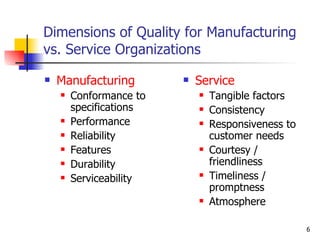
Dimensions of Quality for Manufacturing vs. Service Organizations Manufacturing Conformance to specifications Performance Reliability Features Durability Serviceability Service Tangible factors Consistency Responsiveness to customer needs Courtesy / friendliness Timeliness / promptness Atmosphere
Quality in Practice Motorola and GE attribute their success to having one of the best quality management programs in the world. Six-Sigma was implemented Levels of defects is reduced to 3.4 parts per million Everyone is trained in quality improvement principles and techniques Black-Belt – their full time job is to identify and solve quality problems
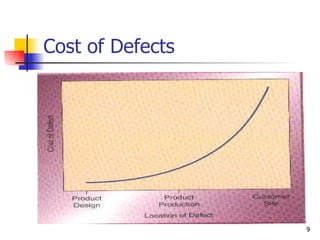
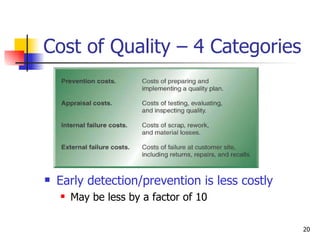
Cost of Quality Quality effects all aspects of the organization and have dramatic cost implications Most obvious consequence of poor quality is dissatisfied customers and eventual loss of business Prevention costs  – cost of preparing and implementing a quality plan Appraisal costs  – cost of testing, evaluating and inspecting quality Internal failure costs  – cost of scrap, rework, and material losses External failure costs  – cost of failure at customer site, including returns, repairs and recalls External failures can sometimes put a company out of business almost overnight External failure costs tend to be particularly high for service organizations
Cost of Defects
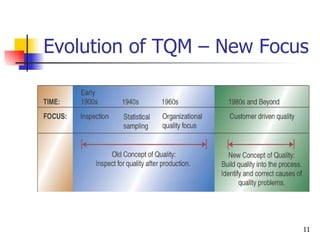
The Evolution of TQM Early 20 th  century – Quality meant inspection. Reactive in nature 1980s – Quality began to have strategic meaning. Proactive in nature Successful companies understand that quality provides a competitive advantage Put customer first, and define quality as meeting or exceeding customers expectation Quality excellence has become a standard for doing business
Evolution of TQM – New Focus
Quality Gurus Walter A. Shewhart (1920s & 1930s) Grandfather of quality control Contributed to understand the process of variability Developed concept of statistical control charts W. Edwards Deming (1940s & 1950s) Father of quality control Stressed  management’s responsibility for quality Developed “14 points” to guide companies in quality improvement Japanese established “Deming Prize” in his name 15% of quality problems are actually due to worker error 85% of quality problems are caused by systems and errors
Quality Gurus – contd. Joseph M. Juran (1950s) Defined quality as “fitness for use” Developed concept of cost of quality Originated idea of quality triology Quality planning Quality control Quality improvement Armand V. Feigenbaum (1960s) Introduced the concept of total quality control Philip B. Crosby (1970s) Coined phrase “quality is free” Introduced concept of zero defects Developed the phrase “Do it right the first time”
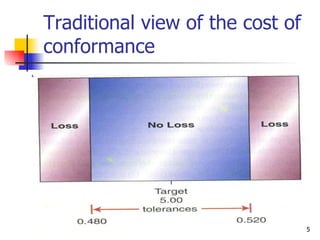
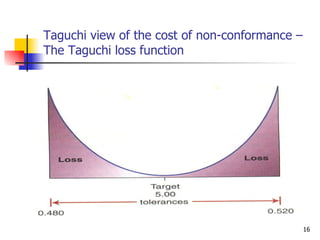
Quality Gurus – contd. Kaoru Ishikawa Developed cause-and-effect diagrams Identified concept of “internal customer” Introduced the concept of “quality circles” Genichi Taguchi Focused on product design quality Developed Taguchi loss function Costs of quality increase as a quadratic function as conformance values move away from target Robust Design A design that results in a product that can perform over a wide range of conditions
Traditional view of the cost of conformance
Taguchi view of the cost of non-conformance – The Taguchi loss function
TQM Philosophy – What’s Different? TQM attempts to embed quality in every aspect of the organization Focus on Customer Identify and meet customer needs Stay tuned to changing needs, e.g. fashion styles Continuous Improvement Continuous learning and problem solving, e.g. Kaizen, 6 sigma Quality at the  Source Inspection vs. prevention & problem solving Employee Empowerment Empower all employees; external and internal customers Team approach, quality circle
TQM Philosophy– What’s Different? ( continued ) Understanding  Quality Tools Ongoing training on analysis, assessment, and correction, & implementation of quality tools Team Approach Teams formed around processes – 8 to 10 people Meet weekly to analyze and solve problems Benchmarking Studying practices at “best in class” companies  Managing Supplier Quality Certifying suppliers vs. receiving inspection
Four Dimensions of Quality Quality of design Determining  which features to include in the final design Quality of conformance to design Production processes are set up to meet design specifications Ease of use Instructions, operation, maintenance, safety  Post-sale service   Responsiveness, rapid repair, p.m., spare parts
Cost of Quality – 4 Categories Early detection/prevention is less costly   May be less by a factor of 10
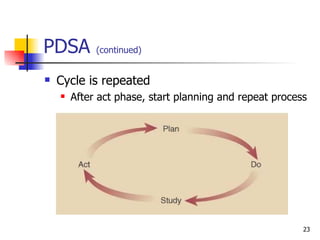
Ways of Improving Quality Plan-Do-Study-Act Cycle (PDSA) Also called the  Deming Wheel  after its originator Circular, never ending problem solving process Quality Function Deployment Used to translate customer preferences to design Seven Tools of Quality Control Tools typically taught to problem solving teams
PDSA Details Plan Evaluate current process Collect procedures, data, identify problems Develop an improvement plan, performance objectives Do Implement the plan – trial basis Study Collect data and evaluate against objectives Act Communicate the results from trial If successful, implement new process
PDSA  (continued) Cycle is repeated  After act phase, start planning and repeat process
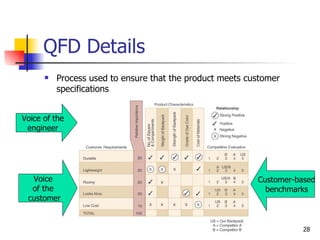
Quality Function Deployment A tool used to translate the preferences of the customer into specific technical requirements QFD begins by identifying customer requirements, coming from marketing department These requirements are numerically scored, based on their importance, and scores are translated into specific product characteristics Comparison of product is made with its competitors, relative to identified characteristics Specific goals are set to address identified problems The resulting matrix looks like a picture of house and is often called the “house of quality”
QFD – Contd. Customer requirements Survey customers to find out what they specifically need in our product Focus groups, telephonic interviews, directly talk to customers Competitive Evaluation How our product compares to those of competitors Evaluation scale is from one to five Higher the rating, the better
QFD – Contd. Product Characteristics Specific product characteristics are on top of relationship matrix The Relationship Matrix The strength of relationship between customer requirements and product characteristics is shown in the relationship matrix A negative relationship means that as we increase the desirability of one variable, we decrease the desirability of other A positive relationship means that as increase in desirability of one variable is related to an increase in the desirability of another
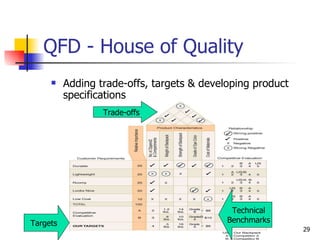
QFD – Contd. The Trade-off Matrix The roof of house is put through trade-off matrix Shows how each product characteristics is related to the others What trade-offs we need to make Setting Targets The bottom row of the house is the output of QFD These are specific, measurable product characteristics that have been formulated from general customer requirements
QFD Details Process used to ensure that the product meets customer specifications Voice of the engineer Voice  of the  customer Customer-based benchmarks
QFD - House of Quality Adding trade-offs, targets & developing product specifications Trade-offs Targets Technical Benchmarks
Seven Problem Solving Tools Cause-and-Effect Diagrams Flowcharts Checklists Control Charts Scatter Diagrams Pareto Analysis Histograms
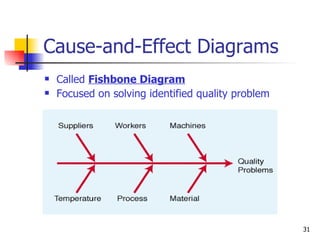
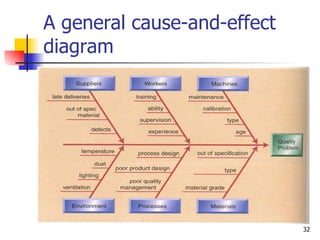
Cause-and-Effect Diagrams Called  Fishbone Diagram Focused on solving identified quality problem
A general cause-and-effect diagram
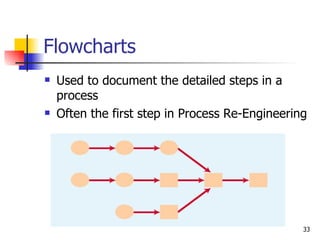
Flowcharts Used to document the detailed steps in a process Often the first step in Process Re-Engineering
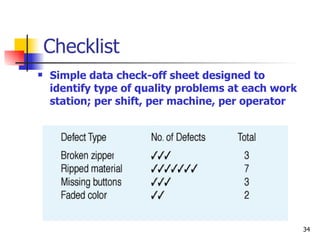
Checklist Simple data check-off sheet designed to identify type of quality problems at each work station; per shift, per machine, per operator
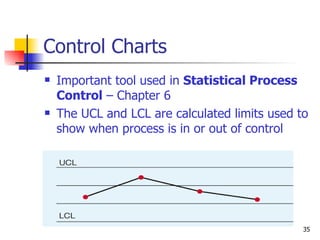
Control Charts Important tool used in  Statistical Process   Control  – Chapter 6 The UCL and LCL are calculated limits used to show when process is in or out of control
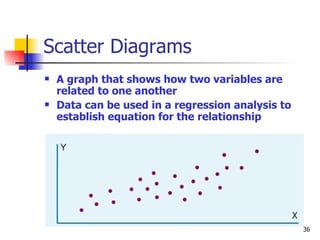
Scatter Diagrams A graph that shows how two variables are related to one another Data can be used in a regression analysis to establish equation for the relationship
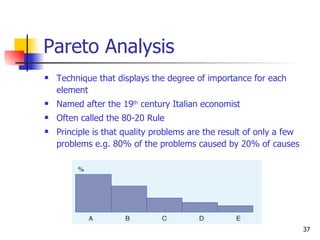
Pareto Analysis Technique that displays the degree of importance for each element Named after the 19 th  century Italian economist Often called the 80-20 Rule Principle is that quality problems are the result of only a few problems e.g. 80% of the problems caused by 20% of causes
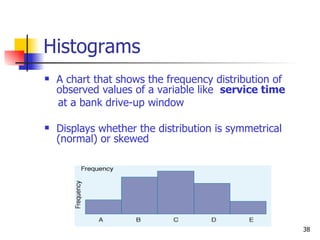
Histograms A chart that shows the frequency distribution of observed values of a variable like  service time at a bank drive-up window Displays whether the distribution is symmetrical (normal) or skewed
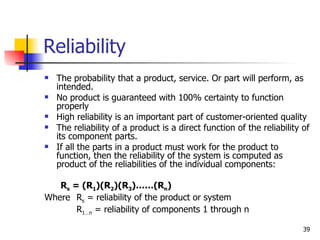
Reliability The probability that a product, service. Or part will perform, as intended. No product is guaranteed with 100% certainty to function properly High reliability is an important part of customer-oriented quality The reliability of a product is a direct function of the reliability of its component parts. If all the parts in a product must work for the product to function, then the reliability of the system is computed as product of the reliabilities of the individual components: R s  = (R 1 )(R 2 )(R 3 )……(R n ) Where  R s  = reliability of the product or system R 1…n  = reliability of components 1 through n
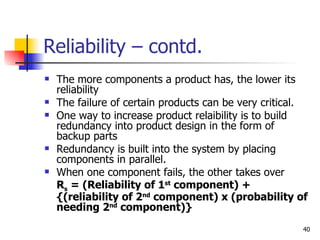
Reliability – contd. The more components a product has, the lower its reliability The failure of certain products can be very critical. One way to increase product relaibility is to build redundancy into product design in the form of backup parts Redundancy is built into the system by placing components in parallel. When one component fails, the other takes over R s  = (Reliability of 1 st  component) + {(reliability of 2 nd  component) x (probability of needing 2 nd  component)}
Process Management A quality product comes from a quality process Quality at source The belief that it is best to uncover the source of quality problems and eliminate it Managing Supplier quality The philosophy of TQM extends to concept of quality suppliers and ensures that they engage in the same quality practices If suppliers meet quality standards, materials do not have to be inspected upon arrival
Quality Awards and Standards Malcolm Baldrige National Quality Award The Deming Prize  ISO 9000 Certification ISO 14000 Standards
MBNQA- What Is It? Award named after the former Secretary of Commerce – Regan Administration Intended to reward and stimulate quality initiatives Given to no more that two companies in each of three categories; manufacturing, service, and small business Past winners; FedEx, 3M, IBM, Ritz-Carlton Typical winners have scored around 700 points
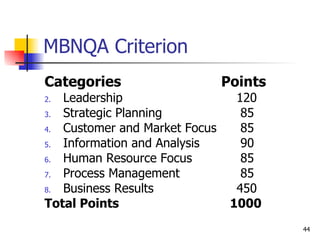
MBNQA Criterion Categories   Points Leadership 120 Strategic Planning  85 Customer and Market Focus  85 Information and Analysis  90 Human Resource Focus  85 Process Management  85 Business Results 450 Total Points   1000
The Deming Prize Given by the Union of Japanese Scientists and Engineers since 1951 Named after W. Edwards Deming who worked to improve Japanese quality after WWII Not open to foreign companies until 1984 Florida P & L was first US company   winner
ISO Standards ISO 9000 Standards:   Certification developed by International Organization for Standardization Set of internationally recognized quality standards  Companies are periodically audited & certified ISO 9000:2000 QMS – Fundamentals and Standards ISO 9001:2000 QMS – Requirements ISO 9004:2000 QMS -  Guidelines for Performance More than 40,000 companies have been certified  ISO 14000:   Focuses on a company’s environmental responsibility
Why TQM Efforts Fail Lack of a genuine quality culture Lack of top management support and commitment Over- and under-reliance on SPC methods
Chapter 5 Highlights TQM focuses on serving the customer’s quality needs TQM uses continuous improvement, quality at the source, employee empowerment, quality tools, teams, benchmarking, and supplier certification Four dimensions: product/service design, conformance, easy of use, post-sale support Quality costs; prevention, appraisal, internal & external failures QFD and Seven Quality Tools used in managing quality The MBNQA, Deming Prize, and ISO Certification help focus on quality improvement and excellence The seven Quality Gurus all made key contributions

Total Quality Management (TQM)

  • 1.
    Chapter 5 - Total Quality Management Mudassar Salman
  • 2.
    Learning Objectives Explainthe meaning of TQM Identify features of the TQM philosophy Describe the four dimensions of Quality Identify the costs of Quality Identify tools used for solving Quality problems Quality awards and Quality certifications Identify Quality leaders and their contributions
  • 3.
    What is TQM?Meeting quality expectations as defined by the customer Integrated organizational effort designed to improve quality of processes at every business level
  • 4.
    Defining Quality –5 Ways Conformance to specifications Does product/service meet targets and tolerances defined by designers? Fitness for use Evaluates performance for intended use Value for price paid Evaluation of usefulness vs. price paid Support services Quality of support after sale Psychological e.g. Ambiance, prestige, friendly staff
  • 5.
    Manufacturing Quality vs.Service Quality Manufacturing quality focuses on tangible product features Conformance, performance, reliability, features, durability, serviceability Service organizations produce intangible products that must be experienced Quality often defined by perceptional factors like courtesy, friendliness of staff, promptness in resolving complaints, atmosphere, waiting time, consistency
  • 6.
    Dimensions of Qualityfor Manufacturing vs. Service Organizations Manufacturing Conformance to specifications Performance Reliability Features Durability Serviceability Service Tangible factors Consistency Responsiveness to customer needs Courtesy / friendliness Timeliness / promptness Atmosphere
  • 7.
    Quality in PracticeMotorola and GE attribute their success to having one of the best quality management programs in the world. Six-Sigma was implemented Levels of defects is reduced to 3.4 parts per million Everyone is trained in quality improvement principles and techniques Black-Belt – their full time job is to identify and solve quality problems
  • 8.
    Cost of QualityQuality effects all aspects of the organization and have dramatic cost implications Most obvious consequence of poor quality is dissatisfied customers and eventual loss of business Prevention costs – cost of preparing and implementing a quality plan Appraisal costs – cost of testing, evaluating and inspecting quality Internal failure costs – cost of scrap, rework, and material losses External failure costs – cost of failure at customer site, including returns, repairs and recalls External failures can sometimes put a company out of business almost overnight External failure costs tend to be particularly high for service organizations
  • 9.
  • 10.
    The Evolution ofTQM Early 20 th century – Quality meant inspection. Reactive in nature 1980s – Quality began to have strategic meaning. Proactive in nature Successful companies understand that quality provides a competitive advantage Put customer first, and define quality as meeting or exceeding customers expectation Quality excellence has become a standard for doing business
  • 11.
    Evolution of TQM– New Focus
  • 12.
    Quality Gurus WalterA. Shewhart (1920s & 1930s) Grandfather of quality control Contributed to understand the process of variability Developed concept of statistical control charts W. Edwards Deming (1940s & 1950s) Father of quality control Stressed management’s responsibility for quality Developed “14 points” to guide companies in quality improvement Japanese established “Deming Prize” in his name 15% of quality problems are actually due to worker error 85% of quality problems are caused by systems and errors
  • 13.
    Quality Gurus –contd. Joseph M. Juran (1950s) Defined quality as “fitness for use” Developed concept of cost of quality Originated idea of quality triology Quality planning Quality control Quality improvement Armand V. Feigenbaum (1960s) Introduced the concept of total quality control Philip B. Crosby (1970s) Coined phrase “quality is free” Introduced concept of zero defects Developed the phrase “Do it right the first time”
  • 14.
    Quality Gurus –contd. Kaoru Ishikawa Developed cause-and-effect diagrams Identified concept of “internal customer” Introduced the concept of “quality circles” Genichi Taguchi Focused on product design quality Developed Taguchi loss function Costs of quality increase as a quadratic function as conformance values move away from target Robust Design A design that results in a product that can perform over a wide range of conditions
  • 15.
    Traditional view ofthe cost of conformance
  • 16.
    Taguchi view ofthe cost of non-conformance – The Taguchi loss function
  • 17.
    TQM Philosophy –What’s Different? TQM attempts to embed quality in every aspect of the organization Focus on Customer Identify and meet customer needs Stay tuned to changing needs, e.g. fashion styles Continuous Improvement Continuous learning and problem solving, e.g. Kaizen, 6 sigma Quality at the Source Inspection vs. prevention & problem solving Employee Empowerment Empower all employees; external and internal customers Team approach, quality circle
  • 18.
    TQM Philosophy– What’sDifferent? ( continued ) Understanding Quality Tools Ongoing training on analysis, assessment, and correction, & implementation of quality tools Team Approach Teams formed around processes – 8 to 10 people Meet weekly to analyze and solve problems Benchmarking Studying practices at “best in class” companies Managing Supplier Quality Certifying suppliers vs. receiving inspection
  • 19.
    Four Dimensions ofQuality Quality of design Determining which features to include in the final design Quality of conformance to design Production processes are set up to meet design specifications Ease of use Instructions, operation, maintenance, safety Post-sale service Responsiveness, rapid repair, p.m., spare parts
  • 20.
    Cost of Quality– 4 Categories Early detection/prevention is less costly May be less by a factor of 10
  • 21.
    Ways of ImprovingQuality Plan-Do-Study-Act Cycle (PDSA) Also called the Deming Wheel after its originator Circular, never ending problem solving process Quality Function Deployment Used to translate customer preferences to design Seven Tools of Quality Control Tools typically taught to problem solving teams
  • 22.
    PDSA Details PlanEvaluate current process Collect procedures, data, identify problems Develop an improvement plan, performance objectives Do Implement the plan – trial basis Study Collect data and evaluate against objectives Act Communicate the results from trial If successful, implement new process
  • 23.
    PDSA (continued)Cycle is repeated After act phase, start planning and repeat process
  • 24.
    Quality Function DeploymentA tool used to translate the preferences of the customer into specific technical requirements QFD begins by identifying customer requirements, coming from marketing department These requirements are numerically scored, based on their importance, and scores are translated into specific product characteristics Comparison of product is made with its competitors, relative to identified characteristics Specific goals are set to address identified problems The resulting matrix looks like a picture of house and is often called the “house of quality”
  • 25.
    QFD – Contd.Customer requirements Survey customers to find out what they specifically need in our product Focus groups, telephonic interviews, directly talk to customers Competitive Evaluation How our product compares to those of competitors Evaluation scale is from one to five Higher the rating, the better
  • 26.
    QFD – Contd.Product Characteristics Specific product characteristics are on top of relationship matrix The Relationship Matrix The strength of relationship between customer requirements and product characteristics is shown in the relationship matrix A negative relationship means that as we increase the desirability of one variable, we decrease the desirability of other A positive relationship means that as increase in desirability of one variable is related to an increase in the desirability of another
  • 27.
    QFD – Contd.The Trade-off Matrix The roof of house is put through trade-off matrix Shows how each product characteristics is related to the others What trade-offs we need to make Setting Targets The bottom row of the house is the output of QFD These are specific, measurable product characteristics that have been formulated from general customer requirements
  • 28.
    QFD Details Processused to ensure that the product meets customer specifications Voice of the engineer Voice of the customer Customer-based benchmarks
  • 29.
    QFD - Houseof Quality Adding trade-offs, targets & developing product specifications Trade-offs Targets Technical Benchmarks
  • 30.
    Seven Problem SolvingTools Cause-and-Effect Diagrams Flowcharts Checklists Control Charts Scatter Diagrams Pareto Analysis Histograms
  • 31.
    Cause-and-Effect Diagrams Called Fishbone Diagram Focused on solving identified quality problem
  • 32.
  • 33.
    Flowcharts Used todocument the detailed steps in a process Often the first step in Process Re-Engineering
  • 34.
    Checklist Simple datacheck-off sheet designed to identify type of quality problems at each work station; per shift, per machine, per operator
  • 35.
    Control Charts Importanttool used in Statistical Process Control – Chapter 6 The UCL and LCL are calculated limits used to show when process is in or out of control
  • 36.
    Scatter Diagrams Agraph that shows how two variables are related to one another Data can be used in a regression analysis to establish equation for the relationship
  • 37.
    Pareto Analysis Techniquethat displays the degree of importance for each element Named after the 19 th century Italian economist Often called the 80-20 Rule Principle is that quality problems are the result of only a few problems e.g. 80% of the problems caused by 20% of causes
  • 38.
    Histograms A chartthat shows the frequency distribution of observed values of a variable like service time at a bank drive-up window Displays whether the distribution is symmetrical (normal) or skewed
  • 39.
    Reliability The probabilitythat a product, service. Or part will perform, as intended. No product is guaranteed with 100% certainty to function properly High reliability is an important part of customer-oriented quality The reliability of a product is a direct function of the reliability of its component parts. If all the parts in a product must work for the product to function, then the reliability of the system is computed as product of the reliabilities of the individual components: R s = (R 1 )(R 2 )(R 3 )……(R n ) Where R s = reliability of the product or system R 1…n = reliability of components 1 through n
  • 40.
    Reliability – contd.The more components a product has, the lower its reliability The failure of certain products can be very critical. One way to increase product relaibility is to build redundancy into product design in the form of backup parts Redundancy is built into the system by placing components in parallel. When one component fails, the other takes over R s = (Reliability of 1 st component) + {(reliability of 2 nd component) x (probability of needing 2 nd component)}
  • 41.
    Process Management Aquality product comes from a quality process Quality at source The belief that it is best to uncover the source of quality problems and eliminate it Managing Supplier quality The philosophy of TQM extends to concept of quality suppliers and ensures that they engage in the same quality practices If suppliers meet quality standards, materials do not have to be inspected upon arrival
  • 42.
    Quality Awards andStandards Malcolm Baldrige National Quality Award The Deming Prize ISO 9000 Certification ISO 14000 Standards
  • 43.
    MBNQA- What IsIt? Award named after the former Secretary of Commerce – Regan Administration Intended to reward and stimulate quality initiatives Given to no more that two companies in each of three categories; manufacturing, service, and small business Past winners; FedEx, 3M, IBM, Ritz-Carlton Typical winners have scored around 700 points
  • 44.
    MBNQA Criterion Categories Points Leadership 120 Strategic Planning 85 Customer and Market Focus 85 Information and Analysis 90 Human Resource Focus 85 Process Management 85 Business Results 450 Total Points 1000
  • 45.
    The Deming PrizeGiven by the Union of Japanese Scientists and Engineers since 1951 Named after W. Edwards Deming who worked to improve Japanese quality after WWII Not open to foreign companies until 1984 Florida P & L was first US company winner
  • 46.
    ISO Standards ISO9000 Standards: Certification developed by International Organization for Standardization Set of internationally recognized quality standards Companies are periodically audited & certified ISO 9000:2000 QMS – Fundamentals and Standards ISO 9001:2000 QMS – Requirements ISO 9004:2000 QMS - Guidelines for Performance More than 40,000 companies have been certified ISO 14000: Focuses on a company’s environmental responsibility
  • 47.
    Why TQM EffortsFail Lack of a genuine quality culture Lack of top management support and commitment Over- and under-reliance on SPC methods
  • 48.
    Chapter 5 HighlightsTQM focuses on serving the customer’s quality needs TQM uses continuous improvement, quality at the source, employee empowerment, quality tools, teams, benchmarking, and supplier certification Four dimensions: product/service design, conformance, easy of use, post-sale support Quality costs; prevention, appraisal, internal & external failures QFD and Seven Quality Tools used in managing quality The MBNQA, Deming Prize, and ISO Certification help focus on quality improvement and excellence The seven Quality Gurus all made key contributions