Barrier:
A problem , rule or situation
that prevents somebody from
doing something.

Appraisal:
A judgment of the value ,
performance or nature of
somebody.
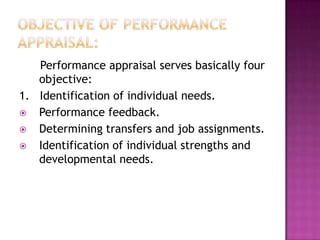
“Performance appraisal is an objective
  assessment of an individuals’ performance
  against well defined benchmarks”
Performance appraisal serves basically four
   objective:
1. Identification of individual needs.
 Performance feedback.
 Determining transfers and job assignments.
 Identification of individual strengths and
   developmental needs.
2. administrative uses/decisions:
 Salary
 Promotion
 Identification of poor performance
3. Organizational maintenance/objective:
    H R planning
 Evaluation of organizational goal
    achievement
 Reinforcement of organizational
    development needs
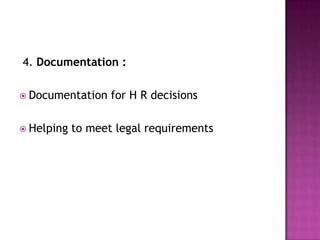
4. Documentation :

 Documentation    for H R decisions

 Helping   to meet legal requirements
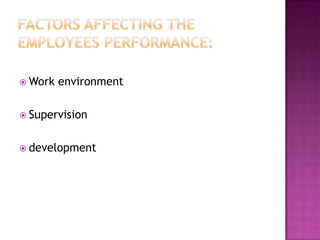
 Work   environment

 Supervision


 development
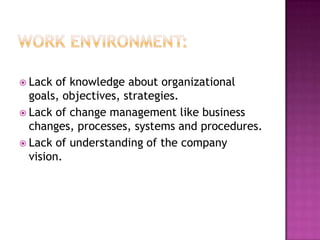
 Lack  of knowledge about organizational
  goals, objectives, strategies.
 Lack of change management like business
  changes, processes, systems and procedures.
 Lack of understanding of the company
  vision.
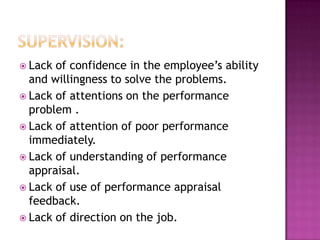
 Lack of confidence in the employee’s ability
  and willingness to solve the problems.
 Lack of attentions on the performance
  problem .
 Lack of attention of poor performance
  immediately.
 Lack of understanding of performance
  appraisal.
 Lack of use of performance appraisal
  feedback.
 Lack of direction on the job.
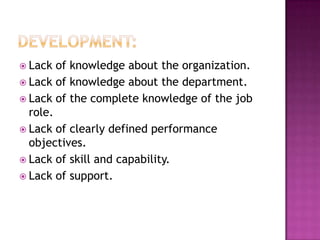
 Lack  of knowledge about the organization.
 Lack of knowledge about the department.
 Lack of the complete knowledge of the job
  role.
 Lack of clearly defined performance
  objectives.
 Lack of skill and capability.
 Lack of support.
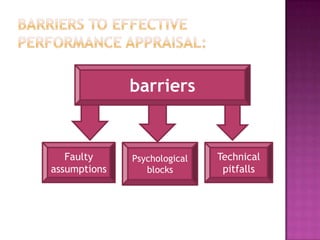
barriers


   Faulty     Psychological   Technical
assumptions      blocks        pitfalls
The assumptions which a manager taking
consider to appraising the employees
performance is fault/ wrong.
    The assumption that managers naturally
    wish to make fair and accurate appraisal of
    subordinate is untenable. Both superior and
    subordinate show tendencies to avoid formal
    appraisal process.
 Particular   appraisal system


 Personal   opinion


 Managers assumptions that employees want to
 know frankly where they do stand and what
 their superiors think about them are not valid.
The utility of performance appraisal depends
upon the psychological characteristic of
managers.
 Managers’   feeling of insecurity

 Appraisal   as an extra burden

 Their  feeling to treat their subordinates
  failure as their deficiency.
 Disliking of resentment by subordinate.
 Disliking of communicating poor performance
  of subordinates.
The main technical difficulties in appraisal
     fall into two categories.

1.    Criterion problem

2.    distortions
A criterion problem is the standard of
performance the managers desires of his
subordinates and against which he compare
their actual performance.
It occur in the form of biases and errors in
making the evaluation.
This distortions exists where the rater is
influenced by ratee’s one or two
outstandingly good (or bad) performance and
he evaluate the entire performance
accordingly.
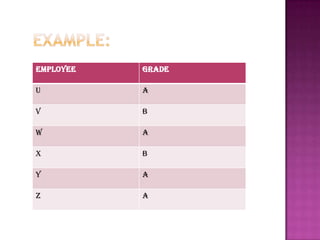
Employee   grade

U          a

v          b

w          a

x          b

y          a

z          A
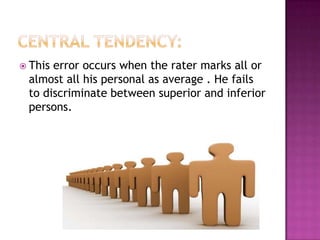
 Thiserror occurs when the rater marks all or
 almost all his personal as average . He fails
 to discriminate between superior and inferior
 persons.
There are easy raters and tough raters in all
phases of life. Some raters habitually rate
everyone high, other tend to rate low. In
such a situation the results of two raters are
hardly comparable.
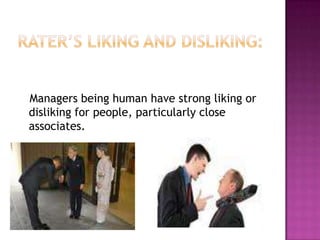
Managers being human have strong liking or
disliking for people, particularly close
associates.
Barriers to effective appraisal

Barriers to effective appraisal

  • 2.
    Barrier: A problem ,rule or situation that prevents somebody from doing something. Appraisal: A judgment of the value , performance or nature of somebody.
  • 3.
    “Performance appraisal isan objective assessment of an individuals’ performance against well defined benchmarks”
  • 4.
    Performance appraisal servesbasically four objective: 1. Identification of individual needs.  Performance feedback.  Determining transfers and job assignments.  Identification of individual strengths and developmental needs.
  • 5.
    2. administrative uses/decisions: Salary  Promotion  Identification of poor performance 3. Organizational maintenance/objective:  H R planning  Evaluation of organizational goal achievement  Reinforcement of organizational development needs
  • 6.
    4. Documentation : Documentation for H R decisions  Helping to meet legal requirements
  • 7.
     Work environment  Supervision  development
  • 8.
     Lack of knowledge about organizational goals, objectives, strategies.  Lack of change management like business changes, processes, systems and procedures.  Lack of understanding of the company vision.
  • 9.
     Lack ofconfidence in the employee’s ability and willingness to solve the problems.  Lack of attentions on the performance problem .  Lack of attention of poor performance immediately.  Lack of understanding of performance appraisal.  Lack of use of performance appraisal feedback.  Lack of direction on the job.
  • 10.
     Lack of knowledge about the organization.  Lack of knowledge about the department.  Lack of the complete knowledge of the job role.  Lack of clearly defined performance objectives.  Lack of skill and capability.  Lack of support.
  • 11.
    barriers Faulty Psychological Technical assumptions blocks pitfalls
  • 12.
    The assumptions whicha manager taking consider to appraising the employees performance is fault/ wrong.
  • 13.
    The assumption that managers naturally wish to make fair and accurate appraisal of subordinate is untenable. Both superior and subordinate show tendencies to avoid formal appraisal process.
  • 14.
     Particular appraisal system  Personal opinion  Managers assumptions that employees want to know frankly where they do stand and what their superiors think about them are not valid.
  • 15.
    The utility ofperformance appraisal depends upon the psychological characteristic of managers.
  • 16.
     Managers’ feeling of insecurity  Appraisal as an extra burden  Their feeling to treat their subordinates failure as their deficiency.  Disliking of resentment by subordinate.  Disliking of communicating poor performance of subordinates.
  • 17.
    The main technicaldifficulties in appraisal fall into two categories. 1. Criterion problem 2. distortions
  • 18.
    A criterion problemis the standard of performance the managers desires of his subordinates and against which he compare their actual performance.
  • 19.
    It occur inthe form of biases and errors in making the evaluation.
  • 20.
    This distortions existswhere the rater is influenced by ratee’s one or two outstandingly good (or bad) performance and he evaluate the entire performance accordingly.
  • 21.
    Employee grade U a v b w a x b y a z A
  • 22.
     Thiserror occurswhen the rater marks all or almost all his personal as average . He fails to discriminate between superior and inferior persons.
  • 23.
    There are easyraters and tough raters in all phases of life. Some raters habitually rate everyone high, other tend to rate low. In such a situation the results of two raters are hardly comparable.
  • 24.
    Managers being humanhave strong liking or disliking for people, particularly close associates.