CONCEPT
of
ENTREPRENEURSHIP
Entrepreneurs: Definitions
Entrepreneur is a ‘proprietary capitalist’ that is a
supplier of capital and at the same time working
as a manager intervening between the labour and
consumer. He effectively coordinates productive
resources to attain profit and growth.
He possesses the vision and foresight of
identifying opportunities in a changing
environment and becomes an economic agent
who transforms demand in to supply for profits.
4/19/2013 6:34 AM2 Concept of Entrepreneurship
UNDERSTANDING OF THE TERM
 The word is derived from the French word
‘entreprendre’ which means ‘undertakers’.
 The word referred to those who undertook the
risk of starting a new enterprise.
 The word entrepreneurship has a very wide range
of meaning. In one extreme, an entrepreneur is
one who pioneers a change and in the other
extreme he is one who works for himself.
 Entrepreneurship is among the four mainstream
economic factors – land, labour, capital and
entrepreneurship.
4/19/2013 6:34 AM3 Concept of Entrepreneurship
 According to Richard Cantillon (1755) a French
economist introduced the concept of
entrepreneurship in economics.
 As per him an entrepreneur is one who buys a
product, repacks and transforms the farm’s
produce to market and then sells it at uncertain
price.
 Thus he takes decisions regarding resource
allocation and bears the consequential risks.
 He evidently seeks best opportunities for highest
yields/profit.
4/19/2013 6:34 AM4 Concept of Entrepreneurship
According to Adam Smith (1776) entrepreneurs
were ‘economic change agents’ who reacted to
environmental changes.
 They were agents who converted new demand in
to supply.
 Entrepreneur was a ‘proprietary capitalist’ that
is a supplier of capital and at the same time
working as a manager intervening between the
labour and consumer.
4/19/2013 6:34 AM5 Concept of Entrepreneurship
Definition-
Entrepreneurship is a multi-dimensional task
defined differently by different authorities.
There is no indisputable definition of
entrepreneurship. Some are discussed below:
 The American Heritage Dictionary defines an
entrepreneur to be "a person who
organizes, operates, and assumes the risk for
business ventures."
 Sociologists assert that entrepreneur brings in
overall change through innovation for the good of
the society. He contributes in modernizing society.
4/19/2013 6:34 AM6 Concept of Entrepreneurship
According to Joseph Schumpeter (1950)
entrepreneur is one who coverts a new invention or
idea in to successful innovation.
He said that entrepreneurs are the business leaders
not simple owners of capital.
 Schumpeter in his definition made the distinction
between entrepreneurs and inventors clear.
The inventor might create a new product but the
entrepreneur gathers resources, organizes talent and
provides leadership to make the venture a
commercial success.
4/19/2013 6:34 AM7 Concept of Entrepreneurship
 In Peter Drucker’s view (1985) – Entrepreneurship is
neither a science nor a art. It is a practice. It is not just
about making money. It is all about imagination,
flexibility, creativity, willingness to think conceptually,
readiness to take risk.
 Acc to H.N.Pathak- Entrepreneurship involves
1.Perceptoin of an opportunities.
2.organizing an industrial unit.
3.Running the industrial unit as profitable, going &
growing concern.
4/19/2013 6:34 AM8 Concept of Entrepreneurship
WHO CAN BE CALLED AN ENTREPRENEUR?
Let us first start with some questions:
 Is a fruit vendor an entrepreneur?
 Were G.D. Birla, Jamnalal Bajaj, Laxmanrao
Kirloskar entrepreuners?
 Was Ohno the GM of Toyota Motors who
introduced many innovative measures that
revolutionized automobile industry an
entrepreneur?
4/19/2013 6:34 AM9 Concept of Entrepreneurship
 Now founders of small industries/ small business,
trading establishments etc are loosely termed as
entrepreneurs.
 They might have the attributes of an entrepreneur
but they are not entrepreneurs in the purest
sense of the term, if they have not innovated.
 They can just be called businessmen with
entrepreneurial attributes of risk taking and
organizing.
4/19/2013 6:34 AM10 Concept of Entrepreneurship
 Professionals in corporate organizations often
exhibit high degree of innovativeness. But they
cannot be called entrepreneurs because they are
essentially salaried employees.
 This form of corporate entrepreneurship also
called ‘Intrapreneurship’ emerges within existing
enterprise.
 Intraprenurs introduce innovative ideas in the
organizations they work for and thus add great
value.
4/19/2013 6:34 AM11 Concept of Entrepreneurship
Few examples-
(for a better understanding of the terms entrepreneurship
and innovation)
1. Mary Quant, the English fashion
designer, arguably invented the miniskirt in the
sixties. But she definitely was the first to
name, market and popularize the product. Skirts
were not a new outfit but her redefining the
hemline and popularizing it was innovative
enough to call her an entrepreneur.
4/19/2013 6:34 AM12 Concept of Entrepreneurship
2. Jeff Bezos, the founder of Amazon (a Web-based
bookstore) was the fist to sell books online on a large
scale and patented the one-click system for online
buying. Though selling books is not an innovation in itself,
Jeff Bezos was innovative in the use of the Internet as a
viable marketing and sales channel for selling books.
So an individual could be termed as an entrepreneur if he
or she sells a product or service using new systems and/
or mediums of marketing, distribution or production
methods as a basis for a new business venture.
4/19/2013 6:34 AM13 Concept of Entrepreneurship
3. Stuart Skorman was the founder of Reel.com, which
is essentially one of the first cyber movie stores. It has
a very large inventory of over a 100 000 videos.
Though setting a movie store was revolutionary then,
Reel.com main distinction was being known as the
first online store to expand by opening an offline
store. Stuart Skorman felt that by doing so, the online
store could be an advertisement for the offline store
and vice versa, thus strengthening this click and
mortar business venture.
It was an example of creativity and innovation in the
field of e-commerce.
4/19/2013 6:34 AM14 Concept of Entrepreneurship
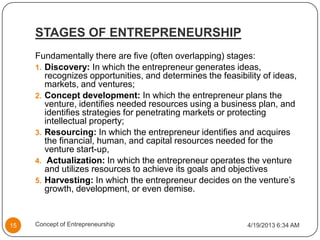
STAGES OF ENTREPRENEURSHIP
Fundamentally there are five (often overlapping) stages:
1. Discovery: In which the entrepreneur generates ideas,
recognizes opportunities, and determines the feasibility of ideas,
markets, and ventures;
2. Concept development: In which the entrepreneur plans the
venture, identifies needed resources using a business plan, and
identifies strategies for penetrating markets or protecting
intellectual property;
3. Resourcing: In which the entrepreneur identifies and acquires
the financial, human, and capital resources needed for the
venture start-up,
4. Actualization: In which the entrepreneur operates the venture
and utilizes resources to achieve its goals and objectives
5. Harvesting: In which the entrepreneur decides on the venture’s
growth, development, or even demise.
4/19/2013 6:34 AM15 Concept of Entrepreneurship
BENEFITS OF ENTREPRENEURSHIP
Benefits of entrepreneurial activities are immense both in terms
of personal growth and contribution to the society. Only a few
have been listed below:
 Opportunity of huge personal financial gain.
 Scope of high order of Job satisfaction, sense of
achievement, self employment.
 Generation of employment / income for others.
 Contribution to overall growth in the region/ nation /world
 Encourages higher quality products.
 Development of new products and markets.
 Contribution towards growth and promotion of the use of
modern technology.
4/19/2013 6:34 AM16 Concept of Entrepreneurship
4/19/2013 6:34 AM17 Concept of Entrepreneurship
4/19/2013 6:34 AM18 Concept of Entrepreneurship

Concep tof entrepreneurship

  • 1.
  • 2.
    Entrepreneurs: Definitions Entrepreneur isa ‘proprietary capitalist’ that is a supplier of capital and at the same time working as a manager intervening between the labour and consumer. He effectively coordinates productive resources to attain profit and growth. He possesses the vision and foresight of identifying opportunities in a changing environment and becomes an economic agent who transforms demand in to supply for profits. 4/19/2013 6:34 AM2 Concept of Entrepreneurship
  • 3.
    UNDERSTANDING OF THETERM  The word is derived from the French word ‘entreprendre’ which means ‘undertakers’.  The word referred to those who undertook the risk of starting a new enterprise.  The word entrepreneurship has a very wide range of meaning. In one extreme, an entrepreneur is one who pioneers a change and in the other extreme he is one who works for himself.  Entrepreneurship is among the four mainstream economic factors – land, labour, capital and entrepreneurship. 4/19/2013 6:34 AM3 Concept of Entrepreneurship
  • 4.
     According toRichard Cantillon (1755) a French economist introduced the concept of entrepreneurship in economics.  As per him an entrepreneur is one who buys a product, repacks and transforms the farm’s produce to market and then sells it at uncertain price.  Thus he takes decisions regarding resource allocation and bears the consequential risks.  He evidently seeks best opportunities for highest yields/profit. 4/19/2013 6:34 AM4 Concept of Entrepreneurship
  • 5.
    According to AdamSmith (1776) entrepreneurs were ‘economic change agents’ who reacted to environmental changes.  They were agents who converted new demand in to supply.  Entrepreneur was a ‘proprietary capitalist’ that is a supplier of capital and at the same time working as a manager intervening between the labour and consumer. 4/19/2013 6:34 AM5 Concept of Entrepreneurship
  • 6.
    Definition- Entrepreneurship is amulti-dimensional task defined differently by different authorities. There is no indisputable definition of entrepreneurship. Some are discussed below:  The American Heritage Dictionary defines an entrepreneur to be "a person who organizes, operates, and assumes the risk for business ventures."  Sociologists assert that entrepreneur brings in overall change through innovation for the good of the society. He contributes in modernizing society. 4/19/2013 6:34 AM6 Concept of Entrepreneurship
  • 7.
    According to JosephSchumpeter (1950) entrepreneur is one who coverts a new invention or idea in to successful innovation. He said that entrepreneurs are the business leaders not simple owners of capital.  Schumpeter in his definition made the distinction between entrepreneurs and inventors clear. The inventor might create a new product but the entrepreneur gathers resources, organizes talent and provides leadership to make the venture a commercial success. 4/19/2013 6:34 AM7 Concept of Entrepreneurship
  • 8.
     In PeterDrucker’s view (1985) – Entrepreneurship is neither a science nor a art. It is a practice. It is not just about making money. It is all about imagination, flexibility, creativity, willingness to think conceptually, readiness to take risk.  Acc to H.N.Pathak- Entrepreneurship involves 1.Perceptoin of an opportunities. 2.organizing an industrial unit. 3.Running the industrial unit as profitable, going & growing concern. 4/19/2013 6:34 AM8 Concept of Entrepreneurship
  • 9.
    WHO CAN BECALLED AN ENTREPRENEUR? Let us first start with some questions:  Is a fruit vendor an entrepreneur?  Were G.D. Birla, Jamnalal Bajaj, Laxmanrao Kirloskar entrepreuners?  Was Ohno the GM of Toyota Motors who introduced many innovative measures that revolutionized automobile industry an entrepreneur? 4/19/2013 6:34 AM9 Concept of Entrepreneurship
  • 10.
     Now foundersof small industries/ small business, trading establishments etc are loosely termed as entrepreneurs.  They might have the attributes of an entrepreneur but they are not entrepreneurs in the purest sense of the term, if they have not innovated.  They can just be called businessmen with entrepreneurial attributes of risk taking and organizing. 4/19/2013 6:34 AM10 Concept of Entrepreneurship
  • 11.
     Professionals incorporate organizations often exhibit high degree of innovativeness. But they cannot be called entrepreneurs because they are essentially salaried employees.  This form of corporate entrepreneurship also called ‘Intrapreneurship’ emerges within existing enterprise.  Intraprenurs introduce innovative ideas in the organizations they work for and thus add great value. 4/19/2013 6:34 AM11 Concept of Entrepreneurship
  • 12.
    Few examples- (for abetter understanding of the terms entrepreneurship and innovation) 1. Mary Quant, the English fashion designer, arguably invented the miniskirt in the sixties. But she definitely was the first to name, market and popularize the product. Skirts were not a new outfit but her redefining the hemline and popularizing it was innovative enough to call her an entrepreneur. 4/19/2013 6:34 AM12 Concept of Entrepreneurship
  • 13.
    2. Jeff Bezos,the founder of Amazon (a Web-based bookstore) was the fist to sell books online on a large scale and patented the one-click system for online buying. Though selling books is not an innovation in itself, Jeff Bezos was innovative in the use of the Internet as a viable marketing and sales channel for selling books. So an individual could be termed as an entrepreneur if he or she sells a product or service using new systems and/ or mediums of marketing, distribution or production methods as a basis for a new business venture. 4/19/2013 6:34 AM13 Concept of Entrepreneurship
  • 14.
    3. Stuart Skormanwas the founder of Reel.com, which is essentially one of the first cyber movie stores. It has a very large inventory of over a 100 000 videos. Though setting a movie store was revolutionary then, Reel.com main distinction was being known as the first online store to expand by opening an offline store. Stuart Skorman felt that by doing so, the online store could be an advertisement for the offline store and vice versa, thus strengthening this click and mortar business venture. It was an example of creativity and innovation in the field of e-commerce. 4/19/2013 6:34 AM14 Concept of Entrepreneurship
  • 15.
    STAGES OF ENTREPRENEURSHIP Fundamentallythere are five (often overlapping) stages: 1. Discovery: In which the entrepreneur generates ideas, recognizes opportunities, and determines the feasibility of ideas, markets, and ventures; 2. Concept development: In which the entrepreneur plans the venture, identifies needed resources using a business plan, and identifies strategies for penetrating markets or protecting intellectual property; 3. Resourcing: In which the entrepreneur identifies and acquires the financial, human, and capital resources needed for the venture start-up, 4. Actualization: In which the entrepreneur operates the venture and utilizes resources to achieve its goals and objectives 5. Harvesting: In which the entrepreneur decides on the venture’s growth, development, or even demise. 4/19/2013 6:34 AM15 Concept of Entrepreneurship
  • 16.
    BENEFITS OF ENTREPRENEURSHIP Benefitsof entrepreneurial activities are immense both in terms of personal growth and contribution to the society. Only a few have been listed below:  Opportunity of huge personal financial gain.  Scope of high order of Job satisfaction, sense of achievement, self employment.  Generation of employment / income for others.  Contribution to overall growth in the region/ nation /world  Encourages higher quality products.  Development of new products and markets.  Contribution towards growth and promotion of the use of modern technology. 4/19/2013 6:34 AM16 Concept of Entrepreneurship
  • 17.
    4/19/2013 6:34 AM17Concept of Entrepreneurship
  • 18.
    4/19/2013 6:34 AM18Concept of Entrepreneurship