Systematic reviews
What is a systematic review? It is a  structured  review integrating pooling the results ( Meta-analysis )  of individual studies addressing the same topic.
Systematic Review structured : for consistent presentation of information Meta-Analysis : combine and statistically summarize the results of individual studies
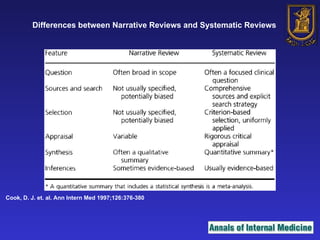
Cook, D. J. et. al. Ann Intern Med 1997;126:376-380 Differences between Narrative Reviews and Systematic Reviews
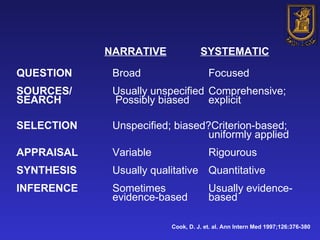
QUESTION Broad Focused SOURCES/ Usually unspecified Comprehensive;    SEARCH    Possibly biased  explicit SELECTION   Unspecified; biased?Criterion-based; uniformly applied APPRAISAL Variable Rigourous SYNTHESIS Usually qualitative Quantitative INFERENCE  Sometimes  Usually evidence-   evidence-based based NARRATIVE SYSTEMATIC Cook, D. J. et. al. Ann Intern Med 1997;126:376-380
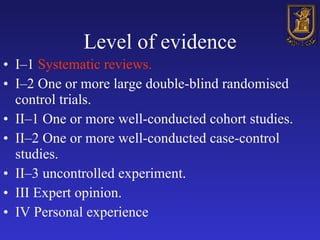
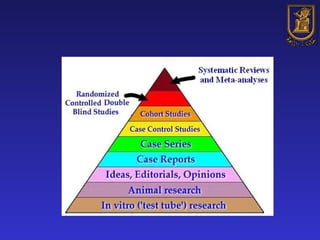
Level of evidence I–1  Systematic reviews. I–2 One or more large double-blind randomised control trials. II–1 One or more well-conducted cohort studies. II–2 One or more well-conducted case-control studies. II–3 uncontrolled experiment. III Expert opinion. IV Personal experience
 
Why on the Top Rigorous  methodology Peer reviewed Relatively large sample size Ensures the highest quality evidence
Why do we need it Too much trials 25000 biomedical journals in print 8000 articles published per day All studies not equally well designed or interpreted
So , we need a study of studies To summarize evidence from studies that address a specific clinical question.  to explain differences among studies on the same question In a way that limit bias (rigorous methodology & clear reporting)
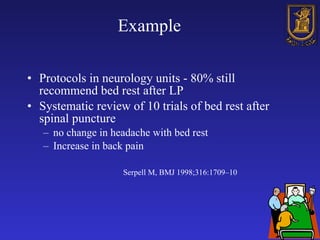
Example Protocols in neurology units - 80% still recommend bed rest after LP Systematic review of 10 trials  of bed rest  after spinal puncture  no  change in headache with  bed rest Increase in back pain   Serpell M, BMJ 1998;316:1709–10
Why do we need it many single trials had relatively low power   avoid Type II error: Investigators did not detect a difference when a difference actually exists  This is not surprising as the power to detect a difference will have been increased by the increase in the sample size
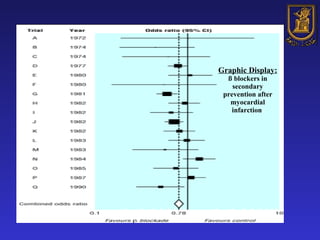
Graphic Display: ß blockers in secondary prevention after myocardial infarction .
Why do we need it Systematic reviews help us to avoid the personal bias inherent in traditional reviews and expert opinion
Why do we need it  Example Mitchell JRA. Timolol after myocardial infarction: an answer or a new set of questions? BMJ  1981 ; 282:1565-70 : "despite claims that they reduce arrhythmias, cardiac work, and infarct size, we still have  no clear evidence  that ß blockers improve long-term survival after infarction  despite almost 20 years of clinical trials."
Cumulative Meta-analysis
Why do we need it Results from systematic reviews are the cornerstone for developing practice guidelines
 
Cochrane Library The current resource with the highest methodological rigor $235/year or abstracts only www.cochrane.org Specific point: e.g role of albumin in OHSS
Abstract Background Objectives Criteria for considering studies for this review Types of participants Types of intervention Types of outcome measures Types of studies Search strategy for identification of studies Methods of the review Description of the studies Methodological qualities of included studies Results Discussion Conclusions Implications for practice Implications for research Internal sources of support to the review External sources of support to the review Potential conflict of interest Acknowledgements Contribution of Reviewer(s) Synopsis Characteristics of included studies Table 01 results References to studies included in this review Additional references   Typical Systematic Review “Skeleton”
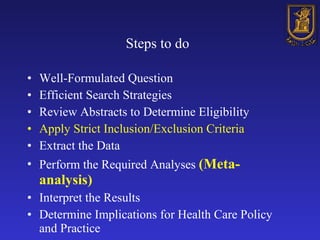
Steps to do   Well-Formulated Question Efficient Search Strategies Review Abstracts to Determine Eligibility Apply Strict Inclusion/Exclusion Criteria Extract the Data Perform the Required Analyses  (Meta-analysis) Interpret the Results Determine Implications for Health Care Policy and Practice
Methodology At least 3 reviewers 7 peer reviewers Trial design characteristics Why included / excluded Quality of included studies in details
Some Controversies About Meta-Analysis Quality of Studies Many Small Studies or One Big Study? Publication Bias
Retrospective Try to make it prospective the  first prospective  systematic review in the entire field of gynecology .  (Al-Inany & Aboulghar)
Repeat the analysis Excluding the unpublished studies (if there were any) Excluding studies of the lowest quality If there were one or more very large studies, the analysis would be repeated excluding them to look at how much they dominate the results.

Meta-analysis vs. a “Mega-study” Single large studies are liable to: Long duration Huge funding a drug that reduces mortality by 10% from myocardial infarction may need a study including 10.000 patient Generalizability of results can be questioned .


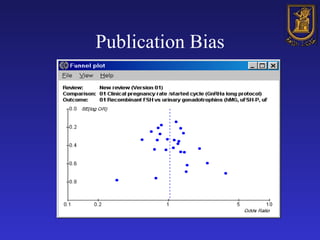
Publication Bias
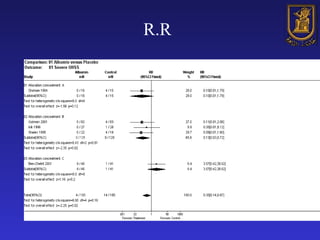
Human Albumin Model The objective was to review the effectiveness of human albumin administration in prevention of severe ovarian hyperstimulation syndrome
Search strategy MEDLINE,  EMBASE,  The MDSG specialised register Abstracts from conferences handsearching of core journals  contact with authors of relevant papers.
Selection criteria Only randomised controlled studies
R.R
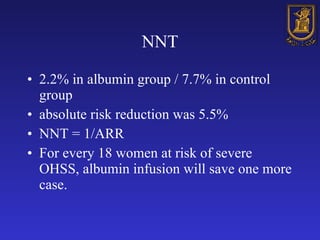
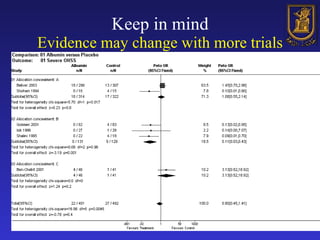
NNT 2.2% in albumin group / 7.7% in control group absolute risk reduction was 5.5% NNT = 1/ARR For every 18 women at risk of severe OHSS, albumin infusion will save one more case.
Caution Whether this NNT would justify the routine use of albumin infusion in cases at risk of severe OHSS needs to be judged by clinical decision makers.
Keep in mind Evidence may change with more trials
challenges for systematic reviews Evidence into practice Many interventions reviewed cannot be implemented in resource-poor situations
Developing Countries Most interventions reviewed so far don’t reflect developing world priorities very few studies that have been conducted in a developing country Most developing country research that  is  found is excluded on quality grounds
Problems in Contribution Lack of EBM awareness Lack of training workshops Lack of Financial resources  Lack of access to information
Major problem “ Applied for grant but was refused on basis of this not being research in real sense and just a review of literature ”
Solutions:  I Systematic reviews are now recognized as a  2ry research Hence, the Cochrane collaboration changed the name of the contributor from  reviewer  to  author
Solutions:  II Address priority topics   it is vital to invest in health care that works (for limited resources) Disseminating the findings of systematic reviews to policymakers
Useful websites Systematic Reviews Training Unit http://www.ich.ucl.ac.uk/srtu NHS Centre for Reviews & Dissemination http://www.york.ac.uk/inst/crd/welcome.htm Centre for Evidence-Based Medicine http://cebm.jr2.ox.ac.uk/
Thank You

Systematic review

  • 1.
  • 2.
    What is asystematic review? It is a structured review integrating pooling the results ( Meta-analysis ) of individual studies addressing the same topic.
  • 3.
    Systematic Review structured: for consistent presentation of information Meta-Analysis : combine and statistically summarize the results of individual studies
  • 4.
    Cook, D. J.et. al. Ann Intern Med 1997;126:376-380 Differences between Narrative Reviews and Systematic Reviews
  • 5.
    QUESTION Broad FocusedSOURCES/ Usually unspecified Comprehensive; SEARCH Possibly biased explicit SELECTION Unspecified; biased?Criterion-based; uniformly applied APPRAISAL Variable Rigourous SYNTHESIS Usually qualitative Quantitative INFERENCE Sometimes Usually evidence- evidence-based based NARRATIVE SYSTEMATIC Cook, D. J. et. al. Ann Intern Med 1997;126:376-380
  • 6.
    Level of evidenceI–1 Systematic reviews. I–2 One or more large double-blind randomised control trials. II–1 One or more well-conducted cohort studies. II–2 One or more well-conducted case-control studies. II–3 uncontrolled experiment. III Expert opinion. IV Personal experience
  • 7.
  • 8.
    Why on theTop Rigorous methodology Peer reviewed Relatively large sample size Ensures the highest quality evidence
  • 9.
    Why do weneed it Too much trials 25000 biomedical journals in print 8000 articles published per day All studies not equally well designed or interpreted
  • 10.
    So , weneed a study of studies To summarize evidence from studies that address a specific clinical question. to explain differences among studies on the same question In a way that limit bias (rigorous methodology & clear reporting)
  • 11.
    Example Protocols inneurology units - 80% still recommend bed rest after LP Systematic review of 10 trials of bed rest after spinal puncture no change in headache with bed rest Increase in back pain Serpell M, BMJ 1998;316:1709–10
  • 12.
    Why do weneed it many single trials had relatively low power avoid Type II error: Investigators did not detect a difference when a difference actually exists This is not surprising as the power to detect a difference will have been increased by the increase in the sample size
  • 13.
    Graphic Display: ßblockers in secondary prevention after myocardial infarction .
  • 14.
    Why do weneed it Systematic reviews help us to avoid the personal bias inherent in traditional reviews and expert opinion
  • 15.
    Why do weneed it Example Mitchell JRA. Timolol after myocardial infarction: an answer or a new set of questions? BMJ 1981 ; 282:1565-70 : "despite claims that they reduce arrhythmias, cardiac work, and infarct size, we still have no clear evidence that ß blockers improve long-term survival after infarction despite almost 20 years of clinical trials."
  • 16.
  • 17.
    Why do weneed it Results from systematic reviews are the cornerstone for developing practice guidelines
  • 18.
  • 19.
    Cochrane Library Thecurrent resource with the highest methodological rigor $235/year or abstracts only www.cochrane.org Specific point: e.g role of albumin in OHSS
  • 20.
    Abstract Background ObjectivesCriteria for considering studies for this review Types of participants Types of intervention Types of outcome measures Types of studies Search strategy for identification of studies Methods of the review Description of the studies Methodological qualities of included studies Results Discussion Conclusions Implications for practice Implications for research Internal sources of support to the review External sources of support to the review Potential conflict of interest Acknowledgements Contribution of Reviewer(s) Synopsis Characteristics of included studies Table 01 results References to studies included in this review Additional references Typical Systematic Review “Skeleton”
  • 21.
    Steps to do Well-Formulated Question Efficient Search Strategies Review Abstracts to Determine Eligibility Apply Strict Inclusion/Exclusion Criteria Extract the Data Perform the Required Analyses (Meta-analysis) Interpret the Results Determine Implications for Health Care Policy and Practice
  • 22.
    Methodology At least3 reviewers 7 peer reviewers Trial design characteristics Why included / excluded Quality of included studies in details
  • 23.
    Some Controversies AboutMeta-Analysis Quality of Studies Many Small Studies or One Big Study? Publication Bias
  • 24.
    Retrospective Try tomake it prospective the first prospective systematic review in the entire field of gynecology . (Al-Inany & Aboulghar)
  • 25.
    Repeat the analysisExcluding the unpublished studies (if there were any) Excluding studies of the lowest quality If there were one or more very large studies, the analysis would be repeated excluding them to look at how much they dominate the results.
  • 26.
    Meta-analysis vs. a“Mega-study” Single large studies are liable to: Long duration Huge funding a drug that reduces mortality by 10% from myocardial infarction may need a study including 10.000 patient Generalizability of results can be questioned .
  • 27.
  • 28.
    Human Albumin ModelThe objective was to review the effectiveness of human albumin administration in prevention of severe ovarian hyperstimulation syndrome
  • 29.
    Search strategy MEDLINE, EMBASE, The MDSG specialised register Abstracts from conferences handsearching of core journals contact with authors of relevant papers.
  • 30.
    Selection criteria Onlyrandomised controlled studies
  • 31.
  • 32.
    NNT 2.2% inalbumin group / 7.7% in control group absolute risk reduction was 5.5% NNT = 1/ARR For every 18 women at risk of severe OHSS, albumin infusion will save one more case.
  • 33.
    Caution Whether thisNNT would justify the routine use of albumin infusion in cases at risk of severe OHSS needs to be judged by clinical decision makers.
  • 34.
    Keep in mindEvidence may change with more trials
  • 35.
    challenges for systematicreviews Evidence into practice Many interventions reviewed cannot be implemented in resource-poor situations
  • 36.
    Developing Countries Mostinterventions reviewed so far don’t reflect developing world priorities very few studies that have been conducted in a developing country Most developing country research that is found is excluded on quality grounds
  • 37.
    Problems in ContributionLack of EBM awareness Lack of training workshops Lack of Financial resources Lack of access to information
  • 38.
    Major problem “Applied for grant but was refused on basis of this not being research in real sense and just a review of literature ”
  • 39.
    Solutions: ISystematic reviews are now recognized as a 2ry research Hence, the Cochrane collaboration changed the name of the contributor from reviewer to author
  • 40.
    Solutions: IIAddress priority topics it is vital to invest in health care that works (for limited resources) Disseminating the findings of systematic reviews to policymakers
  • 41.
    Useful websites SystematicReviews Training Unit http://www.ich.ucl.ac.uk/srtu NHS Centre for Reviews & Dissemination http://www.york.ac.uk/inst/crd/welcome.htm Centre for Evidence-Based Medicine http://cebm.jr2.ox.ac.uk/
  • 42.

Editor's Notes

  • #4 Just read the slide – and try to elicit answers.
  • #10 The lag period between publication of research findings demonstrating clinical effectiveness and the subsequent implementation in clinical practice is well recognized. Practitioners continue to base clinical decisions on outdated training and on experience with individual patients.