Systematic Reviews Susan Fowler, MLIS Medical Librarian [email_address] 314-362-8092 pg: 314-360-1069
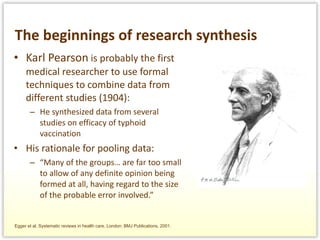
The beginnings of research synthesis Karl Pearson  is probably the first medical researcher to use formal techniques to combine data from different studies (1904): He synthesized data from several studies on efficacy of typhoid vaccination His rationale for pooling data: “ Many of the groups… are far too small to allow of any definite opinion being formed at all, having regard to the size of the probable error involved.” Egger et al. Systematic reviews in health care. London: BMJ Publications, 2001.
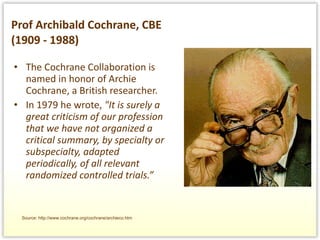
Prof Archibald Cochrane, CBE  (1909 - 1988) The Cochrane Collaboration is named in honor of Archie Cochrane, a British researcher. In 1979 he wrote,  "It is surely a great criticism of our profession that we have not organized a critical summary, by specialty or subspecialty, adapted periodically, of all relevant randomized controlled trials.” Source: http://www.cochrane.org/cochrane/archieco.htm
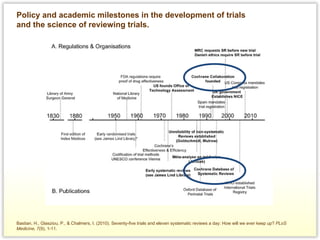
Bastian, H., Glasziou, P., & Chalmers, I. (2010). Seventy-five trials and eleven systematic reviews a day: How will we ever keep up?  PLoS Medicine, 7 (9), 1-11.  Policy and academic milestones in the development of trials and the science of reviewing trials.
The number of systematic reviews in health care, 1990 to 2007. Bastian, H., Glasziou, P., & Chalmers, I. (2010). Seventy-five trials and eleven systematic reviews a day: How will we ever keep up?  PLoS Medicine, 7 (9), 1-11.
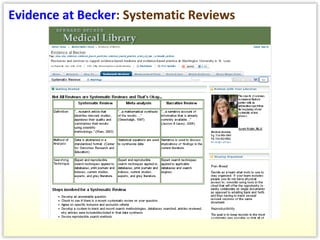
Evidence at Becker : Systematic Reviews
Reproducibility A systematic review is just like any other kind of research which means that an independent party can read your lab notes, execute the same actions, and return the same results. If you keep this in mind from the beginning, you will have a much easier time later in the process, when you are writing the article for publication, and when you update the review in the future.  Start Out Right, Stay Organized
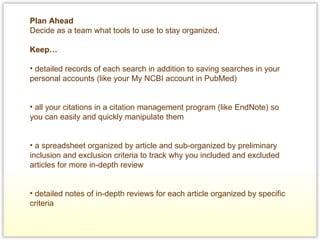
Plan Ahead Decide as a team what tools to use to stay organized.  Keep…   detailed records of each search in addition to saving searches in your personal accounts (like your My NCBI account in PubMed)   all your citations in a citation management program (like EndNote) so you can easily and quickly manipulate them   a spreadsheet organized by article and sub-organized by preliminary inclusion and exclusion criteria to track why you included and excluded articles for more in-depth review   detailed notes of in-depth reviews for each article organized by specific criteria
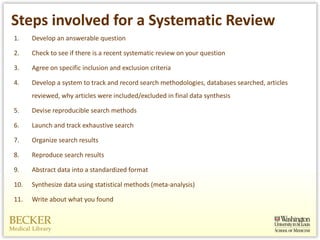
Steps involved for a Systematic Review Develop an answerable question  Check to see if there is a recent systematic review on your question  Agree on specific inclusion and exclusion criteria  Develop a system to track and record search methodologies, databases searched, articles reviewed, why articles were included/excluded in final data synthesis  Devise reproducible search methods  Launch and track exhaustive search  Organize search results  Reproduce search results  Abstract data into a standardized format Synthesize data using statistical methods (meta-analysis)   Write about what you found  
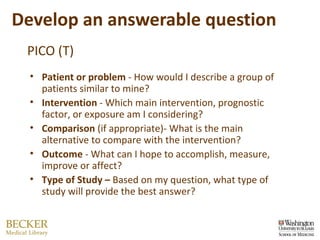
Develop an answerable question PICO (T) Patient or problem  - How would I describe a group of patients similar to mine? Intervention  - Which main intervention, prognostic factor, or exposure am I considering? Comparison  (if appropriate)- What is the main alternative to compare with the intervention? Outcome  - What can I hope to accomplish, measure, improve or affect? Type of Study –  Based on my question, what type of study will provide the best answer?
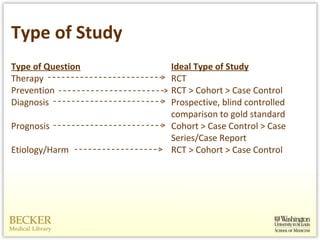
Type of Study Type of Question Ideal Type of Study Therapy  RCT Prevention RCT > Cohort > Case Control Diagnosis Prospective, blind controlled comparison to gold standard Prognosis Cohort > Case Control > Case  Series/Case Report Etiology/Harm RCT > Cohort > Case Control
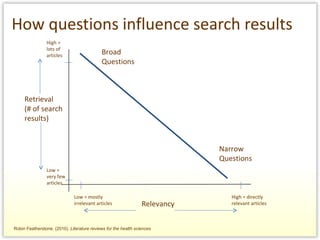
How questions influence search results Robin Featherstone. (2010).  Literature reviews for the health sciences Relevancy Retrieval (# of search results) Broad Questions Narrow Questions High = lots of articles Low = very few articles High = directly relevant articles Low = mostly irrelevant articles
“ A high level of expertise is required to understand the technical aspects of data structure and databases, to narrow the search to manageable numbers without losing relevant citations, to access the gray  literature, to manage the references, and to document retrieval methods for the eventual write-up of the review. It is advisable to have a professional medical librarian or information specialist set up the search terms, using the key words you have identified, and conduct the search [2,27].” Access the evidence Haines, T., McKnight, L., Duku, E., Perry, L., & Thoma, A. (2008). The role of systematic reviews in clinical research and practice.  Clinics in Plastic Surgery, 35 (2), 207-214.
For your search to be thorough, you will need to search several databases like…  Medline Embase CINAHL CENTRAL Health Services/Technology Assessment (HSTAT) Grey Literature… CADTH Mednar Proquest Dissertations and Thesis Current Trials – clinicaltrials.gov Hand search print indexes, journal table of contents, and bibliographies  Contact experts in the field Thoroughness
Appraise the evidence How to appraise evidence depends on the type of publication … FRISBE for Therapy… F – Follow Up R – Randomized  I – Intention to Treat S – Similar baseline characteristics in participants B – Blinded E – Equal – aside from intervention, were participants treated equally
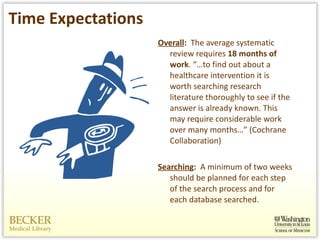
Time Expectations Overall :  The average systematic review requires  18 months of work . “…to find out about a healthcare intervention it is worth searching research literature thoroughly to see if the answer is already known. This may require considerable work over many months…” (Cochrane Collaboration) Searching :  A minimum of two weeks should be planned for each step of the search process and for each database searched.
Resources Cochrane Collaboration   Cochrane Handbook for Systematic Reviews of Interventions   How to read a paper.  Greenhalgh, T.;  BMJ, 315  (1997)   Johns Hopkins Evidence-Based Practice Center   Systematic reviews to support evidence-based medicine : How to review and apply findings of healthcare research . Khan, K. S.; London ; Lake Forest, IL: Royal Society of Medicine Press. (2003)   Systematic Reviews: CRD’s guidance for undertaking reviews in health care   Paul Glasziou, Les Irwig, Chris Bain. (2001).  Systematic reviews in health care: A practical guide  Cambridge University Press.  References  Allen, I. E., & Olkin, I. (1999). Estimating time to conduct a meta-analysis from number of citations retrieved.  JAMA, 282 , 634-635.  Center for Outcomes Research and Education.  ResearchCORE.org.  Retrieved July/27, 2009, from  http://www.researchcore.org/faq/answers.php?recID=5 Cochrane Collaboration.  Cochrane and systematic reviews.  Retrieved July 6, 2009, from  http://www.cochrane.org/consumers/sysrev.htm Grant, M. J., & Booth, A. (2009). A typology of reviews: An analysis of 14 review types and associated methodologies.  Health Information & Libraries Journal, 26 (2), 91. Greenhalgh, T. (1997). How to read a paper: Papers that summarise other papers.  BMJ, 315 , 596-599.  Haines, T., McKnight, L., Duku, E., Perry, L., & Thoma, A. (2008). The role of systematic reviews in clinical research and practice.  Clinics in Plastic Surgery, 35 (2), 207-214.  Higgins, J., Green, S., Prof, Cochrane Collaboration & NetLibrary, I. (2008).  Cochrane handbook for systematic reviews of interventions.   http://www.cochrane-handbook.org/ Jesson, J., & Lacey, F. (2006). How to do (or not to do) a critical literature review;  Pharmacy Education, 6 (2), 139-148.  Khan, K. S. (2003).  Systematic reviews to support evidence-based medicine : How to review and apply findings of healthcare research . London ; Lake Forest, IL: Royal Society of Medicine Press.  Manchikanti, L., Benyamin, R. M., Helm, S., & Hirsch, J. A. (2009). Evidence-based medicine, systematic reviews, and guidelines in interventional pain management: Part 3: Systematic reviews and meta-analyses of randomized trials.  Pain Physician, 12 (1), 35-72.  McGowan, J., & Sampson, M. (2005). Systematic reviews need systematic searchers;  Journal of the Medical Library Association, 93 (1), 74-80.  Shell, L., Hofstetter, S., Carlock, D., & Amani, J. (2006). Survivor's guide for the novice: A simplified model for a collaborative systematic review;  Journal of Hospital Librarianship, 6 (4), 1-12.  University of York, & NHS Centre for Reviews & Dissemination. (2009).  Systematic reviews CRDs guidance for undertaking reviews in healthcare.
Questions?

Systematic reviews

  • 1.
    Systematic Reviews SusanFowler, MLIS Medical Librarian [email_address] 314-362-8092 pg: 314-360-1069
  • 2.
    The beginnings ofresearch synthesis Karl Pearson is probably the first medical researcher to use formal techniques to combine data from different studies (1904): He synthesized data from several studies on efficacy of typhoid vaccination His rationale for pooling data: “ Many of the groups… are far too small to allow of any definite opinion being formed at all, having regard to the size of the probable error involved.” Egger et al. Systematic reviews in health care. London: BMJ Publications, 2001.
  • 3.
    Prof Archibald Cochrane,CBE (1909 - 1988) The Cochrane Collaboration is named in honor of Archie Cochrane, a British researcher. In 1979 he wrote, "It is surely a great criticism of our profession that we have not organized a critical summary, by specialty or subspecialty, adapted periodically, of all relevant randomized controlled trials.” Source: http://www.cochrane.org/cochrane/archieco.htm
  • 4.
    Bastian, H., Glasziou,P., & Chalmers, I. (2010). Seventy-five trials and eleven systematic reviews a day: How will we ever keep up? PLoS Medicine, 7 (9), 1-11. Policy and academic milestones in the development of trials and the science of reviewing trials.
  • 5.
    The number ofsystematic reviews in health care, 1990 to 2007. Bastian, H., Glasziou, P., & Chalmers, I. (2010). Seventy-five trials and eleven systematic reviews a day: How will we ever keep up? PLoS Medicine, 7 (9), 1-11.
  • 6.
    Evidence at Becker: Systematic Reviews
  • 7.
    Reproducibility A systematicreview is just like any other kind of research which means that an independent party can read your lab notes, execute the same actions, and return the same results. If you keep this in mind from the beginning, you will have a much easier time later in the process, when you are writing the article for publication, and when you update the review in the future. Start Out Right, Stay Organized
  • 8.
    Plan Ahead Decideas a team what tools to use to stay organized. Keep…   detailed records of each search in addition to saving searches in your personal accounts (like your My NCBI account in PubMed)   all your citations in a citation management program (like EndNote) so you can easily and quickly manipulate them   a spreadsheet organized by article and sub-organized by preliminary inclusion and exclusion criteria to track why you included and excluded articles for more in-depth review   detailed notes of in-depth reviews for each article organized by specific criteria
  • 9.
    Steps involved fora Systematic Review Develop an answerable question  Check to see if there is a recent systematic review on your question  Agree on specific inclusion and exclusion criteria  Develop a system to track and record search methodologies, databases searched, articles reviewed, why articles were included/excluded in final data synthesis  Devise reproducible search methods  Launch and track exhaustive search  Organize search results  Reproduce search results  Abstract data into a standardized format Synthesize data using statistical methods (meta-analysis)   Write about what you found  
  • 10.
    Develop an answerablequestion PICO (T) Patient or problem - How would I describe a group of patients similar to mine? Intervention - Which main intervention, prognostic factor, or exposure am I considering? Comparison (if appropriate)- What is the main alternative to compare with the intervention? Outcome - What can I hope to accomplish, measure, improve or affect? Type of Study – Based on my question, what type of study will provide the best answer?
  • 11.
    Type of StudyType of Question Ideal Type of Study Therapy RCT Prevention RCT > Cohort > Case Control Diagnosis Prospective, blind controlled comparison to gold standard Prognosis Cohort > Case Control > Case Series/Case Report Etiology/Harm RCT > Cohort > Case Control
  • 12.
    How questions influencesearch results Robin Featherstone. (2010). Literature reviews for the health sciences Relevancy Retrieval (# of search results) Broad Questions Narrow Questions High = lots of articles Low = very few articles High = directly relevant articles Low = mostly irrelevant articles
  • 13.
    “ A highlevel of expertise is required to understand the technical aspects of data structure and databases, to narrow the search to manageable numbers without losing relevant citations, to access the gray literature, to manage the references, and to document retrieval methods for the eventual write-up of the review. It is advisable to have a professional medical librarian or information specialist set up the search terms, using the key words you have identified, and conduct the search [2,27].” Access the evidence Haines, T., McKnight, L., Duku, E., Perry, L., & Thoma, A. (2008). The role of systematic reviews in clinical research and practice. Clinics in Plastic Surgery, 35 (2), 207-214.
  • 14.
    For your searchto be thorough, you will need to search several databases like… Medline Embase CINAHL CENTRAL Health Services/Technology Assessment (HSTAT) Grey Literature… CADTH Mednar Proquest Dissertations and Thesis Current Trials – clinicaltrials.gov Hand search print indexes, journal table of contents, and bibliographies Contact experts in the field Thoroughness
  • 15.
    Appraise the evidenceHow to appraise evidence depends on the type of publication … FRISBE for Therapy… F – Follow Up R – Randomized I – Intention to Treat S – Similar baseline characteristics in participants B – Blinded E – Equal – aside from intervention, were participants treated equally
  • 16.
    Time Expectations Overall: The average systematic review requires 18 months of work . “…to find out about a healthcare intervention it is worth searching research literature thoroughly to see if the answer is already known. This may require considerable work over many months…” (Cochrane Collaboration) Searching : A minimum of two weeks should be planned for each step of the search process and for each database searched.
  • 17.
    Resources Cochrane Collaboration Cochrane Handbook for Systematic Reviews of Interventions How to read a paper. Greenhalgh, T.; BMJ, 315 (1997) Johns Hopkins Evidence-Based Practice Center Systematic reviews to support evidence-based medicine : How to review and apply findings of healthcare research . Khan, K. S.; London ; Lake Forest, IL: Royal Society of Medicine Press. (2003) Systematic Reviews: CRD’s guidance for undertaking reviews in health care Paul Glasziou, Les Irwig, Chris Bain. (2001). Systematic reviews in health care: A practical guide Cambridge University Press. References Allen, I. E., & Olkin, I. (1999). Estimating time to conduct a meta-analysis from number of citations retrieved. JAMA, 282 , 634-635. Center for Outcomes Research and Education. ResearchCORE.org. Retrieved July/27, 2009, from http://www.researchcore.org/faq/answers.php?recID=5 Cochrane Collaboration. Cochrane and systematic reviews. Retrieved July 6, 2009, from http://www.cochrane.org/consumers/sysrev.htm Grant, M. J., & Booth, A. (2009). A typology of reviews: An analysis of 14 review types and associated methodologies. Health Information & Libraries Journal, 26 (2), 91. Greenhalgh, T. (1997). How to read a paper: Papers that summarise other papers. BMJ, 315 , 596-599. Haines, T., McKnight, L., Duku, E., Perry, L., & Thoma, A. (2008). The role of systematic reviews in clinical research and practice. Clinics in Plastic Surgery, 35 (2), 207-214. Higgins, J., Green, S., Prof, Cochrane Collaboration & NetLibrary, I. (2008). Cochrane handbook for systematic reviews of interventions. http://www.cochrane-handbook.org/ Jesson, J., & Lacey, F. (2006). How to do (or not to do) a critical literature review; Pharmacy Education, 6 (2), 139-148. Khan, K. S. (2003). Systematic reviews to support evidence-based medicine : How to review and apply findings of healthcare research . London ; Lake Forest, IL: Royal Society of Medicine Press. Manchikanti, L., Benyamin, R. M., Helm, S., & Hirsch, J. A. (2009). Evidence-based medicine, systematic reviews, and guidelines in interventional pain management: Part 3: Systematic reviews and meta-analyses of randomized trials. Pain Physician, 12 (1), 35-72. McGowan, J., & Sampson, M. (2005). Systematic reviews need systematic searchers; Journal of the Medical Library Association, 93 (1), 74-80. Shell, L., Hofstetter, S., Carlock, D., & Amani, J. (2006). Survivor's guide for the novice: A simplified model for a collaborative systematic review; Journal of Hospital Librarianship, 6 (4), 1-12. University of York, & NHS Centre for Reviews & Dissemination. (2009). Systematic reviews CRDs guidance for undertaking reviews in healthcare.
  • 18.