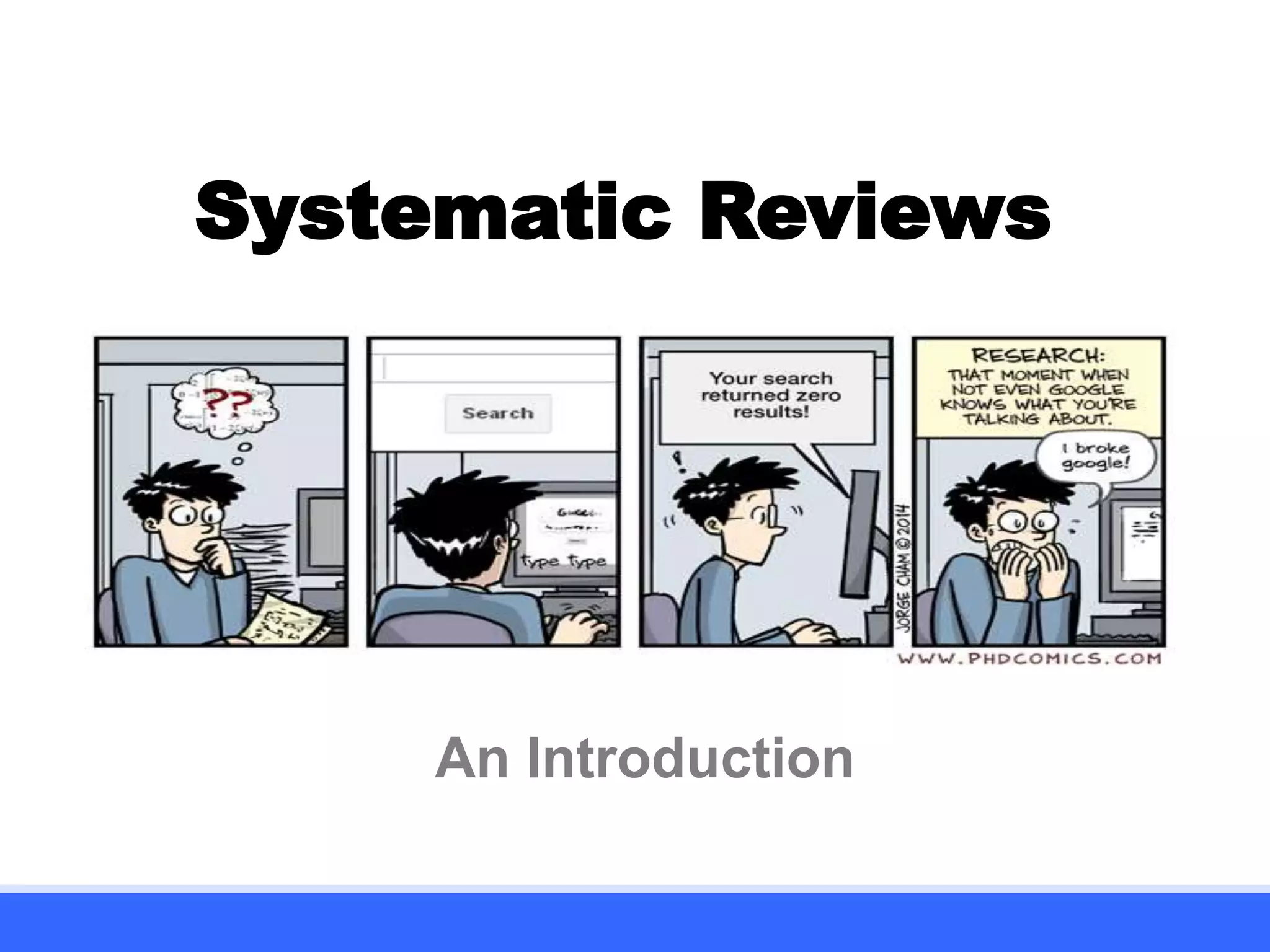
Systematic Reviews
An Introduction
Evidence-based medicine
Definition: “Evidence-Based Medicine is the
integration of the best research evidence
with clinical expertise and patient values”
Straus, S.E. 2011. Evidence-based medicine: how to practice and teach it. 4th ed.
Edinburgh: Churchill Livingstone/Elsevier
Mar 2016
M.Shelton, Health Sciences Library,
UCT
5- Step EBM model
• ASK Formulate an answerable clinical
question
• ACCESS Search for evidence
• APPRAISE Critically evaluate studies in terms
of validity, importance and
applicability
• APPLY Applying evidence to patient care
• ASSESS Evaluation of performance.
M.Shelton, Health Sciences Library, UCTMay 2013
Systematic review uses explicit
methodology to identify, select
and evaluate relevant primary
studies in an attempt to answer
a specific question
Characteristics of a Systematic
Review
• clearly defined question with inclusion and
exclusion criteria; ask
• systematic search of the literature; access
• critical appraisal of included studies; appraise
• data extraction and management; synthesize
• analysis and interpretation of results; interpret
• report for publication
http://guides.mclibrary.duke.edu/sysreview
Literature Review vs
Systematic Review
• Literature review puts your research in context of
past and existing research, supports your thesis.
• Literature review can also stand alone – qualitative
overview of research on a topic
• Systematic Review attempts to identify and
appraise all the literature (using pre-determined
methodology) in order to answer a specific
question. Uses quantitative methods to compare
and evaluate primary studies (meta-analysis)
cf: traditional, narrative review
• Selective review of literature, often chosen
to reinforce author’s viewpoint
• Does not follow strict methodology
• Prone to bias
• Lower in evidence hierarchy (strength of
evidence)
Cf: Scoping review
• a precursor to doing a systematic review
• estimate the size of the literature on a
particular issue or question
• feasibility of doing a systematic review
• question is less precise
• methodology less rigorous
• it is necessary to have a strategy and
document the process for accountability and
replicability.
Cf: Rapid review
• Speed up process of synthesizing the
evidence
• Limit number of databases searched
• Limit or omit grey literature searches, hand
searching
• Much shorter time frame
• Risk of bias
• Focused question – what works?
• New thinking – what happened? What is
likely to happen in other settings?
• May examine qualitative evidence –often
mixed method systematic review
Pettigrew, M. 2015. Time to rethink the systematic review catechism? Moving from ‘what works’ to
‘what happens’. Systematic Reviews. 4:36.
Systematic Reviews
Cochrane Handbook
‘... reviews can be conducted in an effort to
resolve conflicting evidence, to address
questions where clinical practice is uncertain, to
explore variations in
practice, to confirm the appropriateness of
current practice or to highlight a need for
future research. The overarching aim of
Cochrane reviews should be
to summarize and help people to
understand the evidence...’
Standards for Finding and
Assessing Individual Studies (IOMS)
3.1 Conduct systematic search
3.2 Address bias
3.3 Screen and select studies
3.4 Document the search
3.5 Manage data collection
3.6 Critically appraise each study
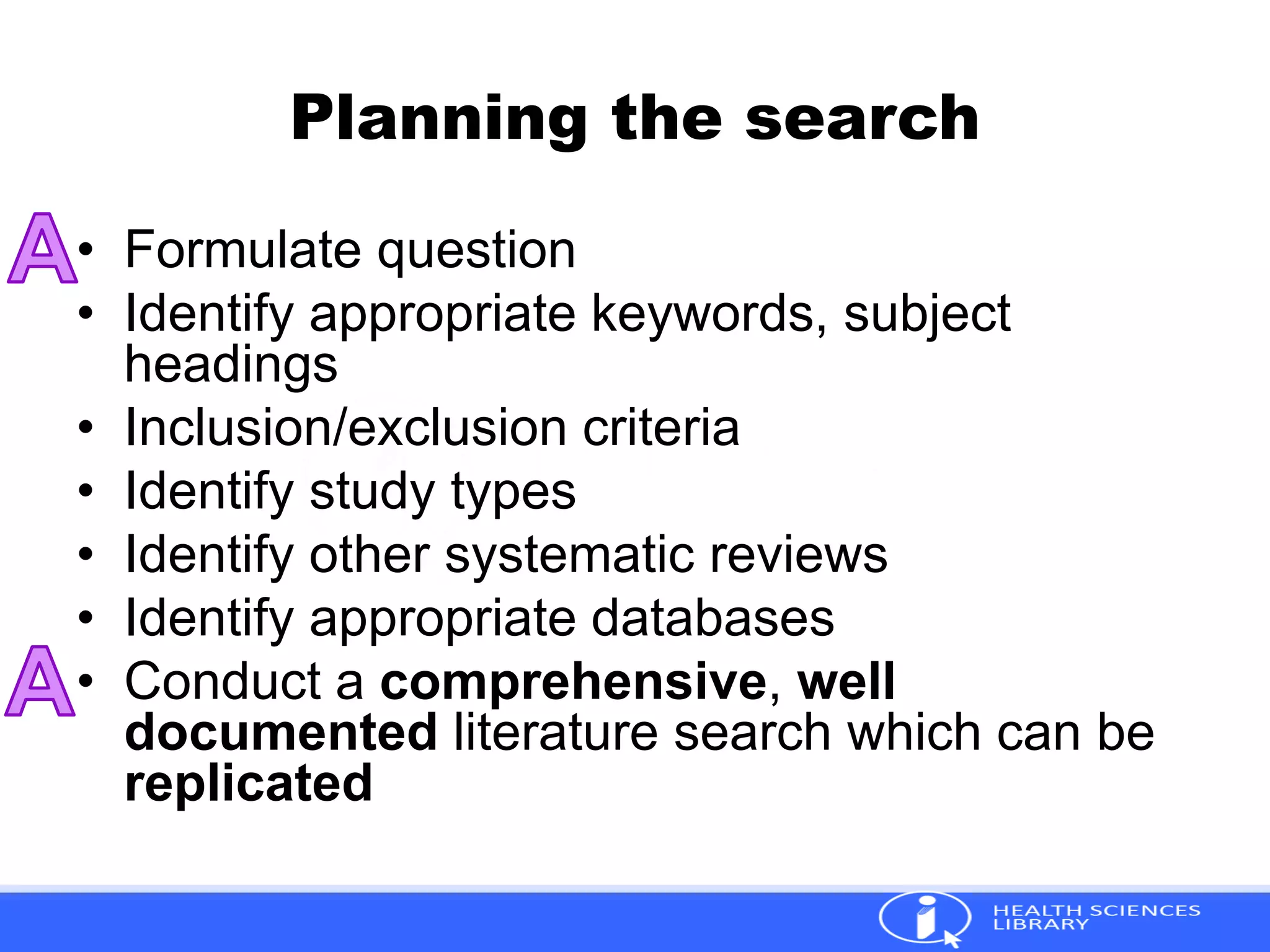
Planning the search
• Formulate question
• Identify appropriate keywords, subject
headings
• Inclusion/exclusion criteria
• Identify study types
• Identify other systematic reviews
• Identify appropriate databases
• Conduct a comprehensive, well
documented literature search which can be
replicated
Protocol
• Rationale for review, question or topic
• Outlines methodology – criteria, searches,
appraisal, data
• Register it with PROSPERO (Prospective
Register of Systematic Reviews)
http://www.crd.york.ac.uk/PROSPERO/
Library guides
Postgraduate Research in
the Health Sciences
Evidence-Based Medicine: Finding
the Evidence in the Practice of
Evidence-Based Healthcare
Ask Question is important
• Conducting research
– Foundation of research protocol
• Searching for evidence
– Plan search strategies
– Recognized answers when we find it
– Evaluating studies
Does early initiation
of antiretroviral therapy (ART) in HIV-
infected children aged 2 to 5 years old
reduce mortality rate?
Question
PICO
Population = HIV-infected children,
age 2-5 yrs
Intervention = early initiation of ARV
Comparison = delayed treatment
Outcome = reduction in mortality
Search terms
HIV OR human immune deficiency syndrome
OR acquired immune deficiency syndrome OR
immunodeficiency syndrome
AND
child OR children (Or filter to age group)
AND
Antiretroviral OR anti-retroviral OR antiviral OR
anti-HIV agents OR ART OR HAART OR ARV
AND
early OR immediate OR timing OR time to
treatment
Question
Are peer-led sex education interventions
effective in reducing the risk of contracting
HIV among university students?
PICO
Population = University students
Intervention = Peer-led interventions
Comparison = No Comparison
Outcome = Lowered risk of
contracting HIV
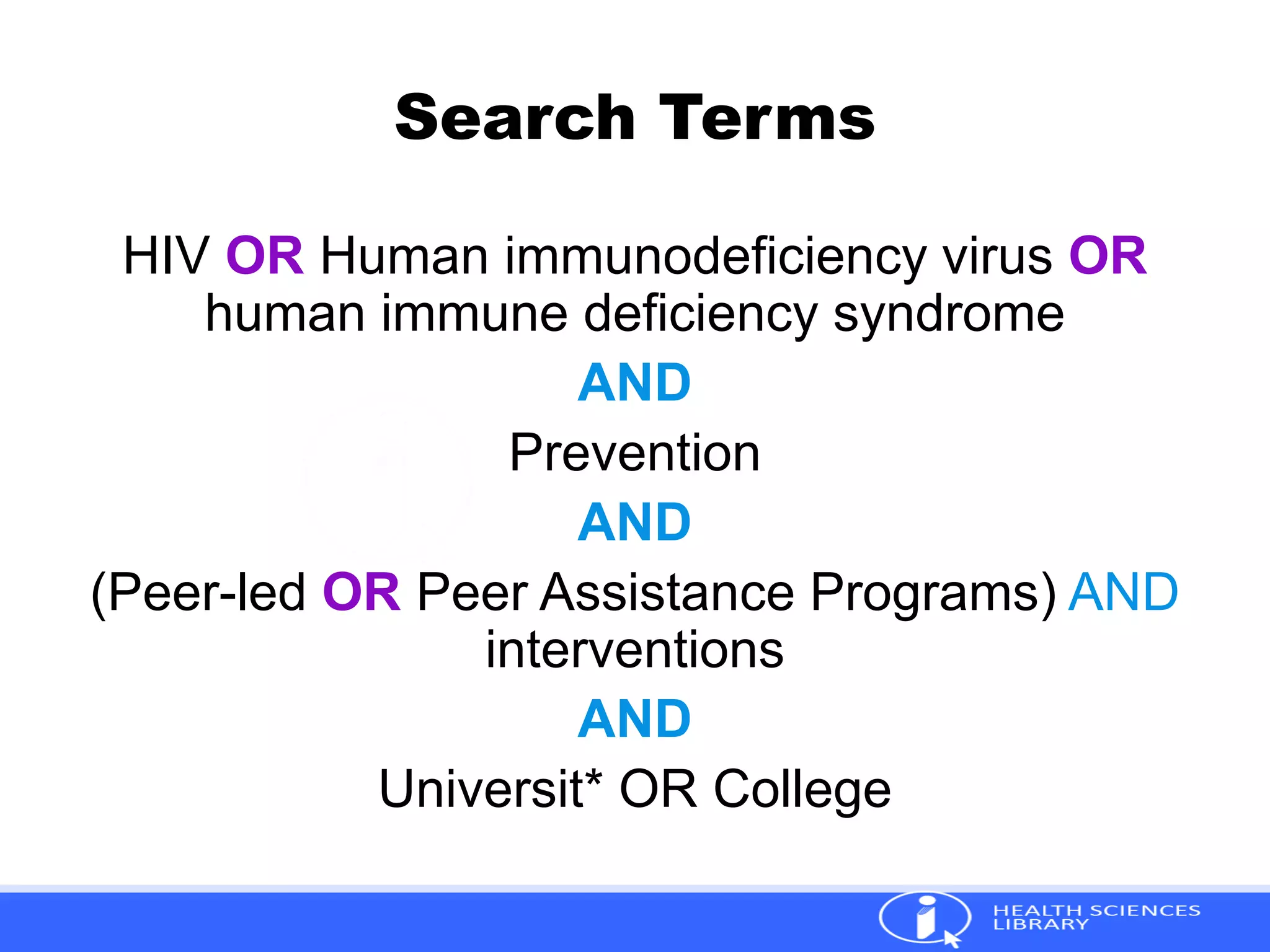
Search Terms
HIV OR Human immunodeficiency virus OR
human immune deficiency syndrome
AND
Prevention
AND
(Peer-led OR Peer Assistance Programs) AND
interventions
AND
Universit* OR College
Question
Does workplace trust relations
improve the motivation of health
care workers?
PIE
Population – Health care workers
Intervention – trust relations
Evaluation – improved motivation
Health care personnel OR health care workers
OR Nurses OR Doctors OR primary care
workers
AND
Trust
AND
motivation OR job satisfaction OR Attitude of
Health Personnel OR staff attitude OR team
work OR staff retention
SEARCHING TECHNIQUES
April 2013
M.Shelton, Health Sciences Library,
UCT
Boolean searching
OR
HIV AIDS
HIV
&
AIDS
AND
HIV ARVs
HIV
&
ARVs
NOT
HIV TB
HIV
&
TB
Boolean operators
AND - combine two or more
OR - synonyms
NOT- exclude words/subject
April 2013
M.Shelton, Health Sciences Library,
UCT
More Techniques
April 2013
M.Shelton, Health Sciences Library,
UCT
• Truncation *
allerg* for allergy or allergies or
allergens or allergic
• Parentheses ()allows you to control and
define way search is executed
(heart OR cardiac) AND surgery
• Quotation marks “” when exact phrase is
to be searched
“rural community”
Final Search
April 2013
M.Shelton, Health Sciences Library,
UCT
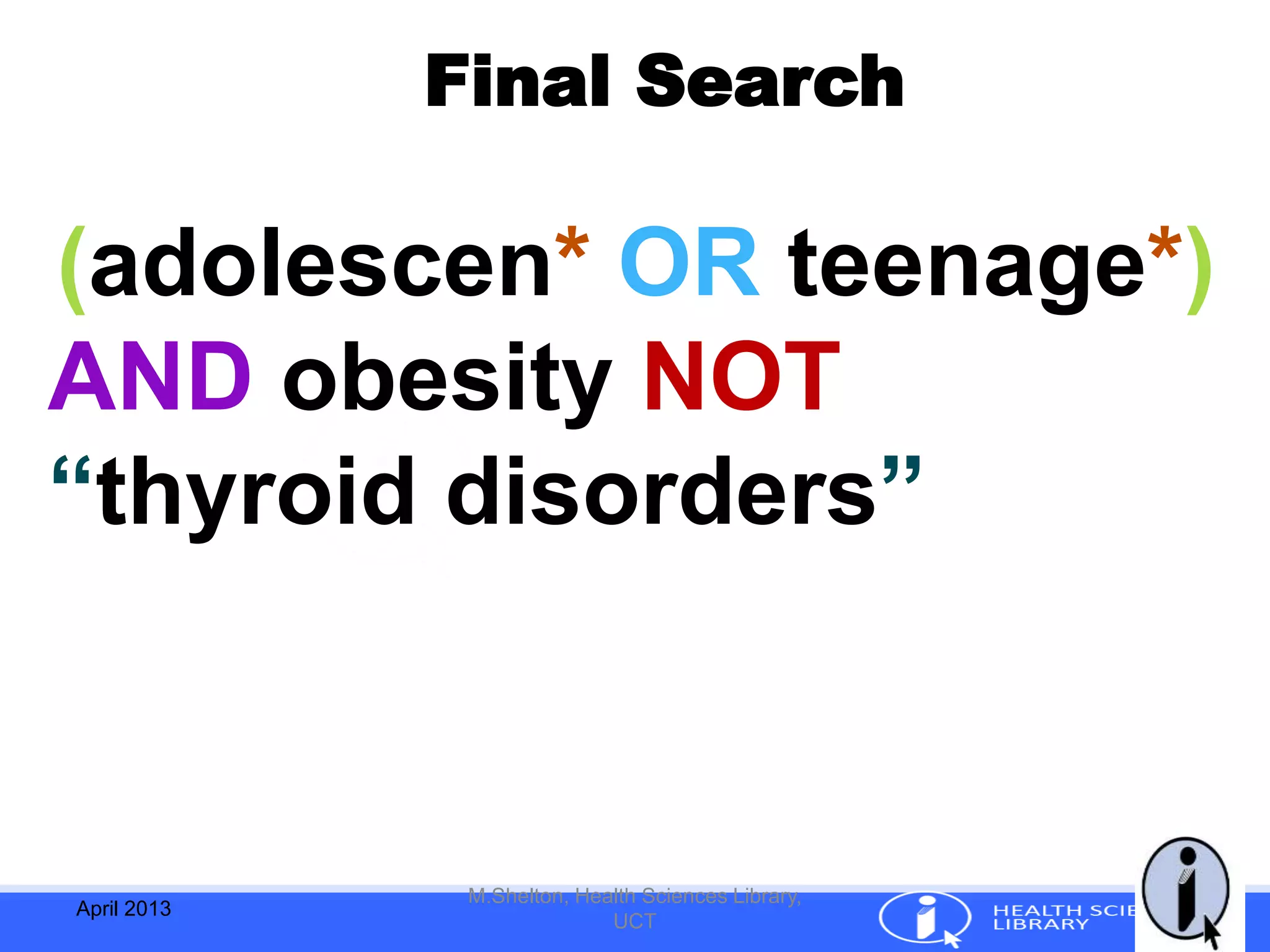
(adolescen* OR teenage*)
AND obesity NOT
“thyroid disorders”
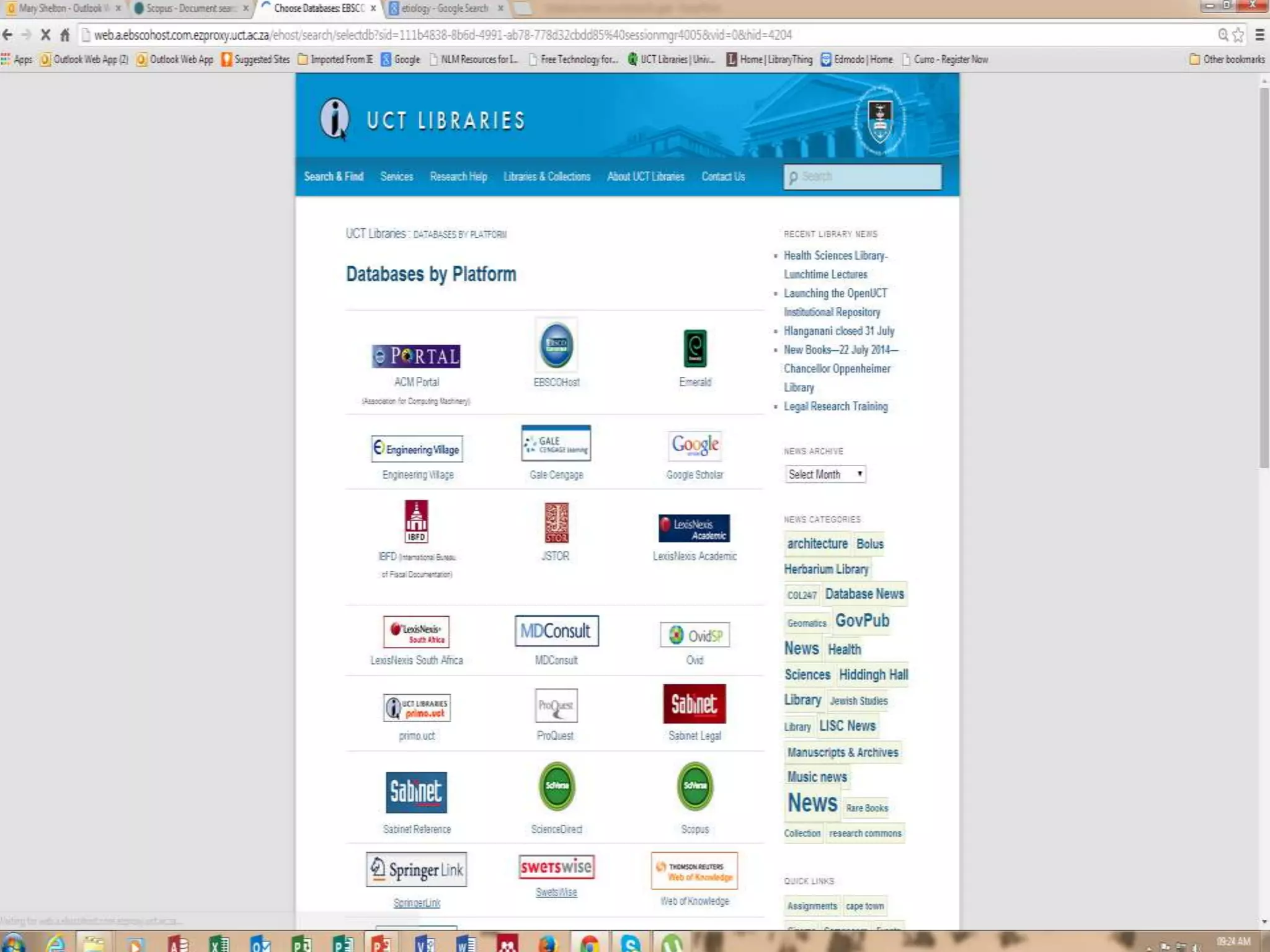
Choose best databases
May 2014
M.Shelton, Health Sciences Library,
UCT
Identify most appropriate
databases
• Most systematic reviews include searches
done in PubMed and Embase
• Evidence hierarchy – choice of database is
determined by type of study
• Citation database, e.g. Scopus, Web of
Science
• Indigenous database, e.g. Africa-Wide
• Subject-specific, e.g. PsychINFO, CINAHL
(Based on IOMS Standard 3.2)
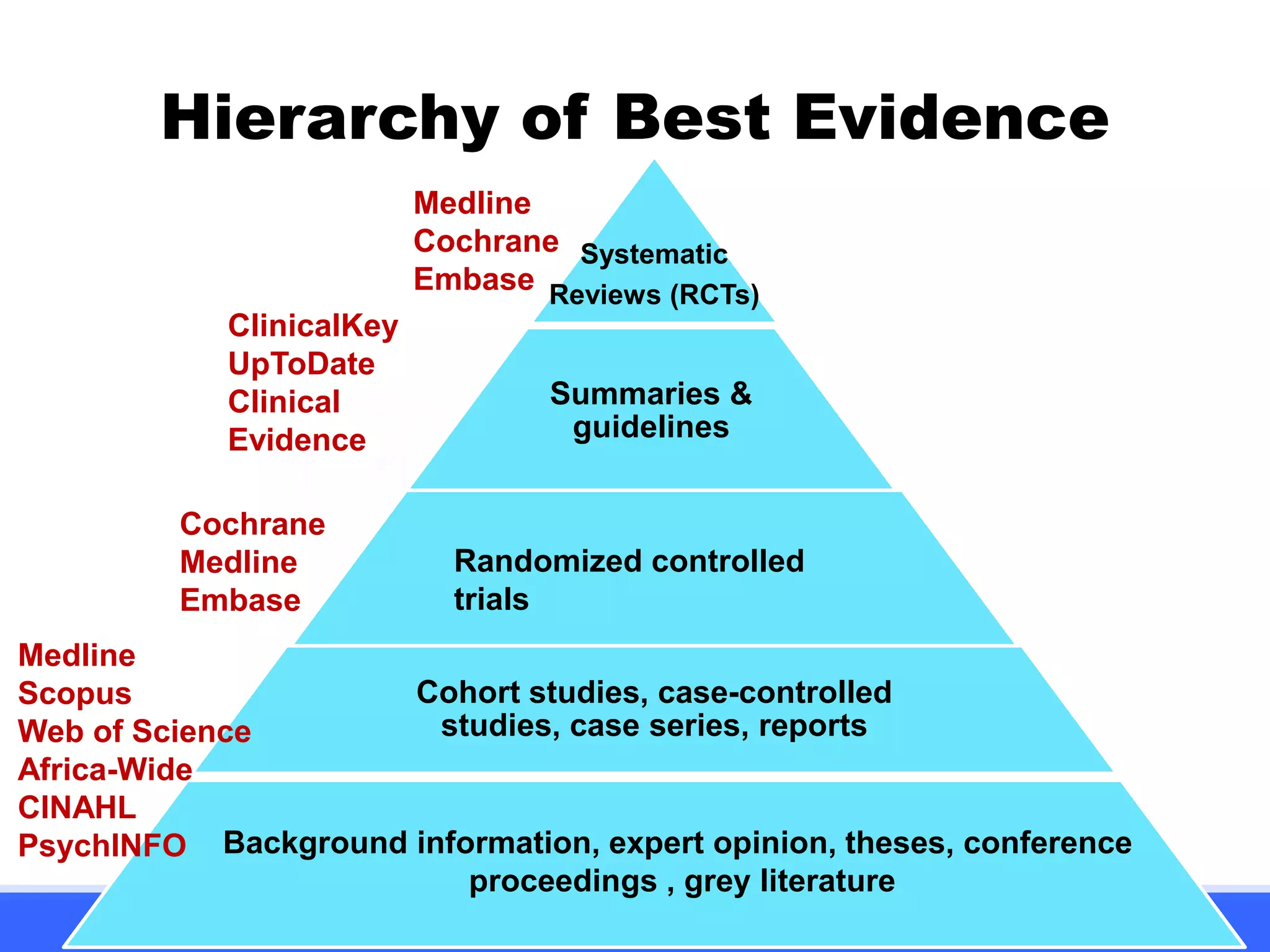
Hierarchy of Best Evidence
Systematic
Reviews (RCTs)
Summaries &
guidelines
Cohort studies, case-controlled
studies, case series, reports
Randomized controlled
trials
Medline
Cochrane
Embase
ClinicalKey
UpToDate
Clinical
Evidence
Cochrane
Medline
Embase
Medline
Scopus
Web of Science
Africa-Wide
CINAHL
PsychINFO Background information, expert opinion, theses, conference
proceedings , grey literature
Top Four
Most high quality primary studies
(clinical) to be found here:
• Medline
• Embase (Scopus)
• Cochrane Library
• Web of Science
However, informal methods such as hand searching and
snowballing (citation tracking) are essential to increase
yield and efficiency of search
(Greenhalgh & Peacock, 2005)
M.Shelton, Health Sciences Library,
UCTSept 2014
Question: Does early initiation
of antiretroviral therapy (ART) in HIV-infected
children aged 2 to 5 years old reduce mortality rate?
PICO
Population = HIV-infected children, age 2-5 yrs
Intervention = early initiation of ARV
Comparison = delayed treatment
Outcome = reduction in mortality
Strategy option 1
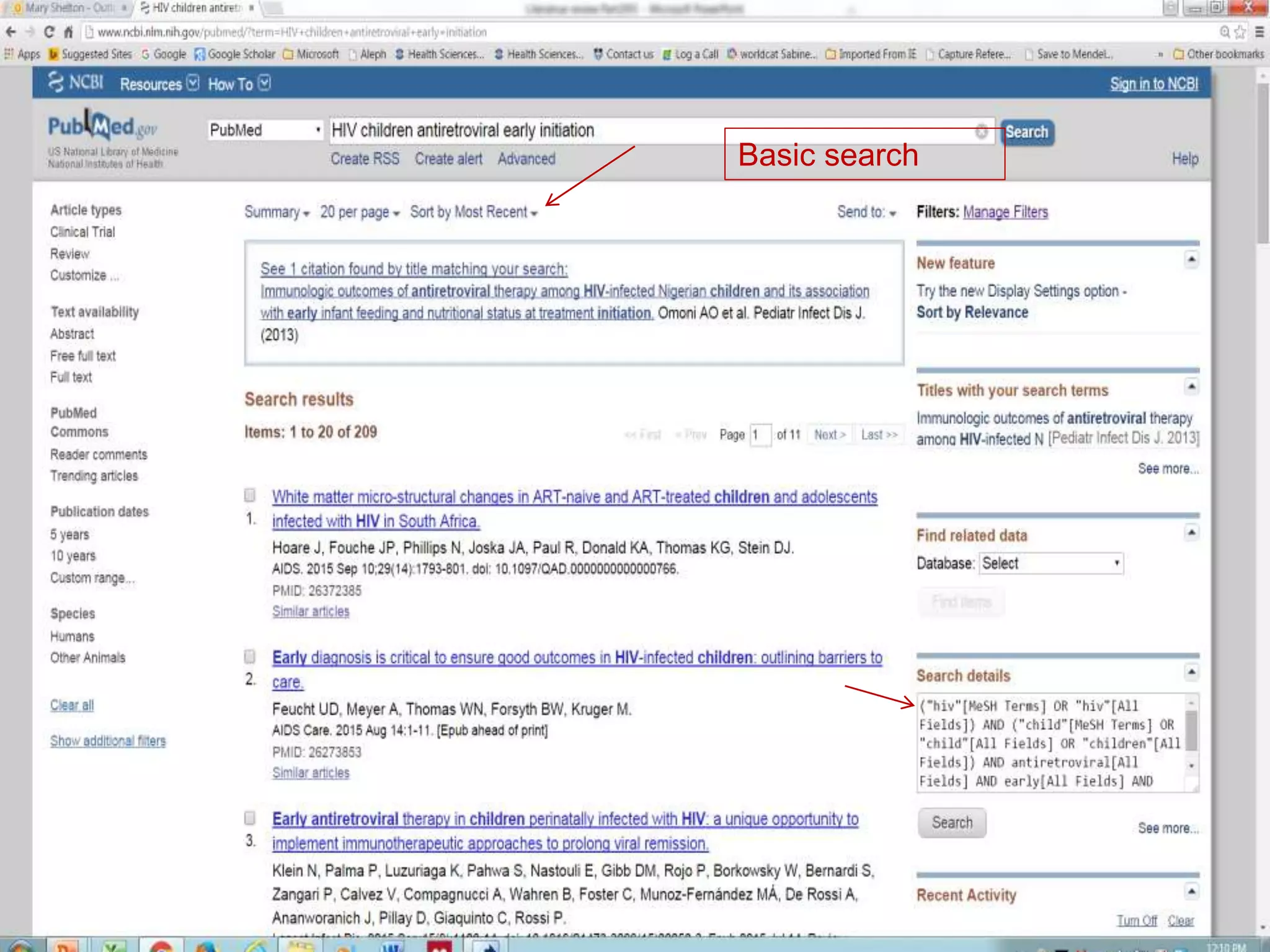
Basic search
HIV children antiretroviral early initiation
Used to gain an understanding what
literature is available
Basic search
Strategy
HIV OR human immune deficiency
syndrome OR acquired immune deficiency
syndrome OR immunodeficiency syndrome
AND
Child*
AND
Antiretroviral OR ART OR HAART OR ARV
AND
early OR immediate OR timing OR time to
treatment
Systematic Review Search
S1 – HIV
S2 – human immune deficiency syndrome
S3 – acquired immune deficiency syndrome
S4 – AIDS
S5 – S1 OR S2 OR S3 OR S4
S6 – Child*
S7 – Antiretroviral
S8 – ART
S9 – HAART
S10 – ARV
S11 – S7 OR S8 OR S9 OR S10
S12 – Early
S13 – Immediate
S14 – Timing
S15 – Time to Treatment
S16 – S12 OR S13 OR S14 OR S15
S17 – S5 AND S6 AND S11 AND S16
Strategy
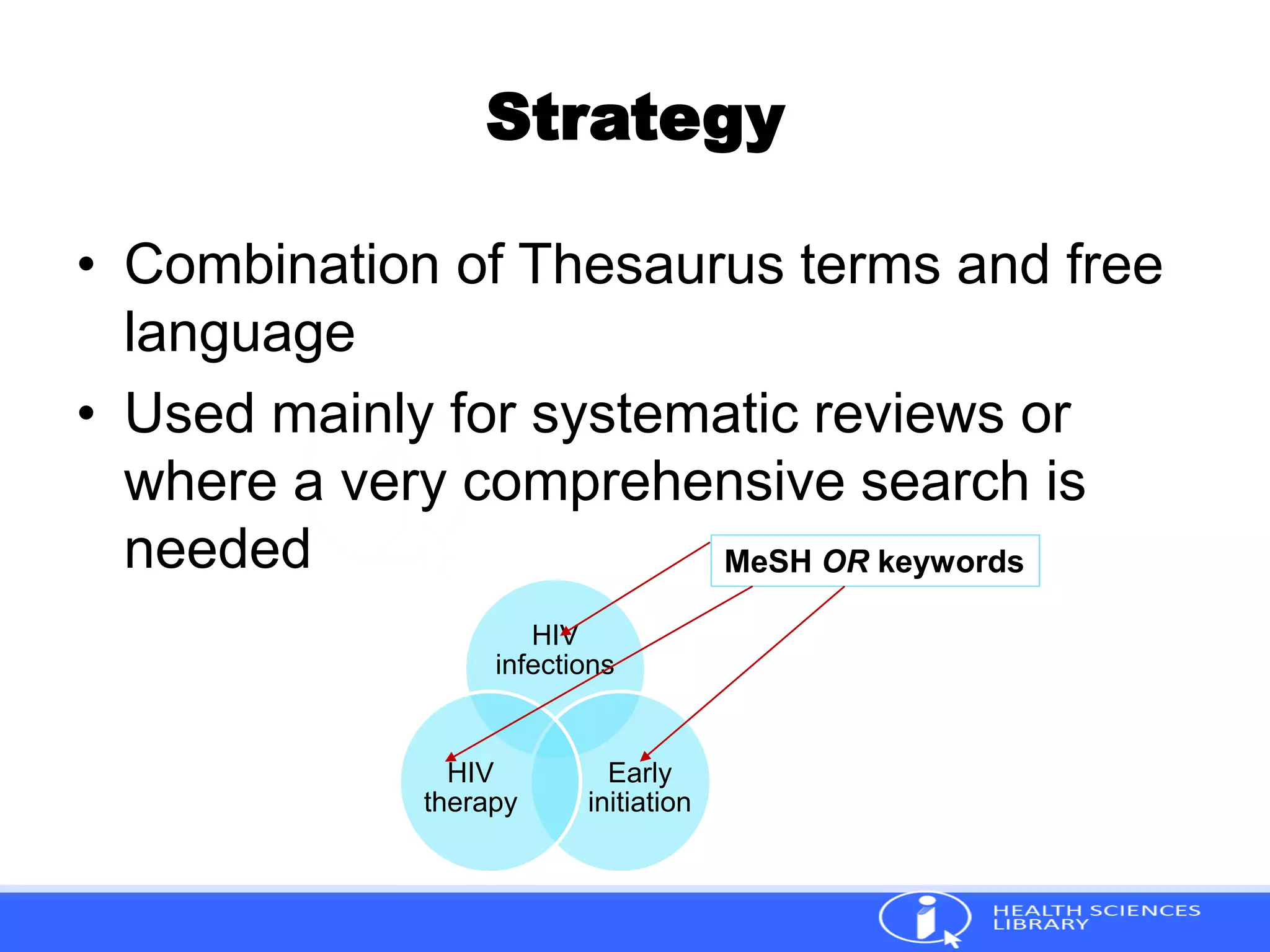
• Combination of Thesaurus terms and free
language
• Used mainly for systematic reviews or
where a very comprehensive search is
needed
HIV
infections
Early
initiation
HIV
therapy
MeSH OR keywords
Advanced search
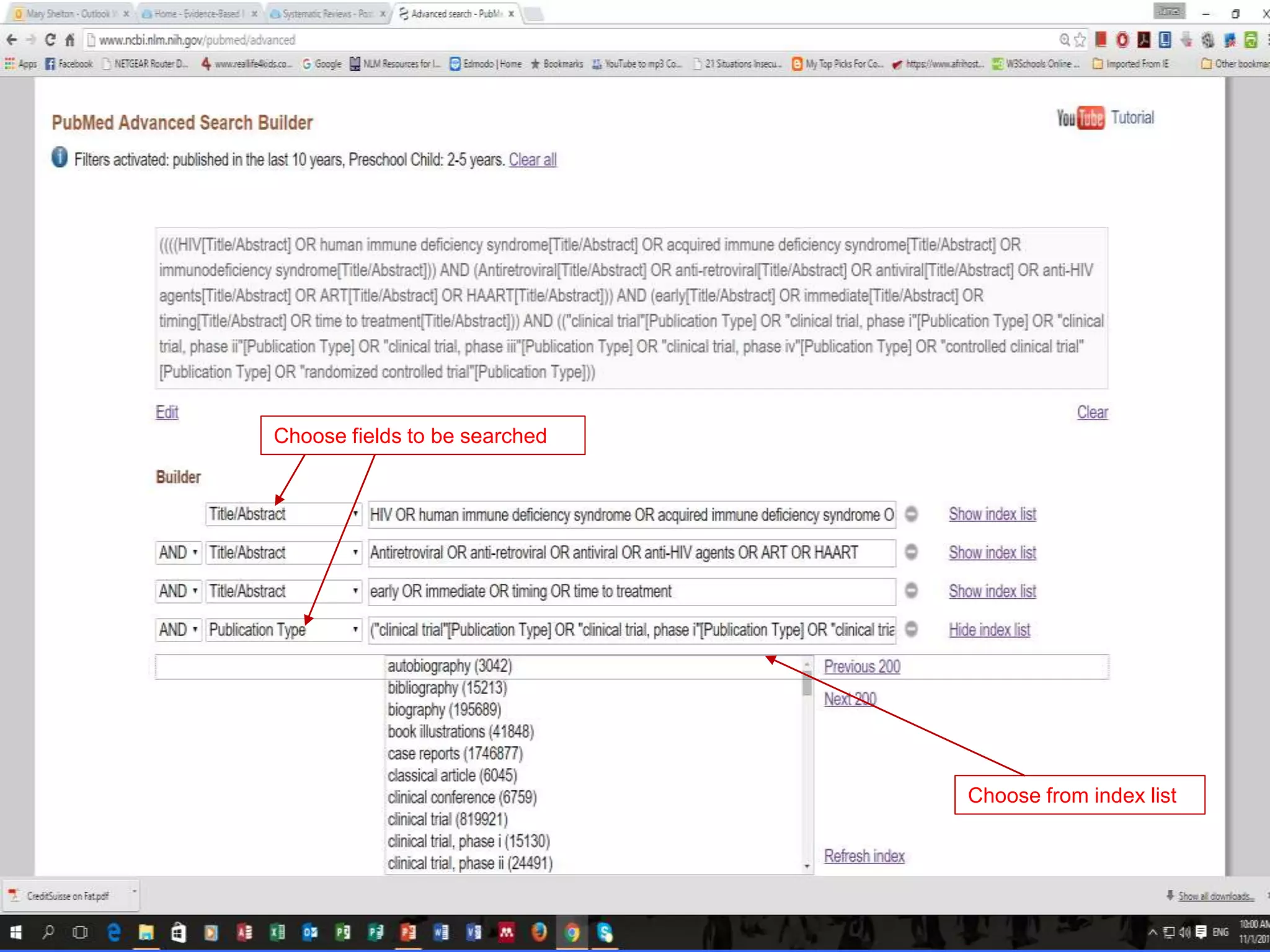
• Choose which fields to be searched
• Explore the indexes
Choose fields to be searched
Choose from index list
Found a good article??
See how it was indexed
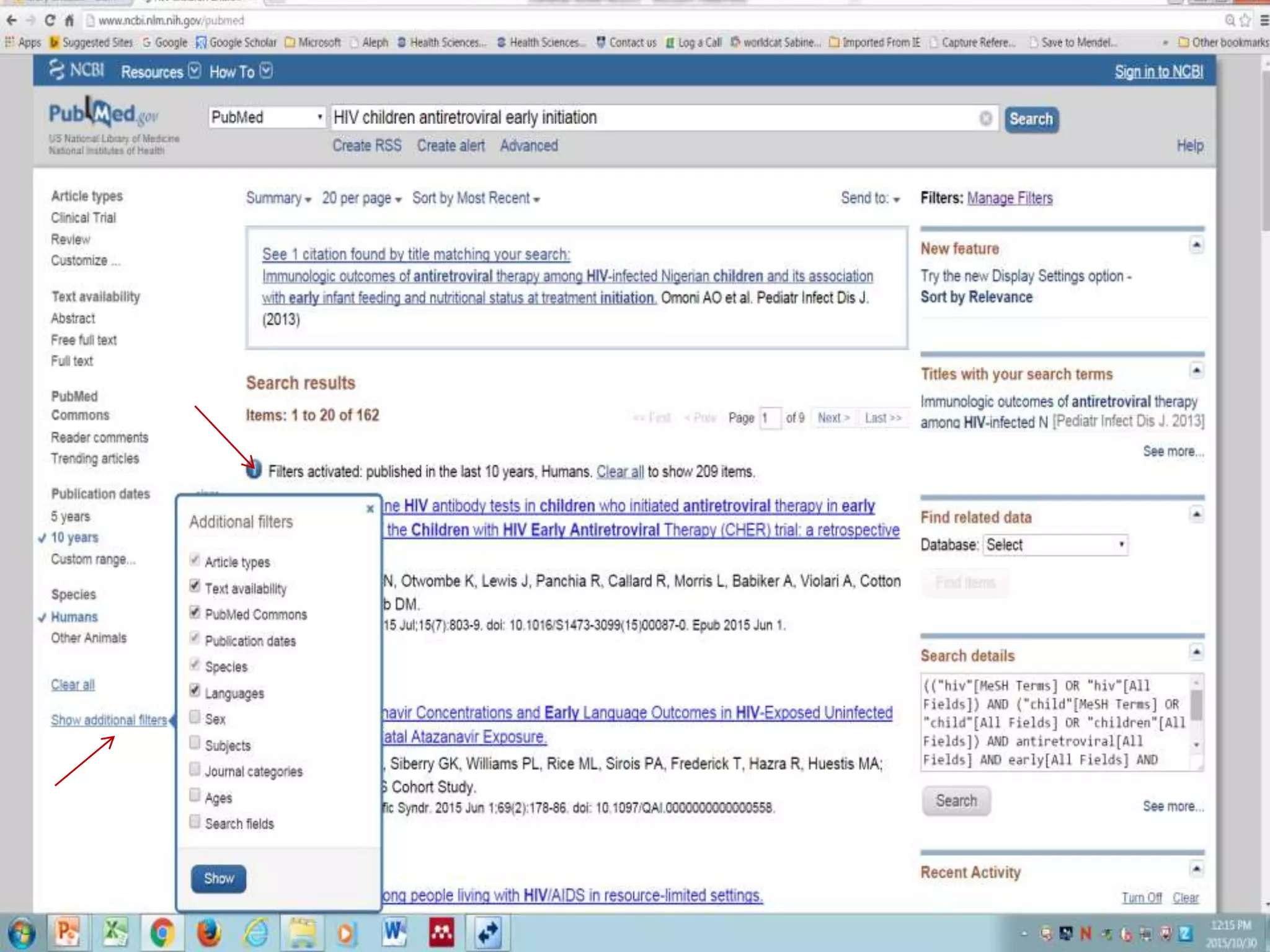
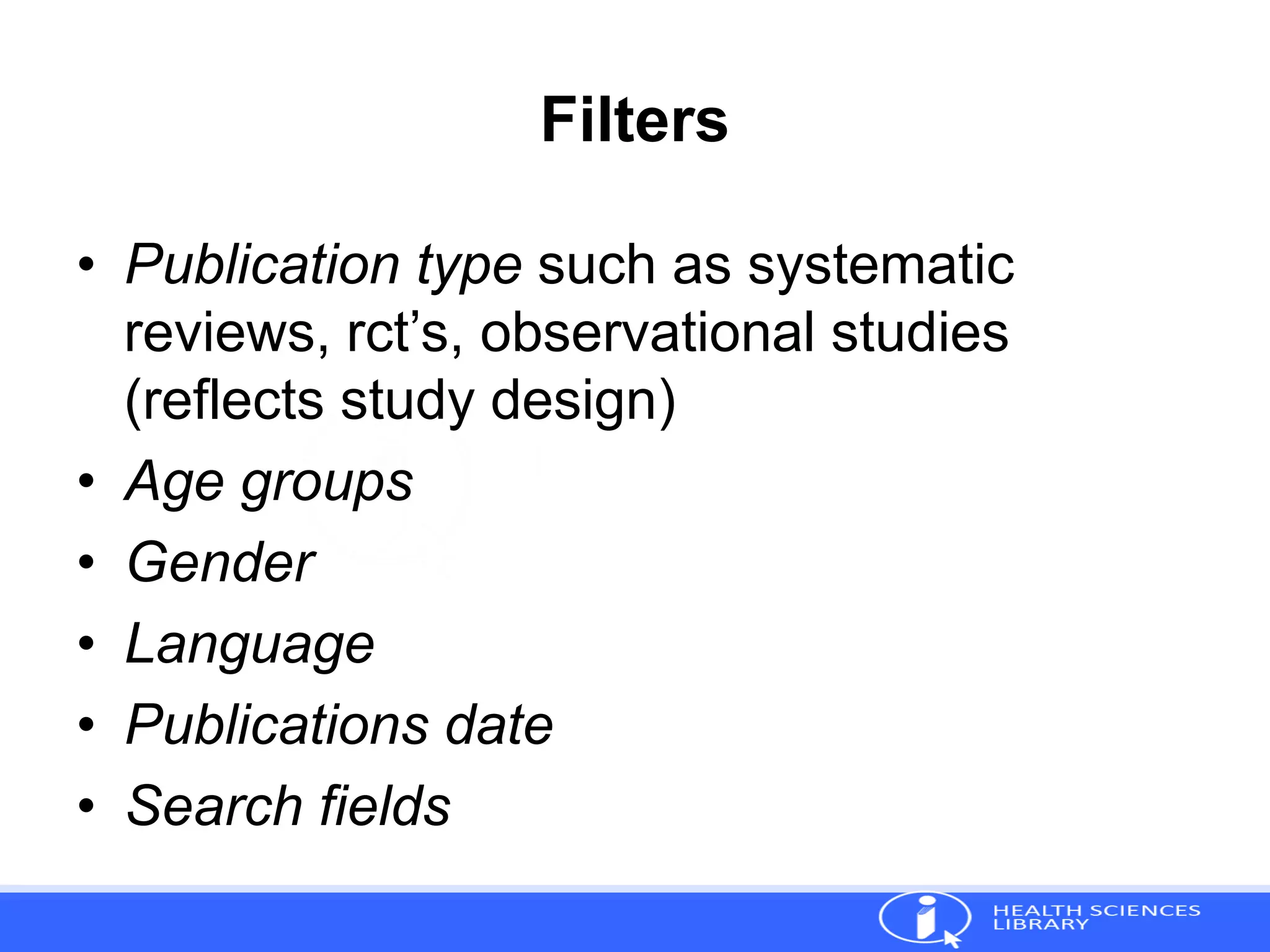
Filters
• Publication type such as systematic
reviews, rct’s, observational studies
(reflects study design)
• Age groups
• Gender
• Language
• Publications date
• Search fields
EBM LibGuide http://libguides.lib.uct.ac.za/evidence
• Search strategy tab
African search filters
Low and Middle Income Countries filters
World Bank countries and economies
Good enough?? Comprehensive?
• What about synonyms ?
• What about controlled vocabulary or
thesaurus headings? (i.e. MeSH)
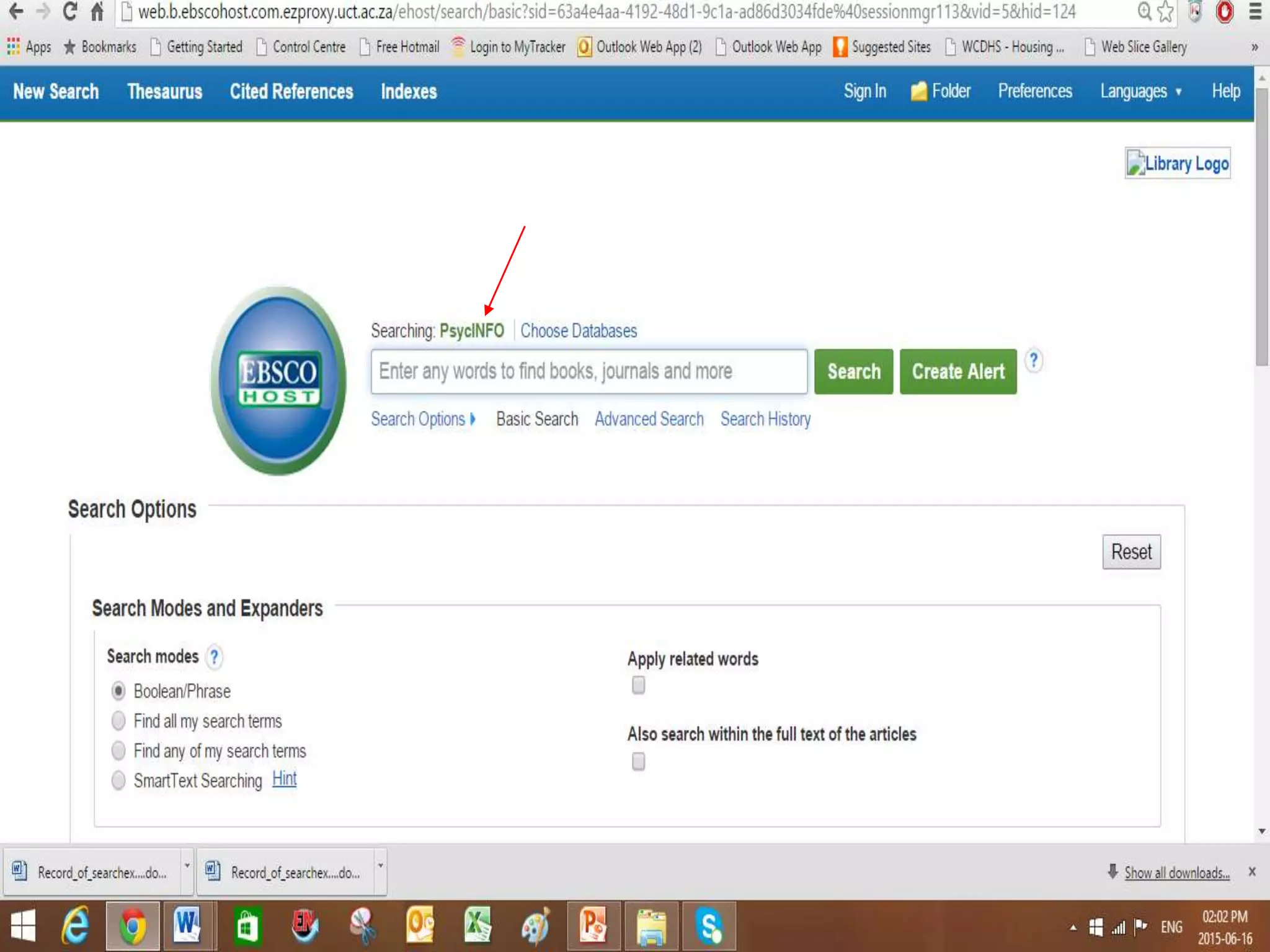
Ebsco Databases
• Academic Search Premier (multidisciplinary)
• Africa-Wide
• Business Source Premier
• CINAHL (Cumulative Index to Nursing and Allied
Health)
• Eric
• Health Source – Nursing /Academic
• Medline
• PsychArticles
• PsychInfo
Effects of raising a child with
intellectual disability on mother
(impact or effect*)
and
mother*
and
(intellectual disability)
and
child*
CINAHL Headings
PsychINFO Thesaurus
Effects of raising a child with
intellectual disability on mother
(impact OR effect* OR coping)
AND
mother*
AND
(intellectual disability OR intellectual
development disorder OR mental retardation
OR mental disability)
AND
child*
Multi-database search
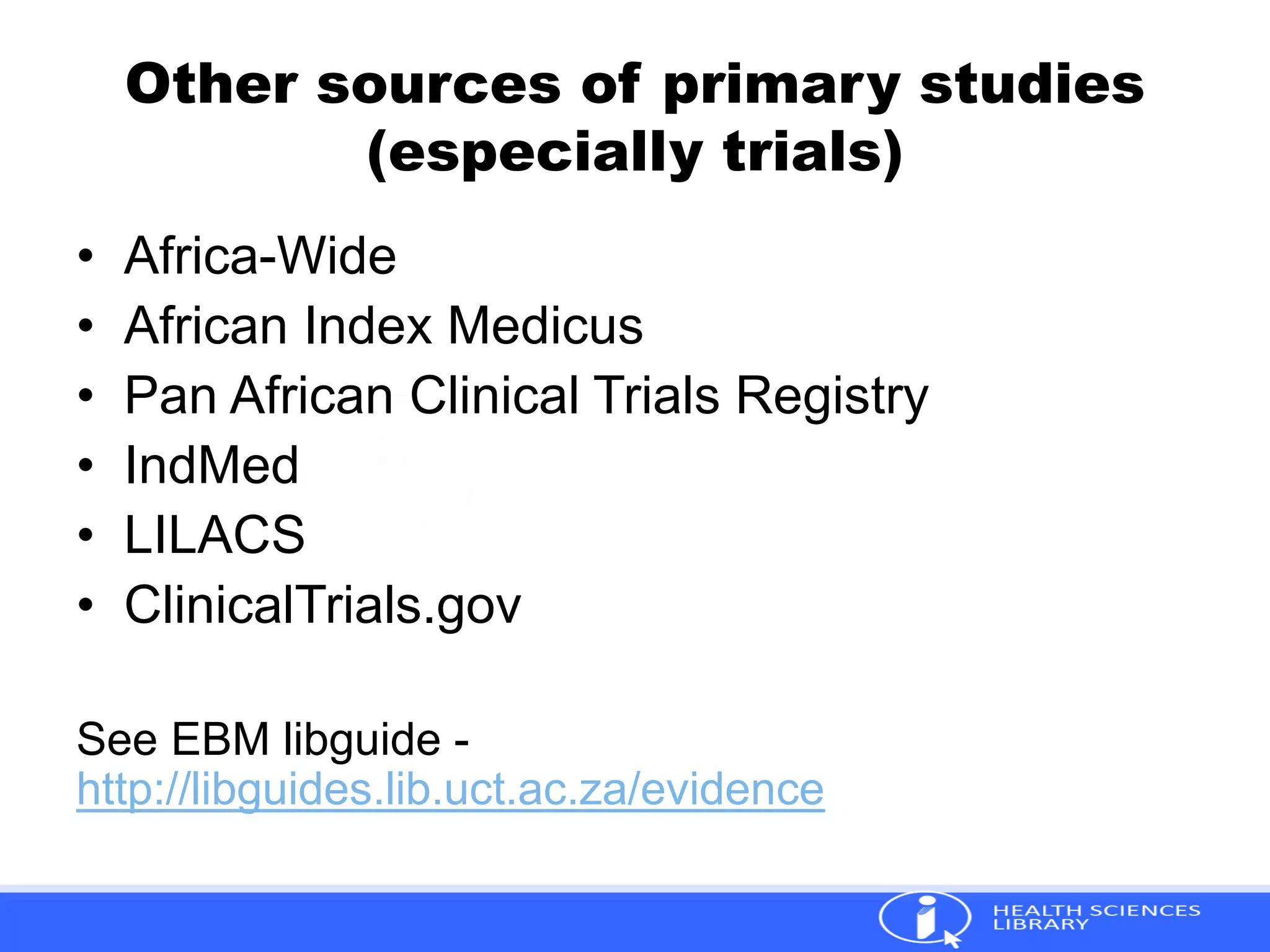
Other sources of primary studies
(especially trials)
• Africa-Wide
• African Index Medicus
• Pan African Clinical Trials Registry
• IndMed
• LILACS
• ClinicalTrials.gov
See EBM libguide -
http://libguides.lib.uct.ac.za/evidence
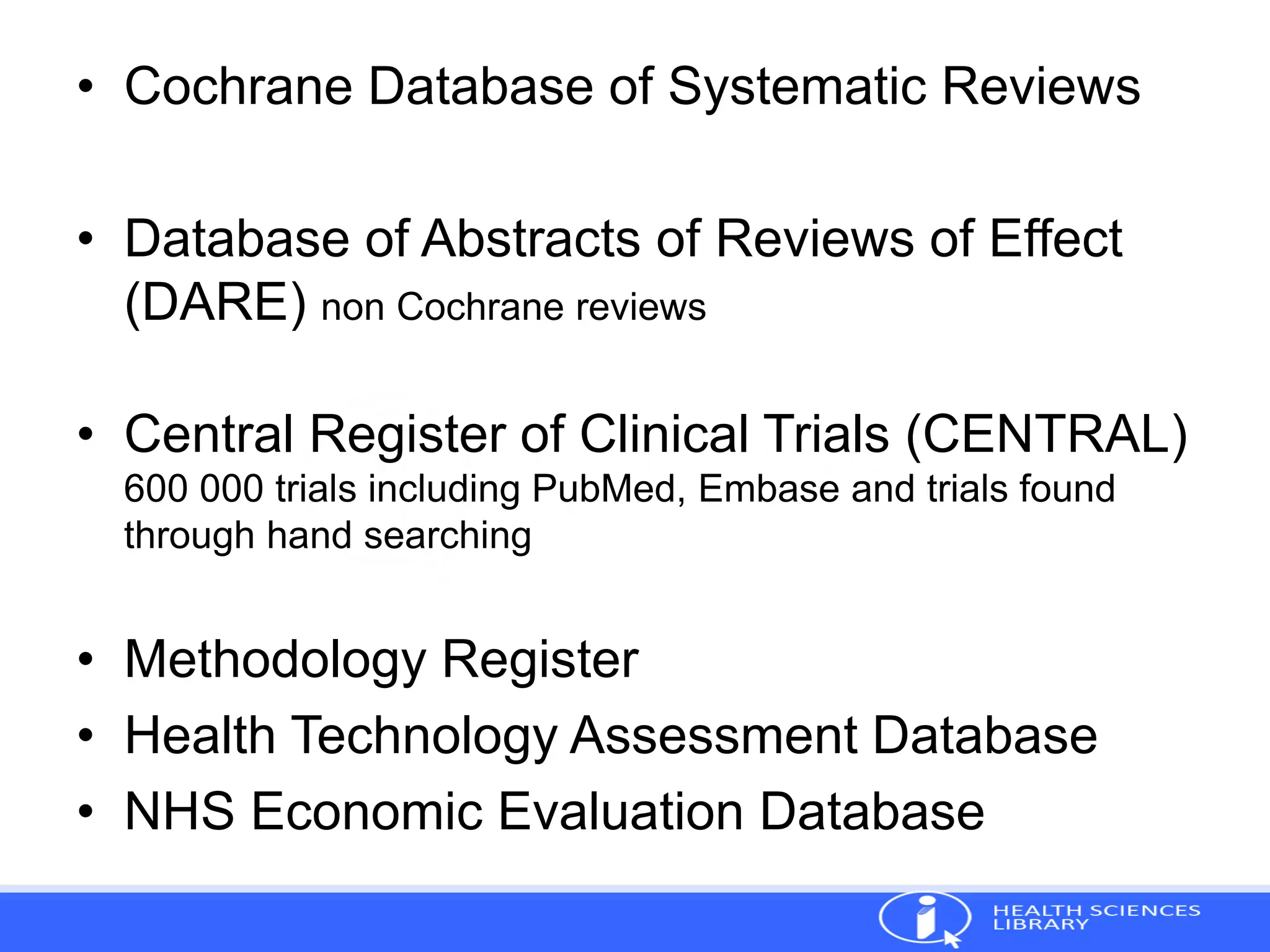
Cochrane Library
• Cochrane Database of Systematic Reviews
• Database of Abstracts of Reviews of Effect
(DARE) non Cochrane reviews
• Central Register of Clinical Trials (CENTRAL)
600 000 trials including PubMed, Embase and trials found
through hand searching
• Methodology Register
• Health Technology Assessment Database
• NHS Economic Evaluation Database
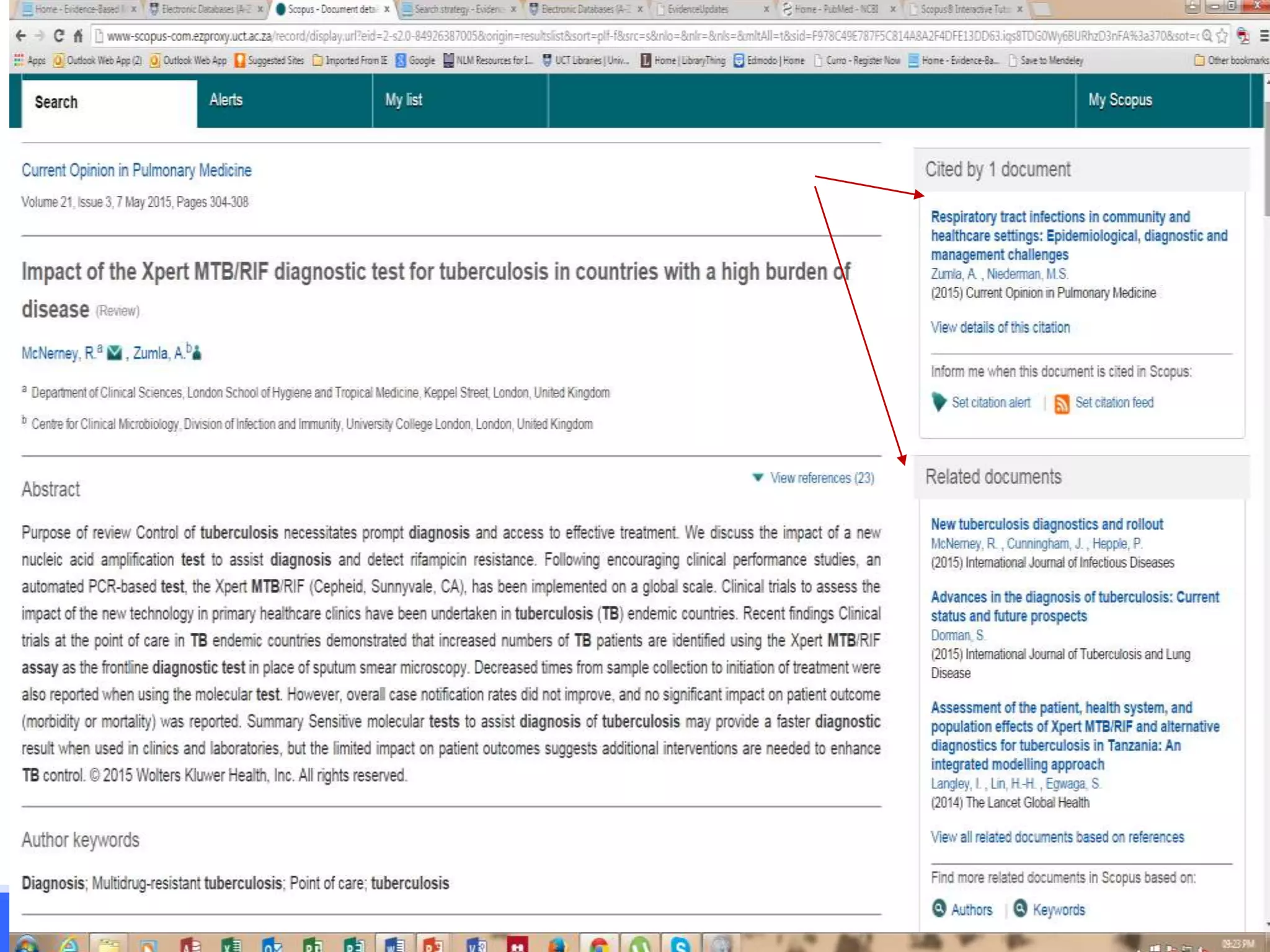
Authors and citation tracking
• Search by author’s name in databases
• Search for author in Google and Google
• Scholar for CV’s and bibliographies
• List of references at end of article
• Cited references in Science Citation Index,
Scopus and Google Scholar
• Related articles in PubMed and Web of
Science
May 2013
May 2013
M.Shelton, Health Sciences Library,
UCT
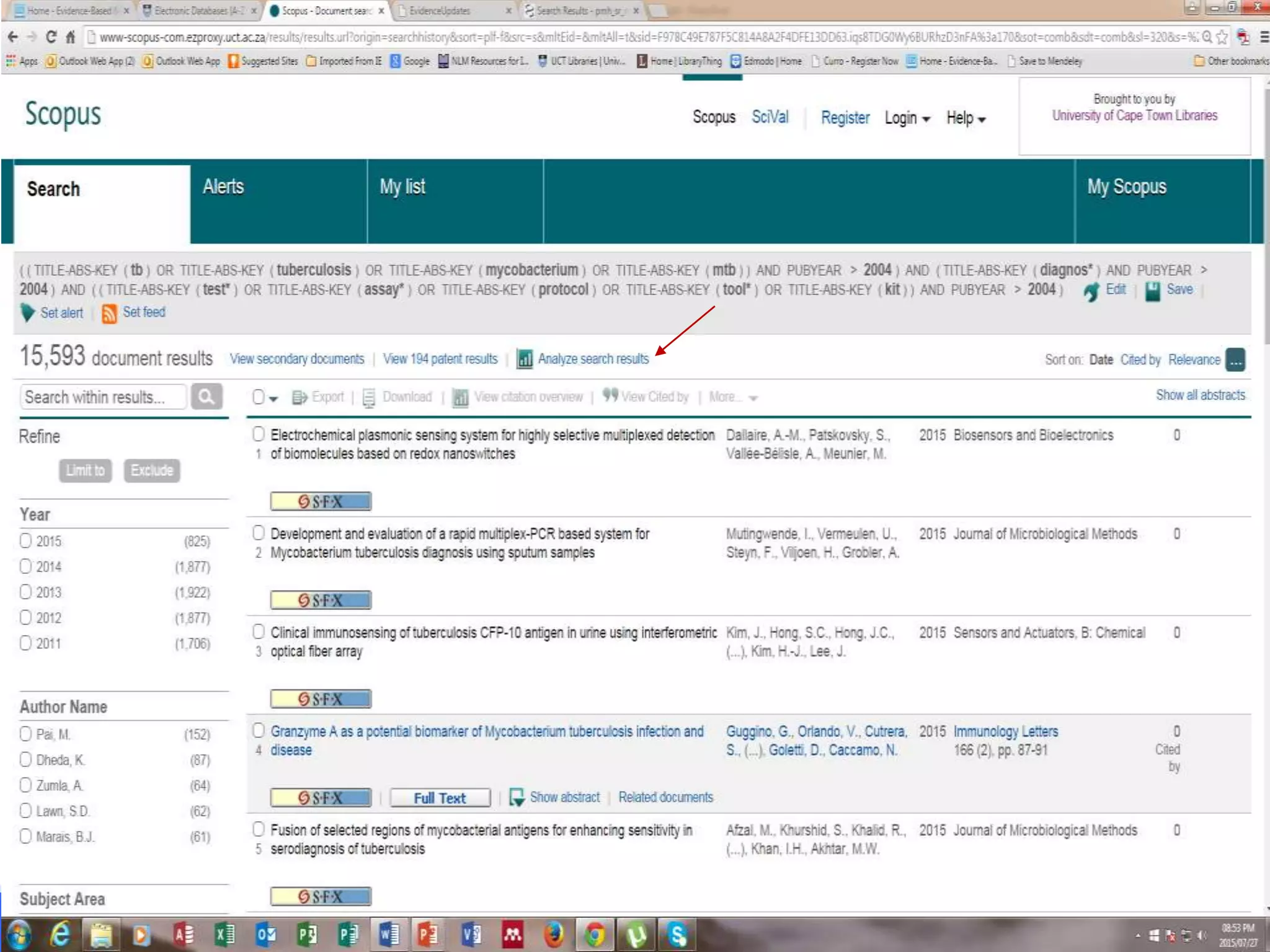
Scopus
• Citation index
• Includes content of Medline
and Embase
• Embase complements Medline
with references from Europe,
Asia, developing world
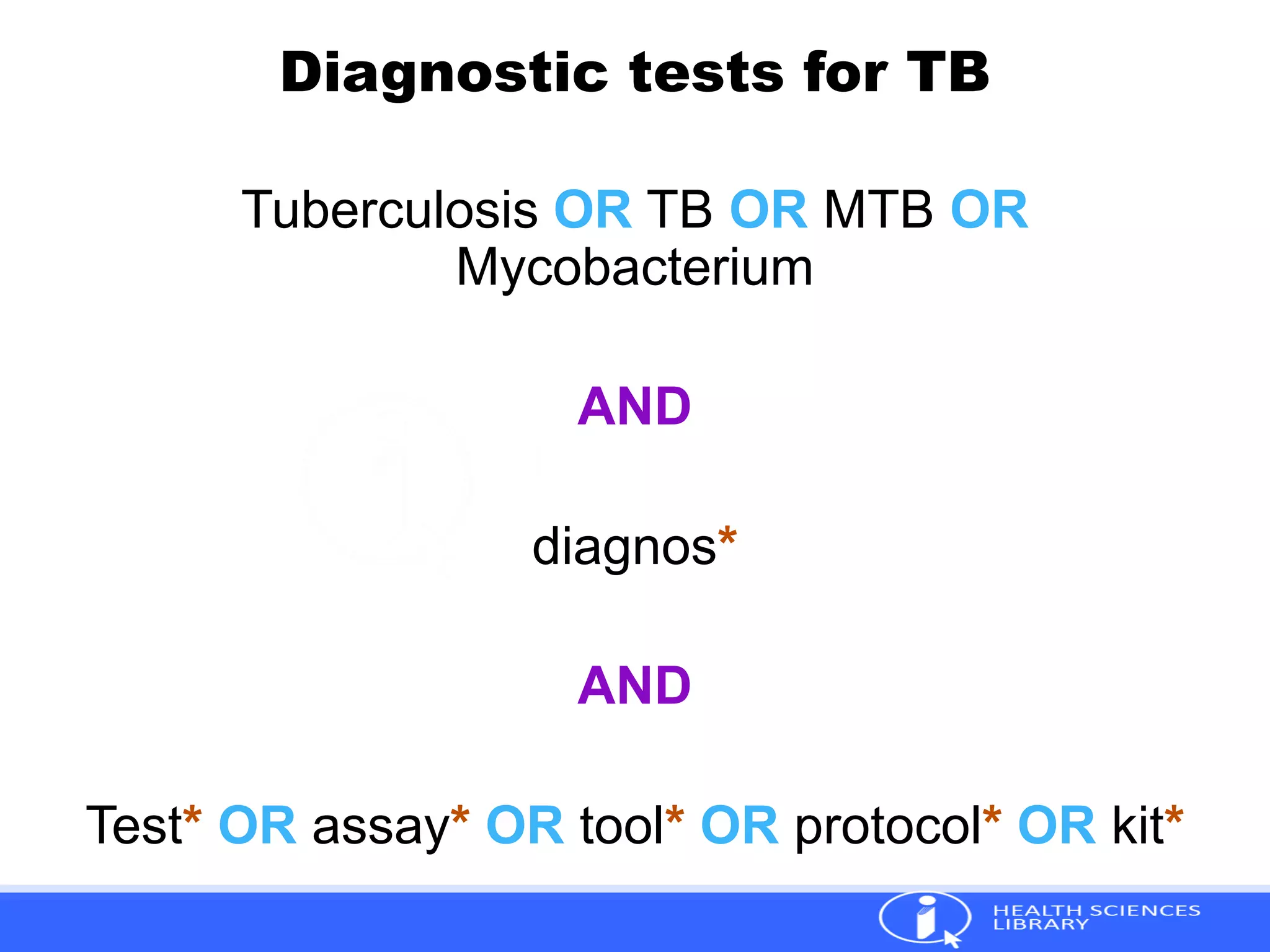
Diagnostic tests for TB
Tuberculosis OR TB OR MTB OR
Mycobacterium
AND
diagnos*
AND
Test* OR assay* OR tool* OR protocol* OR kit*
(HIV or AIDS or Acquired Immune Deficiency
Syndrome)
And
Diagnosis
And
Disclosure
Web of Science
• Citation index which includes PubMed,
SciELO and Biological Abstracts.
• SciELO (content includes open content
journals from Latin America and the
Caribbean as well as titles from Spain,
Portugal and South Africa)
• Save search history
Address bias
• Publication bias - various databases
• Grey literature (unpublished or published in
non-commercial form, e.g. conferences,
theses, working papers)
• Contact researcher for clarification
• Language bias
• Hand searching
• Web search
See EBM LibGuide http://libguides.lib.uct.ac.za/evidence
Life Sciences, Laboratory sciences
• Biological and Agricultural Index (via Ebsco)
• General Science Abstracts (via Ebsco)
• SciFinder (which includes Chemical
Abstracts)
• Medline
• Scopus
• Springer Protocols
• Web of Science (incl. Biological Abstracts)
(find in A-Z list of databases)
Searching - how much is enough?
• Comprehensive
databases, grey literature, trials registries, theses,
conferences, follow references
• Precision of summary estimate
Keep track of what you have done!
• Sign into each database
• Save search history
• Set up alerts
• Document search strategy - Library guide
• Document search results - Library guide
Managing your citations
• RefWorks (supported by UCT)
• EndNote (supported by UCT)
• Mendeley (free)
Making your Reference Manager
work for you
• Share libraries with your team
• Remove duplicates
• File and sort according to categories
Screen and select studies
• Inclusion/exclusion criteria
• Screen abstracts
• PRISMA flow diagram
• Read full text
• At least two people screening in big
reviews
PRISMA Diagram
Manage data
• Extraction
• Standard data extraction forms
• RevMan(Cochrane)
• Nvivo
• SPSS
• CAQDAS
Postgraduate Research in the Health Sciences, research methodology
tab
REVMAN 5
• RevMan 5 is the software used for
preparing and maintaining Cochrane
Reviews. RevMan facilitates preparation of
protocols and full reviews, including text,
characteristics of studies, comparison
tables, and study data.
• Integrates well with EndNote
http://community.cochrane.org/tools/review-production-tools/revman-5/about-revman-5
Critically appraise each study
• CASP (Critical Appraisal Skills Programme)
• CEBM
• GATE
• JBI (qualitative studies)
EBM Libguide
http://libguides.lib.uct.ac.za/evidence
Critical Appraisal
1. Is the study valid?
Unbiased
Valid
Level of evidence and
Degrees of recommendation.
2. What are the results?
Significant
Confidence intervals
3. Are the results useful?
Applicable
http://www.casp-uk.net/casp-tools-checklists
CASP
JBI Qualitative Studies
Reporting guidelines
• PRISMA (Reporting of systematic Reviews)
http://www.prisma-statement.org/Default.aspx
EBM LibGuide
http://libguides.lib.uct.ac.za/evidence
CEBM checklist – used for evaluating
SR’s
• What question (PICO) did the systematic
review address? question
• Is it unlikely that important, relevant
studies were missed? Which databases, grey
literature, search terms, limits e.g. publication, language,
time, geographic bias
• Were the criteria used to select articles for
inclusion appropriate? Inclusion and exclusion
criteria, study design, PRISMA, number of reviewers
CEBM checklist contd.
• Were the included studies sufficiently valid
for the type of question asked? Appraisal tools
• Were the results similar from study to
study?
• How are the results presented? Reporting
guidelines
http://www.cebm.net/critical-appraisal/
Mar 2016
M.Shelton, Health Sciences Library,
UCT
Thank you!
Contact us:
Tamyzn.Suliaman@uct.ac.za
References
• CEBM. Critical appraisal tools. http://www.cebm.net/critical-appraisal/
• Cochrane Handbook for Systematic Reviews of Interventions.
http://handbook.cochrane.org/
• Finding what works in health care: standards for systematic reviews.
http://iom.nationalacademies.org/hmd/Reports/2011/Finding-What-
Works-in-Health-Care-Standards-for-Systematic-Reviews.aspx
• Greenhalgh, T. 1997. How to read a paper: the Medline database. BMJ
315(7101) p.180.
• Health Sciences Library. Subject Guides.
http://www.medical.lib.uct.ac.za/health-sciences-guides
• Pettigrew, M. 2015. Time to rethink the systematic review catechism?
Moving from ‘what works’ to ‘what happens’. Systematic Reviews. 4:36.
• PROSPERO. http://www.crd.york.ac.uk/PROSPERO/
• Straus, S.E. 2011. Evidence-based medicine: how to practice and teach
it. 4th ed. Edinburgh: Churchill Livingstone/Elsevier
• Systematic Reviews: the process.
http://guides.mclibrary.duke.edu/sysreview

Systematic reviews

  • 1.
  • 2.
    Evidence-based medicine Definition: “Evidence-BasedMedicine is the integration of the best research evidence with clinical expertise and patient values” Straus, S.E. 2011. Evidence-based medicine: how to practice and teach it. 4th ed. Edinburgh: Churchill Livingstone/Elsevier Mar 2016 M.Shelton, Health Sciences Library, UCT
  • 3.
    5- Step EBMmodel • ASK Formulate an answerable clinical question • ACCESS Search for evidence • APPRAISE Critically evaluate studies in terms of validity, importance and applicability • APPLY Applying evidence to patient care • ASSESS Evaluation of performance. M.Shelton, Health Sciences Library, UCTMay 2013
  • 4.
    Systematic review usesexplicit methodology to identify, select and evaluate relevant primary studies in an attempt to answer a specific question
  • 5.
    Characteristics of aSystematic Review • clearly defined question with inclusion and exclusion criteria; ask • systematic search of the literature; access • critical appraisal of included studies; appraise • data extraction and management; synthesize • analysis and interpretation of results; interpret • report for publication http://guides.mclibrary.duke.edu/sysreview
  • 6.
    Literature Review vs SystematicReview • Literature review puts your research in context of past and existing research, supports your thesis. • Literature review can also stand alone – qualitative overview of research on a topic • Systematic Review attempts to identify and appraise all the literature (using pre-determined methodology) in order to answer a specific question. Uses quantitative methods to compare and evaluate primary studies (meta-analysis)
  • 7.
    cf: traditional, narrativereview • Selective review of literature, often chosen to reinforce author’s viewpoint • Does not follow strict methodology • Prone to bias • Lower in evidence hierarchy (strength of evidence)
  • 8.
    Cf: Scoping review •a precursor to doing a systematic review • estimate the size of the literature on a particular issue or question • feasibility of doing a systematic review • question is less precise • methodology less rigorous • it is necessary to have a strategy and document the process for accountability and replicability.
  • 9.
    Cf: Rapid review •Speed up process of synthesizing the evidence • Limit number of databases searched • Limit or omit grey literature searches, hand searching • Much shorter time frame • Risk of bias
  • 10.
    • Focused question– what works? • New thinking – what happened? What is likely to happen in other settings? • May examine qualitative evidence –often mixed method systematic review Pettigrew, M. 2015. Time to rethink the systematic review catechism? Moving from ‘what works’ to ‘what happens’. Systematic Reviews. 4:36. Systematic Reviews
  • 11.
    Cochrane Handbook ‘... reviewscan be conducted in an effort to resolve conflicting evidence, to address questions where clinical practice is uncertain, to explore variations in practice, to confirm the appropriateness of current practice or to highlight a need for future research. The overarching aim of Cochrane reviews should be to summarize and help people to understand the evidence...’
  • 12.
    Standards for Findingand Assessing Individual Studies (IOMS) 3.1 Conduct systematic search 3.2 Address bias 3.3 Screen and select studies 3.4 Document the search 3.5 Manage data collection 3.6 Critically appraise each study
  • 13.
    Planning the search •Formulate question • Identify appropriate keywords, subject headings • Inclusion/exclusion criteria • Identify study types • Identify other systematic reviews • Identify appropriate databases • Conduct a comprehensive, well documented literature search which can be replicated
  • 14.
    Protocol • Rationale forreview, question or topic • Outlines methodology – criteria, searches, appraisal, data • Register it with PROSPERO (Prospective Register of Systematic Reviews) http://www.crd.york.ac.uk/PROSPERO/
  • 15.
    Library guides Postgraduate Researchin the Health Sciences Evidence-Based Medicine: Finding the Evidence in the Practice of Evidence-Based Healthcare
  • 16.
    Ask Question isimportant • Conducting research – Foundation of research protocol • Searching for evidence – Plan search strategies – Recognized answers when we find it – Evaluating studies
  • 17.
    Does early initiation ofantiretroviral therapy (ART) in HIV- infected children aged 2 to 5 years old reduce mortality rate? Question
  • 18.
    PICO Population = HIV-infectedchildren, age 2-5 yrs Intervention = early initiation of ARV Comparison = delayed treatment Outcome = reduction in mortality
  • 19.
    Search terms HIV ORhuman immune deficiency syndrome OR acquired immune deficiency syndrome OR immunodeficiency syndrome AND child OR children (Or filter to age group) AND Antiretroviral OR anti-retroviral OR antiviral OR anti-HIV agents OR ART OR HAART OR ARV AND early OR immediate OR timing OR time to treatment
  • 20.
    Question Are peer-led sexeducation interventions effective in reducing the risk of contracting HIV among university students?
  • 21.
    PICO Population = Universitystudents Intervention = Peer-led interventions Comparison = No Comparison Outcome = Lowered risk of contracting HIV
  • 22.
    Search Terms HIV ORHuman immunodeficiency virus OR human immune deficiency syndrome AND Prevention AND (Peer-led OR Peer Assistance Programs) AND interventions AND Universit* OR College
  • 23.
    Question Does workplace trustrelations improve the motivation of health care workers?
  • 24.
    PIE Population – Healthcare workers Intervention – trust relations Evaluation – improved motivation
  • 25.
    Health care personnelOR health care workers OR Nurses OR Doctors OR primary care workers AND Trust AND motivation OR job satisfaction OR Attitude of Health Personnel OR staff attitude OR team work OR staff retention
  • 26.
    SEARCHING TECHNIQUES April 2013 M.Shelton,Health Sciences Library, UCT
  • 27.
  • 28.
  • 29.
  • 30.
  • 31.
    Boolean operators AND -combine two or more OR - synonyms NOT- exclude words/subject April 2013 M.Shelton, Health Sciences Library, UCT
  • 32.
    More Techniques April 2013 M.Shelton,Health Sciences Library, UCT • Truncation * allerg* for allergy or allergies or allergens or allergic • Parentheses ()allows you to control and define way search is executed (heart OR cardiac) AND surgery • Quotation marks “” when exact phrase is to be searched “rural community”
  • 33.
    Final Search April 2013 M.Shelton,Health Sciences Library, UCT (adolescen* OR teenage*) AND obesity NOT “thyroid disorders”
  • 34.
    Choose best databases May2014 M.Shelton, Health Sciences Library, UCT
  • 35.
    Identify most appropriate databases •Most systematic reviews include searches done in PubMed and Embase • Evidence hierarchy – choice of database is determined by type of study • Citation database, e.g. Scopus, Web of Science • Indigenous database, e.g. Africa-Wide • Subject-specific, e.g. PsychINFO, CINAHL (Based on IOMS Standard 3.2)
  • 36.
    Hierarchy of BestEvidence Systematic Reviews (RCTs) Summaries & guidelines Cohort studies, case-controlled studies, case series, reports Randomized controlled trials Medline Cochrane Embase ClinicalKey UpToDate Clinical Evidence Cochrane Medline Embase Medline Scopus Web of Science Africa-Wide CINAHL PsychINFO Background information, expert opinion, theses, conference proceedings , grey literature
  • 38.
    Top Four Most highquality primary studies (clinical) to be found here: • Medline • Embase (Scopus) • Cochrane Library • Web of Science However, informal methods such as hand searching and snowballing (citation tracking) are essential to increase yield and efficiency of search (Greenhalgh & Peacock, 2005) M.Shelton, Health Sciences Library, UCTSept 2014
  • 39.
    Question: Does earlyinitiation of antiretroviral therapy (ART) in HIV-infected children aged 2 to 5 years old reduce mortality rate? PICO Population = HIV-infected children, age 2-5 yrs Intervention = early initiation of ARV Comparison = delayed treatment Outcome = reduction in mortality
  • 40.
    Strategy option 1 Basicsearch HIV children antiretroviral early initiation Used to gain an understanding what literature is available
  • 42.
  • 45.
    Strategy HIV OR humanimmune deficiency syndrome OR acquired immune deficiency syndrome OR immunodeficiency syndrome AND Child* AND Antiretroviral OR ART OR HAART OR ARV AND early OR immediate OR timing OR time to treatment
  • 46.
    Systematic Review Search S1– HIV S2 – human immune deficiency syndrome S3 – acquired immune deficiency syndrome S4 – AIDS S5 – S1 OR S2 OR S3 OR S4 S6 – Child* S7 – Antiretroviral S8 – ART S9 – HAART S10 – ARV S11 – S7 OR S8 OR S9 OR S10 S12 – Early S13 – Immediate S14 – Timing S15 – Time to Treatment S16 – S12 OR S13 OR S14 OR S15 S17 – S5 AND S6 AND S11 AND S16
  • 49.
    Strategy • Combination ofThesaurus terms and free language • Used mainly for systematic reviews or where a very comprehensive search is needed HIV infections Early initiation HIV therapy MeSH OR keywords
  • 50.
    Advanced search • Choosewhich fields to be searched • Explore the indexes
  • 52.
    Choose fields tobe searched Choose from index list
  • 53.
    Found a goodarticle?? See how it was indexed
  • 54.
    Filters • Publication typesuch as systematic reviews, rct’s, observational studies (reflects study design) • Age groups • Gender • Language • Publications date • Search fields
  • 55.
    EBM LibGuide http://libguides.lib.uct.ac.za/evidence •Search strategy tab African search filters Low and Middle Income Countries filters World Bank countries and economies
  • 56.
    Good enough?? Comprehensive? •What about synonyms ? • What about controlled vocabulary or thesaurus headings? (i.e. MeSH)
  • 57.
    Ebsco Databases • AcademicSearch Premier (multidisciplinary) • Africa-Wide • Business Source Premier • CINAHL (Cumulative Index to Nursing and Allied Health) • Eric • Health Source – Nursing /Academic • Medline • PsychArticles • PsychInfo
  • 59.
    Effects of raisinga child with intellectual disability on mother (impact or effect*) and mother* and (intellectual disability) and child*
  • 61.
  • 65.
  • 67.
    Effects of raisinga child with intellectual disability on mother (impact OR effect* OR coping) AND mother* AND (intellectual disability OR intellectual development disorder OR mental retardation OR mental disability) AND child*
  • 68.
  • 71.
    Other sources ofprimary studies (especially trials) • Africa-Wide • African Index Medicus • Pan African Clinical Trials Registry • IndMed • LILACS • ClinicalTrials.gov See EBM libguide - http://libguides.lib.uct.ac.za/evidence
  • 72.
  • 73.
    • Cochrane Databaseof Systematic Reviews • Database of Abstracts of Reviews of Effect (DARE) non Cochrane reviews • Central Register of Clinical Trials (CENTRAL) 600 000 trials including PubMed, Embase and trials found through hand searching • Methodology Register • Health Technology Assessment Database • NHS Economic Evaluation Database
  • 74.
    Authors and citationtracking • Search by author’s name in databases • Search for author in Google and Google • Scholar for CV’s and bibliographies • List of references at end of article • Cited references in Science Citation Index, Scopus and Google Scholar • Related articles in PubMed and Web of Science May 2013
  • 75.
    May 2013 M.Shelton, HealthSciences Library, UCT Scopus • Citation index • Includes content of Medline and Embase • Embase complements Medline with references from Europe, Asia, developing world
  • 76.
    Diagnostic tests forTB Tuberculosis OR TB OR MTB OR Mycobacterium AND diagnos* AND Test* OR assay* OR tool* OR protocol* OR kit*
  • 77.
    (HIV or AIDSor Acquired Immune Deficiency Syndrome) And Diagnosis And Disclosure
  • 87.
    Web of Science •Citation index which includes PubMed, SciELO and Biological Abstracts. • SciELO (content includes open content journals from Latin America and the Caribbean as well as titles from Spain, Portugal and South Africa) • Save search history
  • 92.
    Address bias • Publicationbias - various databases • Grey literature (unpublished or published in non-commercial form, e.g. conferences, theses, working papers) • Contact researcher for clarification • Language bias • Hand searching • Web search See EBM LibGuide http://libguides.lib.uct.ac.za/evidence
  • 93.
    Life Sciences, Laboratorysciences • Biological and Agricultural Index (via Ebsco) • General Science Abstracts (via Ebsco) • SciFinder (which includes Chemical Abstracts) • Medline • Scopus • Springer Protocols • Web of Science (incl. Biological Abstracts) (find in A-Z list of databases)
  • 94.
    Searching - howmuch is enough? • Comprehensive databases, grey literature, trials registries, theses, conferences, follow references • Precision of summary estimate
  • 95.
    Keep track ofwhat you have done! • Sign into each database • Save search history • Set up alerts • Document search strategy - Library guide • Document search results - Library guide
  • 96.
    Managing your citations •RefWorks (supported by UCT) • EndNote (supported by UCT) • Mendeley (free)
  • 97.
    Making your ReferenceManager work for you • Share libraries with your team • Remove duplicates • File and sort according to categories
  • 98.
    Screen and selectstudies • Inclusion/exclusion criteria • Screen abstracts • PRISMA flow diagram • Read full text • At least two people screening in big reviews
  • 99.
  • 100.
    Manage data • Extraction •Standard data extraction forms • RevMan(Cochrane) • Nvivo • SPSS • CAQDAS Postgraduate Research in the Health Sciences, research methodology tab
  • 101.
    REVMAN 5 • RevMan5 is the software used for preparing and maintaining Cochrane Reviews. RevMan facilitates preparation of protocols and full reviews, including text, characteristics of studies, comparison tables, and study data. • Integrates well with EndNote http://community.cochrane.org/tools/review-production-tools/revman-5/about-revman-5
  • 104.
    Critically appraise eachstudy • CASP (Critical Appraisal Skills Programme) • CEBM • GATE • JBI (qualitative studies) EBM Libguide http://libguides.lib.uct.ac.za/evidence
  • 105.
    Critical Appraisal 1. Isthe study valid? Unbiased Valid Level of evidence and Degrees of recommendation. 2. What are the results? Significant Confidence intervals 3. Are the results useful? Applicable http://www.casp-uk.net/casp-tools-checklists
  • 106.
  • 107.
  • 108.
    Reporting guidelines • PRISMA(Reporting of systematic Reviews) http://www.prisma-statement.org/Default.aspx EBM LibGuide http://libguides.lib.uct.ac.za/evidence
  • 109.
    CEBM checklist –used for evaluating SR’s • What question (PICO) did the systematic review address? question • Is it unlikely that important, relevant studies were missed? Which databases, grey literature, search terms, limits e.g. publication, language, time, geographic bias • Were the criteria used to select articles for inclusion appropriate? Inclusion and exclusion criteria, study design, PRISMA, number of reviewers
  • 110.
    CEBM checklist contd. •Were the included studies sufficiently valid for the type of question asked? Appraisal tools • Were the results similar from study to study? • How are the results presented? Reporting guidelines http://www.cebm.net/critical-appraisal/
  • 112.
    Mar 2016 M.Shelton, HealthSciences Library, UCT Thank you! Contact us: Tamyzn.Suliaman@uct.ac.za
  • 113.
    References • CEBM. Criticalappraisal tools. http://www.cebm.net/critical-appraisal/ • Cochrane Handbook for Systematic Reviews of Interventions. http://handbook.cochrane.org/ • Finding what works in health care: standards for systematic reviews. http://iom.nationalacademies.org/hmd/Reports/2011/Finding-What- Works-in-Health-Care-Standards-for-Systematic-Reviews.aspx • Greenhalgh, T. 1997. How to read a paper: the Medline database. BMJ 315(7101) p.180. • Health Sciences Library. Subject Guides. http://www.medical.lib.uct.ac.za/health-sciences-guides • Pettigrew, M. 2015. Time to rethink the systematic review catechism? Moving from ‘what works’ to ‘what happens’. Systematic Reviews. 4:36. • PROSPERO. http://www.crd.york.ac.uk/PROSPERO/ • Straus, S.E. 2011. Evidence-based medicine: how to practice and teach it. 4th ed. Edinburgh: Churchill Livingstone/Elsevier • Systematic Reviews: the process. http://guides.mclibrary.duke.edu/sysreview

Editor's Notes

  • #2 Introduce talk, what is EBM, what is SR and how you will attempt to show the process Some live demo as well as slides
  • #6 Process of doing a Systematic review mirrors that of EBM process
  • #9 Summarize what’s been done and identify gaps
  • #11 Critical Appraisal Skills Programme has a checklist for qualitative studies (CASP)
  • #66 Searching for Intellectual disability took one nowhere
  • #68 Once you have investigated the terms in PsychINFO the search search strategy changes somewhat
  • #69 Now single searches can be done and combined using Boolean operators
  • #70 Use filter ‘mothers’ to improve relevance
  • #95 Homogeneity in studies
  • #96 Short paragraph or tabulate search strategy and use PRISMA flow diagram
  • #99 PRISMA under reporting guidelines in EBM libguide, also under Systematic reviews in PG libguide
  • #101 Show libguide and RevMan and CAQDAS