Pitfalls in Studies   Models from Literature
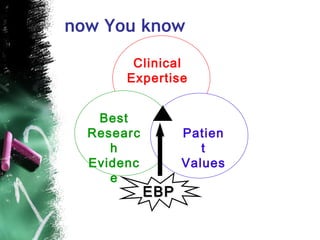
now You know Clinical   Expertise Best Research Evidence Patient Values EBP
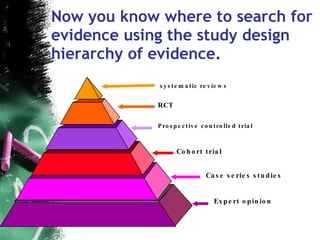
Now you know where to search for evidence using the study design hierarchy of evidence. systematic reviews Prospective controlled trial Cohort trial Case series studies Expert opinion RCT
So you can decide the proper terminology of the research design you perform to avoid others’ mistakes
Example I A non-randomized controlled trial was described as prospective randomized study  (Alhelou et al, MEFS 2004: 37-41)
Example II A case series was described as prospective cohort study  (Bigelow et al, Human Reprod 2004; 889-92)
Example III Semen sample collection in medium enhances the implantation rate following ICSI in patients with severe oligoasthenoteratozoospermia   Zollner , Human Reproduction, , 1110-1114, June 2001   However, on re-analysis of the data, non-significant  P  value of 0.37 which is quite different from the authors'  P  value of < 0.001  Van Royen, and J. Gerris
Thus Clinical as well as statistical knowledge is needed in the field of subfertility  Dickey, 2003
Miracle Trial Infertile women who were prayed for by  prayer groups became pregnant twice as often as those who did not have people praying for them.  Later, accused of being fabricated
Getting Started Read to learn; read to analyze About research methodology Studies on similar topics  Interesting studies
Then perform Methodologically sound studies with appropriate follow up  To improve outcome (conception) To prevent Adverse event (OHSS)
Keep In Mind That No study is perfect “All data is contaminated some way or another; research is what you do with these data”  Data collection involves agreement & consent Partnership job description
Basic steps of a research project Find a topic  What Formulate questions  What, Why Define population  Who, When Select design & measurement  How Gather data  How Interpret results  Why Tell about what you did and found out
Common Pitfalls Problems with population Sampling?  Representativeness?
Common Pitfalls Problems with operationalization Defining of what is measured
Common Pitfalls Problems with generalizability  False conclusions
How to avoid research pitfalls Treatment efficacy is most reliably assessed by undertaking a randomized, controlled trial. allocation to the experimental and control interventions occurs by chance
30% in the last 5 ys acceptance of the randomized controlled trial (RCT) in the field of reproductive medicine is evident by the increasing numbers of such trials being published From 1966 -2005 = 864 From 2000-2005 = 258
But even in well designed studies Certain pitfalls could happen and can be avoided
Intention-to-treat analysis: Including and analysing all randomised patients according to their original treatment allocation, irrespective of whether they actually received that treatment. This preserves the unbiased comparison of treatment groups afforded by randomization.
Loss to follow-up: Where patients stop contributing outcome data. This may be because they can no longer be contacted, for example, having moved away or because they actively want to  drop-out  of further participation in the trial. The latter may be related to clinician  withdrawal  or patient  compliance .
cross-over trial   Women will have the opportunity to receive the experimental treatment, if not in the first cycle (or period) then in the second cycle (or period).  when pregnancy is the outcome of interest, it is an inappropriate methodology and should be avoided
Why the subject who conceives with one treatment in the first period will be classified as a dropout in the second period.  The effect of treatment in the first period could extend to the second period Bias
primary outcome indicator  It needs to be stressed that in RCTs in which women undergoing assisted reproduction treatment are randomized to receive an experimental or control intervention, the unit of analysis is the randomized woman
For example The use of implantation rates (which requires calculating the proportion of all embryos that implant) uses the embryo as the unit of analysis.  This is methodologically incorrect and inflates the denominator because each randomized woman may contribute several embryos to the analysis.
Example II evaluating outcomes on a per-cycle of treatment basis rather than a per-patient basis.
Clinical heterogeneity Down regulation protocol long, short, agonist or antagonist Day of ET  Luteal phase support regimen
The CONSORT statement checklist and flow diagram for reporting RCTs associated with an improvement in the quality of reports of RCTs (Moher et al., 2001)
Gaps: Example Currently, there is no randomized study addressing the effect of metformin on the rate of early miscarriage  PCOS are well known cause of miscarriage
Example II Effect of fibroids on fertility in patients undergoing assisted reproduction
Be Critical About Numbers How was the choice for the measurement made? What type of sample was gathered & how does that affect result? Is the statistical result interpreted correctly? If comparisons are made, are they appropriate?
Estimate of effect The o bserved relationship between an   intervention and an outcome  is  statistically expressed as an “estimate of effect” e.g. an  Odds ratio (OR) or a  Relative risk (RR)
Odds ratio (OR) If the OR = 1: Intervention has no effect The ratio of the number of people in a group with an event to the number without an event =1
Relative risk (RR) If the RR = 1: there is no difference between the risk of the event occurring in the intervention group or the control group.  The risk of the event in both intervention and control groups is equal.
Confidence Interval (CI) The range within which the “true” value (e.g. size of the effect of the intervention) is expected to lie with a given degree of certainty (e.g. 95% or 99%).
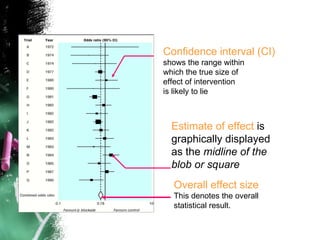
Estimate of effect  is  graphically displayed  as the  midline of the  blob or square Confidence interval (CI) shows the range within  which the true size of effect of intervention  is likely to lie Overall effect size This denotes the overall statistical result.
Number needed to treat (NNT) The NNT reflects the number of patients who need to be treated to prevent one bad outcome.
Meta-analysis A meta-analysis is a statistical technique used to combine or pool the results numerically of several independent studies addressing the same question.
 
Thank You

Research methodology 101

  • 1.
    Pitfalls in Studies Models from Literature
  • 2.
    now You knowClinical Expertise Best Research Evidence Patient Values EBP
  • 3.
    Now you knowwhere to search for evidence using the study design hierarchy of evidence. systematic reviews Prospective controlled trial Cohort trial Case series studies Expert opinion RCT
  • 4.
    So you candecide the proper terminology of the research design you perform to avoid others’ mistakes
  • 5.
    Example I Anon-randomized controlled trial was described as prospective randomized study (Alhelou et al, MEFS 2004: 37-41)
  • 6.
    Example II Acase series was described as prospective cohort study (Bigelow et al, Human Reprod 2004; 889-92)
  • 7.
    Example III Semensample collection in medium enhances the implantation rate following ICSI in patients with severe oligoasthenoteratozoospermia Zollner , Human Reproduction, , 1110-1114, June 2001 However, on re-analysis of the data, non-significant P value of 0.37 which is quite different from the authors' P value of < 0.001 Van Royen, and J. Gerris
  • 8.
    Thus Clinical aswell as statistical knowledge is needed in the field of subfertility Dickey, 2003
  • 9.
    Miracle Trial Infertilewomen who were prayed for by prayer groups became pregnant twice as often as those who did not have people praying for them. Later, accused of being fabricated
  • 10.
    Getting Started Readto learn; read to analyze About research methodology Studies on similar topics Interesting studies
  • 11.
    Then perform Methodologicallysound studies with appropriate follow up To improve outcome (conception) To prevent Adverse event (OHSS)
  • 12.
    Keep In MindThat No study is perfect “All data is contaminated some way or another; research is what you do with these data” Data collection involves agreement & consent Partnership job description
  • 13.
    Basic steps ofa research project Find a topic  What Formulate questions  What, Why Define population  Who, When Select design & measurement  How Gather data  How Interpret results  Why Tell about what you did and found out
  • 14.
    Common Pitfalls Problemswith population Sampling? Representativeness?
  • 15.
    Common Pitfalls Problemswith operationalization Defining of what is measured
  • 16.
    Common Pitfalls Problemswith generalizability False conclusions
  • 17.
    How to avoidresearch pitfalls Treatment efficacy is most reliably assessed by undertaking a randomized, controlled trial. allocation to the experimental and control interventions occurs by chance
  • 18.
    30% in thelast 5 ys acceptance of the randomized controlled trial (RCT) in the field of reproductive medicine is evident by the increasing numbers of such trials being published From 1966 -2005 = 864 From 2000-2005 = 258
  • 19.
    But even inwell designed studies Certain pitfalls could happen and can be avoided
  • 20.
    Intention-to-treat analysis: Includingand analysing all randomised patients according to their original treatment allocation, irrespective of whether they actually received that treatment. This preserves the unbiased comparison of treatment groups afforded by randomization.
  • 21.
    Loss to follow-up:Where patients stop contributing outcome data. This may be because they can no longer be contacted, for example, having moved away or because they actively want to drop-out of further participation in the trial. The latter may be related to clinician withdrawal or patient compliance .
  • 22.
    cross-over trial Women will have the opportunity to receive the experimental treatment, if not in the first cycle (or period) then in the second cycle (or period). when pregnancy is the outcome of interest, it is an inappropriate methodology and should be avoided
  • 23.
    Why the subjectwho conceives with one treatment in the first period will be classified as a dropout in the second period. The effect of treatment in the first period could extend to the second period Bias
  • 24.
    primary outcome indicator It needs to be stressed that in RCTs in which women undergoing assisted reproduction treatment are randomized to receive an experimental or control intervention, the unit of analysis is the randomized woman
  • 25.
    For example Theuse of implantation rates (which requires calculating the proportion of all embryos that implant) uses the embryo as the unit of analysis. This is methodologically incorrect and inflates the denominator because each randomized woman may contribute several embryos to the analysis.
  • 26.
    Example II evaluatingoutcomes on a per-cycle of treatment basis rather than a per-patient basis.
  • 27.
    Clinical heterogeneity Downregulation protocol long, short, agonist or antagonist Day of ET Luteal phase support regimen
  • 28.
    The CONSORT statementchecklist and flow diagram for reporting RCTs associated with an improvement in the quality of reports of RCTs (Moher et al., 2001)
  • 29.
    Gaps: Example Currently,there is no randomized study addressing the effect of metformin on the rate of early miscarriage PCOS are well known cause of miscarriage
  • 30.
    Example II Effectof fibroids on fertility in patients undergoing assisted reproduction
  • 31.
    Be Critical AboutNumbers How was the choice for the measurement made? What type of sample was gathered & how does that affect result? Is the statistical result interpreted correctly? If comparisons are made, are they appropriate?
  • 32.
    Estimate of effectThe o bserved relationship between an intervention and an outcome is statistically expressed as an “estimate of effect” e.g. an Odds ratio (OR) or a Relative risk (RR)
  • 33.
    Odds ratio (OR)If the OR = 1: Intervention has no effect The ratio of the number of people in a group with an event to the number without an event =1
  • 34.
    Relative risk (RR)If the RR = 1: there is no difference between the risk of the event occurring in the intervention group or the control group. The risk of the event in both intervention and control groups is equal.
  • 35.
    Confidence Interval (CI)The range within which the “true” value (e.g. size of the effect of the intervention) is expected to lie with a given degree of certainty (e.g. 95% or 99%).
  • 36.
    Estimate of effect is graphically displayed as the midline of the blob or square Confidence interval (CI) shows the range within which the true size of effect of intervention is likely to lie Overall effect size This denotes the overall statistical result.
  • 37.
    Number needed totreat (NNT) The NNT reflects the number of patients who need to be treated to prevent one bad outcome.
  • 38.
    Meta-analysis A meta-analysisis a statistical technique used to combine or pool the results numerically of several independent studies addressing the same question.
  • 39.
  • 40.

Editor's Notes

  • #3 Practicing EBM requires the integration of best research evidence with clinical expertise and patient values. This includes clinically relevant patient centered research about the accuracy and precision of diagnostic tests, the harms and benefits of therapies and the prognosis of patients with certain diseases. This information must be both valid and relevant. The best evidence must be integrated with the clinical expertise of the physician. With each patient encounter, the physician becomes more proficient at different diagnoses and treatments. Finally, the patient’s values must be integrated into the treatment plan. Decisions about care are modified by the patient’s beliefs, understanding of issues, preferences and expectations.
  • #4 When doing a search to answer a question, one wants to find the best evidence first. This pyramid offers a concept of checking Cochrane clinical evidence and other secondary pre-appraised literature first, both for the quality of information that can be found as well as speed with which one can find information.
  • #14 Hey there, does this list of steps sound familiar with all you instruction folk out there? Or any of you who have conducted a class session on research basics? Yes! It’s the same basic plan. It was when you were writing your first research paper in high school and college and it’s the same plan now. Finding the right topic can seem like a daunting task but we’ll show you some ways to make that step easier. After that you need to figure out just what your research focus really is, and that’s often done in the form of a question. Next, or even simultaneously, you should define your population of study. Students? Faculty? Users in your library? Which users? On to the next step of deciding your research design as well as deciding on your research instrument. You might ask yourself, “Am I going to conduct a survey? Via the web? E-mail? In person? Mail in? Will I interview people? Will I use a published measurement or scale? Will I do a pre and post test study?” Next you need to put your research plan into action by gathering your data set. Maybe you are collecting transaction logs from your web site or from your catalog or maybe you are doing classroom research so you are collecting data from your students over many semesters to do a learning outcomes assessment study. Next, you need to interpret what you have found. This step takes a little time and more than a lot of thought. Finally, you should write up your findings. Think of it as telling a story about what you did and what you found out. Simple? No? Fun? Sometimes~ Long term rewards? Priceless!
  • #15 You should try to avoid some typical problems that befall researchers. One of these is found in population. First of all is your sample representative of what you are trying to study? How did you arrive at your sample? Did you not exclude those that need to be included or did you include those that shouldn’t be included. Let’s look at some of those research problems we looked at in the beginning of this session.
  • #16 It’s important to thoroughly define what you are measuring and how you are measuring it otherwise you may run into some problems.
  • #33 Explain that in studies of the effects of health care, the “estimate of effect” is the observed relationship between an intervention and an outcome. Tell participants that calculations for the OR and RR are contained at the end of the session in their Manuals.
  • #34 If the OR = 1, the intervention has no effect. With respect to the event being measured, there is no difference between the control group and the group receiving the intervention. Another way of saying this is that the ratio of the number of people in a group with an event to the number without an event is equal to one.
  • #35 Remind the participants that “relative risk” is one of the measures of effect that is reported in studies of the effects of health care.
  • #36 A 95% confidence interval (95% CI) can broadly be translated to mean that if the trial was to be repeated 100 times with all factors remaining identical, a result (estimate of effect) which lay within the range of the CI will be found in 95% of cases . A 99% confidence interval (99% CI) can thus broadly be translated to mean that if the trial was to be repeated 100 times with all factors remaining identical, a result (estimate of effect) which lay within the range of the CI will be found in 99% of cases .
  • #38 Explain that the number needed to treat is a useful way of looking at results of reviews or trials because it expresses the therapeutic effort that is needed to get a therapeutic result. Increasingly we have choices of treatments, and the NNTs should help us make the choice that is right for an individual patient. It is calculated from the relative risk. For trainer information only: NNT = 1 / Risk difference Risk difference = Incidence in exposed – Incidence in unexposed
  • #39 Explain that a “ meta-analysis ” is a statistical procedure that integrates the results of several independent studies that can be “combined”. It provides a quantitative summary of the overall effect of the intervention (a pooled estimate and a confidence interval). Please stress that: a systematic review can stand alone without a meta-analysis should the individual studies be too diverse to combine statistically. the main requirement for a worthwhile meta-analysis is a well-executed systematic review.