Critically Appraise Evidence-
Based Findings
Objectives

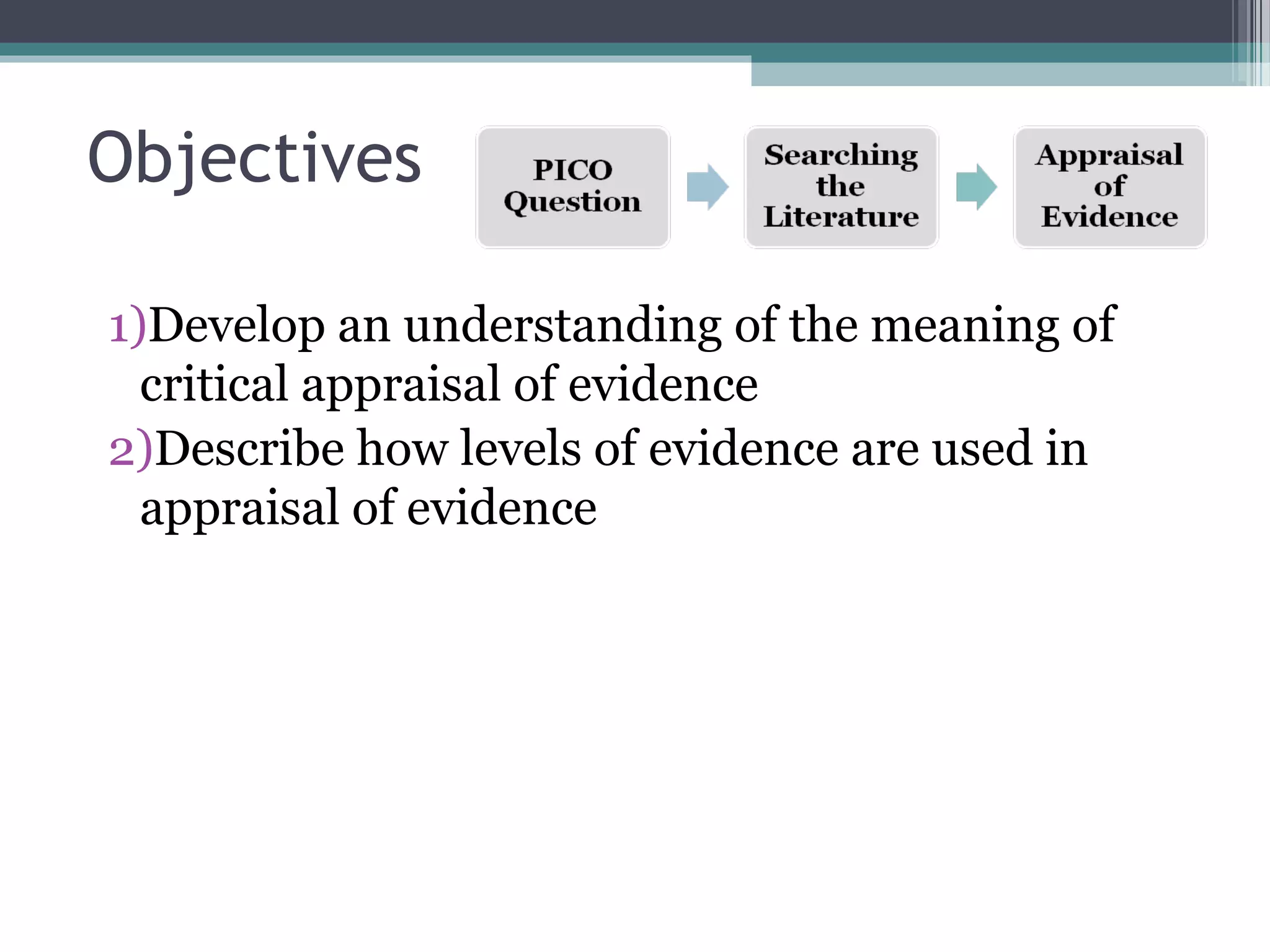
1)Develop an understanding of the meaning of
  critical appraisal of evidence
2)Describe how levels of evidence are used in
  appraisal of evidence
Evidence Based Practice
• Uses highest quality of knowledge in
  providing care to produce the greatest
  impact on health status and health care
Critical Appraisal of Evidence
• Key characteristic of evidence based
  practice
• Core skill needed to use evidence to
  support nursing practice decisions
Critical Appraisal of Evidence
• Ensures relevance and transferability of
  evidence from the search to the specific
  population for whom the care will be
  provided
Critical Appraisal of Evidence Defined
• 1) Assessing the strength of the scientific
  evidence
• 2) Evaluating the research for its quality
  and applicability to health care decision
  making
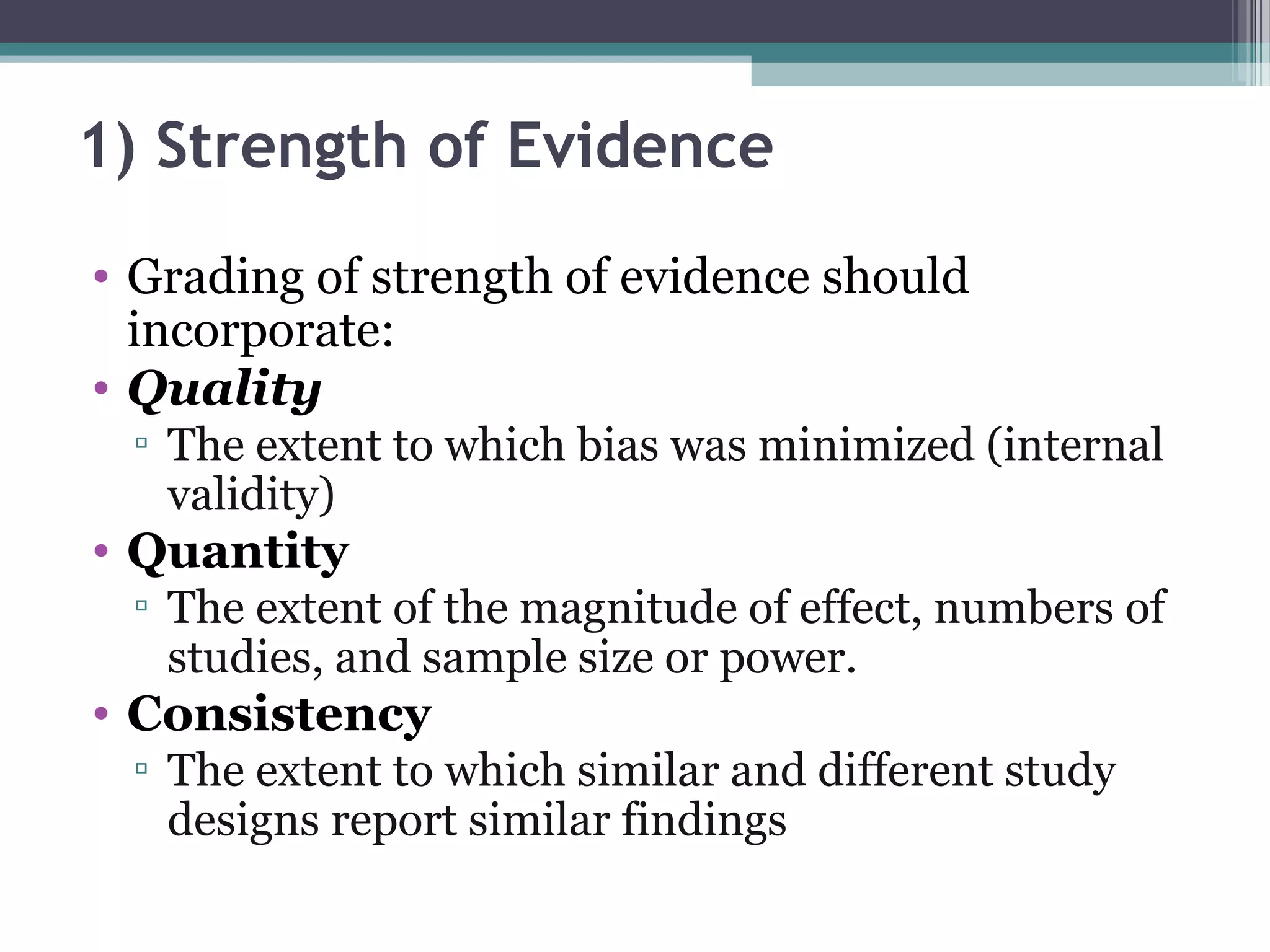
1) Strength of Evidence
• Grading of strength of evidence should
  incorporate:
• Quality
 ▫ The extent to which bias was minimized (internal
   validity)
• Quantity
 ▫ The extent of the magnitude of effect, numbers of
   studies, and sample size or power.
• Consistency
 ▫ The extent to which similar and different study
   designs report similar findings
1) Strength of Evidence

• Evidence exists on a continuum of rigor
• Amount of research attention or maturity of
  science varies, therefore evidence varies
• Type of research design reflects the strength of
  the evidence – known as levels of evidence
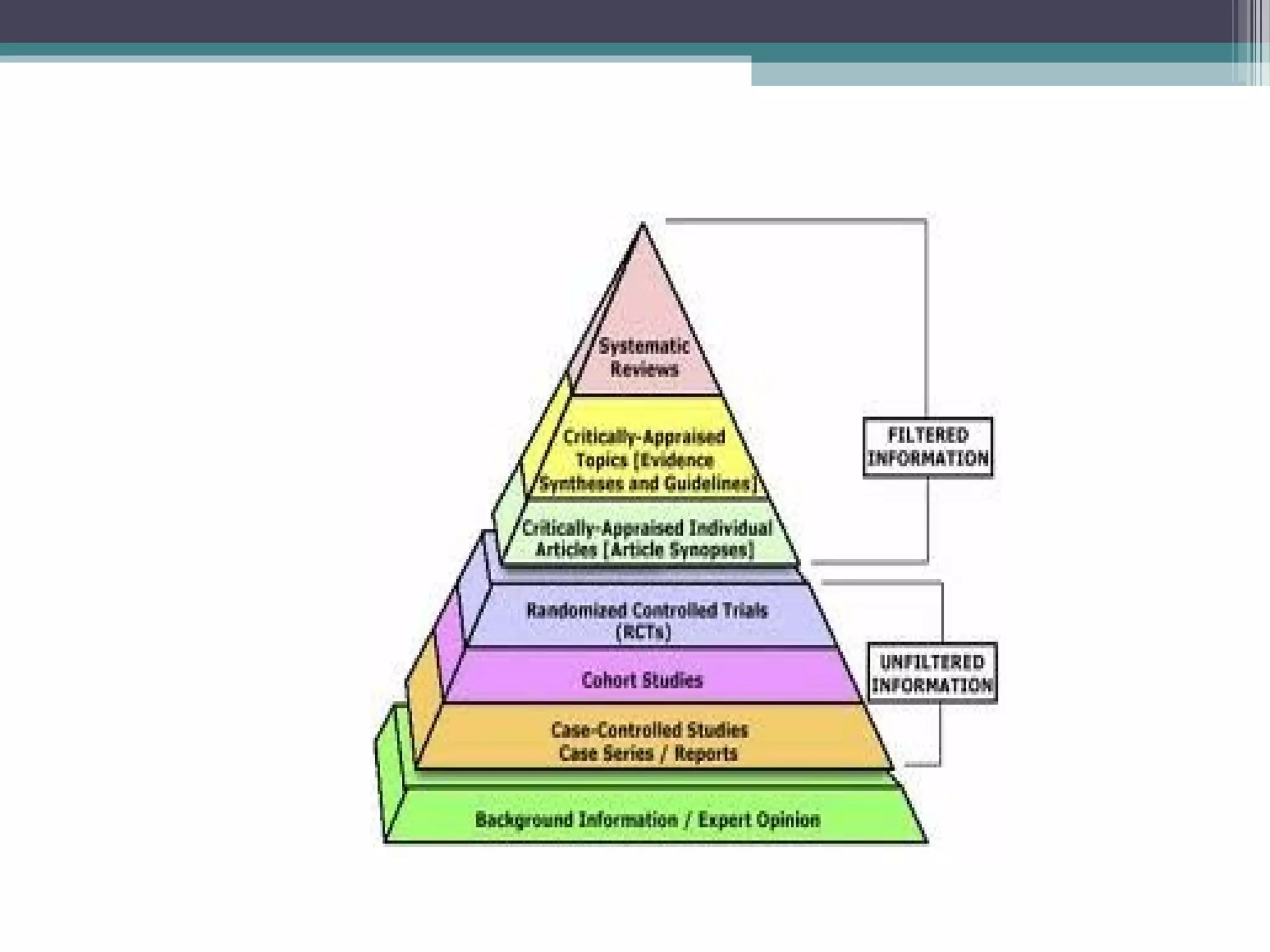
Levels of Evidence
 • Ranking as to how well the evidence
   informs clinical interventions
 • The stronger the level of evidence, the
   greater the confidence that the probability
   of applying the evidence in practice will be
   effective
 • Levels of evidence are based on research
   design
Levels of Evidence
• Experts have developed
  a number of
  taxonomies to rate
  strength of evidence
• Most are organized
  around research
  designs
Levels of Evidence
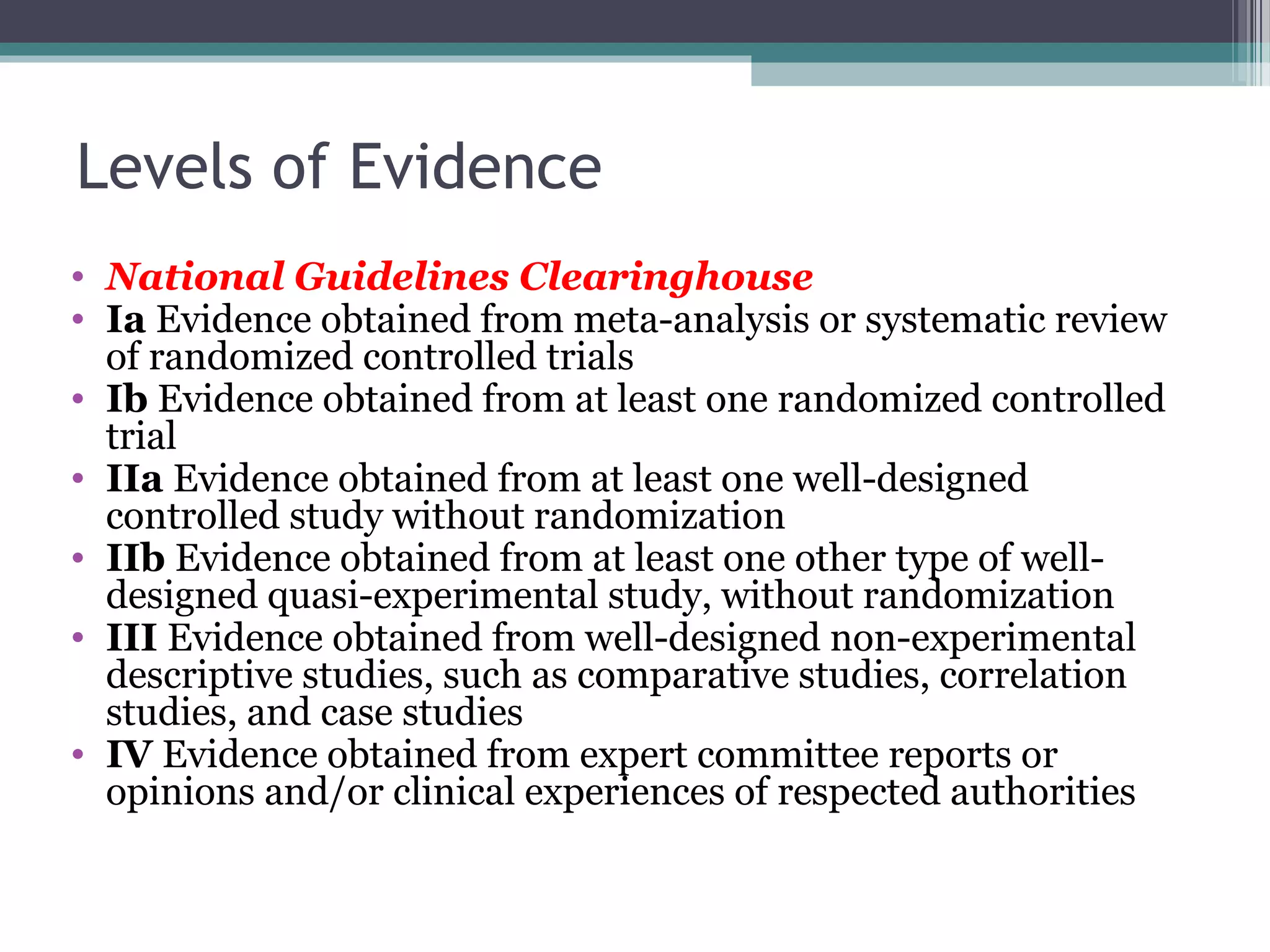
• National Guidelines Clearinghouse
• Ia Evidence obtained from meta-analysis or systematic review
  of randomized controlled trials
• Ib Evidence obtained from at least one randomized controlled
  trial
• IIa Evidence obtained from at least one well-designed
  controlled study without randomization
• IIb Evidence obtained from at least one other type of well-
  designed quasi-experimental study, without randomization
• III Evidence obtained from well-designed non-experimental
  descriptive studies, such as comparative studies, correlation
  studies, and case studies
• IV Evidence obtained from expert committee reports or
  opinions and/or clinical experiences of respected authorities
Levels of Evidence
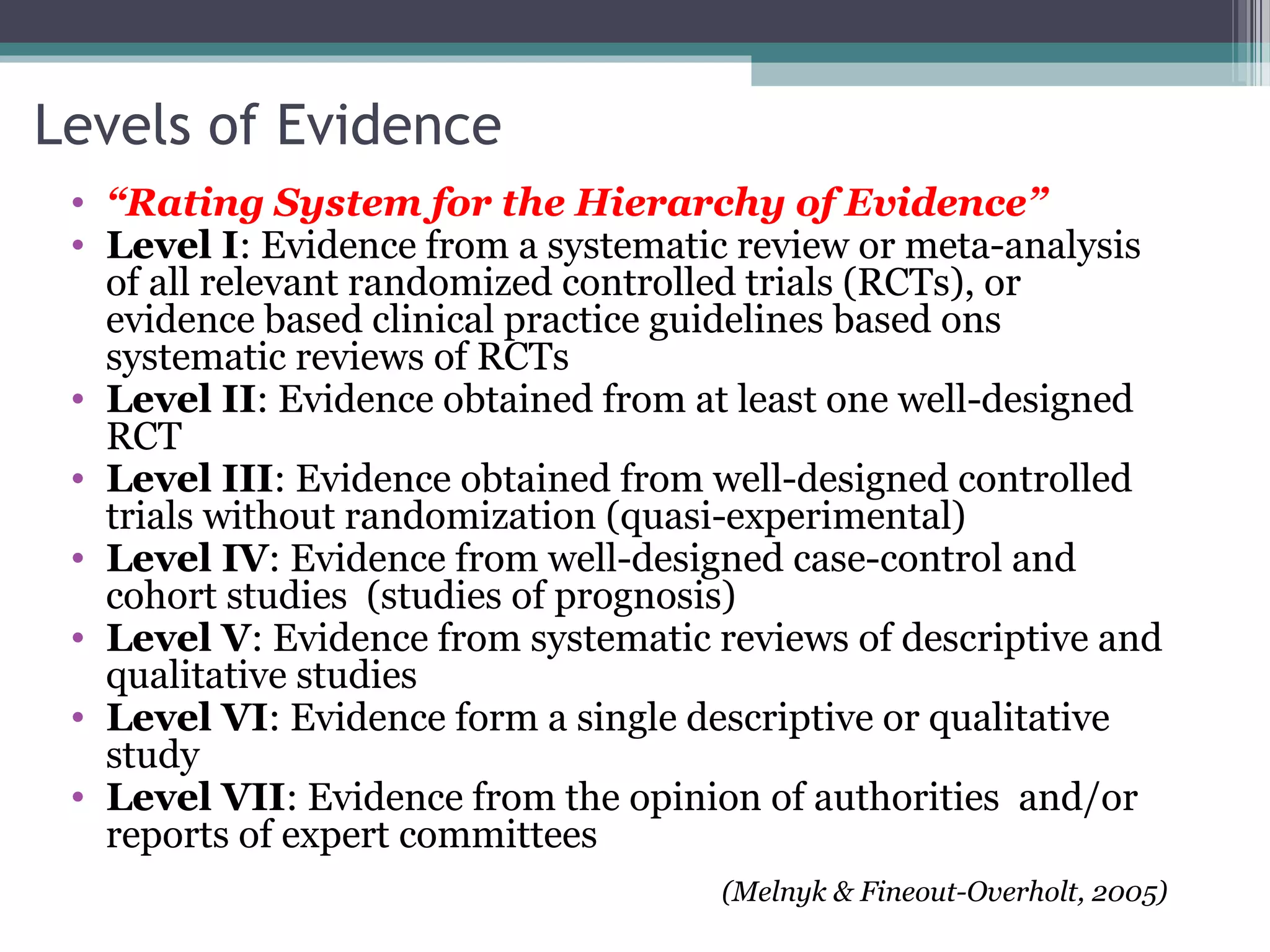
 • “Rating System for the Hierarchy of Evidence”
 • Level I: Evidence from a systematic review or meta-analysis
   of all relevant randomized controlled trials (RCTs), or
   evidence based clinical practice guidelines based ons
   systematic reviews of RCTs
 • Level II: Evidence obtained from at least one well-designed
   RCT
 • Level III: Evidence obtained from well-designed controlled
   trials without randomization (quasi-experimental)
 • Level IV: Evidence from well-designed case-control and
   cohort studies (studies of prognosis)
 • Level V: Evidence from systematic reviews of descriptive and
   qualitative studies
 • Level VI: Evidence form a single descriptive or qualitative
   study
 • Level VII: Evidence from the opinion of authorities and/or
   reports of expert committees
                                     (Melnyk & Fineout-Overholt, 2005)
Levels of Evidence
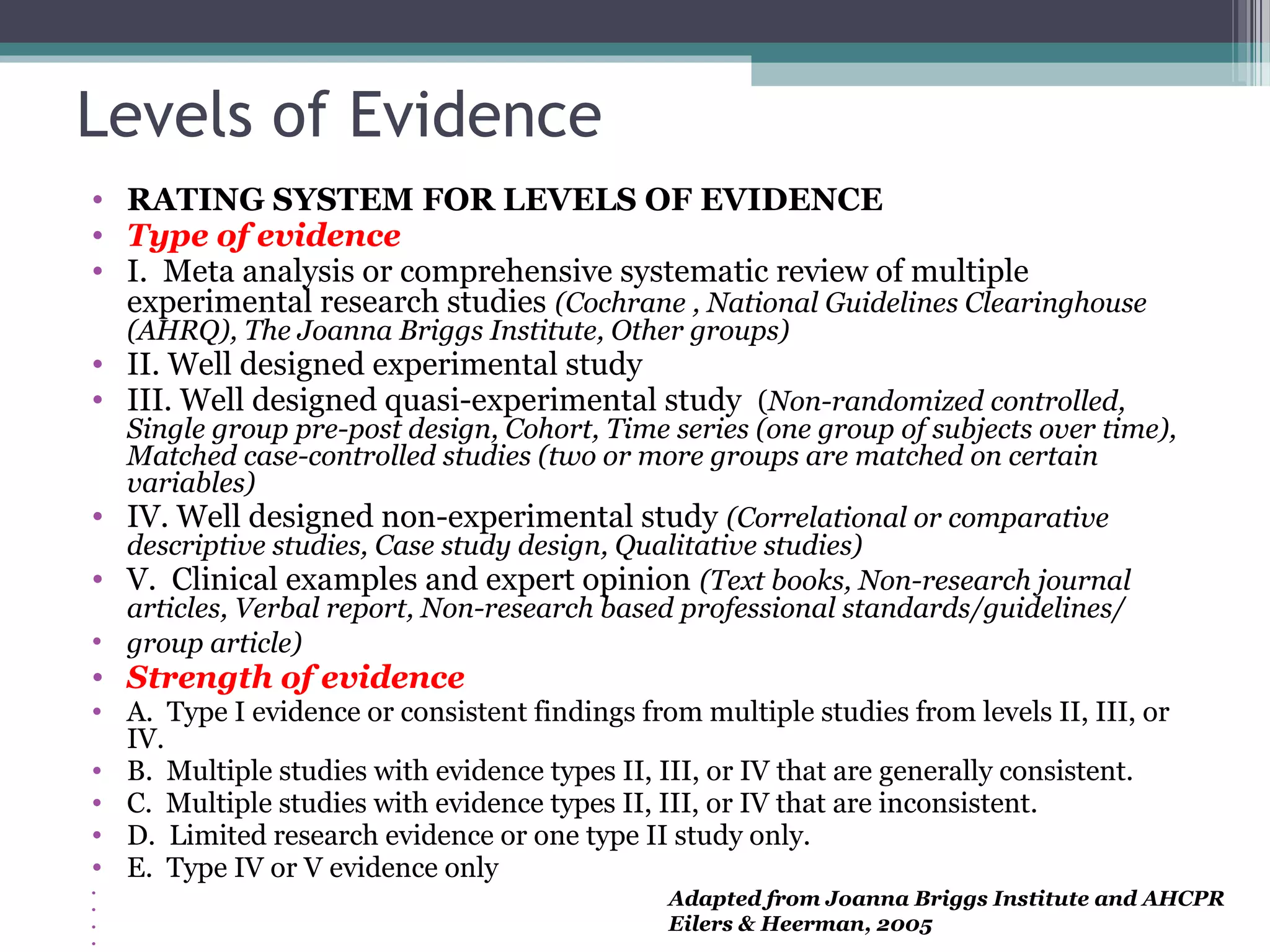
• RATING SYSTEM FOR LEVELS OF EVIDENCE
• Type of evidence
• I. Meta analysis or comprehensive systematic review of multiple
  experimental research studies (Cochrane , National Guidelines Clearinghouse
    (AHRQ), The Joanna Briggs Institute, Other groups)
• II. Well designed experimental study
• III. Well designed quasi-experimental study (Non-randomized controlled,
  Single group pre-post design, Cohort, Time series (one group of subjects over time),
  Matched case-controlled studies (two or more groups are matched on certain
  variables)
• IV. Well designed non-experimental study (Correlational or comparative
  descriptive studies, Case study design, Qualitative studies)
• V. Clinical examples and expert opinion (Text books, Non-research journal
  articles, Verbal report, Non-research based professional standards/guidelines/
• group article)
• Strength of evidence
• A. Type I evidence or consistent findings from multiple studies from levels II, III, or
  IV.
• B. Multiple studies with evidence types II, III, or IV that are generally consistent.
• C. Multiple studies with evidence types II, III, or IV that are inconsistent.
• D. Limited research evidence or one type II study only.
• E. Type IV or V evidence only
•
•
                                               Adapted from Joanna Briggs Institute and AHCPR
•                                              Eilers & Heerman, 2005
•
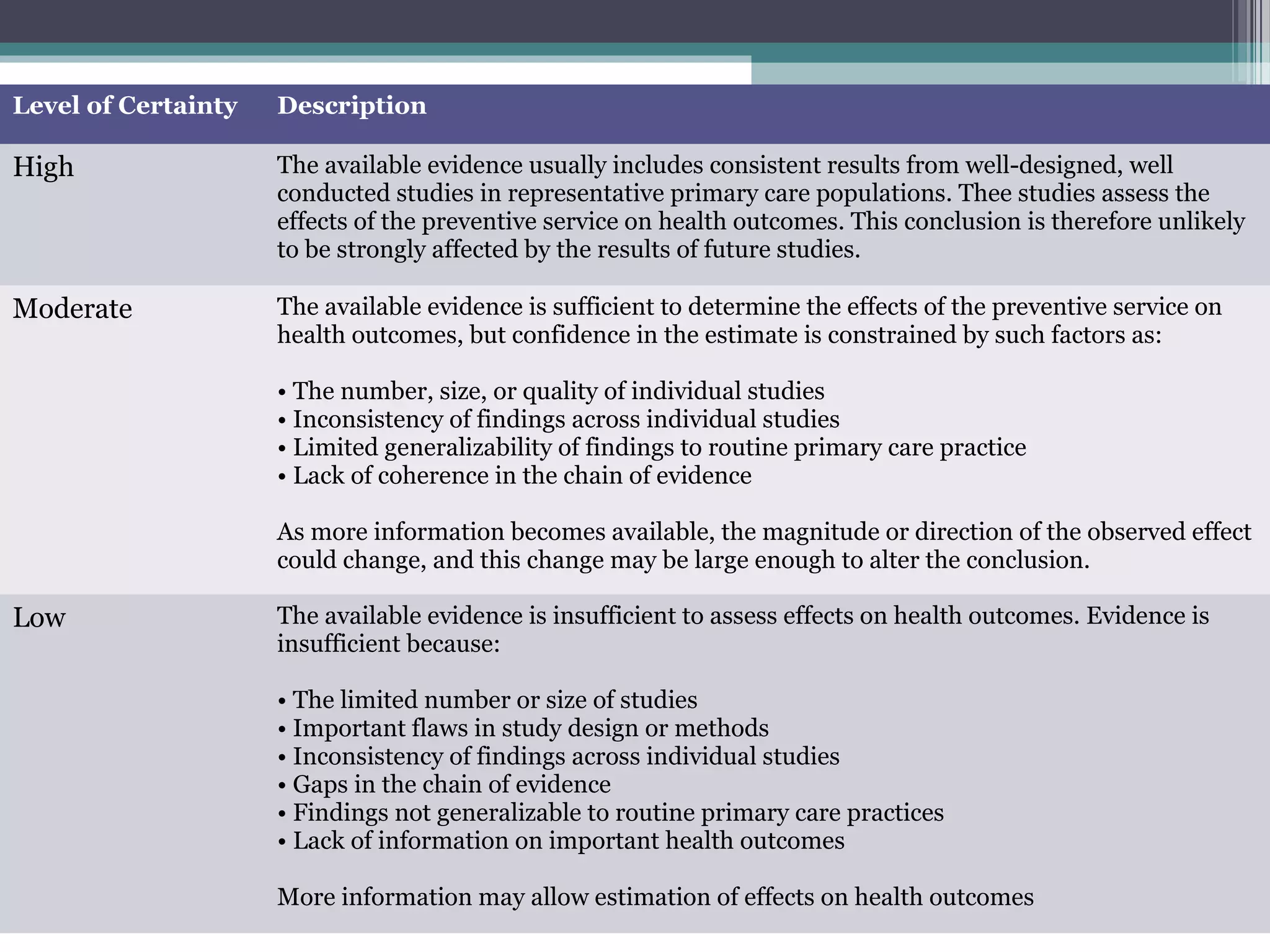
Level of Certainty   Description

High                 The available evidence usually includes consistent results from well-designed, well
                     conducted studies in representative primary care populations. Thee studies assess the
                     effects of the preventive service on health outcomes. This conclusion is therefore unlikely
                     to be strongly affected by the results of future studies.

Moderate             The available evidence is sufficient to determine the effects of the preventive service on
                     health outcomes, but confidence in the estimate is constrained by such factors as:

                     • The number, size, or quality of individual studies
                     • Inconsistency of findings across individual studies
                     • Limited generalizability of findings to routine primary care practice
                     • Lack of coherence in the chain of evidence

                     As more information becomes available, the magnitude or direction of the observed effect
                     could change, and this change may be large enough to alter the conclusion.

Low                  The available evidence is insufficient to assess effects on health outcomes. Evidence is
                     insufficient because:

                     • The limited number or size of studies
                     • Important flaws in study design or methods
                     • Inconsistency of findings across individual studies
                     • Gaps in the chain of evidence
                     • Findings not generalizable to routine primary care practices
                     • Lack of information on important health outcomes

                     More information may allow estimation of effects on health outcomes
Systematic Reviews
 ▫ Provides state of the science conclusions about
   evidence supporting benefits and risks of a given
   healthcare practice (Stevens, 2001)
 ▫ Most powerful and useful evidence available
 ▫ Refers to summary that uses a rigorous scientific
   approach to combine results from a body of
   original research studies into a clinically
   meaningful whole
                                       Systematic Reviews &
                                       Meta Analysis
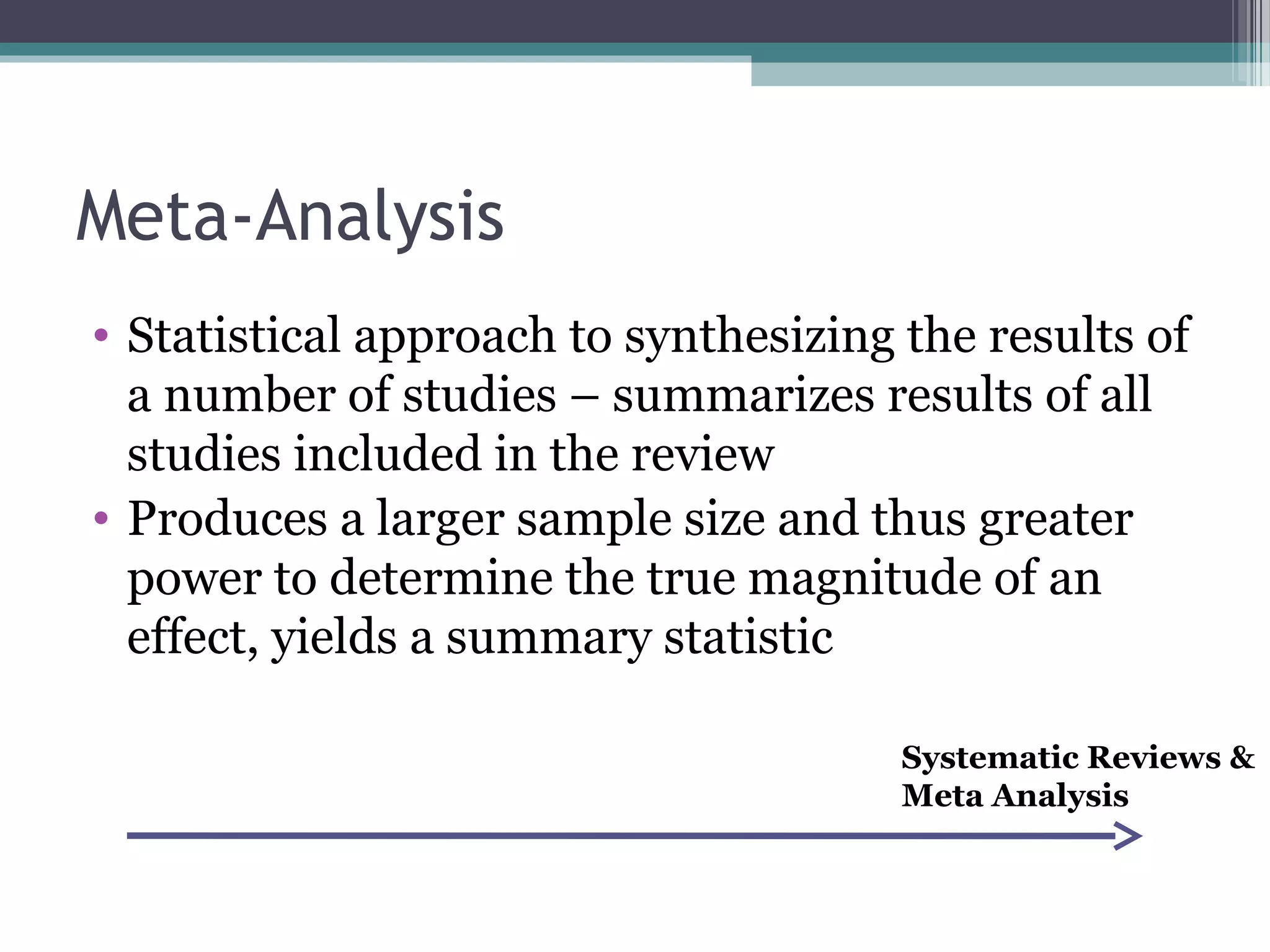
Meta-Analysis
• Statistical approach to synthesizing the results of
  a number of studies – summarizes results of all
  studies included in the review
• Produces a larger sample size and thus greater
  power to determine the true magnitude of an
  effect, yields a summary statistic

                                       Systematic Reviews &
                                       Meta Analysis
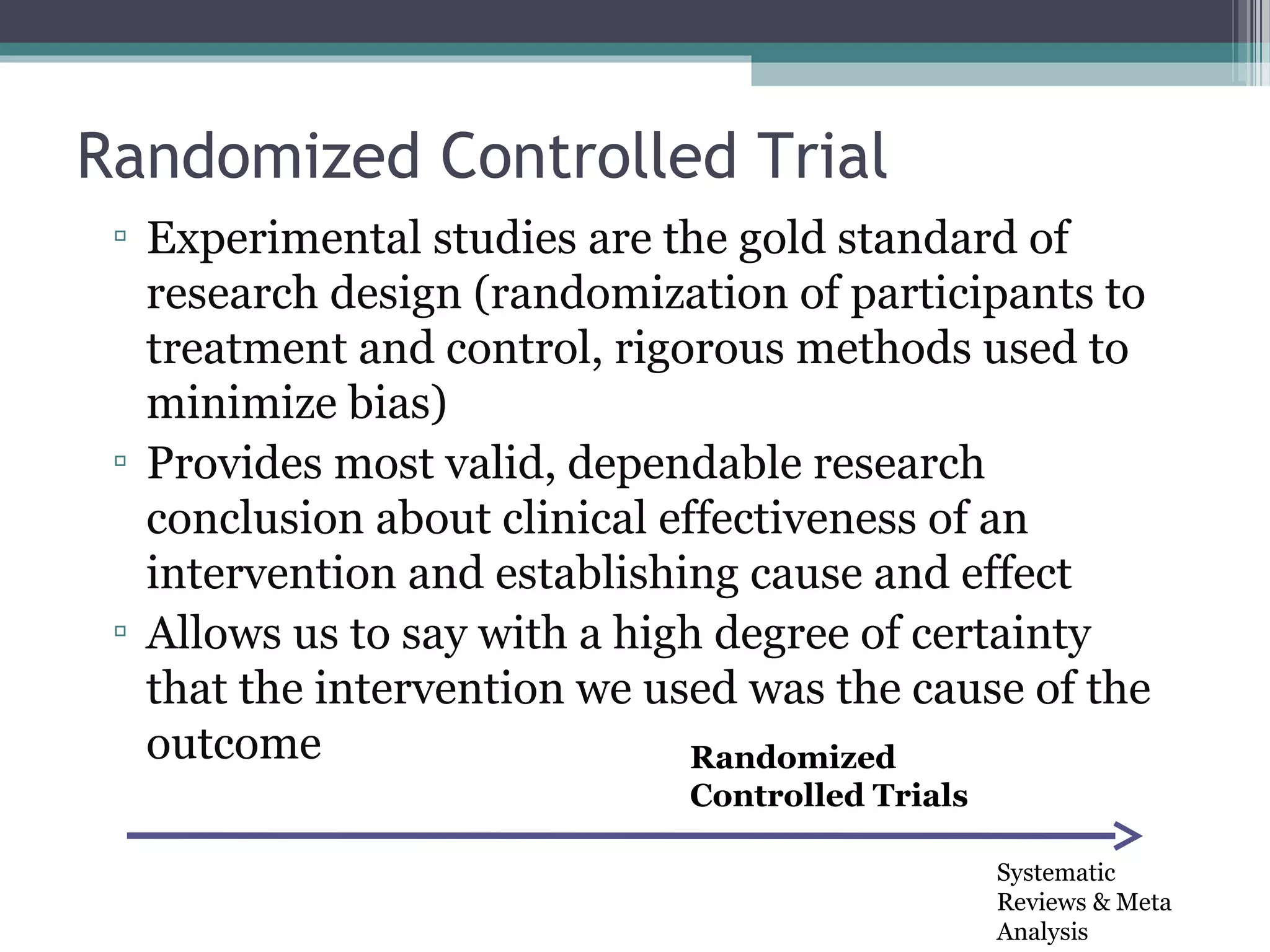
Randomized Controlled Trial
 ▫ Experimental studies are the gold standard of
   research design (randomization of participants to
   treatment and control, rigorous methods used to
   minimize bias)
 ▫ Provides most valid, dependable research
   conclusion about clinical effectiveness of an
   intervention and establishing cause and effect
 ▫ Allows us to say with a high degree of certainty
   that the intervention we used was the cause of the
   outcome                     Randomized
                             Controlled Trials

                                                 Systematic
                                                 Reviews & Meta
                                                 Analysis
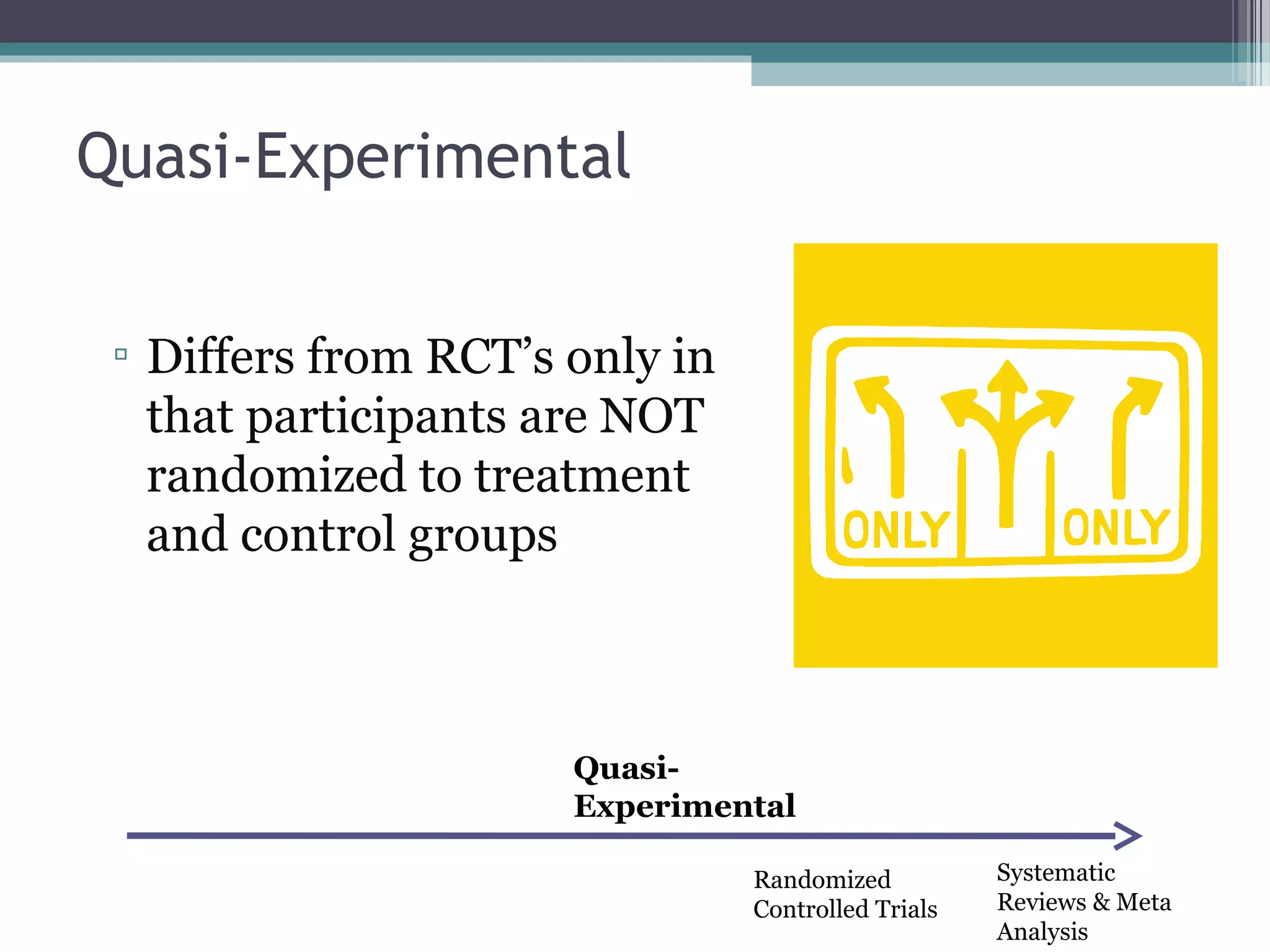
Quasi-Experimental


 ▫ Differs from RCT’s only in
   that participants are NOT
   randomized to treatment
   and control groups


                      Quasi-
                      Experimental

                                Randomized          Systematic
                                Controlled Trials   Reviews & Meta
                                                    Analysis
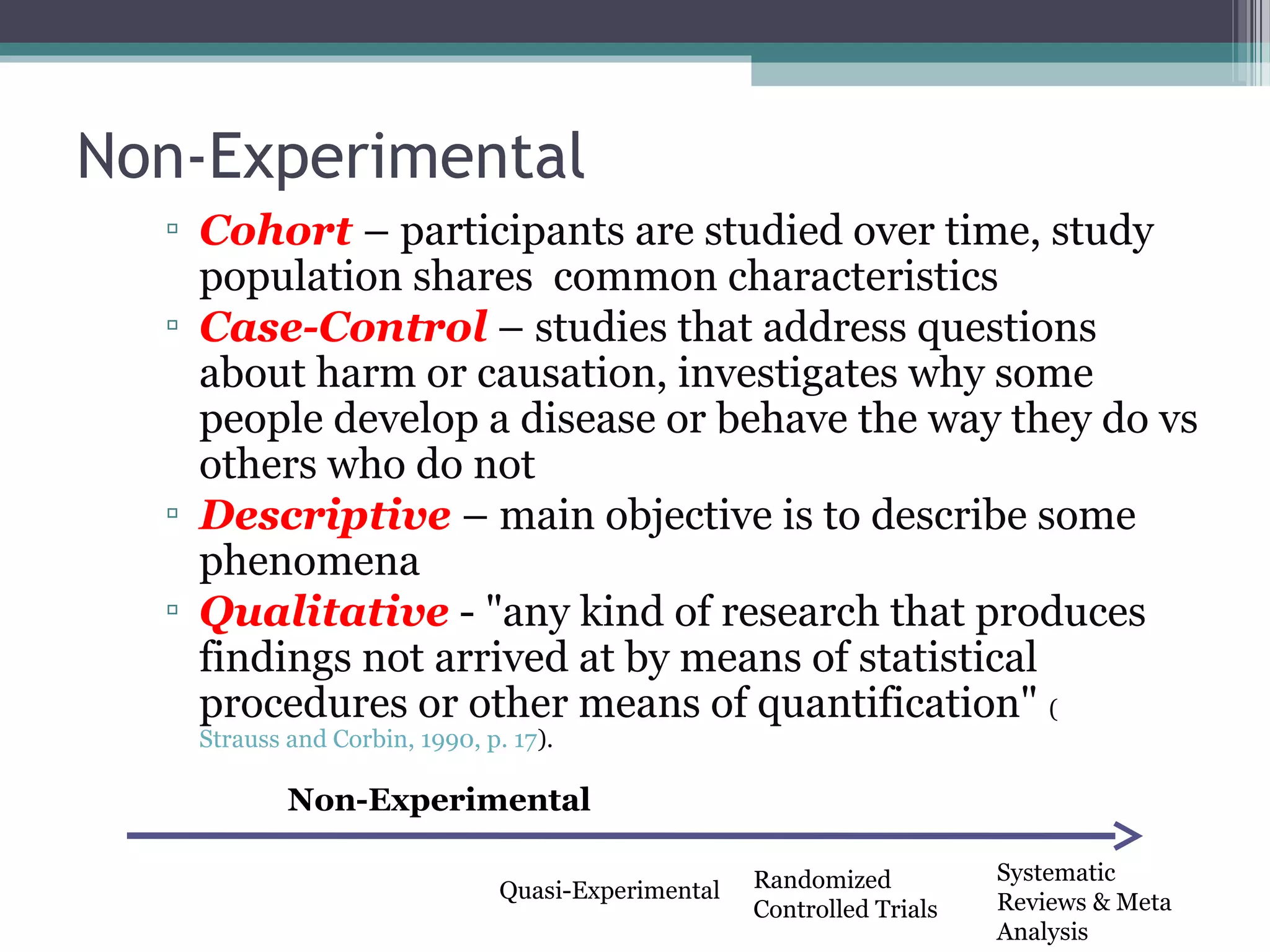
Non-Experimental
  ▫ Cohort – participants are studied over time, study
    population shares common characteristics
  ▫ Case-Control – studies that address questions
    about harm or causation, investigates why some
    people develop a disease or behave the way they do vs
    others who do not
  ▫ Descriptive – main objective is to describe some
    phenomena
  ▫ Qualitative - "any kind of research that produces
    findings not arrived at by means of statistical
    procedures or other means of quantification" (
   Strauss and Corbin, 1990, p. 17).

           Non-Experimental

                                                   Randomized          Systematic
                              Quasi-Experimental                       Reviews & Meta
                                                   Controlled Trials
                                                                       Analysis
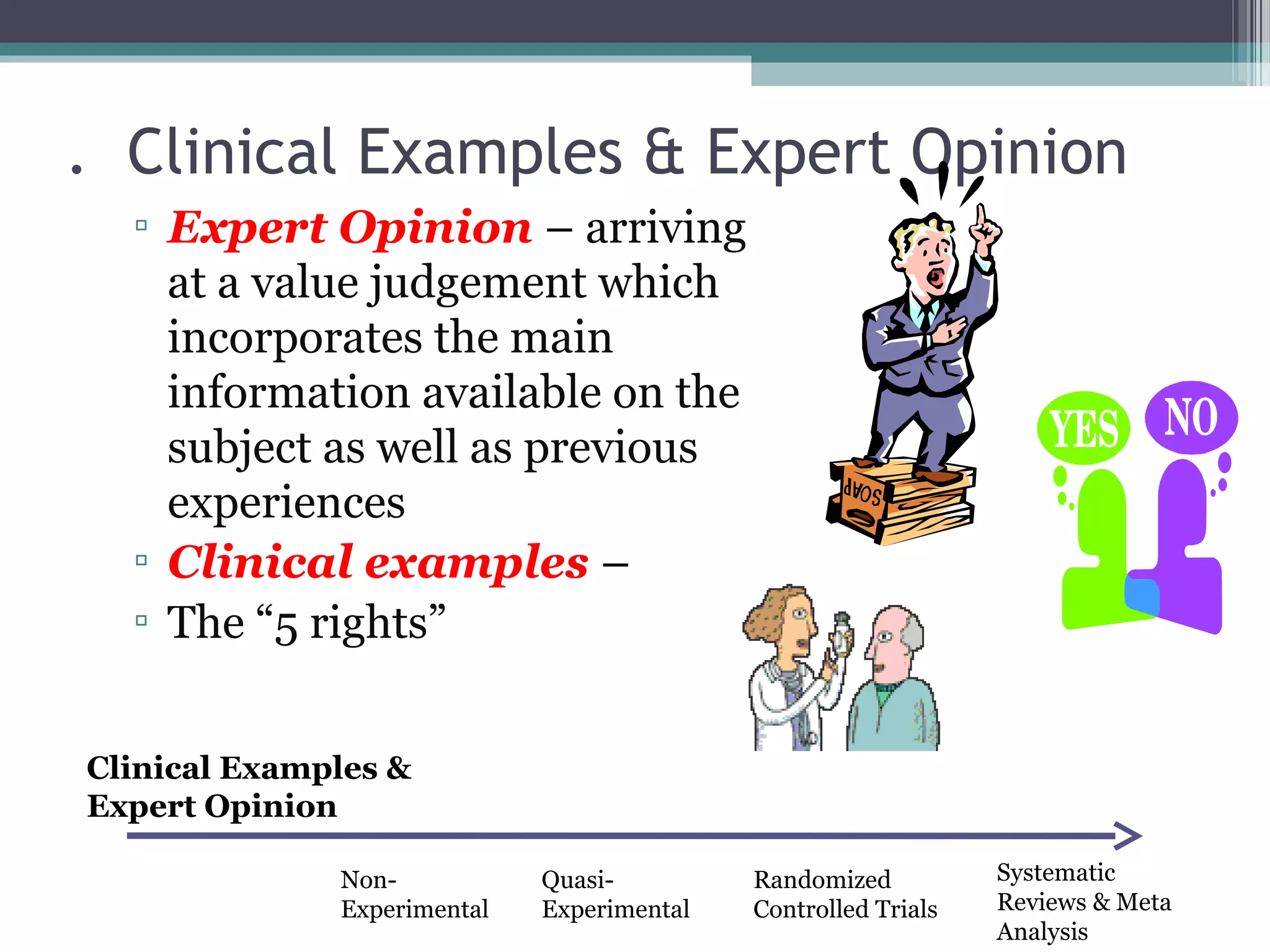
. Clinical Examples & Expert Opinion
  ▫ Expert Opinion – arriving
    at a value judgement which
    incorporates the main
    information available on the
    subject as well as previous
    experiences
  ▫ Clinical examples –
  ▫ The “5 rights”


Clinical Examples &
Expert Opinion

              Non-           Quasi-         Randomized          Systematic
              Experimental   Experimental   Controlled Trials   Reviews & Meta
                                                                Analysis
2) Evaluating Quality & Applicability
• What are the results?
• Are the results valid?
• Can the results be applied to the targeted
  population and/or public health practice and
  intervention?
What are the results?

• Were the results similar
  from study to study (if
  systematic review or meta-
  analysis)?
• What are the overall
  results?
• How precise were the
  results?
• Can a causal relationship be
  inferred from the data?
Are the Results Valid?

• Does this article explicitly address our public
  health question?
• Was the search for our article detailed and
  exhaustive? Is it likely that important, relevant
  studies were missed?
• Does the study selected appear to be of high
  methodological quality?
• Do you feel the study selected is reproducible?
Is the Evidence Applicable?

 • How can the results be interpreted
   and applied to public health practice
   and intervention?
 • Are study subjects similar to clients
   to whom care is to be delivered?
 • Were all important outcomes
   considered?
 • Are the benefits worth the costs and
   potential risks?
Other Methods Used to Appraise
Evidence
• Statistical Evaluation, for example calculating effect size
• Effect size measures the magnitude or strength of the
  treatment or intervention effect (how well the
  intervention worked in the group who received the
  intervention vs the group that did not receive the
  intervention)
• Small, medium and large effects are designated as .2, .5,
  and .8 respectively
• Several formulas to use depending on statistical analysis
  used (e.g.; t-tests, etc)

• Thalheimer, W., & Cook, S. (2002, August). How to calculate effect sizes from
  published research articles: A simplified methodology. Retrieved April 29, 2009
  from http://www.work-
  learning.com/white_papers/effect_sizes/Effect_Sizes_pdf5.pdf

Critically appraise evidence based findings

  • 1.
  • 3.
    Objectives 1)Develop an understandingof the meaning of critical appraisal of evidence 2)Describe how levels of evidence are used in appraisal of evidence
  • 4.
    Evidence Based Practice •Uses highest quality of knowledge in providing care to produce the greatest impact on health status and health care
  • 5.
    Critical Appraisal ofEvidence • Key characteristic of evidence based practice • Core skill needed to use evidence to support nursing practice decisions
  • 6.
    Critical Appraisal ofEvidence • Ensures relevance and transferability of evidence from the search to the specific population for whom the care will be provided
  • 7.
    Critical Appraisal ofEvidence Defined • 1) Assessing the strength of the scientific evidence • 2) Evaluating the research for its quality and applicability to health care decision making
  • 8.
    1) Strength ofEvidence • Grading of strength of evidence should incorporate: • Quality ▫ The extent to which bias was minimized (internal validity) • Quantity ▫ The extent of the magnitude of effect, numbers of studies, and sample size or power. • Consistency ▫ The extent to which similar and different study designs report similar findings
  • 9.
    1) Strength ofEvidence • Evidence exists on a continuum of rigor • Amount of research attention or maturity of science varies, therefore evidence varies • Type of research design reflects the strength of the evidence – known as levels of evidence
  • 10.
    Levels of Evidence • Ranking as to how well the evidence informs clinical interventions • The stronger the level of evidence, the greater the confidence that the probability of applying the evidence in practice will be effective • Levels of evidence are based on research design
  • 11.
    Levels of Evidence •Experts have developed a number of taxonomies to rate strength of evidence • Most are organized around research designs
  • 13.
    Levels of Evidence •National Guidelines Clearinghouse • Ia Evidence obtained from meta-analysis or systematic review of randomized controlled trials • Ib Evidence obtained from at least one randomized controlled trial • IIa Evidence obtained from at least one well-designed controlled study without randomization • IIb Evidence obtained from at least one other type of well- designed quasi-experimental study, without randomization • III Evidence obtained from well-designed non-experimental descriptive studies, such as comparative studies, correlation studies, and case studies • IV Evidence obtained from expert committee reports or opinions and/or clinical experiences of respected authorities
  • 14.
    Levels of Evidence • “Rating System for the Hierarchy of Evidence” • Level I: Evidence from a systematic review or meta-analysis of all relevant randomized controlled trials (RCTs), or evidence based clinical practice guidelines based ons systematic reviews of RCTs • Level II: Evidence obtained from at least one well-designed RCT • Level III: Evidence obtained from well-designed controlled trials without randomization (quasi-experimental) • Level IV: Evidence from well-designed case-control and cohort studies (studies of prognosis) • Level V: Evidence from systematic reviews of descriptive and qualitative studies • Level VI: Evidence form a single descriptive or qualitative study • Level VII: Evidence from the opinion of authorities and/or reports of expert committees (Melnyk & Fineout-Overholt, 2005)
  • 15.
    Levels of Evidence •RATING SYSTEM FOR LEVELS OF EVIDENCE • Type of evidence • I. Meta analysis or comprehensive systematic review of multiple experimental research studies (Cochrane , National Guidelines Clearinghouse (AHRQ), The Joanna Briggs Institute, Other groups) • II. Well designed experimental study • III. Well designed quasi-experimental study (Non-randomized controlled, Single group pre-post design, Cohort, Time series (one group of subjects over time), Matched case-controlled studies (two or more groups are matched on certain variables) • IV. Well designed non-experimental study (Correlational or comparative descriptive studies, Case study design, Qualitative studies) • V. Clinical examples and expert opinion (Text books, Non-research journal articles, Verbal report, Non-research based professional standards/guidelines/ • group article) • Strength of evidence • A. Type I evidence or consistent findings from multiple studies from levels II, III, or IV. • B. Multiple studies with evidence types II, III, or IV that are generally consistent. • C. Multiple studies with evidence types II, III, or IV that are inconsistent. • D. Limited research evidence or one type II study only. • E. Type IV or V evidence only • • Adapted from Joanna Briggs Institute and AHCPR • Eilers & Heerman, 2005 •
  • 16.
    Level of Certainty Description High The available evidence usually includes consistent results from well-designed, well conducted studies in representative primary care populations. Thee studies assess the effects of the preventive service on health outcomes. This conclusion is therefore unlikely to be strongly affected by the results of future studies. Moderate The available evidence is sufficient to determine the effects of the preventive service on health outcomes, but confidence in the estimate is constrained by such factors as: • The number, size, or quality of individual studies • Inconsistency of findings across individual studies • Limited generalizability of findings to routine primary care practice • Lack of coherence in the chain of evidence As more information becomes available, the magnitude or direction of the observed effect could change, and this change may be large enough to alter the conclusion. Low The available evidence is insufficient to assess effects on health outcomes. Evidence is insufficient because: • The limited number or size of studies • Important flaws in study design or methods • Inconsistency of findings across individual studies • Gaps in the chain of evidence • Findings not generalizable to routine primary care practices • Lack of information on important health outcomes More information may allow estimation of effects on health outcomes
  • 17.
    Systematic Reviews ▫Provides state of the science conclusions about evidence supporting benefits and risks of a given healthcare practice (Stevens, 2001) ▫ Most powerful and useful evidence available ▫ Refers to summary that uses a rigorous scientific approach to combine results from a body of original research studies into a clinically meaningful whole Systematic Reviews & Meta Analysis
  • 18.
    Meta-Analysis • Statistical approachto synthesizing the results of a number of studies – summarizes results of all studies included in the review • Produces a larger sample size and thus greater power to determine the true magnitude of an effect, yields a summary statistic Systematic Reviews & Meta Analysis
  • 19.
    Randomized Controlled Trial ▫ Experimental studies are the gold standard of research design (randomization of participants to treatment and control, rigorous methods used to minimize bias) ▫ Provides most valid, dependable research conclusion about clinical effectiveness of an intervention and establishing cause and effect ▫ Allows us to say with a high degree of certainty that the intervention we used was the cause of the outcome Randomized Controlled Trials Systematic Reviews & Meta Analysis
  • 20.
    Quasi-Experimental ▫ Differsfrom RCT’s only in that participants are NOT randomized to treatment and control groups Quasi- Experimental Randomized Systematic Controlled Trials Reviews & Meta Analysis
  • 21.
    Non-Experimental ▫Cohort – participants are studied over time, study population shares common characteristics ▫ Case-Control – studies that address questions about harm or causation, investigates why some people develop a disease or behave the way they do vs others who do not ▫ Descriptive – main objective is to describe some phenomena ▫ Qualitative - "any kind of research that produces findings not arrived at by means of statistical procedures or other means of quantification" ( Strauss and Corbin, 1990, p. 17). Non-Experimental Randomized Systematic Quasi-Experimental Reviews & Meta Controlled Trials Analysis
  • 22.
    . Clinical Examples& Expert Opinion ▫ Expert Opinion – arriving at a value judgement which incorporates the main information available on the subject as well as previous experiences ▫ Clinical examples – ▫ The “5 rights” Clinical Examples & Expert Opinion Non- Quasi- Randomized Systematic Experimental Experimental Controlled Trials Reviews & Meta Analysis
  • 23.
    2) Evaluating Quality& Applicability • What are the results? • Are the results valid? • Can the results be applied to the targeted population and/or public health practice and intervention?
  • 24.
    What are theresults? • Were the results similar from study to study (if systematic review or meta- analysis)? • What are the overall results? • How precise were the results? • Can a causal relationship be inferred from the data?
  • 25.
    Are the ResultsValid? • Does this article explicitly address our public health question? • Was the search for our article detailed and exhaustive? Is it likely that important, relevant studies were missed? • Does the study selected appear to be of high methodological quality? • Do you feel the study selected is reproducible?
  • 26.
    Is the EvidenceApplicable? • How can the results be interpreted and applied to public health practice and intervention? • Are study subjects similar to clients to whom care is to be delivered? • Were all important outcomes considered? • Are the benefits worth the costs and potential risks?
  • 27.
    Other Methods Usedto Appraise Evidence • Statistical Evaluation, for example calculating effect size • Effect size measures the magnitude or strength of the treatment or intervention effect (how well the intervention worked in the group who received the intervention vs the group that did not receive the intervention) • Small, medium and large effects are designated as .2, .5, and .8 respectively • Several formulas to use depending on statistical analysis used (e.g.; t-tests, etc) • Thalheimer, W., & Cook, S. (2002, August). How to calculate effect sizes from published research articles: A simplified methodology. Retrieved April 29, 2009 from http://www.work- learning.com/white_papers/effect_sizes/Effect_Sizes_pdf5.pdf