Hierarchies of
Evidence
An important concept for
any health professional.
The term levels of evidence refers to what degree that
information can be trusted. 1
Traditionally, in scientific research, some (study) methods
have been considered to be ‘better’ than others, or at least
more useful for evidence based decision making. 2
Systematic reviews have increasingly replaced traditional
narrative reviews and expert commentaries as a way of
summarising the research evidence. 3
1
Buckingham JB Greenhalgh T. Searching the literature. In: Greenhalgh T.
How to read a paper: the basics of evidence-based medicine.5th
ed. Hoboken: John Wiley & Sons; 2014.
2
MRC/CSO Social and Public Health Sciences Unit, University of Glasgow. Are some types of evidence better than others; IN:
Understanding Health Research, A tool for making sense of Health Studies
3
Davies, HT, Crombie, IK. What is a Systematic Review. In: What is….? Series. London: Hayward Medical Communications; 2009
Levels of Evidence
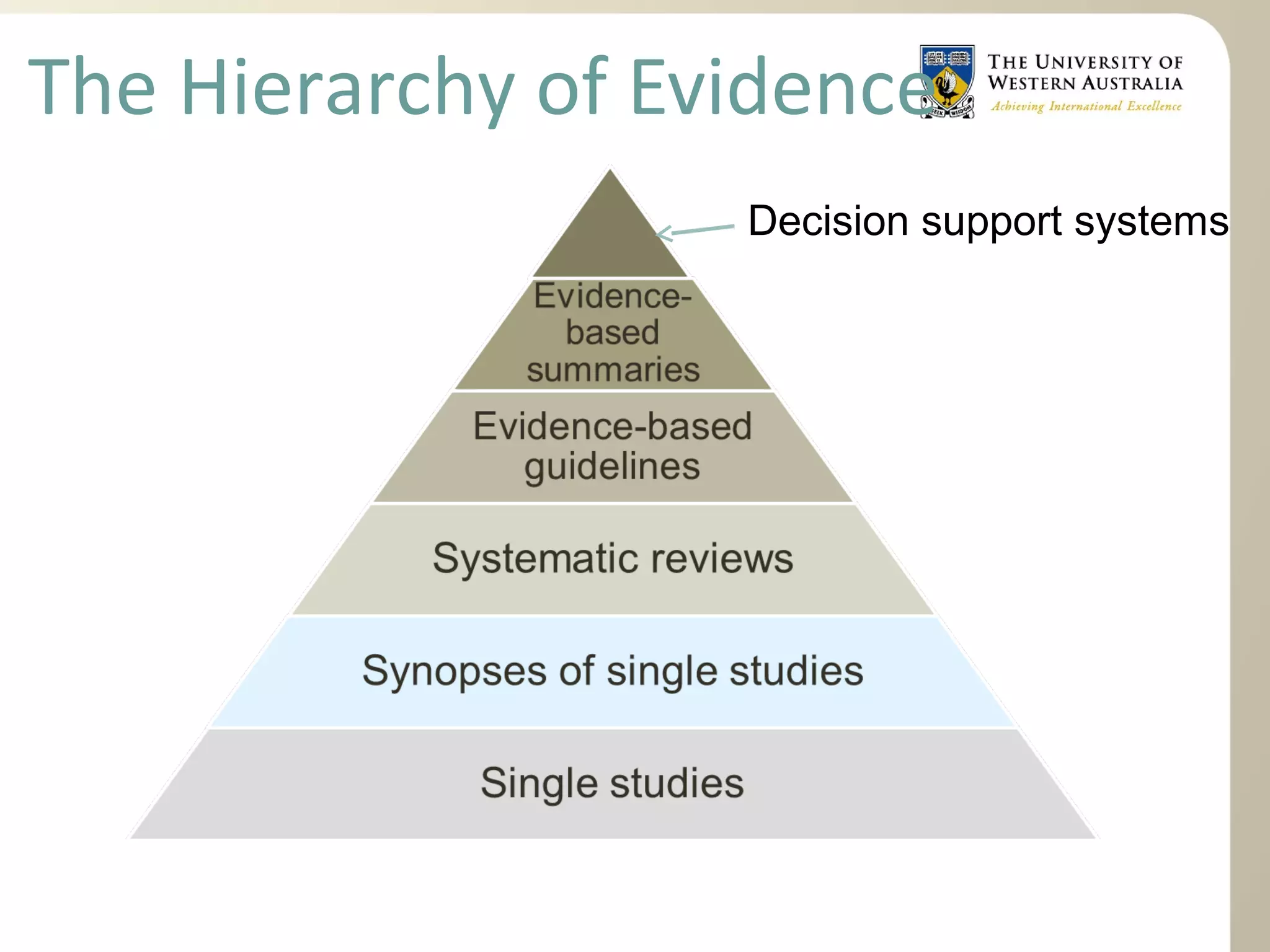
The Hierarchy of Evidence
Decision support systems
Hierarchy of Single Studies
Randomised controlled trials
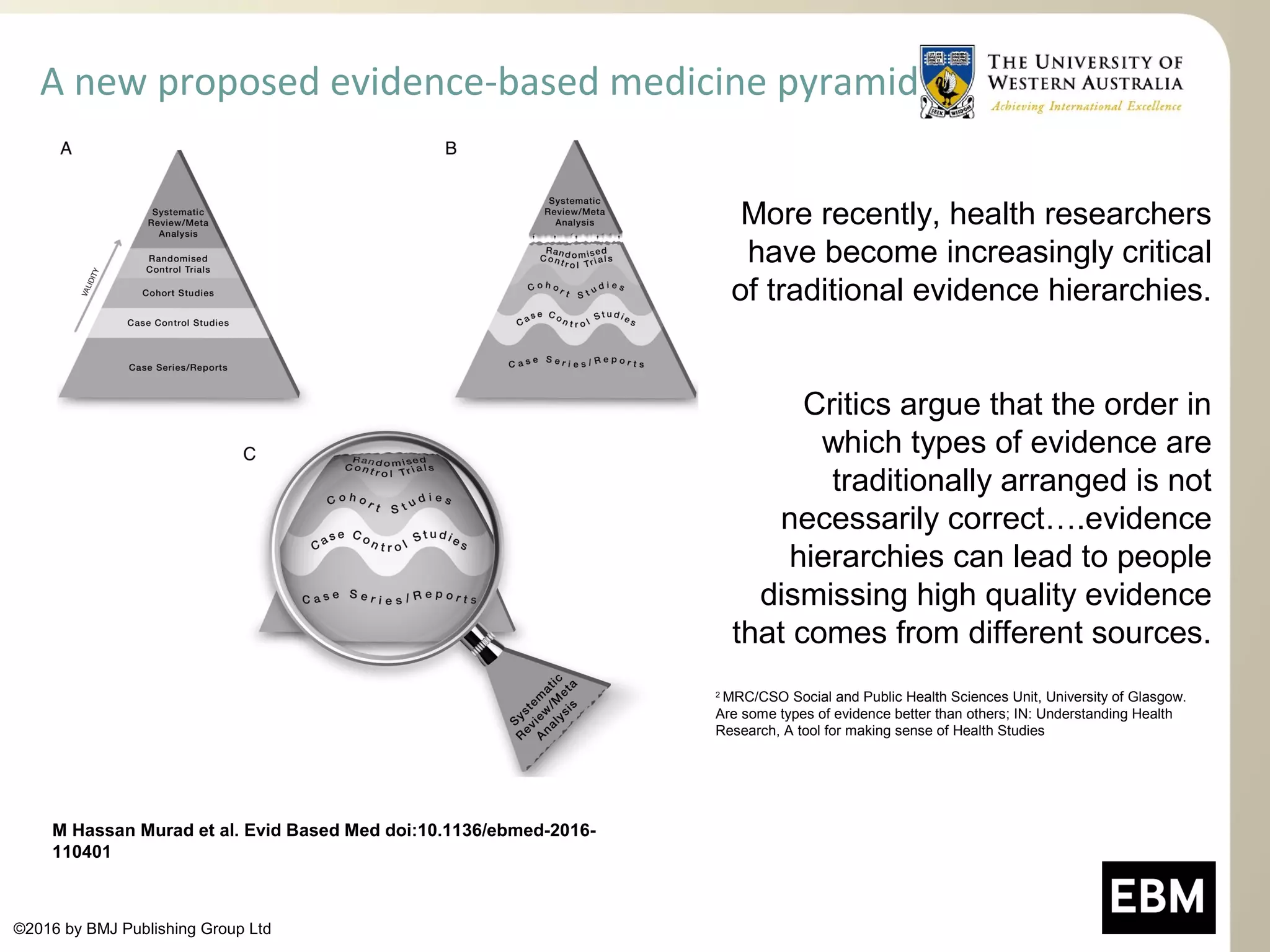
A new proposed evidence-based medicine pyramid
M Hassan Murad et al. Evid Based Med doi:10.1136/ebmed-2016-
110401
©2016 by BMJ Publishing Group Ltd
More recently, health researchers
have become increasingly critical
of traditional evidence hierarchies.
Critics argue that the order in
which types of evidence are
traditionally arranged is not
necessarily correct….evidence
hierarchies can lead to people
dismissing high quality evidence
that comes from different sources.
2
MRC/CSO Social and Public Health Sciences Unit, University of Glasgow.
Are some types of evidence better than others; IN: Understanding Health
Research, A tool for making sense of Health Studies
Key Players: Australia
JBI Connect
Produce systematic reviews and
best practice guidelines.
http://joannabriggs.org/research/critical-appraisal-tools.html
Systematic Reviews
http://guides.is.uwa.edu.au/systematic_reviews
Key Players: International
Cochrane Collaboration
Systematic
Reviews and
RCT’s
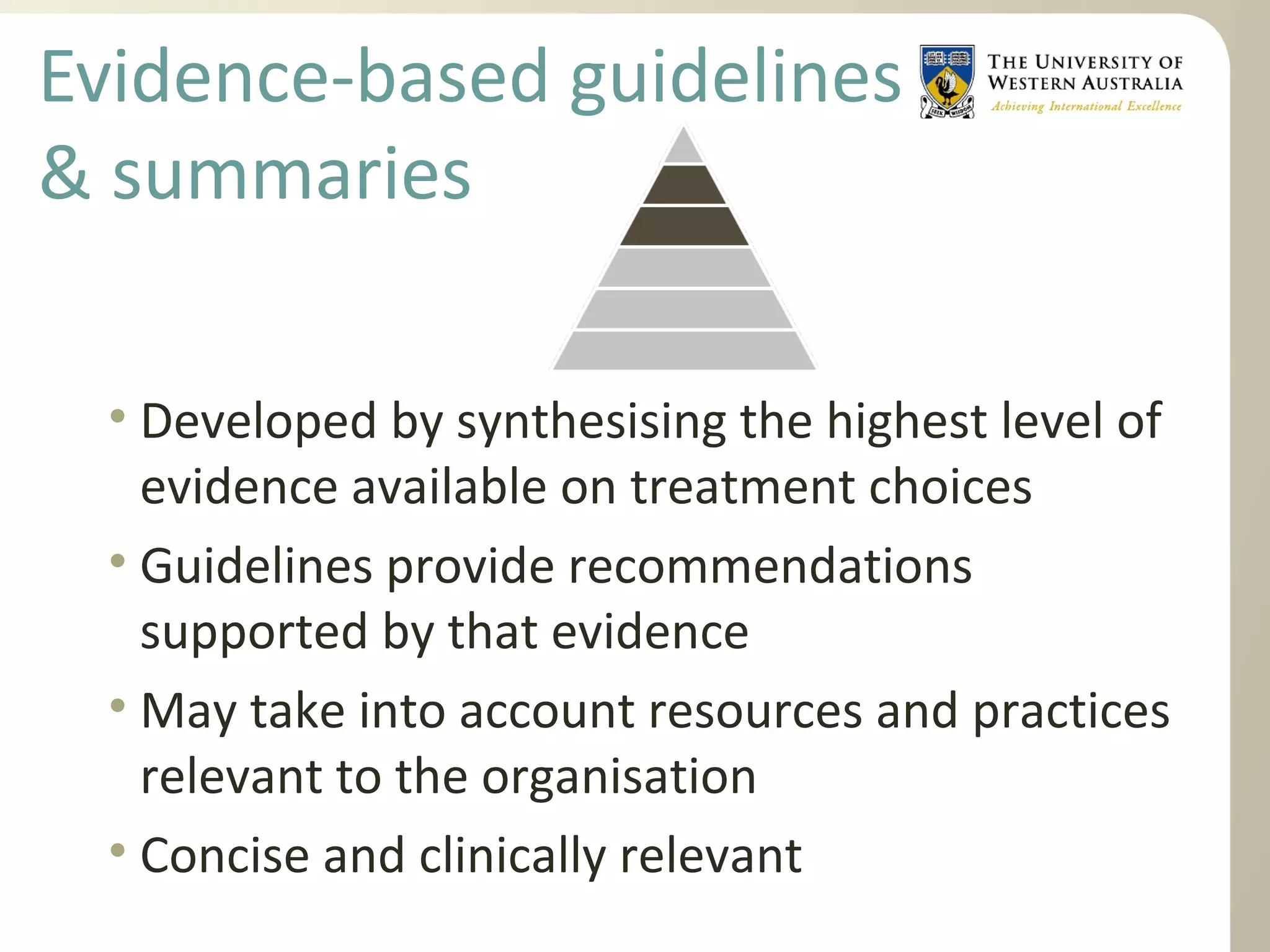
Evidence-based guidelines
& summaries
• Developed by synthesising the highest level of
evidence available on treatment choices
• Guidelines provide recommendations
supported by that evidence
• May take into account resources and practices
relevant to the organisation
• Concise and clinically relevant
Where do I find evidence?
• MEDLINE/Pubmed
and Embase
• Cochrane/JBI
Connect
• TRIP/OvidMD
• BMJ Best Practice
• ClinicalKey
• UpToDate
• ETG Complete
See: Resources for Answering Clinical Questions
Developed by US National Library of Medicine (NLM)
this life sciences and biomedicine database uses
specialist Medical Subject Headings (MeSH) to index
highly reputed medical journals.
Ability to map to MeSH search terms and to build up
your search strategy with inbuilt Boolean operators.
A range of ways to refine and limit search results based
on types of studies, cohort study groups and more.
MeSH topics and sub-topics provide a range of ways to
focus in on very specific medical areas of research.
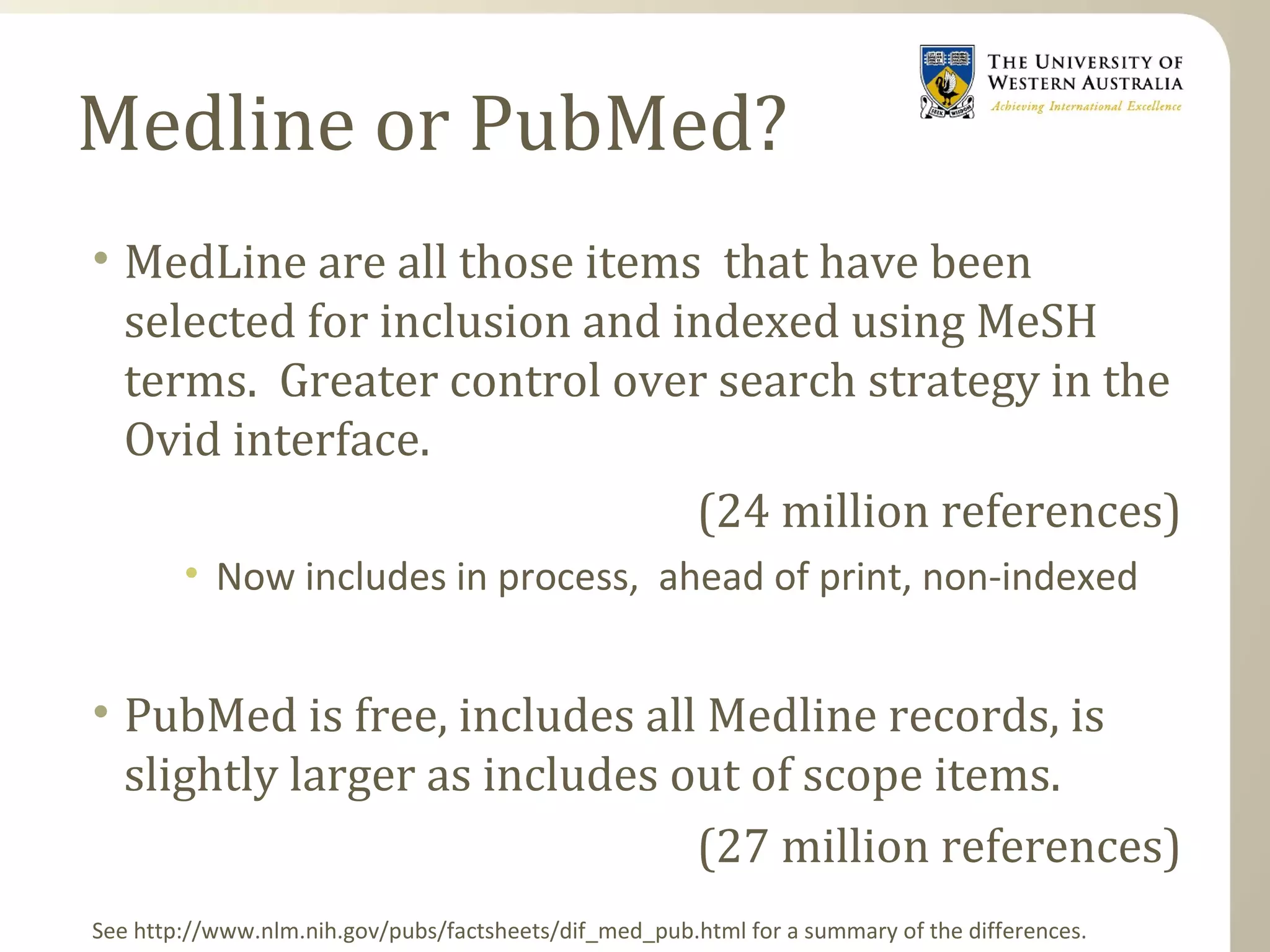
Medline or PubMed?
• MedLine are all those items that have been
selected for inclusion and indexed using MeSH
terms. Greater control over search strategy in the
Ovid interface.
(24 million references)
• Now includes in process, ahead of print, non-indexed
• PubMed is free, includes all Medline records, is
slightly larger as includes out of scope items.
(27 million references)
See http://www.nlm.nih.gov/pubs/factsheets/dif_med_pub.html for a summary of the differences.
Developed by Elsevier, Embase aims to provide the
widest possible coverage of biomedical literature
incorporating many conferences and journal titles
not covered by MEDLINE.
Ability to map to Emtree search index providing a
comprehensive vocabulary to describe biomedical data.
Use of Ovid interface to build up your search strategy
with inbuilt Boolean operators.
A range of ways to refine and limit search results based
on types of studies, cohort study groups and more.
University Library
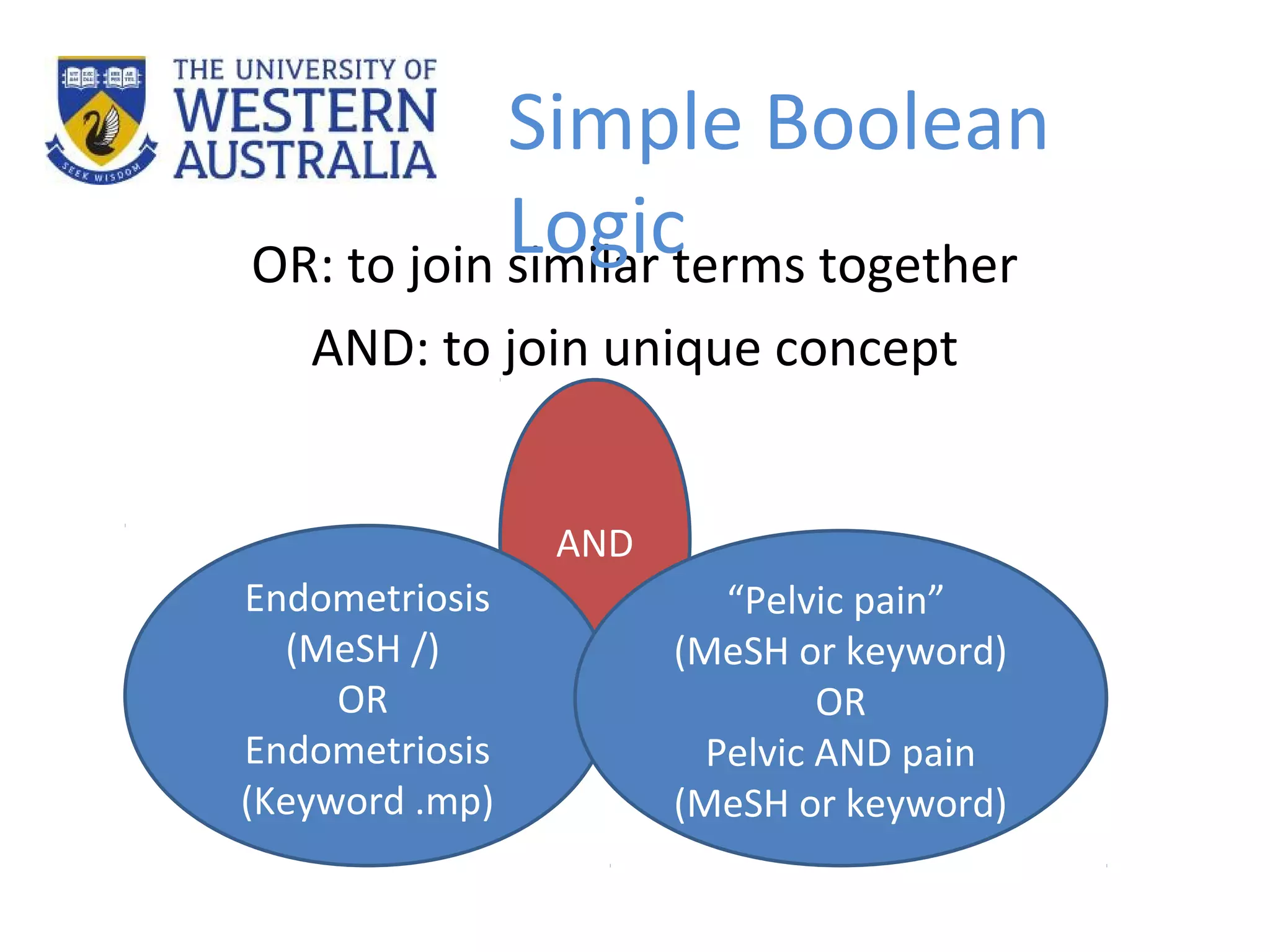
AND
OR: to join similar terms together
AND: to join unique concept
Endometriosis
(MeSH /)
OR
Endometriosis
(Keyword .mp)
“Pelvic pain”
(MeSH or keyword)
OR
Pelvic AND pain
(MeSH or keyword)
Simple Boolean
Logic
For Further Assistance
hmslibrarians-lib@uwa.edu.au
(08) 6457 7570
Please book an appointment for longer queries.
Lucia RaviKaren Jones Danielle KongSamantha Blake

Hierarchies of Evidence 2017

  • 1.
    Hierarchies of Evidence An importantconcept for any health professional.
  • 2.
    The term levelsof evidence refers to what degree that information can be trusted. 1 Traditionally, in scientific research, some (study) methods have been considered to be ‘better’ than others, or at least more useful for evidence based decision making. 2 Systematic reviews have increasingly replaced traditional narrative reviews and expert commentaries as a way of summarising the research evidence. 3 1 Buckingham JB Greenhalgh T. Searching the literature. In: Greenhalgh T. How to read a paper: the basics of evidence-based medicine.5th ed. Hoboken: John Wiley & Sons; 2014. 2 MRC/CSO Social and Public Health Sciences Unit, University of Glasgow. Are some types of evidence better than others; IN: Understanding Health Research, A tool for making sense of Health Studies 3 Davies, HT, Crombie, IK. What is a Systematic Review. In: What is….? Series. London: Hayward Medical Communications; 2009 Levels of Evidence
  • 3.
    The Hierarchy ofEvidence Decision support systems
  • 4.
    Hierarchy of SingleStudies Randomised controlled trials
  • 5.
    A new proposedevidence-based medicine pyramid M Hassan Murad et al. Evid Based Med doi:10.1136/ebmed-2016- 110401 ©2016 by BMJ Publishing Group Ltd More recently, health researchers have become increasingly critical of traditional evidence hierarchies. Critics argue that the order in which types of evidence are traditionally arranged is not necessarily correct….evidence hierarchies can lead to people dismissing high quality evidence that comes from different sources. 2 MRC/CSO Social and Public Health Sciences Unit, University of Glasgow. Are some types of evidence better than others; IN: Understanding Health Research, A tool for making sense of Health Studies
  • 6.
    Key Players: Australia JBIConnect Produce systematic reviews and best practice guidelines. http://joannabriggs.org/research/critical-appraisal-tools.html
  • 7.
  • 8.
    Key Players: International CochraneCollaboration Systematic Reviews and RCT’s
  • 9.
    Evidence-based guidelines & summaries •Developed by synthesising the highest level of evidence available on treatment choices • Guidelines provide recommendations supported by that evidence • May take into account resources and practices relevant to the organisation • Concise and clinically relevant
  • 10.
    Where do Ifind evidence? • MEDLINE/Pubmed and Embase • Cochrane/JBI Connect • TRIP/OvidMD • BMJ Best Practice • ClinicalKey • UpToDate • ETG Complete See: Resources for Answering Clinical Questions
  • 11.
    Developed by USNational Library of Medicine (NLM) this life sciences and biomedicine database uses specialist Medical Subject Headings (MeSH) to index highly reputed medical journals. Ability to map to MeSH search terms and to build up your search strategy with inbuilt Boolean operators. A range of ways to refine and limit search results based on types of studies, cohort study groups and more. MeSH topics and sub-topics provide a range of ways to focus in on very specific medical areas of research.
  • 12.
    Medline or PubMed? •MedLine are all those items that have been selected for inclusion and indexed using MeSH terms. Greater control over search strategy in the Ovid interface. (24 million references) • Now includes in process, ahead of print, non-indexed • PubMed is free, includes all Medline records, is slightly larger as includes out of scope items. (27 million references) See http://www.nlm.nih.gov/pubs/factsheets/dif_med_pub.html for a summary of the differences.
  • 13.
    Developed by Elsevier,Embase aims to provide the widest possible coverage of biomedical literature incorporating many conferences and journal titles not covered by MEDLINE. Ability to map to Emtree search index providing a comprehensive vocabulary to describe biomedical data. Use of Ovid interface to build up your search strategy with inbuilt Boolean operators. A range of ways to refine and limit search results based on types of studies, cohort study groups and more. University Library
  • 14.
    AND OR: to joinsimilar terms together AND: to join unique concept Endometriosis (MeSH /) OR Endometriosis (Keyword .mp) “Pelvic pain” (MeSH or keyword) OR Pelvic AND pain (MeSH or keyword) Simple Boolean Logic
  • 15.
    For Further Assistance hmslibrarians-lib@uwa.edu.au (08)6457 7570 Please book an appointment for longer queries. Lucia RaviKaren Jones Danielle KongSamantha Blake

Editor's Notes

  • #3 There is so much medical literature published you need to know how it is organised and the quickest way to find the information you need. In Medical research it is particularly important to you are familiar with notions of evidenced based practice – that you base your practice decisions on the most up to date and high quality research on the population focus group you are working with in order to determine the best treatment. Click link to OneSearch record of this eBook (will need Pheme credentials to read it), also shows the Multiple Versions feature. Show contents and discuss briefly use of ebook platforms and of bookshelf. Look at contents.. Focus particularly on break down of how to assess different papers that evaluate particular studies and in particular systematic reviews and guidelines. Ask if students are familiar systematic reviews and Evidence based guidelines (hands up) and then to discuss some of the differences between them? Ask for feedback on these? Greenhalgh, Trisha. 2014. How to read a paper: the basics of evidence-based medicine. BMJ Books: Hoboken.)
  • #4 “The term ‘level of evidence’ refers to what degree that information can be trusted based on study design”. (Greenhalgh 2014) As you can see from this pyramid the higher the corroboration of different types of evidence, the higher it is on the hierarchy. You will come across many different forms of the hierarchy as it is continually being contested and evolving – so you will have to get used to interpreting it at a critical level. This is the pyramid at its most basic level.. With single studies being considered the least reliable, moving to systematic reviews that undertake a robust review of studies undertaken on specific interventions, through to evidence based guidelines.. (however need to question if these latter do belong at the top of the hierarchy – in trying to provide an overview of current best practice of a condition as a whole) We don’t have access to decision support systems at this time. They are systems that directly link to patient records. Do have a EBM Lib Guide that provides links to the resources we offer to support EBM.
  • #5 The bottom layer of the main hierarchy – single studies – has its own hierarchy depending on the original type of study performed. This is where – if you are doing your own literature search or systematic review of treatment/disease research for a specific cohort – you would need to critically assess the research/studies/case focus for their research vigour and relevance to your area of health and cohort. For single studies RCT are considered the most robust and unbiased and they are often the focus on systematic reviews.
  • #6 Here is a new revised pyramid, (Developed by Dr Murad and his team at the Evidence Based Practice Centre, Mayo Clinic in Rochester USA.) to take into account the need to think critically about the design and development of individual studies – replacing a straight line with a wavy one to indicate that some research lower down the hierarchy may actually be better if designed better than RCTs. The separation of systematic reviews from the pyramid emphasises that they themselves are a filter through which evidence is viewed and also subject to critical review in their overall design and development The proposed new evidence-based medicine pyramid. (A) The traditional pyramid. (B) Revising the pyramid: (1) lines separating the study designs become wavy (Grading of Recommendations Assessment, Development and Evaluation), (2) systematic reviews are ‘chopped off’ the pyramid. (C) The revised pyramid: systematic reviews are a lens through which evidence is viewed (applied).
  • #7 One consideration in the evaluation of evidence is who has produced it and how good their methodology is. One of the key highly reputed players in Australia is The Joanna Briggs Institute who collaborate with Australian and international research institutes to produce systematic reviews and from these best practice guidelines available through their library JBI Connect. They also produce methodology guides and software to support critical appraisal. This link is a good one for quick checklists on how to appraise different types of studies as well as systematic reviews.
  • #8 Middle level: Systematic Reviews. Systematic reviews analyse and appraise primary studies on the same question. This is a simplified version of the process. (There are UWA as a well as a number of resources for this) The final report will include their search strategies, keywords, subject headings. It is good to look at this to enhance your own learning. Finding a systematic review on a topic can save you a lot of time. A well structured systematic review will include the databases searched, search strategies used and a detailed analysis of studies included in the review – their quality and strengths.
  • #9 One of the most robust and trusted producers of systematic reviews is Cochrane Collaboration. The Cochrane Reviews (like JBI) also work in collaboration with International research bodies to produce systematic reviews and have a number of specialist resource databases such as their SR Database and database of Randomised control trials. Like JBI they also produce and collate methodology reviews and critical appraisal of research tools which have been collated into a number of Handbooks. This link is a good one for quick checklists on how to appraise different types of studies as well as systematic reviews.
  • #10 The top levels This section of the literature will become important later in your course when you begin clinical practice. Can you trust the synthesis of the evidence that has been completed – who has been involved in it, how recent? Is it comprehensive and based on appraised high level studies and systematic reviews or in providing a comprehensive overview of current best practice is it compromised. http://ebm.bmj.com/content/21/4/121.full Pyramids are Guides not rules: the evolution of the evidence pyramid.
  • #11 These are the key databases where you can find studies and systematic reviews on dentistry related topics. See our guide for access to them: Resources for Answering Clinical Questions: http://guides.is.uwa.edu.au/ACQresources?hs=a Go to this site and And Dentistry – EBM tab http://guides.is.uwa.edu.au/c.php?g=324873&p=2177834 We will be looking at some of these in more detail in the upcoming workshop. Take a bit of stretch and break now or have a look at the websites of the Joanna Briggs Institute or Cochrane Collaboration or our LibGuide link here.
  • #12 MEDLINE® contains journal citations and abstracts for biomedical literature from around the world.  PubMed® provides free access to MEDLINE and links to full text articles when possible
  • #13 Medline (1960) represents a much more highly selected range of medical journals as selected by the US National Library of Medicine which have been catalogued using MeSH – Medical subject headings. 5600 scholarly journals. PubMed (1996) as well as Medline contains in process and ahead of print citations, out of scope articles (from within Medline journals), some full-text OA journals, Book citations from NCBI PubMed Central (2000) for open access only journal publications – some also in Medline. As such you will get more results in Pubmed but unlikely to be as relevant to biomedical science as those just in MedLine. Pubmed is easier to search. MeSH 27,883 description and over 87,000 entry terms. 232,000 supplementary records ( specific chemicals, diseases and drug protocols). MeSH – a thirteen level hierarchy of medical terms (27,883 descriptors + 87,000 entry terms) Medical Subject Terms Includes Supplementary Concept Records (SRC)– contain specific examples of chemicals, diseases and drug protocols. HM – Heading map field, used to identify the most specific descriptor class (SRC’s are related to descriptors in the HM) Perhaps change image to Venn diagram. . (you might have used a different one in the past) which is much simpler to use.
  • #14 Strong biomedical focus – evidence based medicine, drug and medical device efficacy studies https://www.elsevier.com/solutions/embase-biomedical-research Europena focus. 32+ million records from 8,300 published journals. (6+ million records and 2900+ journals not covered by medline) EmTree: 70,000 + preferred terms (30,000 for drugs and chemicals), 290,000 synonyms (2/3rds drugs and chemicals) Medical devices and related medical procedures (includes MeSH terms)