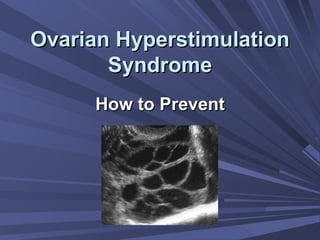
Ovarian Hyperstimulation Syndrome How to Prevent
What is it It is an iatrogenic condition Induced by the clinician
Exact Pathogenesis is not clear High E2 is the underlying factor
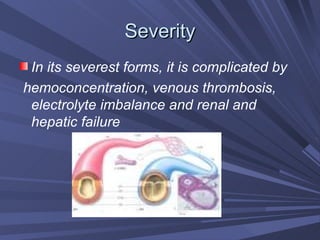
Severity In its severest forms, it is complicated by  hemoconcentration, venous thrombosis, electrolyte imbalance and renal and hepatic failure
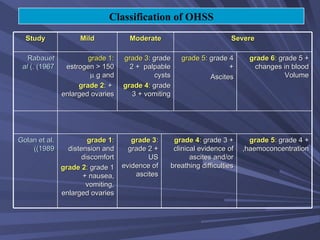
Classification of OHSS Study Mild Moderate Severe Rabau  et al . (1967)  grade 1:  estrogen > 150   g and  grade 2 : + enlarged ovaries grade 3 : grade 2 +  palpable cysts  grade 4 :  grade 3 + vomiting grade 5 : grade 4 +  Ascites  grade 6 :  grade 5 + changes in blood Volume  Golan et al. (1989)  grade 1 :  distension and discomfort  grade 2 :  grade 1 + nausea, vomiting, enlarged ovaries  grade 3 :  grade 2 + US evidence of ascites  grade 4 :  grade 3 + clinical evidence of ascites and/or breathing difficulties  grade 5 :  grade 4 + haemoconcentration,
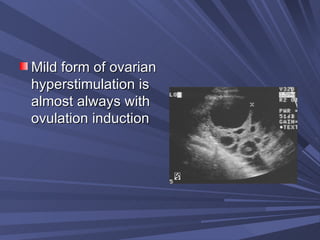
Mild form of ovarian hyperstimulation is almost always with ovulation induction
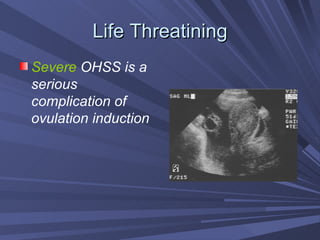
Life Threatining Severe  OHSS is a serious complication of ovulation induction
 
How to prevent Steps before stimulation Steps during stimulation Steps on impending severe OHSS
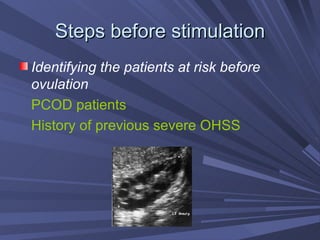
Steps before stimulation Identifying the patients at risk before ovulation PCOD patients History of previous severe OHSS
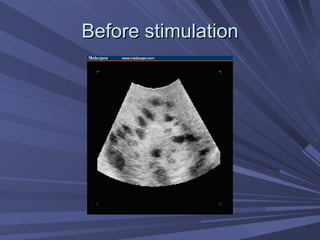
Before stimulation
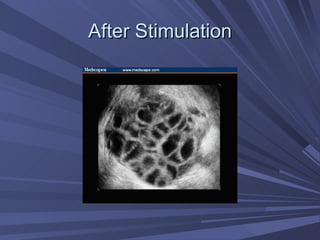
After Stimulation
Steps during Stimulation Be aware of Large number of developing follicles ( more than 20 ) Be aware of High E2 level ( more than 3000 ) on approaching day of hCG If any or both, then what to do!!!!!
Steps during Stimulation Gonadotrophin dose according to age and body weight Young age <25 ys : 2 amp Thin woman < 60 kg  2 amp
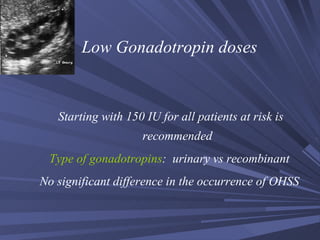
Low Gonadotropin doses Starting with 150 IU for all patients at risk is recommended Type of gonadotropins :  urinary vs recombinant No significant difference in the occurrence of OHSS
Stop hMG and continue down regulation. This is the only complete prevention. (Aboulghar and Mansour, 2003) Not a preferred choice  for both doctors or patients Active Steps
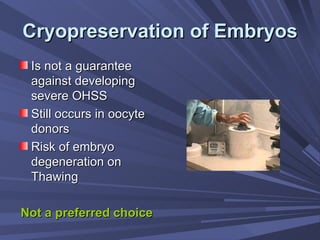
Cryopreservation of Embryos Is not a guarantee against developing severe OHSS Still occurs in oocyte donors Risk of embryo degeneration on Thawing Not a preferred choice
Coasting withholding gonadotropins for few days before giving hCG until E2 drops to a safer level (below 3000) Available evidence suggests that such “coasting” does not adversely affect outcome in IVF cycles unless it is prolonged (>2 days)
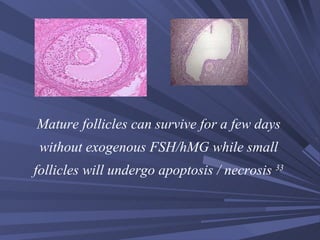
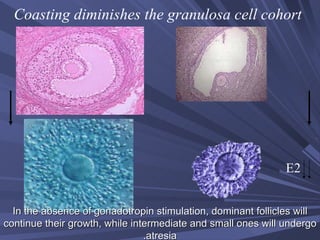
Mature follicles can survive for a few days without exogenous FSH/hMG while small follicles will undergo apoptosis / necrosis  33
In the absence of gonadotropin stimulation, dominant follicles will continue their growth, while intermediate and small ones will undergo atresia. Coasting diminishes the granulosa cell cohort E2
The granulosa cells aspirated from coasted patients showed a ratio in favor of apoptosis, especially in smaller follicles. VEGF protein secretion and gene expression in granulosa cells especially in small and medium follicles were reduced in coasting  24
What happens when you start coasting? Follicular growth will continue with the same rate. E2 will continue to rise then will platform and then decline.
Clinical and practical Tips The Egyptian IVF-ET Center Experience When to stop gonadotropins? When the leading follicles reach 16mm how many days? Till the E2 drops to < 3000 pg/ml Fluker et al., 2000; Ohata et al., 2000)
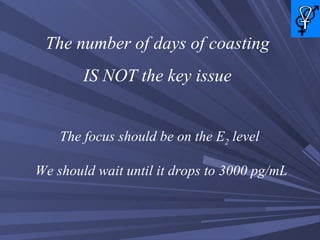
The number of days of coasting IS NOT the key issue The focus should be on the E 2  level  We should wait until it drops to 3000 pg/mL
Dose of hCG? 5000 IU is enough Special laboratory aspects? Extra time to identify the oocytes from the follicular fluid
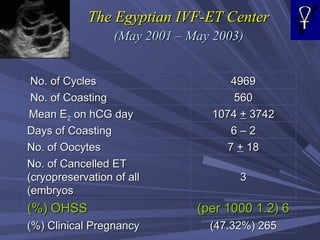
The   Egyptian IVF-ET Center (May 2001 – May 2003) No. of Cycles  4969 No. of Coasting  560 Mean E 2  on hCG day   3742  +  1074 Days of Coasting 2 – 6 No. of Oocytes 18  +  7 No. of Cancelled ET (cryopreservation of all embryos) 3 OHSS (%) 6 (1.2 per 1000) Clinical Pregnancy (%) 265 (47.32%)
Problems with coasting Occasionally E2 drops markedly to very low levels and cycle is canceled. Difficulty in identification of oocytes in aspirated follicular fluid after prolonged coasting.
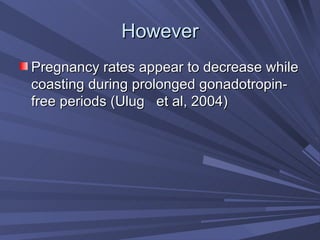
However Pregnancy rates appear to decrease while coasting during prolonged gonadotropin-free periods (Ulug   et al, 2004)
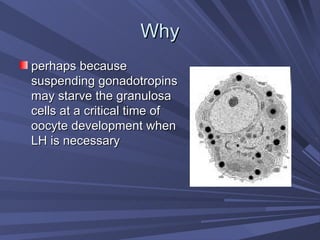
Why perhaps because suspending gonadotropins may starve the granulosa cells at a critical time of oocyte development when LH is necessary
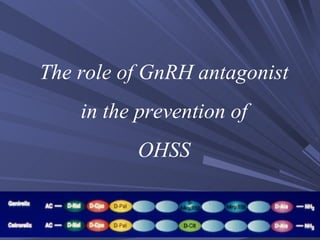
The role of GnRH antagonist in the prevention of  OHSS
GnRH antagonist In a Cochrane review by Al-Inany et al (2006) comparing agonist and antagonist, significant difference in the incidence of OHSS was found
(GnRH) antagonists  A unique Idea Administration when follicle reach 16 mm Continue hMG (step down protocol) Monitor by E2 Not more than 3 days
Value allow continued stimulation while rapidly decreasing the E2 level to a range that is clinically acceptable.
serum E2 decreased by 49.5% and 41.0% of pretreatment values (long luteal and microdose flare, respectively) after initiation of ganirelix, and 68.1% of the patients became pregnant. ( Gustofson , 2006)
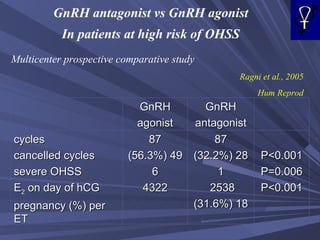
GnRH antagonist vs GnRH agonist In patients at high risk of OHSS Multicenter prospective comparative study   Ragni et al., 2005 Hum Reprod GnRH agonist GnRH antagonist cycles cancelled cycles severe OHSS E 2  on day of hCG pregnancy (%) per ET 87 49 (56.3%) 6 4322 87 28 (32.2%) 1 2538  18 (31.6%) P<0.001 P=0.006 P<0.001
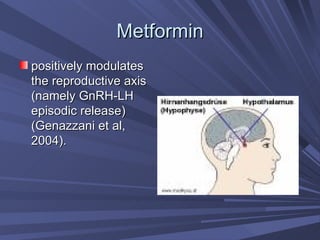
Metformin positively modulates the reproductive axis (namely GnRH-LH episodic release) (Genazzani et al, 2004).
Evidence E2 was significantly higher in cycles treated with FSH alone than in those treated with FSH and metformin. (De Leo et al, 1999).
Metformin & OHSS Metformin was found to decrease significantly the incidence of severe OHSS (ESHRE award, 2005)
It is now our routine to give metformin with the start of down regulation till the day of hCG
possible Mechanisms lower intraovarian androgen levels. (Visnova et al; 2003).
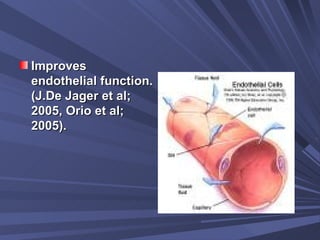
Improves endothelial function. (J.De Jager et al; 2005, Orio et al; 2005).
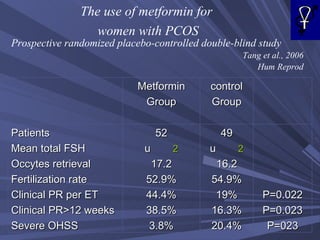
The use of metformin for  women with PCOS Prospective randomized placebo-controlled double-blind study Tang et al., 2006 Hum Reprod Metformin Group control Group Patients Mean total FSH Occytes retrieval Fertilization rate Clinical PR per ET Clinical PR>12 weeks Severe OHSS 52 u 17.2 52.9% 44.4% 38.5% 3.8% 49 u 16.2 54.9% 19% 16.3% 20.4% P=0.022 P=0.023 P=023
A systematic review and meta-analysis of randomized controlled trials on metformin co-administration during gonadotropins ovulation induction in PCOS patients Significant reduction in OHSS (OR=0.21; 95% CI = 0.11-0.41 P<0.00001) Does not significantly improve the pregnancy rate Costello et al., 2006 Hum Reprod
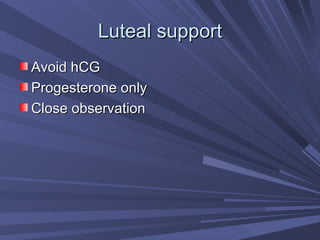
Luteal support Avoid hCG  Progesterone only Close observation
.) OHSS is a preventable disease
What if it Happens How to Manage
Always remember Investigations  Haematocrite Liver functions Creatinine Fluid monitoring
Always remember ICU Job
May do paracentesis :  if dyspnoea massive ascitis (>3 liters) Hydrothorax

Ovarian hyperstimulation syndrome

  • 1.
  • 2.
    What is itIt is an iatrogenic condition Induced by the clinician
  • 3.
    Exact Pathogenesis isnot clear High E2 is the underlying factor
  • 4.
    Severity In itsseverest forms, it is complicated by hemoconcentration, venous thrombosis, electrolyte imbalance and renal and hepatic failure
  • 5.
    Classification of OHSSStudy Mild Moderate Severe Rabau et al . (1967) grade 1: estrogen > 150  g and grade 2 : + enlarged ovaries grade 3 : grade 2 + palpable cysts grade 4 : grade 3 + vomiting grade 5 : grade 4 + Ascites grade 6 : grade 5 + changes in blood Volume Golan et al. (1989) grade 1 : distension and discomfort grade 2 : grade 1 + nausea, vomiting, enlarged ovaries grade 3 : grade 2 + US evidence of ascites grade 4 : grade 3 + clinical evidence of ascites and/or breathing difficulties grade 5 : grade 4 + haemoconcentration,
  • 6.
    Mild form ofovarian hyperstimulation is almost always with ovulation induction
  • 7.
    Life Threatining Severe OHSS is a serious complication of ovulation induction
  • 8.
  • 9.
    How to preventSteps before stimulation Steps during stimulation Steps on impending severe OHSS
  • 10.
    Steps before stimulationIdentifying the patients at risk before ovulation PCOD patients History of previous severe OHSS
  • 11.
  • 12.
  • 13.
    Steps during StimulationBe aware of Large number of developing follicles ( more than 20 ) Be aware of High E2 level ( more than 3000 ) on approaching day of hCG If any or both, then what to do!!!!!
  • 14.
    Steps during StimulationGonadotrophin dose according to age and body weight Young age <25 ys : 2 amp Thin woman < 60 kg 2 amp
  • 15.
    Low Gonadotropin dosesStarting with 150 IU for all patients at risk is recommended Type of gonadotropins : urinary vs recombinant No significant difference in the occurrence of OHSS
  • 16.
    Stop hMG andcontinue down regulation. This is the only complete prevention. (Aboulghar and Mansour, 2003) Not a preferred choice for both doctors or patients Active Steps
  • 17.
    Cryopreservation of EmbryosIs not a guarantee against developing severe OHSS Still occurs in oocyte donors Risk of embryo degeneration on Thawing Not a preferred choice
  • 18.
    Coasting withholding gonadotropinsfor few days before giving hCG until E2 drops to a safer level (below 3000) Available evidence suggests that such “coasting” does not adversely affect outcome in IVF cycles unless it is prolonged (>2 days)
  • 19.
    Mature follicles cansurvive for a few days without exogenous FSH/hMG while small follicles will undergo apoptosis / necrosis 33
  • 20.
    In the absenceof gonadotropin stimulation, dominant follicles will continue their growth, while intermediate and small ones will undergo atresia. Coasting diminishes the granulosa cell cohort E2
  • 21.
    The granulosa cellsaspirated from coasted patients showed a ratio in favor of apoptosis, especially in smaller follicles. VEGF protein secretion and gene expression in granulosa cells especially in small and medium follicles were reduced in coasting 24
  • 22.
    What happens whenyou start coasting? Follicular growth will continue with the same rate. E2 will continue to rise then will platform and then decline.
  • 23.
    Clinical and practicalTips The Egyptian IVF-ET Center Experience When to stop gonadotropins? When the leading follicles reach 16mm how many days? Till the E2 drops to < 3000 pg/ml Fluker et al., 2000; Ohata et al., 2000)
  • 24.
    The number ofdays of coasting IS NOT the key issue The focus should be on the E 2 level We should wait until it drops to 3000 pg/mL
  • 25.
    Dose of hCG?5000 IU is enough Special laboratory aspects? Extra time to identify the oocytes from the follicular fluid
  • 26.
    The Egyptian IVF-ET Center (May 2001 – May 2003) No. of Cycles 4969 No. of Coasting 560 Mean E 2 on hCG day 3742 + 1074 Days of Coasting 2 – 6 No. of Oocytes 18 + 7 No. of Cancelled ET (cryopreservation of all embryos) 3 OHSS (%) 6 (1.2 per 1000) Clinical Pregnancy (%) 265 (47.32%)
  • 27.
    Problems with coastingOccasionally E2 drops markedly to very low levels and cycle is canceled. Difficulty in identification of oocytes in aspirated follicular fluid after prolonged coasting.
  • 28.
    However Pregnancy ratesappear to decrease while coasting during prolonged gonadotropin-free periods (Ulug  et al, 2004)
  • 29.
    Why perhaps becausesuspending gonadotropins may starve the granulosa cells at a critical time of oocyte development when LH is necessary
  • 30.
    The role ofGnRH antagonist in the prevention of OHSS
  • 31.
    GnRH antagonist Ina Cochrane review by Al-Inany et al (2006) comparing agonist and antagonist, significant difference in the incidence of OHSS was found
  • 32.
    (GnRH) antagonists A unique Idea Administration when follicle reach 16 mm Continue hMG (step down protocol) Monitor by E2 Not more than 3 days
  • 33.
    Value allow continuedstimulation while rapidly decreasing the E2 level to a range that is clinically acceptable.
  • 34.
    serum E2 decreasedby 49.5% and 41.0% of pretreatment values (long luteal and microdose flare, respectively) after initiation of ganirelix, and 68.1% of the patients became pregnant. ( Gustofson , 2006)
  • 35.
    GnRH antagonist vsGnRH agonist In patients at high risk of OHSS Multicenter prospective comparative study Ragni et al., 2005 Hum Reprod GnRH agonist GnRH antagonist cycles cancelled cycles severe OHSS E 2 on day of hCG pregnancy (%) per ET 87 49 (56.3%) 6 4322 87 28 (32.2%) 1 2538 18 (31.6%) P<0.001 P=0.006 P<0.001
  • 36.
    Metformin positively modulatesthe reproductive axis (namely GnRH-LH episodic release) (Genazzani et al, 2004).
  • 37.
    Evidence E2 wassignificantly higher in cycles treated with FSH alone than in those treated with FSH and metformin. (De Leo et al, 1999).
  • 38.
    Metformin & OHSSMetformin was found to decrease significantly the incidence of severe OHSS (ESHRE award, 2005)
  • 39.
    It is nowour routine to give metformin with the start of down regulation till the day of hCG
  • 40.
    possible Mechanisms lowerintraovarian androgen levels. (Visnova et al; 2003).
  • 41.
    Improves endothelial function.(J.De Jager et al; 2005, Orio et al; 2005).
  • 42.
    The use ofmetformin for women with PCOS Prospective randomized placebo-controlled double-blind study Tang et al., 2006 Hum Reprod Metformin Group control Group Patients Mean total FSH Occytes retrieval Fertilization rate Clinical PR per ET Clinical PR>12 weeks Severe OHSS 52 u 17.2 52.9% 44.4% 38.5% 3.8% 49 u 16.2 54.9% 19% 16.3% 20.4% P=0.022 P=0.023 P=023
  • 43.
    A systematic reviewand meta-analysis of randomized controlled trials on metformin co-administration during gonadotropins ovulation induction in PCOS patients Significant reduction in OHSS (OR=0.21; 95% CI = 0.11-0.41 P<0.00001) Does not significantly improve the pregnancy rate Costello et al., 2006 Hum Reprod
  • 44.
    Luteal support AvoidhCG Progesterone only Close observation
  • 45.
    .) OHSS isa preventable disease
  • 46.
    What if itHappens How to Manage
  • 47.
    Always remember Investigations Haematocrite Liver functions Creatinine Fluid monitoring
  • 48.
  • 49.
    May do paracentesis: if dyspnoea massive ascitis (>3 liters) Hydrothorax