kasr al ainy school of Medicine Cairo University   CHANGING ATTITUDES IN OVARIAN STIMULATION
CHANGING ATTITUDE IS A FACT OF LIFE To improve efficacy :  better results: pregnancy To improve safety : less complications: OHSS
THE BEST MODEL  Breech Trial
WHAT ABOUT GYNECOLOGY HRT: WHI study
IVF Safety comes first
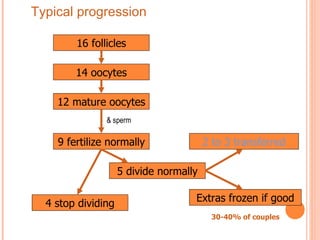
16 follicles 12 mature oocytes 14 oocytes Extras frozen if good 2 to 3 transferred 9 fertilize normally 5 divide normally 30-40% of couples 4 stop dividing & sperm Typical progression
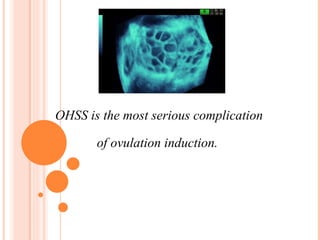
OHSS is the most serious complication  of ovulation induction.
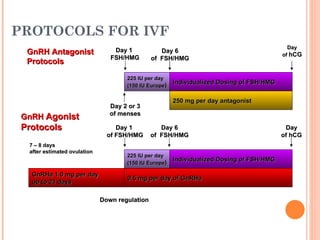
PROTOCOLS FOR IVF  GnRH Antagonist Protocols GnRH  Agonist Protocols   225 IU per day (150 IU Europe ) Individualized Dosing of FSH/HMG 250 mg per day antagonist Individualized Dosing of FSH/HMG GnRHa 1.0 mg per day  up to 21 days 0.5 mg per day of GnRHa 225 IU per day (150 IU Europe ) Day 6 of  FSH/HMG Day of  hCG Day 1  of FSH/HMG Day 6 of  FSH/HMG Day of hCG 7 – 8 days after estimated ovulation Down regulation Day 2 or 3 of menses Day 1  FSH/HMG
SHOULD BE EVIDENCE BASED RCT Systematic Reviews
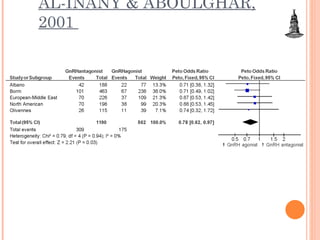
AL-INANY & ABOULGHAR, 2001
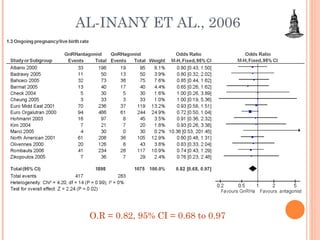
AL-INANY ET AL., 2006  O.R = 0.82, 95% CI = 0.68 to 0.97
AL-INANY  ET AL., 2010 45  RCTs 7532  participants Many subgroup analyses: - Poor responders - PCOS - OCP pretreatment - LH stability examined - Cetrotide vs. ganerilix - Fixed vs. flexible protocol Conclusion differed
IT IS JUSTIFIED TO Shift from GnRH agonist to GnRH antagonist for IVF/ ICSI cycles
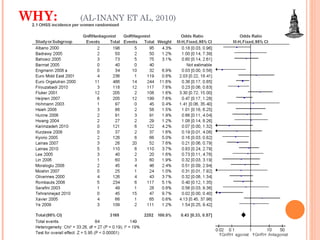
WHY:  (AL-INANY ET AL, 2010)
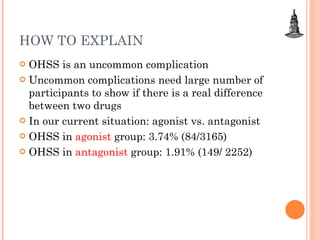
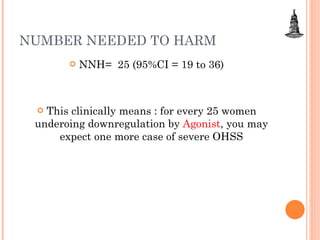
HOW TO EXPLAIN OHSS is an uncommon complication Uncommon complications need large number of participants to show if there is a real difference between two drugs In our current situation: agonist vs. antagonist OHSS in  agonist  group: 3.74% (84/3165) OHSS in  antagonist  group: 1.91% (149/ 2252)
NUMBER NEEDED TO HARM NNH=  25 (95%CI = 19 to 36) This clinically means : for every 25 women underoing downregulation by  Agonist , you may expect one more case of severe OHSS
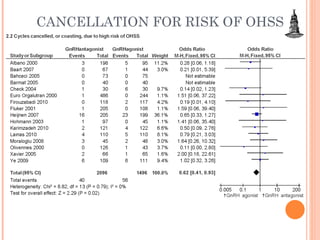
CANCELLATION FOR RISK OF OHSS
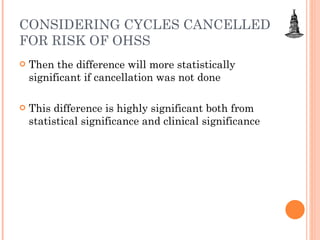
CONSIDERING CYCLES CANCELLED FOR RISK OF OHSS Then the difference will more statistically significant if cancellation was not done This difference is highly significant both from statistical significance and clinical significance
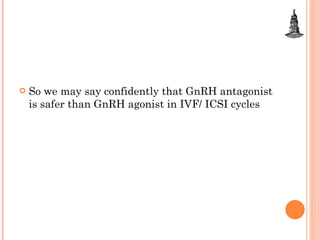
So we may say confidently that GnRH antagonist is safer than GnRH agonist in IVF/ ICSI cycles
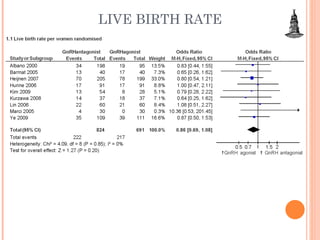
LIVE BIRTH RATE
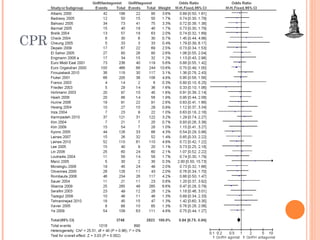
CPR
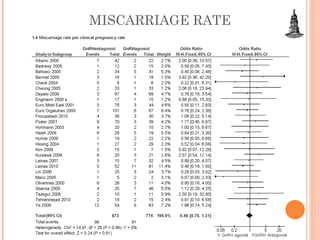
MISCARRIAGE RATE
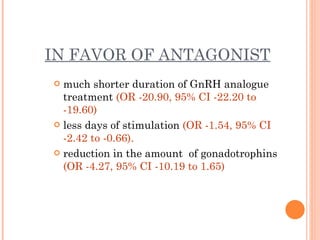
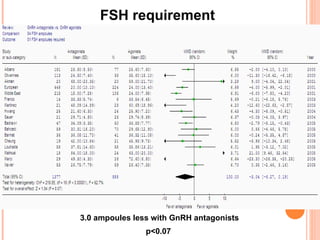
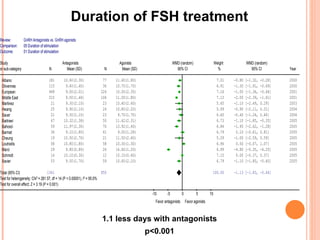
IN FAVOR OF ANTAGONIST much shorter duration of GnRH analogue treatment  (OR -20.90, 95% CI -22.20 to -19.60) less days of stimulation  (OR -1.54, 95% CI -2.42 to -0.66).  reduction in the amount  of gonadotrophins  (OR -4.27, 95% CI -10.19 to 1.65)
3. 0  ampoules less with GnRH antagonists p<0.0 7   FSH requirement
1. 1  less days with antagonists p<0.001 Duration of FSH treatment
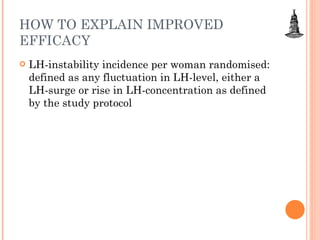
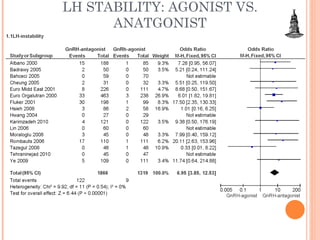
HOW TO EXPLAIN IMPROVED EFFICACY LH-instability incidence per woman randomised: defined as any fluctuation in LH-level, either a LH-surge or rise in LH-concentration as defined by the study protocol
LH STABILITY: AGONIST VS. ANATGONIST
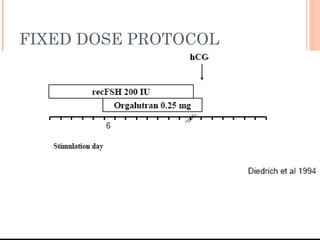
FIXED DOSE PROTOCOL
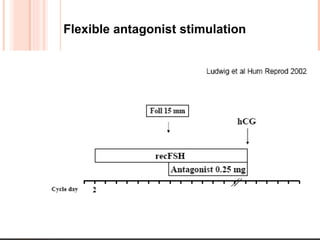
Flexible antagonist stimulation
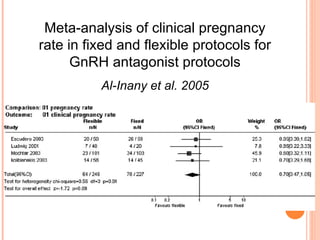
Meta-analysis of clinical pregnancy rate in fixed and flexible protocols for GnRH antagonist protocols Al-Inany et al. 2005
FURTHER ANALYSIS LH instability is more reported in studies using flexible antagonist protocol Al-Inany et al, 2005 showed fixed protocol achieve better results than flexible Clinicians tend to use fixed protocol more now  Thus better LH stability
SO OUR CONCLUSION:  There are no significant differences in the efficacy of GnRH antagonist and long agonist protocols with a  significant reduction in the incidence of severe OHSS  with the antagonist.
BUT NOT ALL DOCTORS WOULD GO FOR ANTAGONIST
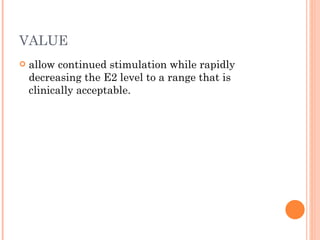
(GNRH) ANTAGONISTS: OFF LABEL INDICATION  unique Idea Administration during GnRH agonist cycle when follicle reach ~16mm and E2 level > 4000pmol Decrease but Continue hMG (step down protocol) Monitor by E2 Not more than 3 days
VALUE allow continued stimulation while rapidly decreasing the E2 level to a range that is clinically acceptable.
 
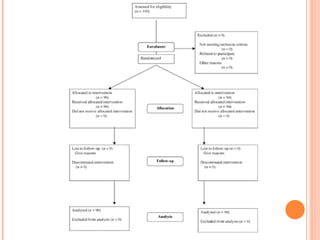
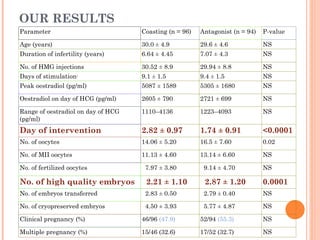
OUR RESULTS Parameter Coasting (n = 96) Antagonist (n = 94) P-value Age (years) 30.0 ± 4.9 29.6 ± 4.6 NS Duration of infertility (years) 6.64 ± 4.45 7.07 ± 4.3 NS No. of HMG injections 30.52 ± 8.9 29.94 ± 8.8 NS Days of stimulation 1 9.1 ± 1.5 9.4 ± 1.5 NS Peak oestradiol (pg/ml) 5087 ± 1589 5305 ± 1680 NS Oestradiol on day of HCG (pg/ml) 2605 ± 790 2721 ± 699 NS Range of oestradiol on day of HCG (pg/ml)  1110–4136 1223–4093 NS Day of intervention 2.82 ± 0.97 1.74 ± 0.91 <0.0001 No. of oocytes 14.06 ± 5.20 16.5 ± 7.60 0.02 No. of MII oocytes  11.13 ± 4.60 13.14 ± 6.60 NS No. of fertilized oocytes    7.97 ± 3.80    9.14 ± 4.70 NS No. of high quality embryos    2.21 ± 1.10    2.87 ± 1.20 0.0001 No. of embryos transferred    2.83 ± 0.50    2.79 ± 0.40 NS No. of cryopreserved embryos    4.50 ± 3.93    5.77 ± 4.87 NS Clinical pregnancy (%) 46/96  (47.9) 52/94  (55.3) NS Multiple pregnancy (%) 15/46 (32.6) 17/52 (32.7) NS
THE FUTURE  Simplifying IVF procedure ELONVA
JUST A QUESTION Would u change ur protocol from agonist to antagonist??
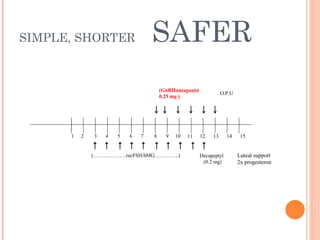
SIMPLE, SHORTER  SAFER
WHY CHANGING ATTITUDE  For Tomorrow Better  Health
THANK YOU Dr. Hesham Al-Inany  MD, PhD e-mail : hesham@khosoba.com

GnRH antagonists

  • 1.
    kasr al ainyschool of Medicine Cairo University CHANGING ATTITUDES IN OVARIAN STIMULATION
  • 2.
    CHANGING ATTITUDE ISA FACT OF LIFE To improve efficacy : better results: pregnancy To improve safety : less complications: OHSS
  • 3.
    THE BEST MODEL Breech Trial
  • 4.
    WHAT ABOUT GYNECOLOGYHRT: WHI study
  • 5.
  • 6.
    16 follicles 12mature oocytes 14 oocytes Extras frozen if good 2 to 3 transferred 9 fertilize normally 5 divide normally 30-40% of couples 4 stop dividing & sperm Typical progression
  • 7.
    OHSS is themost serious complication of ovulation induction.
  • 8.
    PROTOCOLS FOR IVF GnRH Antagonist Protocols GnRH Agonist Protocols 225 IU per day (150 IU Europe ) Individualized Dosing of FSH/HMG 250 mg per day antagonist Individualized Dosing of FSH/HMG GnRHa 1.0 mg per day up to 21 days 0.5 mg per day of GnRHa 225 IU per day (150 IU Europe ) Day 6 of FSH/HMG Day of hCG Day 1 of FSH/HMG Day 6 of FSH/HMG Day of hCG 7 – 8 days after estimated ovulation Down regulation Day 2 or 3 of menses Day 1 FSH/HMG
  • 9.
    SHOULD BE EVIDENCEBASED RCT Systematic Reviews
  • 10.
  • 11.
    AL-INANY ET AL.,2006 O.R = 0.82, 95% CI = 0.68 to 0.97
  • 12.
    AL-INANY ETAL., 2010 45 RCTs 7532 participants Many subgroup analyses: - Poor responders - PCOS - OCP pretreatment - LH stability examined - Cetrotide vs. ganerilix - Fixed vs. flexible protocol Conclusion differed
  • 13.
    IT IS JUSTIFIEDTO Shift from GnRH agonist to GnRH antagonist for IVF/ ICSI cycles
  • 14.
    WHY: (AL-INANYET AL, 2010)
  • 15.
    HOW TO EXPLAINOHSS is an uncommon complication Uncommon complications need large number of participants to show if there is a real difference between two drugs In our current situation: agonist vs. antagonist OHSS in agonist group: 3.74% (84/3165) OHSS in antagonist group: 1.91% (149/ 2252)
  • 16.
    NUMBER NEEDED TOHARM NNH= 25 (95%CI = 19 to 36) This clinically means : for every 25 women underoing downregulation by Agonist , you may expect one more case of severe OHSS
  • 17.
  • 18.
    CONSIDERING CYCLES CANCELLEDFOR RISK OF OHSS Then the difference will more statistically significant if cancellation was not done This difference is highly significant both from statistical significance and clinical significance
  • 19.
    So we maysay confidently that GnRH antagonist is safer than GnRH agonist in IVF/ ICSI cycles
  • 20.
  • 21.
  • 22.
  • 23.
    IN FAVOR OFANTAGONIST much shorter duration of GnRH analogue treatment (OR -20.90, 95% CI -22.20 to -19.60) less days of stimulation (OR -1.54, 95% CI -2.42 to -0.66). reduction in the amount of gonadotrophins (OR -4.27, 95% CI -10.19 to 1.65)
  • 24.
    3. 0 ampoules less with GnRH antagonists p<0.0 7 FSH requirement
  • 25.
    1. 1 less days with antagonists p<0.001 Duration of FSH treatment
  • 26.
    HOW TO EXPLAINIMPROVED EFFICACY LH-instability incidence per woman randomised: defined as any fluctuation in LH-level, either a LH-surge or rise in LH-concentration as defined by the study protocol
  • 27.
    LH STABILITY: AGONISTVS. ANATGONIST
  • 28.
  • 29.
  • 30.
    Meta-analysis of clinicalpregnancy rate in fixed and flexible protocols for GnRH antagonist protocols Al-Inany et al. 2005
  • 31.
    FURTHER ANALYSIS LHinstability is more reported in studies using flexible antagonist protocol Al-Inany et al, 2005 showed fixed protocol achieve better results than flexible Clinicians tend to use fixed protocol more now Thus better LH stability
  • 32.
    SO OUR CONCLUSION: There are no significant differences in the efficacy of GnRH antagonist and long agonist protocols with a significant reduction in the incidence of severe OHSS with the antagonist.
  • 33.
    BUT NOT ALLDOCTORS WOULD GO FOR ANTAGONIST
  • 34.
    (GNRH) ANTAGONISTS: OFFLABEL INDICATION unique Idea Administration during GnRH agonist cycle when follicle reach ~16mm and E2 level > 4000pmol Decrease but Continue hMG (step down protocol) Monitor by E2 Not more than 3 days
  • 35.
    VALUE allow continuedstimulation while rapidly decreasing the E2 level to a range that is clinically acceptable.
  • 36.
  • 37.
    OUR RESULTS ParameterCoasting (n = 96) Antagonist (n = 94) P-value Age (years) 30.0 ± 4.9 29.6 ± 4.6 NS Duration of infertility (years) 6.64 ± 4.45 7.07 ± 4.3 NS No. of HMG injections 30.52 ± 8.9 29.94 ± 8.8 NS Days of stimulation 1 9.1 ± 1.5 9.4 ± 1.5 NS Peak oestradiol (pg/ml) 5087 ± 1589 5305 ± 1680 NS Oestradiol on day of HCG (pg/ml) 2605 ± 790 2721 ± 699 NS Range of oestradiol on day of HCG (pg/ml) 1110–4136 1223–4093 NS Day of intervention 2.82 ± 0.97 1.74 ± 0.91 <0.0001 No. of oocytes 14.06 ± 5.20 16.5 ± 7.60 0.02 No. of MII oocytes 11.13 ± 4.60 13.14 ± 6.60 NS No. of fertilized oocytes   7.97 ± 3.80   9.14 ± 4.70 NS No. of high quality embryos   2.21 ± 1.10   2.87 ± 1.20 0.0001 No. of embryos transferred   2.83 ± 0.50   2.79 ± 0.40 NS No. of cryopreserved embryos   4.50 ± 3.93   5.77 ± 4.87 NS Clinical pregnancy (%) 46/96 (47.9) 52/94 (55.3) NS Multiple pregnancy (%) 15/46 (32.6) 17/52 (32.7) NS
  • 38.
    THE FUTURE Simplifying IVF procedure ELONVA
  • 39.
    JUST A QUESTIONWould u change ur protocol from agonist to antagonist??
  • 40.
  • 41.
    WHY CHANGING ATTITUDE For Tomorrow Better Health
  • 42.
    THANK YOU Dr.Hesham Al-Inany MD, PhD e-mail : hesham@khosoba.com

Editor's Notes