INTRODUCTION TO
SYSTEMATIC REVIEW AND
META-ANALYSIS
VINOTHINI S
MPH-II YEAR
LEARNING OBJECTIVES
What is a systematic review
Differentiate between a narrative review and a systematic review
Explore the steps in conducting a systematic review
Learn the basics of meta-analysis and effect size
Understand tools and software used in systematic review and meta-analysis
What is a systematic review?
• "Systematic reviews aim to gather evidence that meets pre-established eligibility criteria to
address a particular research question," according to the Cochrane Handbook for systematic
reviews of treatments. They use systematic techniques that are pre-documented with a
procedure to reduce bias.
TERMINOLOGY:
• Review of a clearly formulated question that uses systematic and explicit methods to identify,
select, and critically appraise relevant research, and to collect and analyze data from the studies
that are include in the review
Meta-analysis:
• Use of statistical techniques in an SR to integrate the results of include studies to conduct
statistical inference
Why do we need a systematic review?
Limited time to catch up with and critically appraise the vast amount of literature is not the only reason
why we need systematic reviews
Systematic reviews are useful in interpreting conflicting results of primary studies, synthesizing results of
a large number of primary studies, and judging the external applicability of the evidence, especially when
there are only a few primary studies.
Systematic reviews help us know existing research (and its
quality) in our area of interest, prevent duplication of efforts by letting us know what has already been
done, and provide insights through the comparison and/or combination of different studies.
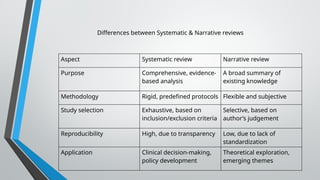
Differences between Systematic & Narrative reviews
Aspect Systematic review Narrative review
Purpose Comprehensive, evidence-
based analysis
A broad summary of
existing knowledge
Methodology Rigid, predefined protocols Flexible and subjective
Study selection Exhaustive, based on
inclusion/exclusion criteria
Selective, based on
author’s judgement
Reproducibility High, due to transparency Low, due to lack of
standardization
Application Clinical decision-making,
policy development
Theoretical exploration,
emerging themes
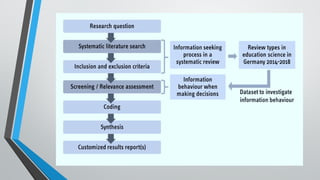
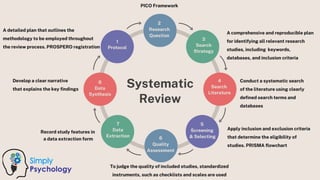
STEPS IN A SYSTEMATIC REVIEW
 Check for existing reviews – Avoid duplication; refine questions if needed.
 Define research question – Use PICO (Population, Intervention, Comparison, and Outcome)
 Registered protocol – Outline rationale, eligibility criteria, and methods.
 Design search strategy – Collaborate with a librarian for reproducibility
 Search literature – Cover multiple databases and grey literature
 Appraise studies – Use tools like Cochrane’s risk of bias
 Extract & synthesize data – Meta-analysis if suitable (based on PICO)
 Interpret & report findings – Discuss clinical implications.
Search in Systematic Review Databases
1. PROSPERO:
A registry of ongoing and completed systematic reviews in health and social care. Useful for
checking if a review is already underway.
2. Cochrane Library:
A premier resource for systematic reviews in healthcare and medicine, maintained by the
Cochrane Collaboration. It includes the Cochrane Database of Systematic Reviews (CDSR) and is known for its
rigorous methodology.
3. PubMed:
A widely used biomedical literature database. You can apply a “Systematic Review” filter in the
search to find systematic reviews.
4. JBI Evidence Synthesis:
A high-quality resource from JBI, focusing on systematic reviews in nursing, public health, and
allied health.
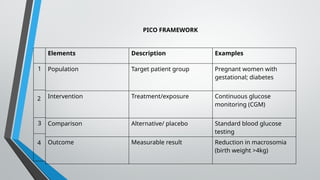
PICO FRAMEWORK
Elements Description Examples
Population Target patient group Pregnant women with
gestational; diabetes
Intervention Treatment/exposure Continuous glucose
monitoring (CGM)
Comparison Alternative/ placebo Standard blood glucose
testing
Outcome Measurable result Reduction in macrosomia
(birth weight >4kg)
1
3
2
4
Registered Protocol for Systematic Review
The rationale explains the justification for the review, highlighting gaps in existing
research and the potential impact of the findings. The eligibility criteria define the
inclusion and exclusion parameters such as population, intervention, comparison,
outcomes, study design, language, and publication date. The methods section details
the search strategy, selection process, data extraction, risk of bias assessment, and
synthesis approach, outlining how the review will be systematically conducted to
produce reliable and reproducible results.
Design Search Strategy
A well-structured search strategy is crucial for a systematic review to ensure reproducibility and
minimize bias. Collaborating with an experienced librarian helps refine search terms, select
appropriate databases, and apply standardized search syntax (e.g., Boolean operators, MeSH terms).
The librarian assists in identifying relevant keywords, Medical Subject Headings (MeSH), and Emtree
terms, while also optimizing Boolean operators (AND, OR, NOT), truncation, and proximity searches.
To ensure transparency, the full search strategy, including database-specific adaptations, should be
documented and included as supplementary material. Pre-registering the protocol on platforms like
PROSPERO further enhances reproducibility and reduces the risk of selective reporting.
Search the Literature
Comprehensive literature searches should include multiple databases (e.g., PubMed, Embase,
Cochrane Library, Web of Science) to capture relevant studies. Grey literature (e.g., conference
abstracts, theses, clinical trial registries) should also be searched to minimize publication bias.
Hand-searching reference lists of included studies and contacting experts can identify
additional sources. Search strategies should be tailored to each database while maintaining
consistency in key concepts to ensure thorough coverage.
Appraise Studies
Critical appraisal of the included studies is necessary to assess their quality and risk of bias.
Depending on the study design, various tools are available—Cochrane’s Risk of Bias tool for
randomized controlled trials, ROBINS-I for non-randomized studies, and CASP checklists for
qualitative research. Appraising the methodological quality ensures that the evidence
synthesized is reliable and helps accurately interpret the strength of the findings.
Extract and Synthesize Data
Data extraction involves systematically collecting relevant information from included studies
using a predefined form that captures study characteristics, participant demographics,
intervention details, and outcome measures. The extracted data should be organized
according to the PICO framework to ensure consistency
Statistical software such as RevMan or Stata can be used to calculate pooled effect
estimates, such as risk ratios or mean differences, and assess heterogeneity using metrics
like.
Interpret and Report Findings
The review's conclusions should directly address the research objectives while evaluating
the strength, limitations, and practical applicability of the evidence. Compare findings with
existing literature, noting consistencies or discrepancies, and use GRADE to assess evidence
certainty. Clearly outline clinical implications, specifying how results should inform practice,
policy, or future research. Adhere to PRISMA guidelines to ensure transparent reporting,
and address potential biases through funnel plots or sensitivity analyses. This structured
approach enhances the review's credibility and utility for evidence-based decision-making.
Meta-analysis
“Meta-analysis is a statistical technique for combing the results of independent, but
similar, studies to obtain an overall estimate of treatment effect”.
While all meta-analyses are based on a systematic review of literature, not all systematic
reviews necessarily include mate-analysis.
Systematic reviews represent the structured scientific approach for undertaking literature
reviews on earlier research studies addressing the desired focussed and
properly framed question (PICOS/T). They are tied closely to meta-analyses, i.e. a
statistical method for combining the data from the previous studies. A systematic review
may or may not contain a meta-analysis depending on whether the data from previous
studies addressing the desired question can or cannot be combined.
Condt….
Since meta-analysis is a retrospective look at data, it is important to make the process
rigorous and well-defined to prevent opportunities for bias to distort the results. Only in this
way can it achieve the status of a scientific discipline. This necessitates blinding the selection
of papers, extraction of data, and quality assessment in duplicate following an established
protocol at the start of the study.
There is no reason why data from different more or less similar’ studies answering the
desired question cannot be combined using the technique of meta-analysis,
however, the evidence from such a meta-analysis will not be reliable if the included studies
are not derived by a systematic review. Appreciating the importance of a
systematic review for identifying the studies included in a meta-analysis is critical. It is
important to know that meta-analysis can be used to synthesize results from
RCTs, as well as non-RCTs (‘Observational studies’) and epidemiological studies.
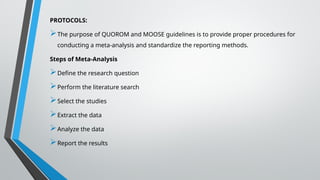
PROTOCOLS:
The purpose of QUOROM and MOOSE guidelines is to provide proper procedures for
conducting a meta-analysis and standardize the reporting methods.
Steps of Meta-Analysis
Define the research question
Perform the literature search
Select the studies
Extract the data
Analyze the data
Report the results
Thank
you…

systematic review and meta-analysis.pptx

  • 1.
    INTRODUCTION TO SYSTEMATIC REVIEWAND META-ANALYSIS VINOTHINI S MPH-II YEAR
  • 2.
    LEARNING OBJECTIVES What isa systematic review Differentiate between a narrative review and a systematic review Explore the steps in conducting a systematic review Learn the basics of meta-analysis and effect size Understand tools and software used in systematic review and meta-analysis
  • 3.
    What is asystematic review? • "Systematic reviews aim to gather evidence that meets pre-established eligibility criteria to address a particular research question," according to the Cochrane Handbook for systematic reviews of treatments. They use systematic techniques that are pre-documented with a procedure to reduce bias. TERMINOLOGY: • Review of a clearly formulated question that uses systematic and explicit methods to identify, select, and critically appraise relevant research, and to collect and analyze data from the studies that are include in the review Meta-analysis: • Use of statistical techniques in an SR to integrate the results of include studies to conduct statistical inference
  • 5.
    Why do weneed a systematic review? Limited time to catch up with and critically appraise the vast amount of literature is not the only reason why we need systematic reviews Systematic reviews are useful in interpreting conflicting results of primary studies, synthesizing results of a large number of primary studies, and judging the external applicability of the evidence, especially when there are only a few primary studies. Systematic reviews help us know existing research (and its quality) in our area of interest, prevent duplication of efforts by letting us know what has already been done, and provide insights through the comparison and/or combination of different studies.
  • 6.
    Differences between Systematic& Narrative reviews Aspect Systematic review Narrative review Purpose Comprehensive, evidence- based analysis A broad summary of existing knowledge Methodology Rigid, predefined protocols Flexible and subjective Study selection Exhaustive, based on inclusion/exclusion criteria Selective, based on author’s judgement Reproducibility High, due to transparency Low, due to lack of standardization Application Clinical decision-making, policy development Theoretical exploration, emerging themes
  • 8.
    STEPS IN ASYSTEMATIC REVIEW  Check for existing reviews – Avoid duplication; refine questions if needed.  Define research question – Use PICO (Population, Intervention, Comparison, and Outcome)  Registered protocol – Outline rationale, eligibility criteria, and methods.  Design search strategy – Collaborate with a librarian for reproducibility  Search literature – Cover multiple databases and grey literature  Appraise studies – Use tools like Cochrane’s risk of bias  Extract & synthesize data – Meta-analysis if suitable (based on PICO)  Interpret & report findings – Discuss clinical implications.
  • 9.
    Search in SystematicReview Databases 1. PROSPERO: A registry of ongoing and completed systematic reviews in health and social care. Useful for checking if a review is already underway. 2. Cochrane Library: A premier resource for systematic reviews in healthcare and medicine, maintained by the Cochrane Collaboration. It includes the Cochrane Database of Systematic Reviews (CDSR) and is known for its rigorous methodology. 3. PubMed: A widely used biomedical literature database. You can apply a “Systematic Review” filter in the search to find systematic reviews. 4. JBI Evidence Synthesis: A high-quality resource from JBI, focusing on systematic reviews in nursing, public health, and allied health.
  • 10.
    PICO FRAMEWORK Elements DescriptionExamples Population Target patient group Pregnant women with gestational; diabetes Intervention Treatment/exposure Continuous glucose monitoring (CGM) Comparison Alternative/ placebo Standard blood glucose testing Outcome Measurable result Reduction in macrosomia (birth weight >4kg) 1 3 2 4
  • 11.
    Registered Protocol forSystematic Review The rationale explains the justification for the review, highlighting gaps in existing research and the potential impact of the findings. The eligibility criteria define the inclusion and exclusion parameters such as population, intervention, comparison, outcomes, study design, language, and publication date. The methods section details the search strategy, selection process, data extraction, risk of bias assessment, and synthesis approach, outlining how the review will be systematically conducted to produce reliable and reproducible results.
  • 12.
    Design Search Strategy Awell-structured search strategy is crucial for a systematic review to ensure reproducibility and minimize bias. Collaborating with an experienced librarian helps refine search terms, select appropriate databases, and apply standardized search syntax (e.g., Boolean operators, MeSH terms). The librarian assists in identifying relevant keywords, Medical Subject Headings (MeSH), and Emtree terms, while also optimizing Boolean operators (AND, OR, NOT), truncation, and proximity searches. To ensure transparency, the full search strategy, including database-specific adaptations, should be documented and included as supplementary material. Pre-registering the protocol on platforms like PROSPERO further enhances reproducibility and reduces the risk of selective reporting.
  • 14.
    Search the Literature Comprehensiveliterature searches should include multiple databases (e.g., PubMed, Embase, Cochrane Library, Web of Science) to capture relevant studies. Grey literature (e.g., conference abstracts, theses, clinical trial registries) should also be searched to minimize publication bias. Hand-searching reference lists of included studies and contacting experts can identify additional sources. Search strategies should be tailored to each database while maintaining consistency in key concepts to ensure thorough coverage. Appraise Studies Critical appraisal of the included studies is necessary to assess their quality and risk of bias. Depending on the study design, various tools are available—Cochrane’s Risk of Bias tool for randomized controlled trials, ROBINS-I for non-randomized studies, and CASP checklists for qualitative research. Appraising the methodological quality ensures that the evidence synthesized is reliable and helps accurately interpret the strength of the findings.
  • 15.
    Extract and SynthesizeData Data extraction involves systematically collecting relevant information from included studies using a predefined form that captures study characteristics, participant demographics, intervention details, and outcome measures. The extracted data should be organized according to the PICO framework to ensure consistency Statistical software such as RevMan or Stata can be used to calculate pooled effect estimates, such as risk ratios or mean differences, and assess heterogeneity using metrics like. Interpret and Report Findings The review's conclusions should directly address the research objectives while evaluating the strength, limitations, and practical applicability of the evidence. Compare findings with existing literature, noting consistencies or discrepancies, and use GRADE to assess evidence certainty. Clearly outline clinical implications, specifying how results should inform practice, policy, or future research. Adhere to PRISMA guidelines to ensure transparent reporting, and address potential biases through funnel plots or sensitivity analyses. This structured approach enhances the review's credibility and utility for evidence-based decision-making.
  • 16.
    Meta-analysis “Meta-analysis is astatistical technique for combing the results of independent, but similar, studies to obtain an overall estimate of treatment effect”. While all meta-analyses are based on a systematic review of literature, not all systematic reviews necessarily include mate-analysis. Systematic reviews represent the structured scientific approach for undertaking literature reviews on earlier research studies addressing the desired focussed and properly framed question (PICOS/T). They are tied closely to meta-analyses, i.e. a statistical method for combining the data from the previous studies. A systematic review may or may not contain a meta-analysis depending on whether the data from previous studies addressing the desired question can or cannot be combined.
  • 17.
    Condt…. Since meta-analysis isa retrospective look at data, it is important to make the process rigorous and well-defined to prevent opportunities for bias to distort the results. Only in this way can it achieve the status of a scientific discipline. This necessitates blinding the selection of papers, extraction of data, and quality assessment in duplicate following an established protocol at the start of the study. There is no reason why data from different more or less similar’ studies answering the desired question cannot be combined using the technique of meta-analysis, however, the evidence from such a meta-analysis will not be reliable if the included studies are not derived by a systematic review. Appreciating the importance of a systematic review for identifying the studies included in a meta-analysis is critical. It is important to know that meta-analysis can be used to synthesize results from RCTs, as well as non-RCTs (‘Observational studies’) and epidemiological studies.
  • 18.
    PROTOCOLS: The purpose ofQUOROM and MOOSE guidelines is to provide proper procedures for conducting a meta-analysis and standardize the reporting methods. Steps of Meta-Analysis Define the research question Perform the literature search Select the studies Extract the data Analyze the data Report the results
  • 20.