بِسْمِ اللَّهِ الرَّحْمَٰنِ الرَّحِيمِ
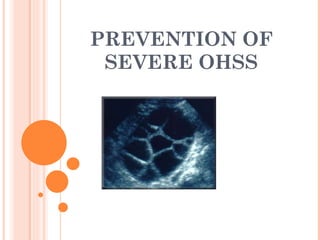
PREVENTION OF SEVERE OHSS
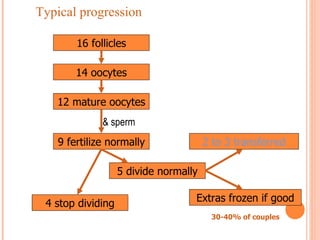
16 follicles 12 mature oocytes 14 oocytes Extras frozen if good 2 to 3 transferred 9 fertilize normally 5 divide normally 30-40% of couples 4 stop dividing & sperm Typical progression
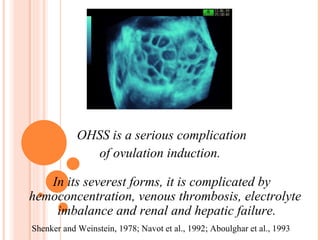
OHSS is a serious complication  of ovulation induction. In its severest forms, it is complicated by  hemoconcentration, venous thrombosis, electrolyte  imbalance and renal and hepatic failure. Shenker and Weinstein, 1978; Navot et al., 1992; Aboulghar et al., 1993
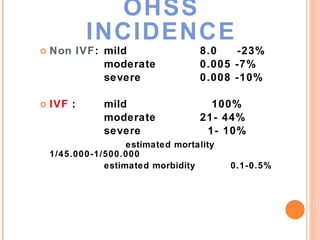
OHSS INCIDENCE Non IVF : mild 8.0  -23% moderate 0.005 -7% severe 0.008 -10% IVF : mild   100% moderate 21- 44% severe   1- 10% estimated mortality  1/45.000-1/500.000 estimated morbidity  0.1-0.5%
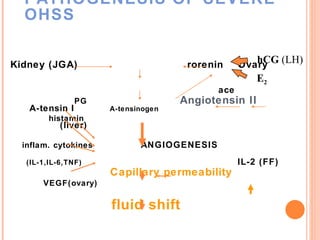
PATHOGENESIS OF SEVERE OHSS Kidney (JGA)   rorenin  Ovary                   ace  PG   Angiotensin II   A-tensin I  A-tensinogen  histamin   (liver) inflam. cytokines   ANGIOGENESIS   (IL-1,IL-6,TNF)  IL-2 (FF)   Capillary permeability VEGF(ovary)       fluid shift hCG  (LH) E 2
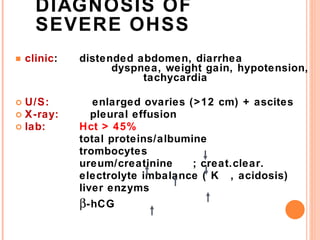
DIAGNOSIS OF SEVERE OHSS clinic : distended abdomen, diarrhea    dyspnea, weight gain, hypotension,  tachycardia U/S:   enlarged ovaries (>12 cm) + ascites  X-ray:   pleural effusion lab: Hct > 45% total proteins/albumine trombocytes  ureum/creatinine  ; creat.clear. electrolyte imbalance ( K  , acidosis) liver enzyms   -hCG
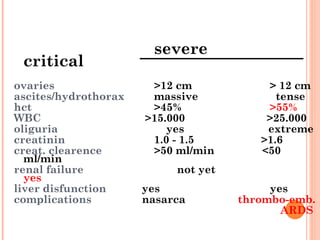
  severe   critical ovaries   >12 cm   > 12 cm ascites/hydrothorax   massive   tense hct   >45%   >55% WBC    >15.000   >25.000 oliguria   yes   extreme creatinin   1.0 - 1.5  >1.6 creat. clearence   >50 ml/min   <50 ml/min renal failure    not yet    yes liver disfunction yes   yes complications nasarca   thrombo-emb.   ARDS
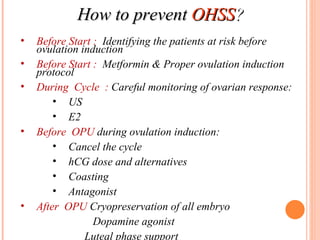
How to prevent  OHSS ? Before Start :  Identifying the patients at risk before ovulation induction . Before Start :  Metformin &   Proper ovulation induction protocol During  Cycle  :  Careful monitoring of ovarian response: US E2 Before  OPU  during ovulation induction: Cancel the cycle hCG dose and alternatives Coasting Antagonist After  OPU  Cryopreservation of all embryo   Dopamine agonist  Luteal phase support
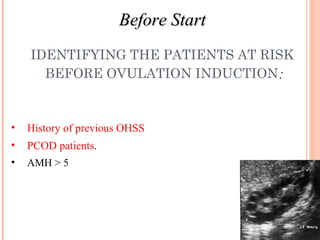
Before Start IDENTIFYING THE PATIENTS AT RISK  BEFORE OVULATION INDUCTION : History of previous OHSS PCOD patients . AMH > 5
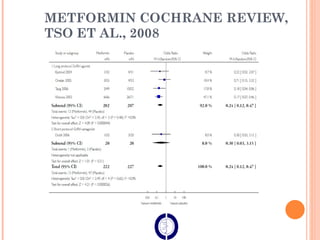
METFORMIN COCHRANE REVIEW,  TSO  ET AL., 2008
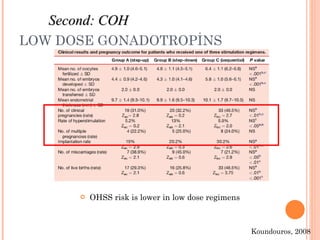
LOW DOSE GONADOTROPİNS OHSS risk is lower in low dose regimens Koundouros, 2008 Second: COH
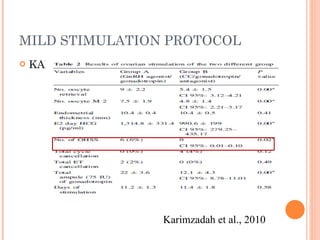
MILD STIMULATION PROTOCOL  KAK Karimzadah et al., 2010
HOW TO SUSPECT DURING COH  rapidly rising serum E2 levels  More than 20 growing follicles
So what to do!! For complete prevention:  withholding hCG and continuing GnRHa  (Navot et al., 1992) Delaying hCG  = Coasting Other alternatives: Rec hCG Rec LH GnRHa
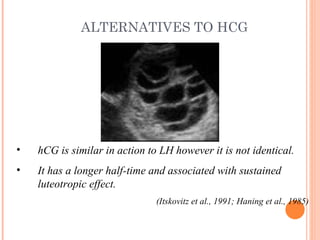
ALTERNATIVES TO HCG hCG is similar in action to LH however it is not identical.  It has a longer half-time and associated with sustained luteotropic effect. (Itskovitz et al., 1991; Haning et al., 1985)
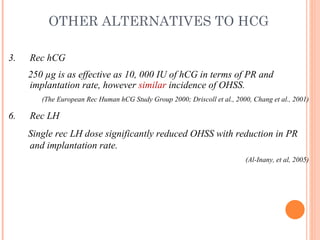
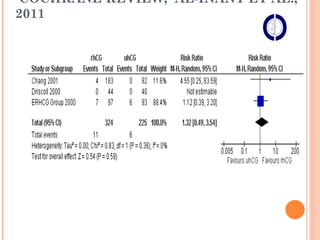
OTHER ALTERNATIVES TO HCG Rec hCG 250 µg is as effective as 10, 000 IU of hCG in terms of PR and implantation rate, however  similar  incidence of OHSS.  (The European Rec Human hCG Study Group 2000; Driscoll et al., 2000, Chang et al., 2001) Rec LH Single rec LH dose significantly reduced OHSS with reduction in PR and implantation rate.  (Al-Inany, et al, 2005)
  COCHRANE REVIEW,  AL-INANY ET AL., 2011
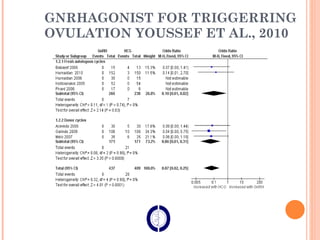
GNRHAGONIST FOR TRIGGERRING OVULATION YOUSSEF ET AL., 2010
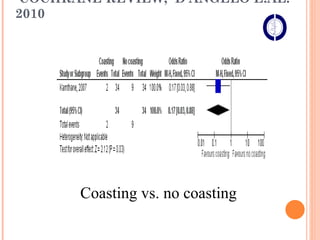
Coasting It is withholding gonadotropins for few days before giving hCG until E2 drops to a safer level. Available evidence suggests that such “coasting” does not adversely affect outcome in IVF cycles unless it is prolonged (>2 days)
  COCHRANE REVIEW,  D’ANGELO E.AL. 2010    Coasting vs. no coasting
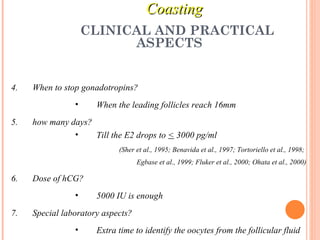
Coasting   CLINICAL AND PRACTICAL ASPECTS When to stop gonadotropins? When the leading follicles reach 16mm how many days? Till the E2 drops to  <  3000 pg/ml (Sher et al., 1995; Benavida et al., 1997; Tortoriello et al., 1998;  Egbase et al., 1999; Fluker et al., 2000; Ohata et al., 2000) Dose of hCG? 5000 IU is enough Special laboratory aspects? Extra time to identify the oocytes from the follicular fluid
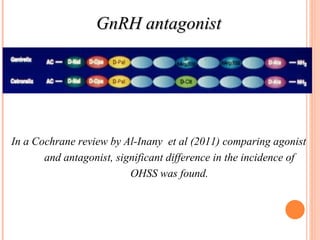
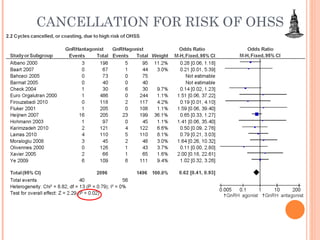
GnRH antagonist In a Cochrane review by Al-Inany  et al (2011) comparing agonist and antagonist, significant difference in the incidence of OHSS was found.
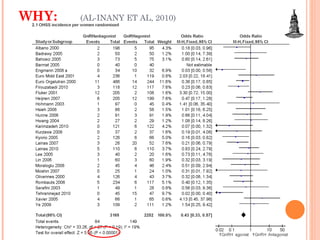
WHY:  (AL-INANY ET AL, 2010)
CANCELLATION FOR RISK OF OHSS
So we may say confidently that GnRH antagonist is safer than GnRH agonist in IVF/ ICSI cycles
BUT NOT ALL DOCTORS WOULD GO FOR ANTAGONIST
(GNRH) ANTAGONISTS: OFF LABEL INDICATION  unique Idea Administration during GnRH agonist cycle when follicle reach ~16mm and E2 level > 4000pmol Decrease but Continue hMG (step down protocol) Monitor by E2 Not more than 3 days
VALUE allow continued stimulation while rapidly decreasing the E2 level to a range that is clinically acceptable.
 
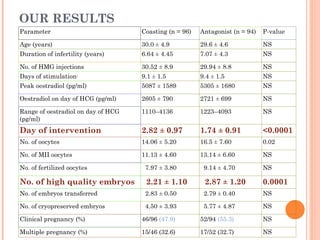
OUR RESULTS Parameter Coasting (n = 96) Antagonist (n = 94) P-value Age (years) 30.0 ± 4.9 29.6 ± 4.6 NS Duration of infertility (years) 6.64 ± 4.45 7.07 ± 4.3 NS No. of HMG injections 30.52 ± 8.9 29.94 ± 8.8 NS Days of stimulation 1 9.1 ± 1.5 9.4 ± 1.5 NS Peak oestradiol (pg/ml) 5087 ± 1589 5305 ± 1680 NS Oestradiol on day of HCG (pg/ml) 2605 ± 790 2721 ± 699 NS Range of oestradiol on day of HCG (pg/ml)  1110–4136 1223–4093 NS Day of intervention 2.82 ± 0.97 1.74 ± 0.91 <0.0001 No. of oocytes 14.06 ± 5.20 16.5 ± 7.60 0.02 No. of MII oocytes  11.13 ± 4.60 13.14 ± 6.60 NS No. of fertilized oocytes    7.97 ± 3.80    9.14 ± 4.70 NS No. of high quality embryos    2.21 ± 1.10    2.87 ± 1.20 0.0001 No. of embryos transferred    2.83 ± 0.50    2.79 ± 0.40 NS No. of cryopreserved embryos    4.50 ± 3.93    5.77 ± 4.87 NS Clinical pregnancy (%) 46/96  (47.9) 52/94  (55.3) NS Multiple pregnancy (%) 15/46 (32.6) 17/52 (32.7) NS
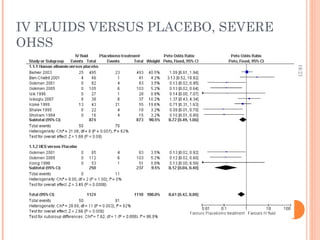
Intravenous Albumin to Prevent OHSS Cochrane review update  (Al-Inany et al., 2011) 7 randomized controlled trials Clear evidence of beneficial effect
BACKGROUND Administration of intravenous fluids such as human albumin might result in :- A restoration of intravascular volume  Inactivation of the vasoactive intermediates responsible for the pathogenesis of OHSS  5/23
BACKGROUND Hydroxyethyl starch (HES)  is a plasma expander that has gained recent attention as an alternative to albumin in reducing the incidence of severe OHSS HES is a non-biological substance, it avoids any potential concern about viral transmission that may be present with albumin 7/23
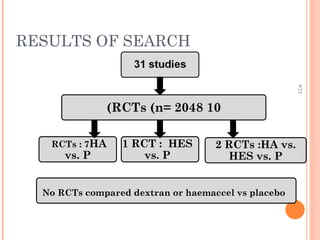
RESULTS OF SEARCH 9/23 10 RCTs (n= 2048) 7 RCTs :  HA vs. P 1 RCT :  HES vs. P 2 RCTs :HA vs. HES vs. P No RCTs compared dextran or haemaccel vs placebo
IV FLUIDS VERSUS PLACEBO, SEVERE OHSS  18/23
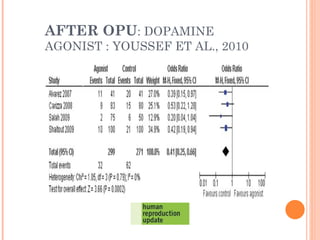
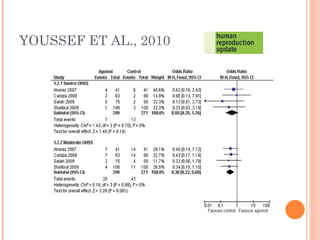
AFTER OPU : DOPAMINE AGONIST : YOUSSEF ET AL., 2010
YOUSSEF ET AL., 2010
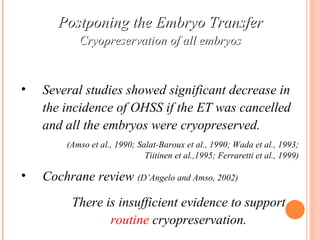
Postponing the Embryo Transfer Cryopreservation of all embryos Several studies showed significant decrease in the incidence of OHSS if the ET was cancelled and all the embryos were cryopreserved. (Amso et al., 1990; Salat-Baroux et al., 1990; Wada et al., 1993; Tiitinen et al.,1995; Ferraretti et al., 1999) Cochrane review  (D’Angelo and Amso, 2002) There is insufficient evidence to support  routine  cryopreservation.
Conclusion OHSS   is a preventable disease that  should not be allowed to happen
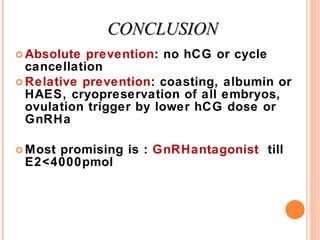
CONCLUSION Absolute prevention : no hCG or cycle cancellation Relative prevention : coasting, albumin or HAES, cryopreservation of all embryos, ovulation trigger by lower hCG dose or GnRHa Most promising is :  GnRHantagonist   till E2<4000pmol
THANK YOU Dr. Hesham Al-Inany  MD, PhD e-mail : hesham@khosoba.com

High responders

  • 1.
  • 2.
  • 3.
    16 follicles 12mature oocytes 14 oocytes Extras frozen if good 2 to 3 transferred 9 fertilize normally 5 divide normally 30-40% of couples 4 stop dividing & sperm Typical progression
  • 4.
    OHSS is aserious complication of ovulation induction. In its severest forms, it is complicated by hemoconcentration, venous thrombosis, electrolyte imbalance and renal and hepatic failure. Shenker and Weinstein, 1978; Navot et al., 1992; Aboulghar et al., 1993
  • 5.
    OHSS INCIDENCE NonIVF : mild 8.0 -23% moderate 0.005 -7% severe 0.008 -10% IVF : mild 100% moderate 21- 44% severe 1- 10% estimated mortality 1/45.000-1/500.000 estimated morbidity 0.1-0.5%
  • 6.
    PATHOGENESIS OF SEVEREOHSS Kidney (JGA) rorenin Ovary ace PG Angiotensin II A-tensin I A-tensinogen histamin (liver) inflam. cytokines ANGIOGENESIS (IL-1,IL-6,TNF) IL-2 (FF) Capillary permeability VEGF(ovary) fluid shift hCG (LH) E 2
  • 7.
    DIAGNOSIS OF SEVEREOHSS clinic : distended abdomen, diarrhea dyspnea, weight gain, hypotension, tachycardia U/S: enlarged ovaries (>12 cm) + ascites X-ray: pleural effusion lab: Hct > 45% total proteins/albumine trombocytes ureum/creatinine ; creat.clear. electrolyte imbalance ( K , acidosis) liver enzyms  -hCG
  • 8.
    severe critical ovaries >12 cm > 12 cm ascites/hydrothorax massive tense hct >45% >55% WBC >15.000 >25.000 oliguria yes extreme creatinin 1.0 - 1.5 >1.6 creat. clearence >50 ml/min <50 ml/min renal failure not yet yes liver disfunction yes yes complications nasarca thrombo-emb. ARDS
  • 9.
    How to prevent OHSS ? Before Start : Identifying the patients at risk before ovulation induction . Before Start : Metformin & Proper ovulation induction protocol During Cycle : Careful monitoring of ovarian response: US E2 Before OPU during ovulation induction: Cancel the cycle hCG dose and alternatives Coasting Antagonist After OPU Cryopreservation of all embryo Dopamine agonist Luteal phase support
  • 10.
    Before Start IDENTIFYINGTHE PATIENTS AT RISK BEFORE OVULATION INDUCTION : History of previous OHSS PCOD patients . AMH > 5
  • 11.
    METFORMIN COCHRANE REVIEW, TSO ET AL., 2008
  • 12.
    LOW DOSE GONADOTROPİNSOHSS risk is lower in low dose regimens Koundouros, 2008 Second: COH
  • 13.
    MILD STIMULATION PROTOCOL KAK Karimzadah et al., 2010
  • 14.
    HOW TO SUSPECTDURING COH rapidly rising serum E2 levels More than 20 growing follicles
  • 15.
    So what todo!! For complete prevention: withholding hCG and continuing GnRHa (Navot et al., 1992) Delaying hCG = Coasting Other alternatives: Rec hCG Rec LH GnRHa
  • 16.
    ALTERNATIVES TO HCGhCG is similar in action to LH however it is not identical. It has a longer half-time and associated with sustained luteotropic effect. (Itskovitz et al., 1991; Haning et al., 1985)
  • 17.
    OTHER ALTERNATIVES TOHCG Rec hCG 250 µg is as effective as 10, 000 IU of hCG in terms of PR and implantation rate, however similar incidence of OHSS. (The European Rec Human hCG Study Group 2000; Driscoll et al., 2000, Chang et al., 2001) Rec LH Single rec LH dose significantly reduced OHSS with reduction in PR and implantation rate. (Al-Inany, et al, 2005)
  • 18.
    COCHRANEREVIEW, AL-INANY ET AL., 2011
  • 19.
    GNRHAGONIST FOR TRIGGERRINGOVULATION YOUSSEF ET AL., 2010
  • 20.
    Coasting It iswithholding gonadotropins for few days before giving hCG until E2 drops to a safer level. Available evidence suggests that such “coasting” does not adversely affect outcome in IVF cycles unless it is prolonged (>2 days)
  • 21.
    COCHRANEREVIEW, D’ANGELO E.AL. 2010 Coasting vs. no coasting
  • 22.
    Coasting CLINICAL AND PRACTICAL ASPECTS When to stop gonadotropins? When the leading follicles reach 16mm how many days? Till the E2 drops to < 3000 pg/ml (Sher et al., 1995; Benavida et al., 1997; Tortoriello et al., 1998; Egbase et al., 1999; Fluker et al., 2000; Ohata et al., 2000) Dose of hCG? 5000 IU is enough Special laboratory aspects? Extra time to identify the oocytes from the follicular fluid
  • 23.
    GnRH antagonist Ina Cochrane review by Al-Inany et al (2011) comparing agonist and antagonist, significant difference in the incidence of OHSS was found.
  • 24.
    WHY: (AL-INANYET AL, 2010)
  • 25.
  • 26.
    So we maysay confidently that GnRH antagonist is safer than GnRH agonist in IVF/ ICSI cycles
  • 27.
    BUT NOT ALLDOCTORS WOULD GO FOR ANTAGONIST
  • 28.
    (GNRH) ANTAGONISTS: OFFLABEL INDICATION unique Idea Administration during GnRH agonist cycle when follicle reach ~16mm and E2 level > 4000pmol Decrease but Continue hMG (step down protocol) Monitor by E2 Not more than 3 days
  • 29.
    VALUE allow continuedstimulation while rapidly decreasing the E2 level to a range that is clinically acceptable.
  • 30.
  • 31.
    OUR RESULTS ParameterCoasting (n = 96) Antagonist (n = 94) P-value Age (years) 30.0 ± 4.9 29.6 ± 4.6 NS Duration of infertility (years) 6.64 ± 4.45 7.07 ± 4.3 NS No. of HMG injections 30.52 ± 8.9 29.94 ± 8.8 NS Days of stimulation 1 9.1 ± 1.5 9.4 ± 1.5 NS Peak oestradiol (pg/ml) 5087 ± 1589 5305 ± 1680 NS Oestradiol on day of HCG (pg/ml) 2605 ± 790 2721 ± 699 NS Range of oestradiol on day of HCG (pg/ml) 1110–4136 1223–4093 NS Day of intervention 2.82 ± 0.97 1.74 ± 0.91 <0.0001 No. of oocytes 14.06 ± 5.20 16.5 ± 7.60 0.02 No. of MII oocytes 11.13 ± 4.60 13.14 ± 6.60 NS No. of fertilized oocytes   7.97 ± 3.80   9.14 ± 4.70 NS No. of high quality embryos   2.21 ± 1.10   2.87 ± 1.20 0.0001 No. of embryos transferred   2.83 ± 0.50   2.79 ± 0.40 NS No. of cryopreserved embryos   4.50 ± 3.93   5.77 ± 4.87 NS Clinical pregnancy (%) 46/96 (47.9) 52/94 (55.3) NS Multiple pregnancy (%) 15/46 (32.6) 17/52 (32.7) NS
  • 32.
    Intravenous Albumin toPrevent OHSS Cochrane review update (Al-Inany et al., 2011) 7 randomized controlled trials Clear evidence of beneficial effect
  • 33.
    BACKGROUND Administration ofintravenous fluids such as human albumin might result in :- A restoration of intravascular volume Inactivation of the vasoactive intermediates responsible for the pathogenesis of OHSS 5/23
  • 34.
    BACKGROUND Hydroxyethyl starch(HES) is a plasma expander that has gained recent attention as an alternative to albumin in reducing the incidence of severe OHSS HES is a non-biological substance, it avoids any potential concern about viral transmission that may be present with albumin 7/23
  • 35.
    RESULTS OF SEARCH9/23 10 RCTs (n= 2048) 7 RCTs : HA vs. P 1 RCT : HES vs. P 2 RCTs :HA vs. HES vs. P No RCTs compared dextran or haemaccel vs placebo
  • 36.
    IV FLUIDS VERSUSPLACEBO, SEVERE OHSS 18/23
  • 37.
    AFTER OPU :DOPAMINE AGONIST : YOUSSEF ET AL., 2010
  • 38.
  • 39.
    Postponing the EmbryoTransfer Cryopreservation of all embryos Several studies showed significant decrease in the incidence of OHSS if the ET was cancelled and all the embryos were cryopreserved. (Amso et al., 1990; Salat-Baroux et al., 1990; Wada et al., 1993; Tiitinen et al.,1995; Ferraretti et al., 1999) Cochrane review (D’Angelo and Amso, 2002) There is insufficient evidence to support routine cryopreservation.
  • 40.
    Conclusion OHSS is a preventable disease that should not be allowed to happen
  • 41.
    CONCLUSION Absolute prevention: no hCG or cycle cancellation Relative prevention : coasting, albumin or HAES, cryopreservation of all embryos, ovulation trigger by lower hCG dose or GnRHa Most promising is : GnRHantagonist till E2<4000pmol
  • 42.
    THANK YOU Dr.Hesham Al-Inany MD, PhD e-mail : hesham@khosoba.com

Editor's Notes

  • #6 8 8 8
  • #7 37 27 27
  • #8 15 14 14
  • #14 Pregnancy rate per transfer comparable with the long agonist protocol No severe OHSS in all studies This protocol should be considered as an option in patients with OHSS risk
  • #34 Oocyte triggering with HCG have some drawbacks as:….. , while oocyte triggering with GnRH agonist means……
  • #35 Oocyte triggering with HCG have some drawbacks as:….. , while oocyte triggering with GnRH agonist means……
  • #36 Oocyte triggering with HCG have some drawbacks as:….. , while oocyte triggering with GnRH agonist means……
  • #37 Oocyte triggering with HCG have some drawbacks as:….. , while oocyte triggering with GnRH agonist means……
  • #42 31 21 21