UNIT I
SYSTEM DEVELOPMENT APPROACHES
By Dr. Dhobale J V
Associate Professor
School of Engineering & Technology
RNB Global University, Bikaner
RNB Global University, Bikaner. 1Course Code - 13004500
Objectives
 System Development Approaches.
 The Waterfall Model
 The Incremental Model
 The Spiral Model
 The V Life Cycle Model
 Rapid Application Development
 Agile Life Cycle Model
 The Prototyping Model
2RNB Global University, Bikaner.Course Code - 13004500
Introduction
 The methodology for system development has
a great variety of approaches.
 We call it as models of system development
life cycle (SDLC).
 Some of the most commonly used models are
the Spiral, Waterfall, V-shaped, and Agile
models.
3RNB Global University, Bikaner.Course Code - 13004500
Cont…
 The point where the model or framework that
will guide the development process is chosen
is a central strategic aspect.
 The wrong life cycle can delay the project and
affect client satisfaction.
4RNB Global University, Bikaner.Course Code - 13004500
The Waterfall Model
 The waterfall model was introduced by Royce
in (1970), specifically for spacecraft mission
software design.
 It is one of the most popular methods of
assessing the evolution of a product or
system.
 It is a step-by-step sequential description that
spans 7 different stages.
5RNB Global University, Bikaner.Course Code - 13004500
The Waterfall Model
 System Requirements, Software requirements,
Analysis, Program design, Coding, Testing
and Operations” (Royce 1970).
 The first premise in which this model is based
is that any development process of any
software or system starts off by two essential
steps: analysis and coding.
6RNB Global University, Bikaner.Course Code - 13004500
The Waterfall Model
 Analysis stage is broken down into two steps -
analysis of both system and software
requirements, while the coding stage is
preceded by program design (Royce 1970).
 It is useful set of guidelines for the
development of new programs or systems.
 Royce (1970) provides five key principles
(guidelines):
7RNB Global University, Bikaner.Course Code - 13004500
The Waterfall Model
1. Program Design comes first.
2. Document the design.
3. Do it twice.
4. Plan, Control and monitor testing.
5. Involve the Customer.
8RNB Global University, Bikaner.Course Code - 13004500
The Waterfall Model
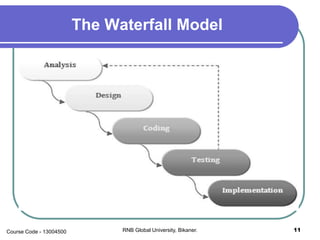
 It is a sequential model.
 Each of its stages must be entirely concluded
before the next can begin.
 Similarly to the flow of a waterfall, the
development of the software is regarded as
continuously streaming downward throughout
its different stages(Massey and Satao 2012).
9RNB Global University, Bikaner.Course Code - 13004500
The Waterfall Model
 Each stage is regarded as a static component,
a rigid step in the process.
 The waterfall model took precedence over
other models in the 1980s and the beginning
of the 1990s.
 But this preponderance suffered an important
setback with the increasing speed of
technological evolution and the subsequent
need to swiftly deliver software systems.
10RNB Global University, Bikaner.Course Code - 13004500
The Waterfall Model
11RNB Global University, Bikaner.Course Code - 13004500
The Waterfall Model
 Viewing each stage as a single, “frozen”
moment of evolution can greatly delay the
implementation stage.
 This model is an idealized and greatly
simplified concept of SDLC.
 It is not very flexible, but it is still popular as a
conceptual basis for other frameworks or
models.
12RNB Global University, Bikaner.Course Code - 13004500
The Waterfall Model
 Its greatest strength lies in that it outlines
generally accepted positive habits of software
development, such as :
 Minute and accurate planning early in the project.
 extensive documentation of the entire process.
 Having robust design concepts before starting to
code.
13RNB Global University, Bikaner.Course Code - 13004500
The Incremental Model
 The incremental model is a particular evolution
of the waterfall model that attempts to address
its more prominent shortcoming, which is the
slowness of the cycle.
 It also aims at outlining a more flexible process
that requires less extensive planning up-front
(Munassar and Govardhan 2010).
14RNB Global University, Bikaner.Course Code - 13004500
The Incremental Model
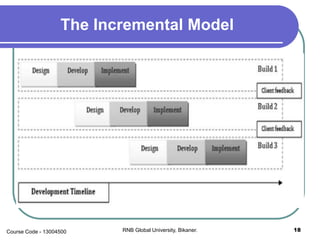
 According to this approach, instead of dividing
the SDLC into static, isolated steps, the whole
process can instead be designed, tested, and
implemented one fraction at a time, in
successive stages, so that with each stage (or
increment), there can be at least some
feedback from the client.
 This feedback will provide valuable assistance
in the next increment of the process and so
forth.
15RNB Global University, Bikaner.Course Code - 13004500
The Incremental Model
 With each ongoing increment, the product is
extensively tested and improved, according to
objectives and expectations from the client,
which facilitates its eventual success (Massey
and Satao 2012).
 With this SDLC model, the process of software
development is made by increments, through
a series of different releases.
16RNB Global University, Bikaner.Course Code - 13004500
The Incremental Model
 When the product is launched, when it has its
first increment, it is ready for consumer use.
Then, according to the clients’ response to the
software, new increments are made to
improve the product.
 The increments will continue to be added, until
the completion of the final product.
17RNB Global University, Bikaner.Course Code - 13004500
The Incremental Model
18RNB Global University, Bikaner.Course Code - 13004500
The Incremental Model
 This model highlights the sequential process
of the different phases of development while
also trying to maximize the benefits of allowing
changes, improvements, and additions to be
made between each increment.
 Thus, product delivery is not only faster, but it
is also easier to test and eventually correct.
19RNB Global University, Bikaner.Course Code - 13004500
The Incremental Model
 The downside to this approach is that it can be
more costly to develop and release multiple
versions of the product.
 Compatibility issues with earlier version of the
product.
 There is a variation of the incremental model,
named the iterative and incremental
development model (IIDM).
20RNB Global University, Bikaner.Course Code - 13004500
The Spiral Model
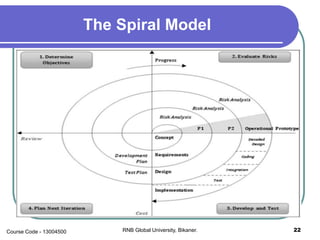
 The Spiral model has introduced in 1980 by Barry
Boehm.
 It introduced to analyze Risk in software development,
which other models where not considered.
 According to this model, the process of developing a
system consists of a series of cycles or iterations.
 Each cycle begins with the identification of objectives
and requirements of the current stage, as well as an
analysis of alternatives and constraints.
21RNB Global University, Bikaner.Course Code - 13004500
The Spiral Model
22RNB Global University, Bikaner.Course Code - 13004500
The Spiral Model
 This process will highlight areas of uncertainty (risk),
which will be taken into account during the next step.
 This process involves constant improvement of the
prototype as risks are decreased.
23RNB Global University, Bikaner.Course Code - 13004500
The Spiral Model
 Once the prototype becomes sufficiently robust, and
risk is reduced to acceptable levels, the next step
develops in accordance with the basic waterfall
approach, through a succession of stages: Concept,
requirements, design, and implementation.
 Once this cycle is concluded, another cycle begins, as
a new increment of the product is created.
24RNB Global University, Bikaner.Course Code - 13004500
The Spiral Model
 The stages or spirals that constitute this model
regarding planning as a first step, moving then to the
exploration of what the requirements are and
subsequently calculating the risks.
 In this stage of risk calculation, the model is structured
to initiate a process of determination of risks and
formulation of alternatives.
25RNB Global University, Bikaner.Course Code - 13004500
The Spiral Model
 Boehm asserts that each cycle or iteration of the
process will invariably display six particular
characteristics, which are named the “invariants”.
 Invariant 1: is the concurrent definition of key artifacts,
such as concept, requirements, plan, design, and
coding.
26RNB Global University, Bikaner.Course Code - 13004500
The Spiral Model
 Invariant 2 is that each cycle follows the four strategic
principles that correspond to the four quadrants of the
model: determine objectives, evaluate risks, develop
and test, and plan the next iteration.
 Invariant 3 is that level of effort is determined by the
risk considerations. Reasonable time frames must be
established for each project in accordance with risk
assessments, to determine “how much is enough”..
27RNB Global University, Bikaner.Course Code - 13004500
The Spiral Model
 Invariant 4 is that the degree of detail is driven by risk
considerations. Just like invariant 3, here it is
important to determine “how much detail is enough”.
 Invariant 5 refers to the use of anchor point
milestones, which Boehm describes as “Life Cycle
Objectives (LCO), Life Cycle Architecture (LCA) and
Initial Operational Capacity (IOC).
28RNB Global University, Bikaner.Course Code - 13004500
The Spiral Model
 Finally, invariant 6 states that besides the construction
aspects, the development process needs to focus also
on the overall life cycle itself. This means that long-
term concerns should always be taken into account..
 It is ideal model for large, mission-critical projects.
 It is not very efficient in smaller projects.
29RNB Global University, Bikaner.Course Code - 13004500
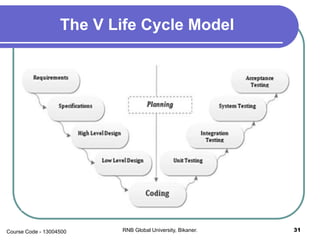
The V Life Cycle Model
 It is presented in the year 1980s by Paul Rook, as a
variation over the waterfall model.
 It emphasize the existing connection between each of
the stages of the development process and its
respective stage of tests.
 Through this relationship, It ensures that adequate
quality measurements and testing are constantly
resorted to throughout the life cycle.
30RNB Global University, Bikaner.Course Code - 13004500
The V Life Cycle Model
31RNB Global University, Bikaner.Course Code - 13004500
The V Life Cycle Model
 The method thus presented is that each step is
implemented by resorting to detailed documentation
from the previous step.
 With this documentation, the product is checked and
approved at each stage of the process, before it can
move on to the next stage, With constant testing, and
its respective documentation, it is possible to increase
the overall efficiency of the process, particularly
because eventual problems can be detected and
resolved early.
32RNB Global University, Bikaner.Course Code - 13004500
The V Life Cycle Model
 The V-Model starts off with a very similar premise to
the classic waterfall models.
 In successive steps, the project goes from analysis of
requirements and specifications, to architectural and
detailed design, to coding.
 However, instead of continuing this downward ladder,
there is a parallel structure that moves upward from
the coding stage, giving the model its distinct V shape.
33RNB Global University, Bikaner.Course Code - 13004500
The V Life Cycle Model
 The upward ladder describes each of the testing steps
that follows coding, starting with unit testing and
ending with acceptance testing, the final step before
final release.
 the V-Model describes three successive layers of
system development that can be described as
requirements (overall system), high-level design
(system architecture), and low-level design (software
components).
34RNB Global University, Bikaner.Course Code - 13004500
The V Life Cycle Model
 To each of these layers, there is a corresponding layer
of planning and testing. Planning is, indeed, the axis
that stands between the left and right ladders that
compose the V, as it is the mediating action set
between design and testing.
 The core objective of the V life cycle model is to
illustrate the importance of the relationship between
development and testing tasks.
35RNB Global University, Bikaner.Course Code - 13004500
The V Life Cycle Model
 To accommodate this reality, Mathur and Malik (2010)
proposed an expanded version of the V-Model, called
the advanced V-Model, that incorporates both testing
and maintenance activities into the life cycle.
 Since the V-Model addresses its errors shortly after
they are identified, it becomes less expensive to
resolve them, which is perhaps the greatest advantage
of using this model, specifically when compared to the
classic waterfall model.
36RNB Global University, Bikaner.Course Code - 13004500
The V Life Cycle Model
 the fact that tests are performed since the beginning of
the process only increases its efficiency.
 On the other hand, and much like the waterfall model,
this model is very rigid and there is little room for
flexible adaptation, particularly because any alteration
in the requirements will render all existing
documentation and testing obsolete.
37RNB Global University, Bikaner.Course Code - 13004500
Rapid Application Development
 Originally conceptualized in the 1970s, the rapid
application development model was substantially
developed and formalized by James Martin in the early
1990s.
 It is grounded on the principle that step-by-step
structured life cycles inevitably entail delays and
errors, urging the need for an alternative methodology.
 When deadlines are the main priority and the
swiftness of software development is critical, RAD
presents itself as a very plausible solution.
38RNB Global University, Bikaner.Course Code - 13004500
Rapid Application Development
 RAD comprises a set of tools and guidelines that
facilitate short-time deployment, within a predefined
time frame or “timebox.”
 The product is not developed in successive steps until
a final, complete delivery, but rather it evolves in
successive increments, following the priorities that are
established by business—not technical —necessities.
 Some of these tools and guidelines include planning
methods, data and process modelling, code
generation, testing, and debugging.
39RNB Global University, Bikaner.Course Code - 13004500
Rapid Application Development
 It is important to note that both developers and
customers are involved in all of the increments.
 However, teams are generally small, highly skilled,
and highly disciplined.
 They are required to flexibly adapt to eventual
changing requirements and feedback from customers.
 It is crucial to strike the proper balance between
flexibility and structural stability.
40RNB Global University, Bikaner.Course Code - 13004500
Rapid Application Development
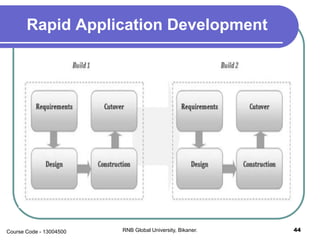
 RAD methodologies can follow three-stage or four-
stage cycles.
 “The four-stage cycle consists of requirements
planning, user design, construction, and cutover.
 While in the three-stage cycle, requirements planning
and user design are consolidated into one iterative
activity”.
41RNB Global University, Bikaner.Course Code - 13004500
Rapid Application Development
 During planning, it is possible to analyze requirements,
alternatives, and opportunities, as well as possible
risks.
 This will form the basis for a definition of the project’s
goals and scope, and more importantly, it will allow for
the establishment of the timebox, which is a fixed
period during which a specific increment of the product
is going to be developed.
 Each increment is then developed in a spiral-like
model, through design, prototyping, and testing.
42RNB Global University, Bikaner.Course Code - 13004500
Rapid Application Development
 This method essentially pushes the team closer to the
project’s business goals, by providing key deadlines
that can be determined by market forces.
 While the advantages of the RAD are evident, due to
its focus on swift delivery and effective developer–
client communication, there are still a number of
issues raised by this approach.
 One of the most obvious flaws is that it removes a
great deal of emphasis on minute planning and
modelling at the start of the project, shifting that focus
to the fluid process of system construction.
43RNB Global University, Bikaner.Course Code - 13004500
Rapid Application Development
44RNB Global University, Bikaner.Course Code - 13004500
Rapid Application Development
 Another prominent issue is that in faster development
cycles, extensive quality testing will become less
prioritized, reflecting in poorer quality overall, which
means that effective RAD methodologies should
reserve space for skilled individuals in quality control
roles.
 It is also possible that managers and leader have
unrealistic expectations regarding the timeboxes,
creating conflict with developing teams.
45RNB Global University, Bikaner.Course Code - 13004500
Agile Life Cycle Model
 In 2001, the manifesto for agile software development
was presented by 17 software developers, in a new
attempt to bring together the best traits of other agile-
like models into one framework.
 Since then, agile methods of development have
become increasingly popular.
 There are 12 principles that guide agile development
models; These are summed as:
46RNB Global University, Bikaner.Course Code - 13004500
Agile Life Cycle Model
47RNB Global University, Bikaner.Course Code - 13004500
Agile Life Cycle Model
1. Customer satisfaction is the highest priority;
2. Change in requirements is welcomed, no longer an
obstacle;
3. Software is delivered regularly in consecutive
releases;
4. Motivated individuals are key to successful projects;
5. Face-to-face conversation is paramount to successful
collaboration;
48RNB Global University, Bikaner.Course Code - 13004500
Agile Life Cycle Model
6. Working software is the measure of the project’s
progress;
7. Sustainable development should be encouraged;
8. Emphasis on technical and design quality;
9. Simplicity should be favored;
49RNB Global University, Bikaner.Course Code - 13004500
Agile Life Cycle Model
10. Self-organizing teams are the best form of project
development;
11. There should be regular discussions on team
improvement;
 the general path that an agile development process
will take, outlined in four steps:
50RNB Global University, Bikaner.Course Code - 13004500
Agile Life Cycle Model
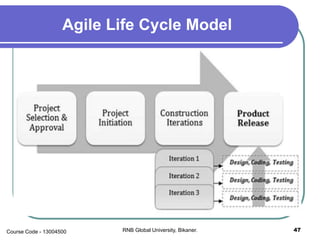
1. Project Selection and approval: During this stage, a
team consisting of developers, managers, and
customers establishes the scope, purpose, and
requirements of the product.
 Through analysis of alternatives and risk
assessments for each idea.
2. Project Initiation: After the establishment of a
coherent project with respective goals and scope, a
working team is built, with the appropriate
environment and tools, as well as the working
architecture in which the system will be based.
51RNB Global University, Bikaner.Course Code - 13004500
Agile Life Cycle Model
3. Construction Iterations: with each iteration consisting
of both planning and building.
 Developers release working software in successive
increments that will accommodate the evolution of
requirements as outlined by the various stakeholders.
 Close collaboration and extensive testing of each
iteration is also important for successful project.
52RNB Global University, Bikaner.Course Code - 13004500
Agile Life Cycle Model
4. Product release: It encompasses two stages:
1. Final testing of the entire system is done, as well as any
necessary final reworks and documentations.
2. The product is released, at which point training is provided to
the users in order to maximize operational integration.
 The working team might maintain the project so as to
allow for product improvement as well as user
support.
 The Agile SDLC emerged from the ever-increasing
need to match the speed at which IT evolves.
53RNB Global University, Bikaner.Course Code - 13004500
Agile Life Cycle Model
 What sets it apart is its dexterity in developing
products at a great speed, with products being
deliverable in the course of weeks instead of months.
 This is possible due to the model’s emphasis on
collaborative efforts and documentation.
 Agile model is very flexible.
54RNB Global University, Bikaner.Course Code - 13004500
Agile Life Cycle Model
 It has been occasionally combined with other existing
models.
 It has the capacity to deliver systems whose
requirements go through constant changes while, at
the same time, demanding strict time limits.
 this model is often praised for its high degree of client
satisfaction and user-friendliness, reduced error
margins and the ability to incorporate solutions to
address the needs of highly mutable requirements.
55RNB Global University, Bikaner.Course Code - 13004500
Agile Life Cycle Model
 Agile models are client-centric and advocate “short
iterations and small releases” in order to obtain
feedback on what has been accomplished.
 With the feedback that is received, improvements can
be made that will have positive repercussions on the
quality of the end product.
56RNB Global University, Bikaner.Course Code - 13004500
The Prototyping Model
 In 1997, Carr and Verner observed that in the past
research, the SDLC models that adopted prototyping
were found to be more dynamic and more responsive
to client needs, as well as less risky and more
efficient.
 For that reason, they attempted to summarize
prototyping models in one consistent framework.
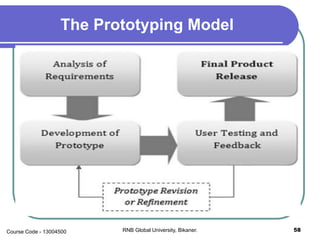
 The prototyping model is based on the idea of creating
the entirety or part of a system in a pilot version, called
the prototype.
57RNB Global University, Bikaner.Course Code - 13004500
The Prototyping Model
58RNB Global University, Bikaner.Course Code - 13004500
The Prototyping Model
 It can be viewed as a process, either one that is part of
the larger SDLC or the central approach that defines
the SDLC in itself. The goal is ultimately to build in
various versions and consistently refine those versions
until a final product is reached.
 The emphasis is placed on the creation of the
software, with less attention to documentation.
 It is also a user-centric approach, because user
feedback is fundamental to develop subsequent
prototypes and, eventually, the final product.
59RNB Global University, Bikaner.Course Code - 13004500
The Prototyping Model
 A prototyping model essentially entails four different
stages:
1. user’s requirements and needs are analyzed and
identified.
2. the team will develop a working prototype of the
product, which is then implemented so that the users
can test it and provide real-time feedback and
experience.
3. If improvements and changes are found necessary,
the prototype is revised and refined, and a new
prototype is released and implemented for testing.
60RNB Global University, Bikaner.Course Code - 13004500
The Prototyping Model
4. This subcycle will go on until the product is generally
accepted by the users and no longer requires
substantial changes or updates, at which time the
final version is released.
 There are three types of prototyping, according to
specific needs of the project: exploration,
experimentation, and evolution.
 By using a form of the prototyping model, a
development project can easily adapt to changing
requirements, because there is constant feedback.
61RNB Global University, Bikaner.Course Code - 13004500
Review
 System Development Approaches.
 The Waterfall Model
 The Incremental Model
 The Spiral Model
 The V Life Cycle Model
 Rapid Application Development
 Agile Life Cycle Model
 The Prototyping Model
62RNB Global University, Bikaner.Course Code - 13004500
Thank You!
RNB Global University, Bikaner. 63Course Code - 13004500

System development approaches

  • 1.
    UNIT I SYSTEM DEVELOPMENTAPPROACHES By Dr. Dhobale J V Associate Professor School of Engineering & Technology RNB Global University, Bikaner RNB Global University, Bikaner. 1Course Code - 13004500
  • 2.
    Objectives  System DevelopmentApproaches.  The Waterfall Model  The Incremental Model  The Spiral Model  The V Life Cycle Model  Rapid Application Development  Agile Life Cycle Model  The Prototyping Model 2RNB Global University, Bikaner.Course Code - 13004500
  • 3.
    Introduction  The methodologyfor system development has a great variety of approaches.  We call it as models of system development life cycle (SDLC).  Some of the most commonly used models are the Spiral, Waterfall, V-shaped, and Agile models. 3RNB Global University, Bikaner.Course Code - 13004500
  • 4.
    Cont…  The pointwhere the model or framework that will guide the development process is chosen is a central strategic aspect.  The wrong life cycle can delay the project and affect client satisfaction. 4RNB Global University, Bikaner.Course Code - 13004500
  • 5.
    The Waterfall Model The waterfall model was introduced by Royce in (1970), specifically for spacecraft mission software design.  It is one of the most popular methods of assessing the evolution of a product or system.  It is a step-by-step sequential description that spans 7 different stages. 5RNB Global University, Bikaner.Course Code - 13004500
  • 6.
    The Waterfall Model System Requirements, Software requirements, Analysis, Program design, Coding, Testing and Operations” (Royce 1970).  The first premise in which this model is based is that any development process of any software or system starts off by two essential steps: analysis and coding. 6RNB Global University, Bikaner.Course Code - 13004500
  • 7.
    The Waterfall Model Analysis stage is broken down into two steps - analysis of both system and software requirements, while the coding stage is preceded by program design (Royce 1970).  It is useful set of guidelines for the development of new programs or systems.  Royce (1970) provides five key principles (guidelines): 7RNB Global University, Bikaner.Course Code - 13004500
  • 8.
    The Waterfall Model 1.Program Design comes first. 2. Document the design. 3. Do it twice. 4. Plan, Control and monitor testing. 5. Involve the Customer. 8RNB Global University, Bikaner.Course Code - 13004500
  • 9.
    The Waterfall Model It is a sequential model.  Each of its stages must be entirely concluded before the next can begin.  Similarly to the flow of a waterfall, the development of the software is regarded as continuously streaming downward throughout its different stages(Massey and Satao 2012). 9RNB Global University, Bikaner.Course Code - 13004500
  • 10.
    The Waterfall Model Each stage is regarded as a static component, a rigid step in the process.  The waterfall model took precedence over other models in the 1980s and the beginning of the 1990s.  But this preponderance suffered an important setback with the increasing speed of technological evolution and the subsequent need to swiftly deliver software systems. 10RNB Global University, Bikaner.Course Code - 13004500
  • 11.
    The Waterfall Model 11RNBGlobal University, Bikaner.Course Code - 13004500
  • 12.
    The Waterfall Model Viewing each stage as a single, “frozen” moment of evolution can greatly delay the implementation stage.  This model is an idealized and greatly simplified concept of SDLC.  It is not very flexible, but it is still popular as a conceptual basis for other frameworks or models. 12RNB Global University, Bikaner.Course Code - 13004500
  • 13.
    The Waterfall Model Its greatest strength lies in that it outlines generally accepted positive habits of software development, such as :  Minute and accurate planning early in the project.  extensive documentation of the entire process.  Having robust design concepts before starting to code. 13RNB Global University, Bikaner.Course Code - 13004500
  • 14.
    The Incremental Model The incremental model is a particular evolution of the waterfall model that attempts to address its more prominent shortcoming, which is the slowness of the cycle.  It also aims at outlining a more flexible process that requires less extensive planning up-front (Munassar and Govardhan 2010). 14RNB Global University, Bikaner.Course Code - 13004500
  • 15.
    The Incremental Model According to this approach, instead of dividing the SDLC into static, isolated steps, the whole process can instead be designed, tested, and implemented one fraction at a time, in successive stages, so that with each stage (or increment), there can be at least some feedback from the client.  This feedback will provide valuable assistance in the next increment of the process and so forth. 15RNB Global University, Bikaner.Course Code - 13004500
  • 16.
    The Incremental Model With each ongoing increment, the product is extensively tested and improved, according to objectives and expectations from the client, which facilitates its eventual success (Massey and Satao 2012).  With this SDLC model, the process of software development is made by increments, through a series of different releases. 16RNB Global University, Bikaner.Course Code - 13004500
  • 17.
    The Incremental Model When the product is launched, when it has its first increment, it is ready for consumer use. Then, according to the clients’ response to the software, new increments are made to improve the product.  The increments will continue to be added, until the completion of the final product. 17RNB Global University, Bikaner.Course Code - 13004500
  • 18.
    The Incremental Model 18RNBGlobal University, Bikaner.Course Code - 13004500
  • 19.
    The Incremental Model This model highlights the sequential process of the different phases of development while also trying to maximize the benefits of allowing changes, improvements, and additions to be made between each increment.  Thus, product delivery is not only faster, but it is also easier to test and eventually correct. 19RNB Global University, Bikaner.Course Code - 13004500
  • 20.
    The Incremental Model The downside to this approach is that it can be more costly to develop and release multiple versions of the product.  Compatibility issues with earlier version of the product.  There is a variation of the incremental model, named the iterative and incremental development model (IIDM). 20RNB Global University, Bikaner.Course Code - 13004500
  • 21.
    The Spiral Model The Spiral model has introduced in 1980 by Barry Boehm.  It introduced to analyze Risk in software development, which other models where not considered.  According to this model, the process of developing a system consists of a series of cycles or iterations.  Each cycle begins with the identification of objectives and requirements of the current stage, as well as an analysis of alternatives and constraints. 21RNB Global University, Bikaner.Course Code - 13004500
  • 22.
    The Spiral Model 22RNBGlobal University, Bikaner.Course Code - 13004500
  • 23.
    The Spiral Model This process will highlight areas of uncertainty (risk), which will be taken into account during the next step.  This process involves constant improvement of the prototype as risks are decreased. 23RNB Global University, Bikaner.Course Code - 13004500
  • 24.
    The Spiral Model Once the prototype becomes sufficiently robust, and risk is reduced to acceptable levels, the next step develops in accordance with the basic waterfall approach, through a succession of stages: Concept, requirements, design, and implementation.  Once this cycle is concluded, another cycle begins, as a new increment of the product is created. 24RNB Global University, Bikaner.Course Code - 13004500
  • 25.
    The Spiral Model The stages or spirals that constitute this model regarding planning as a first step, moving then to the exploration of what the requirements are and subsequently calculating the risks.  In this stage of risk calculation, the model is structured to initiate a process of determination of risks and formulation of alternatives. 25RNB Global University, Bikaner.Course Code - 13004500
  • 26.
    The Spiral Model Boehm asserts that each cycle or iteration of the process will invariably display six particular characteristics, which are named the “invariants”.  Invariant 1: is the concurrent definition of key artifacts, such as concept, requirements, plan, design, and coding. 26RNB Global University, Bikaner.Course Code - 13004500
  • 27.
    The Spiral Model Invariant 2 is that each cycle follows the four strategic principles that correspond to the four quadrants of the model: determine objectives, evaluate risks, develop and test, and plan the next iteration.  Invariant 3 is that level of effort is determined by the risk considerations. Reasonable time frames must be established for each project in accordance with risk assessments, to determine “how much is enough”.. 27RNB Global University, Bikaner.Course Code - 13004500
  • 28.
    The Spiral Model Invariant 4 is that the degree of detail is driven by risk considerations. Just like invariant 3, here it is important to determine “how much detail is enough”.  Invariant 5 refers to the use of anchor point milestones, which Boehm describes as “Life Cycle Objectives (LCO), Life Cycle Architecture (LCA) and Initial Operational Capacity (IOC). 28RNB Global University, Bikaner.Course Code - 13004500
  • 29.
    The Spiral Model Finally, invariant 6 states that besides the construction aspects, the development process needs to focus also on the overall life cycle itself. This means that long- term concerns should always be taken into account..  It is ideal model for large, mission-critical projects.  It is not very efficient in smaller projects. 29RNB Global University, Bikaner.Course Code - 13004500
  • 30.
    The V LifeCycle Model  It is presented in the year 1980s by Paul Rook, as a variation over the waterfall model.  It emphasize the existing connection between each of the stages of the development process and its respective stage of tests.  Through this relationship, It ensures that adequate quality measurements and testing are constantly resorted to throughout the life cycle. 30RNB Global University, Bikaner.Course Code - 13004500
  • 31.
    The V LifeCycle Model 31RNB Global University, Bikaner.Course Code - 13004500
  • 32.
    The V LifeCycle Model  The method thus presented is that each step is implemented by resorting to detailed documentation from the previous step.  With this documentation, the product is checked and approved at each stage of the process, before it can move on to the next stage, With constant testing, and its respective documentation, it is possible to increase the overall efficiency of the process, particularly because eventual problems can be detected and resolved early. 32RNB Global University, Bikaner.Course Code - 13004500
  • 33.
    The V LifeCycle Model  The V-Model starts off with a very similar premise to the classic waterfall models.  In successive steps, the project goes from analysis of requirements and specifications, to architectural and detailed design, to coding.  However, instead of continuing this downward ladder, there is a parallel structure that moves upward from the coding stage, giving the model its distinct V shape. 33RNB Global University, Bikaner.Course Code - 13004500
  • 34.
    The V LifeCycle Model  The upward ladder describes each of the testing steps that follows coding, starting with unit testing and ending with acceptance testing, the final step before final release.  the V-Model describes three successive layers of system development that can be described as requirements (overall system), high-level design (system architecture), and low-level design (software components). 34RNB Global University, Bikaner.Course Code - 13004500
  • 35.
    The V LifeCycle Model  To each of these layers, there is a corresponding layer of planning and testing. Planning is, indeed, the axis that stands between the left and right ladders that compose the V, as it is the mediating action set between design and testing.  The core objective of the V life cycle model is to illustrate the importance of the relationship between development and testing tasks. 35RNB Global University, Bikaner.Course Code - 13004500
  • 36.
    The V LifeCycle Model  To accommodate this reality, Mathur and Malik (2010) proposed an expanded version of the V-Model, called the advanced V-Model, that incorporates both testing and maintenance activities into the life cycle.  Since the V-Model addresses its errors shortly after they are identified, it becomes less expensive to resolve them, which is perhaps the greatest advantage of using this model, specifically when compared to the classic waterfall model. 36RNB Global University, Bikaner.Course Code - 13004500
  • 37.
    The V LifeCycle Model  the fact that tests are performed since the beginning of the process only increases its efficiency.  On the other hand, and much like the waterfall model, this model is very rigid and there is little room for flexible adaptation, particularly because any alteration in the requirements will render all existing documentation and testing obsolete. 37RNB Global University, Bikaner.Course Code - 13004500
  • 38.
    Rapid Application Development Originally conceptualized in the 1970s, the rapid application development model was substantially developed and formalized by James Martin in the early 1990s.  It is grounded on the principle that step-by-step structured life cycles inevitably entail delays and errors, urging the need for an alternative methodology.  When deadlines are the main priority and the swiftness of software development is critical, RAD presents itself as a very plausible solution. 38RNB Global University, Bikaner.Course Code - 13004500
  • 39.
    Rapid Application Development RAD comprises a set of tools and guidelines that facilitate short-time deployment, within a predefined time frame or “timebox.”  The product is not developed in successive steps until a final, complete delivery, but rather it evolves in successive increments, following the priorities that are established by business—not technical —necessities.  Some of these tools and guidelines include planning methods, data and process modelling, code generation, testing, and debugging. 39RNB Global University, Bikaner.Course Code - 13004500
  • 40.
    Rapid Application Development It is important to note that both developers and customers are involved in all of the increments.  However, teams are generally small, highly skilled, and highly disciplined.  They are required to flexibly adapt to eventual changing requirements and feedback from customers.  It is crucial to strike the proper balance between flexibility and structural stability. 40RNB Global University, Bikaner.Course Code - 13004500
  • 41.
    Rapid Application Development RAD methodologies can follow three-stage or four- stage cycles.  “The four-stage cycle consists of requirements planning, user design, construction, and cutover.  While in the three-stage cycle, requirements planning and user design are consolidated into one iterative activity”. 41RNB Global University, Bikaner.Course Code - 13004500
  • 42.
    Rapid Application Development During planning, it is possible to analyze requirements, alternatives, and opportunities, as well as possible risks.  This will form the basis for a definition of the project’s goals and scope, and more importantly, it will allow for the establishment of the timebox, which is a fixed period during which a specific increment of the product is going to be developed.  Each increment is then developed in a spiral-like model, through design, prototyping, and testing. 42RNB Global University, Bikaner.Course Code - 13004500
  • 43.
    Rapid Application Development This method essentially pushes the team closer to the project’s business goals, by providing key deadlines that can be determined by market forces.  While the advantages of the RAD are evident, due to its focus on swift delivery and effective developer– client communication, there are still a number of issues raised by this approach.  One of the most obvious flaws is that it removes a great deal of emphasis on minute planning and modelling at the start of the project, shifting that focus to the fluid process of system construction. 43RNB Global University, Bikaner.Course Code - 13004500
  • 44.
    Rapid Application Development 44RNBGlobal University, Bikaner.Course Code - 13004500
  • 45.
    Rapid Application Development Another prominent issue is that in faster development cycles, extensive quality testing will become less prioritized, reflecting in poorer quality overall, which means that effective RAD methodologies should reserve space for skilled individuals in quality control roles.  It is also possible that managers and leader have unrealistic expectations regarding the timeboxes, creating conflict with developing teams. 45RNB Global University, Bikaner.Course Code - 13004500
  • 46.
    Agile Life CycleModel  In 2001, the manifesto for agile software development was presented by 17 software developers, in a new attempt to bring together the best traits of other agile- like models into one framework.  Since then, agile methods of development have become increasingly popular.  There are 12 principles that guide agile development models; These are summed as: 46RNB Global University, Bikaner.Course Code - 13004500
  • 47.
    Agile Life CycleModel 47RNB Global University, Bikaner.Course Code - 13004500
  • 48.
    Agile Life CycleModel 1. Customer satisfaction is the highest priority; 2. Change in requirements is welcomed, no longer an obstacle; 3. Software is delivered regularly in consecutive releases; 4. Motivated individuals are key to successful projects; 5. Face-to-face conversation is paramount to successful collaboration; 48RNB Global University, Bikaner.Course Code - 13004500
  • 49.
    Agile Life CycleModel 6. Working software is the measure of the project’s progress; 7. Sustainable development should be encouraged; 8. Emphasis on technical and design quality; 9. Simplicity should be favored; 49RNB Global University, Bikaner.Course Code - 13004500
  • 50.
    Agile Life CycleModel 10. Self-organizing teams are the best form of project development; 11. There should be regular discussions on team improvement;  the general path that an agile development process will take, outlined in four steps: 50RNB Global University, Bikaner.Course Code - 13004500
  • 51.
    Agile Life CycleModel 1. Project Selection and approval: During this stage, a team consisting of developers, managers, and customers establishes the scope, purpose, and requirements of the product.  Through analysis of alternatives and risk assessments for each idea. 2. Project Initiation: After the establishment of a coherent project with respective goals and scope, a working team is built, with the appropriate environment and tools, as well as the working architecture in which the system will be based. 51RNB Global University, Bikaner.Course Code - 13004500
  • 52.
    Agile Life CycleModel 3. Construction Iterations: with each iteration consisting of both planning and building.  Developers release working software in successive increments that will accommodate the evolution of requirements as outlined by the various stakeholders.  Close collaboration and extensive testing of each iteration is also important for successful project. 52RNB Global University, Bikaner.Course Code - 13004500
  • 53.
    Agile Life CycleModel 4. Product release: It encompasses two stages: 1. Final testing of the entire system is done, as well as any necessary final reworks and documentations. 2. The product is released, at which point training is provided to the users in order to maximize operational integration.  The working team might maintain the project so as to allow for product improvement as well as user support.  The Agile SDLC emerged from the ever-increasing need to match the speed at which IT evolves. 53RNB Global University, Bikaner.Course Code - 13004500
  • 54.
    Agile Life CycleModel  What sets it apart is its dexterity in developing products at a great speed, with products being deliverable in the course of weeks instead of months.  This is possible due to the model’s emphasis on collaborative efforts and documentation.  Agile model is very flexible. 54RNB Global University, Bikaner.Course Code - 13004500
  • 55.
    Agile Life CycleModel  It has been occasionally combined with other existing models.  It has the capacity to deliver systems whose requirements go through constant changes while, at the same time, demanding strict time limits.  this model is often praised for its high degree of client satisfaction and user-friendliness, reduced error margins and the ability to incorporate solutions to address the needs of highly mutable requirements. 55RNB Global University, Bikaner.Course Code - 13004500
  • 56.
    Agile Life CycleModel  Agile models are client-centric and advocate “short iterations and small releases” in order to obtain feedback on what has been accomplished.  With the feedback that is received, improvements can be made that will have positive repercussions on the quality of the end product. 56RNB Global University, Bikaner.Course Code - 13004500
  • 57.
    The Prototyping Model In 1997, Carr and Verner observed that in the past research, the SDLC models that adopted prototyping were found to be more dynamic and more responsive to client needs, as well as less risky and more efficient.  For that reason, they attempted to summarize prototyping models in one consistent framework.  The prototyping model is based on the idea of creating the entirety or part of a system in a pilot version, called the prototype. 57RNB Global University, Bikaner.Course Code - 13004500
  • 58.
    The Prototyping Model 58RNBGlobal University, Bikaner.Course Code - 13004500
  • 59.
    The Prototyping Model It can be viewed as a process, either one that is part of the larger SDLC or the central approach that defines the SDLC in itself. The goal is ultimately to build in various versions and consistently refine those versions until a final product is reached.  The emphasis is placed on the creation of the software, with less attention to documentation.  It is also a user-centric approach, because user feedback is fundamental to develop subsequent prototypes and, eventually, the final product. 59RNB Global University, Bikaner.Course Code - 13004500
  • 60.
    The Prototyping Model A prototyping model essentially entails four different stages: 1. user’s requirements and needs are analyzed and identified. 2. the team will develop a working prototype of the product, which is then implemented so that the users can test it and provide real-time feedback and experience. 3. If improvements and changes are found necessary, the prototype is revised and refined, and a new prototype is released and implemented for testing. 60RNB Global University, Bikaner.Course Code - 13004500
  • 61.
    The Prototyping Model 4.This subcycle will go on until the product is generally accepted by the users and no longer requires substantial changes or updates, at which time the final version is released.  There are three types of prototyping, according to specific needs of the project: exploration, experimentation, and evolution.  By using a form of the prototyping model, a development project can easily adapt to changing requirements, because there is constant feedback. 61RNB Global University, Bikaner.Course Code - 13004500
  • 62.
    Review  System DevelopmentApproaches.  The Waterfall Model  The Incremental Model  The Spiral Model  The V Life Cycle Model  Rapid Application Development  Agile Life Cycle Model  The Prototyping Model 62RNB Global University, Bikaner.Course Code - 13004500
  • 63.
    Thank You! RNB GlobalUniversity, Bikaner. 63Course Code - 13004500