The document discusses context models and their use in system modeling. Context models illustrate the operational context of a system by showing what lies outside its boundaries, including other systems in the environment. They help define a system's boundaries and show how IT applications fit into the context of people and organizations. Two examples are provided: (1) a Mental Health Care Patient Management System (MHC-PMS) and its connections to other clinical systems; (2) an Automated Teller Machine (ATM) and its links to banking systems. Context models on their own do not show relationships between external systems, so additional models are needed.
SYSTEM MODELLING:
• Systemmodelling helps the analyst to understand the
functionality of system and models are used to
communicate with customer.
4.
• Different modelspresent the system from different
perspectives
• External perspective showing the system’s context or
environment
• Behavioural perspective showing the behaviour of the
system
• Structural perspective showing the system or data
architecture
5.
Context Models:
• Contextmodels are used to illustrate the operational
context of a system.
• They show what lies outside the system boundaries.
• They shows how IT applications fit into the context of
the people and the organization they serve.
• Context models are sometimes called enterprise
architecture models, sometimes high-level
design models and sometimes conceptual models.
6.
• They simplyshow other system in environment, not how
the system being developed in that environment.
• Producing an architectural model is first step in context
modeling.
• Social and organizational concerns may affect the
decision on where to position system boundaries.
7.
System Context Diagram:
•A System Context Diagram (SCD) in software
engineering and systems engineering is a diagram that
defines the boundary between the system, or part of a
system, and its environment, showing the entities that
interact with it.
• This diagram is a high level view of a system.
8.
System Boundaries:
• Systemboundaries are established to define
what is inside and what is outside the system.
• They show other systems that are used or
depend on the system being developed.
9.
• The positionof the system boundary has a profound
effect on the system requirements.
• There may be pressures to develop system boundaries
that increase or decrease the influence or workload of
different parts of an organization.
10.
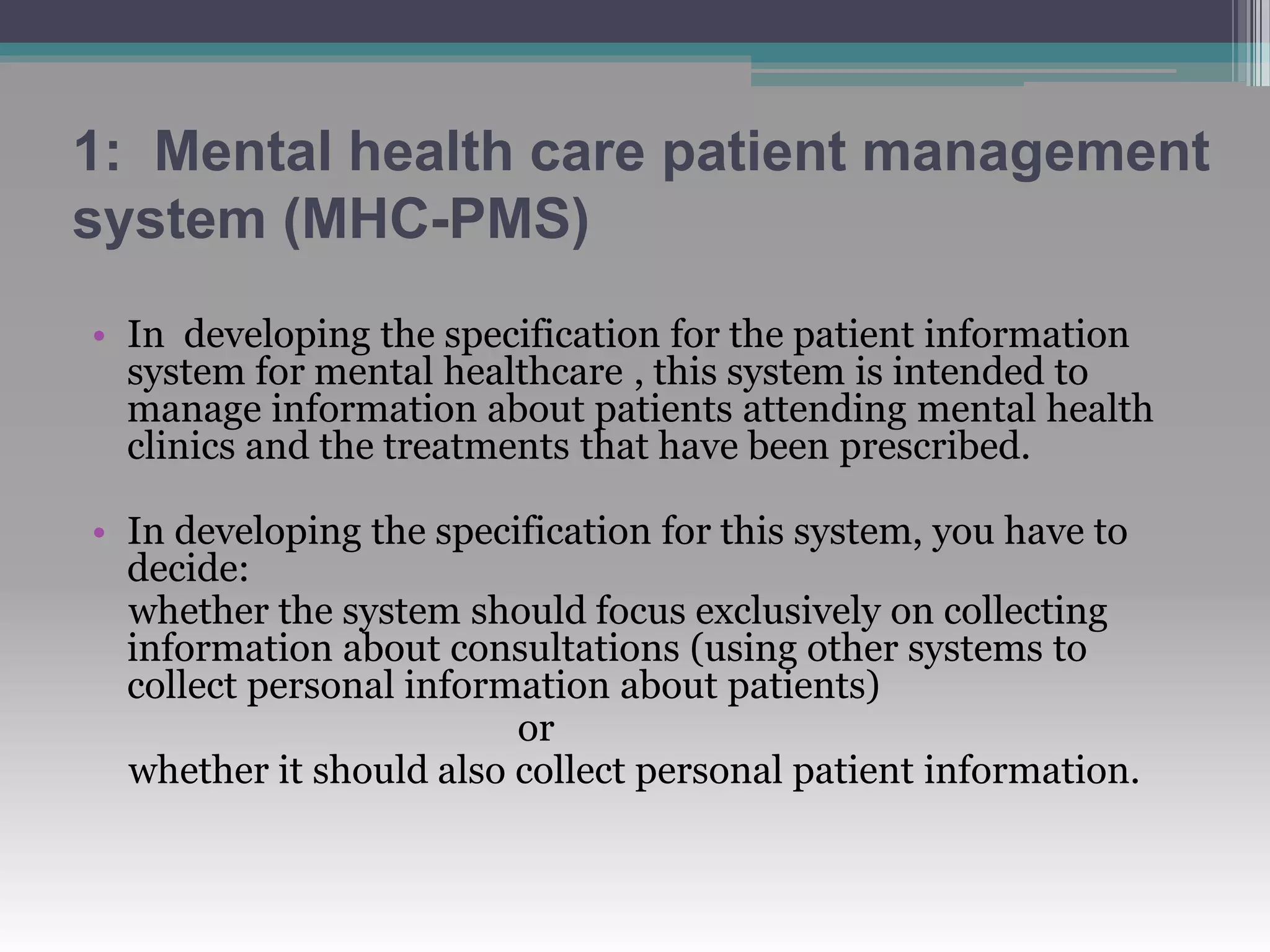
1: Mental healthcare patient management
system (MHC-PMS)
• In developing the specification for the patient information
system for mental healthcare , this system is intended to
manage information about patients attending mental health
clinics and the treatments that have been prescribed.
• In developing the specification for this system, you have to
decide:
whether the system should focus exclusively on collecting
information about consultations (using other systems to
collect personal information about patients)
or
whether it should also collect personal patient information.
11.
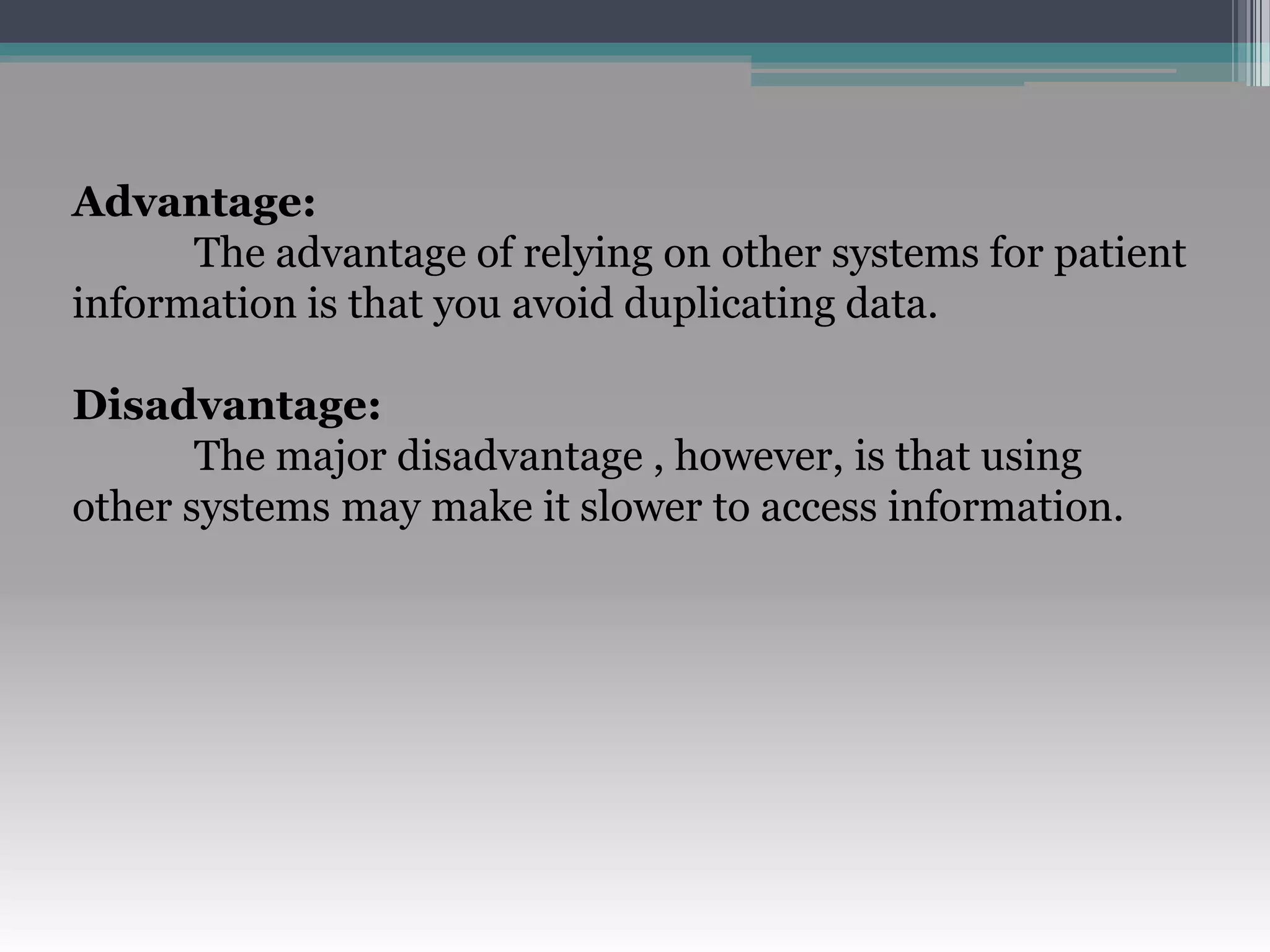
Advantage:
The advantage ofrelying on other systems for patient
information is that you avoid duplicating data.
Disadvantage:
The major disadvantage , however, is that using
other systems may make it slower to access information.
12.
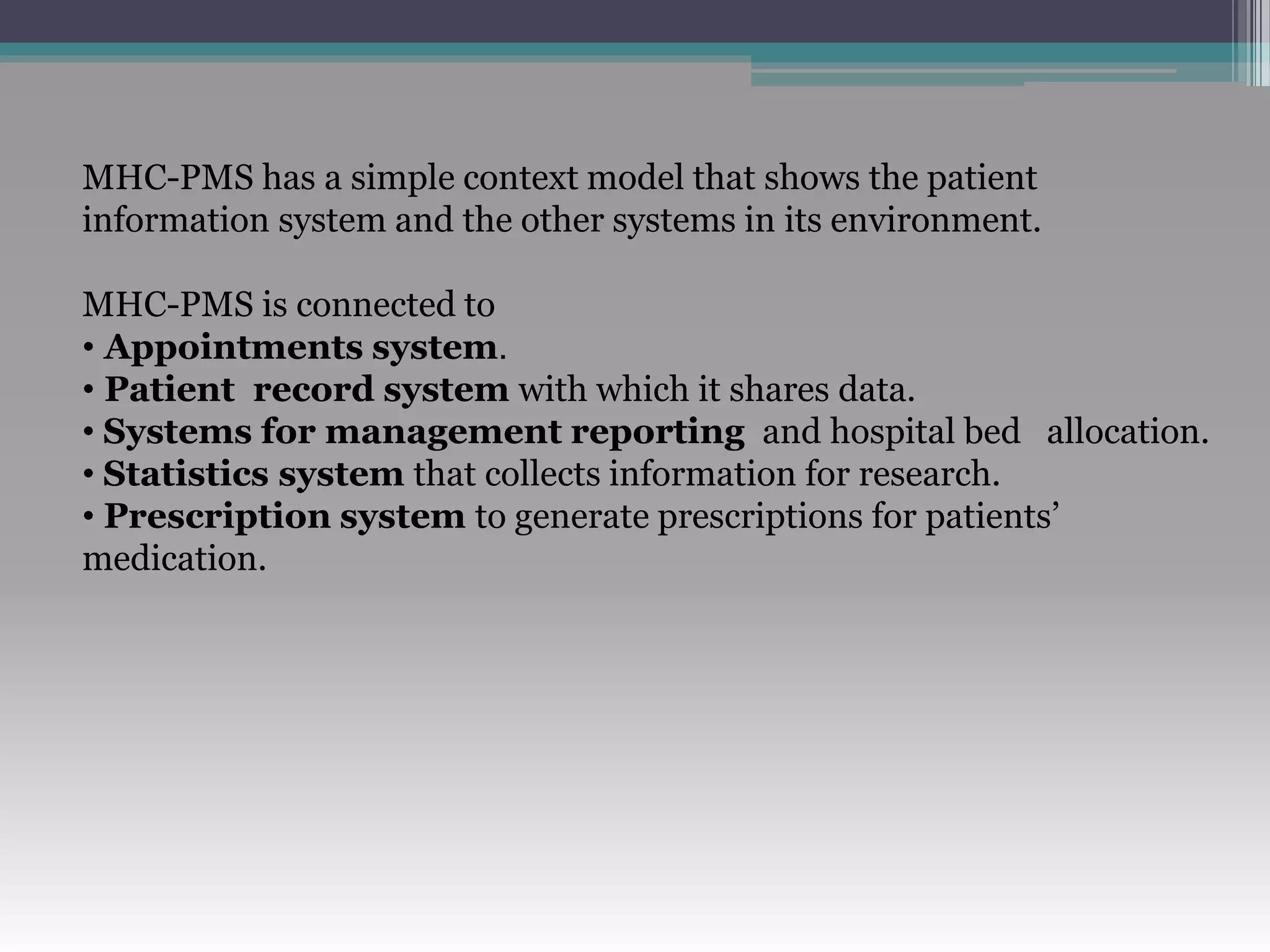
MHC-PMS has asimple context model that shows the patient
information system and the other systems in its environment.
MHC-PMS is connected to
• Appointments system.
• Patient record system with which it shares data.
• Systems for management reporting and hospital bed allocation.
• Statistics system that collects information for research.
• Prescription system to generate prescriptions for patients’
medication.
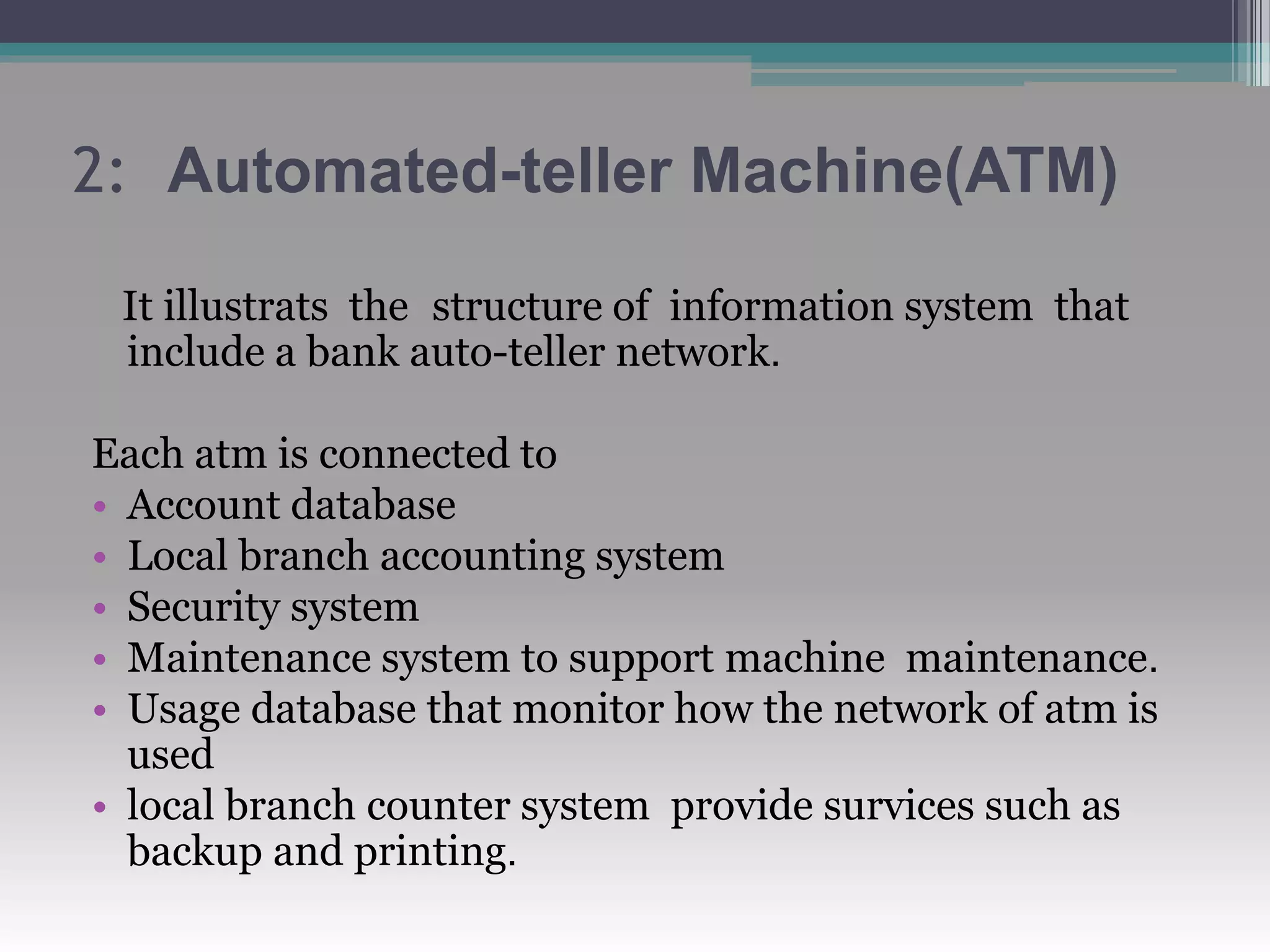
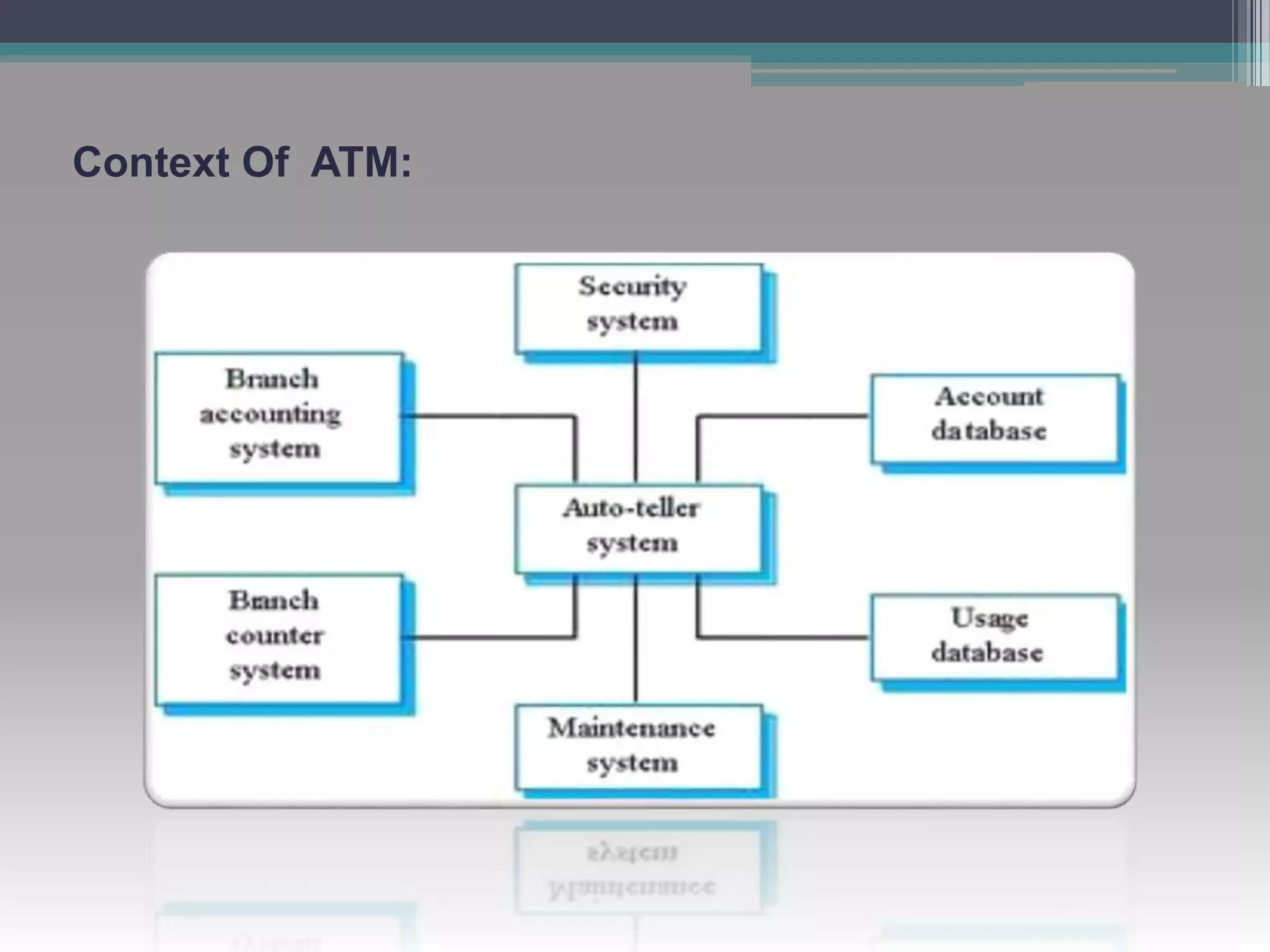
2: Automated-teller Machine(ATM)
Itillustrats the structure of information system that
include a bank auto-teller network.
Each atm is connected to
• Account database
• Local branch accounting system
• Security system
• Maintenance system to support machine maintenance.
• Usage database that monitor how the network of atm is
used
• local branch counter system provide survices such as
backup and printing.
Context models normallyshow that the environment
includes several other automated systems.
However, they do not show the types of relationships
between the systems in the environment and the system
that is being specified.
Therefore, simple context models are used along with other
models, such as business process models. These describe
human and automated processes in which particular
software systems are used.





![RE-1.pdf1 5000H JNC ] M ADD ii] Н PUSH VV](https://cdn.slidesharecdn.com/ss_thumbnails/re-1-250921172131-6ba9aea4-thumbnail.jpg?width=640&height=640&fit=bounds)


