

Software Project Management


                                   By
                              BUSHRA WARIS
INTRODUCTION
 Software economics is situated at intersection of
  information economics and software design and
  engineering.
 The goal is to understand the relationships between
  economic objectives, constraints, and conditions and
  technical software issues.
 Then use this understanding to improve software
  productivity.
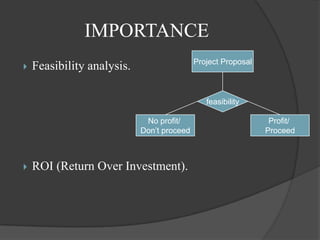
IMPORTANCE
                                            Project Proposal
   Feasibility analysis.

                                               feasibility

                             No profit/                         Profit/
                            Don’t proceed                      Proceed


   ROI (Return Over Investment).
5 BASIC FACTORS
   Size
   Process
   Personnel
   Environment
   Required Quality
 Size
 Usually measured in SLOC or number of Function
  Points required.
    SLOC(Source line of code)- a better metric later in project.

    software metric used to measure the amount of code in
       a software program
    Function Points– a better metric earlier in project.

    Objective and structured technique to measure software size by
       quantifying its functionality provided to the user, based on the
       requirements and logical design.
       Breaks the system into smaller components so they can be better
       understood and analyzed.


 Process
  Methods and techniques use to achieve goals i-e
  software product.
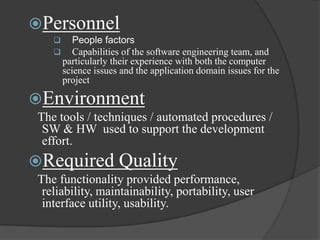
Personnel
          People factors
          Capabilities of the software engineering team, and
        particularly their experience with both the computer
        science issues and the application domain issues for the
        project

Environment
 The tools / techniques / automated procedures /
  SW & HW used to support the development
  effort.
Required Quality
 The functionality provided performance,
  reliability, maintainability, portability, user
  interface utility, usability.
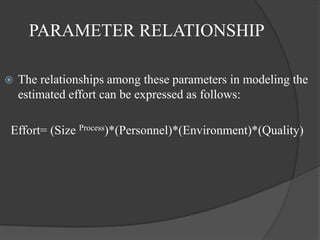
PARAMETER RELATIONSHIP

   The relationships among these parameters in modeling the
    estimated effort can be expressed as follows:

Effort= (Size Process)*(Personnel)*(Environment)*(Quality)
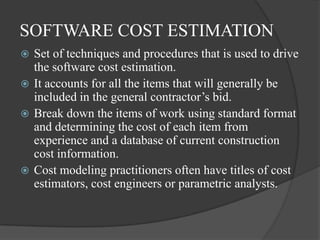
SOFTWARE COST ESTIMATION
 Set of techniques and procedures that is used to drive
  the software cost estimation.
 It accounts for all the items that will generally be
  included in the general contractor’s bid.
 Break down the items of work using standard format
  and determining the cost of each item from
  experience and a database of current construction
  cost information.
 Cost modeling practitioners often have titles of cost
  estimators, cost engineers or parametric analysts.
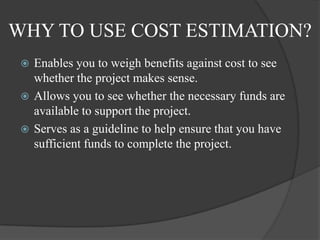
WHY TO USE COST ESTIMATION?
  Enables you to weigh benefits against cost to see
   whether the project makes sense.
  Allows you to see whether the necessary funds are
   available to support the project.
  Serves as a guideline to help ensure that you have
   sufficient funds to complete the project.
BENEFITS OF COST ESTIMATION
 Cost Estimate is a valuable tool for decision
  making.
 Provides a starting point from which to begin
  evaluation of a project.
 Allows comparisons to be made between
  investments or projects.
 Becomes easier to exclude bad projects from
 consideration.
ESTIMATION TECHNIQUES
   Algorithmic (Parametric) Model
   Expert Judgment (Expertise Based)
   Top-down
   Bottom-up
   Estimation by Analogy
   Pricing to win Estimation
THANKS

ANY QUESTIONS

Software project management Software economics

  • 1.
  • 2.
    INTRODUCTION  Software economicsis situated at intersection of information economics and software design and engineering.  The goal is to understand the relationships between economic objectives, constraints, and conditions and technical software issues.  Then use this understanding to improve software productivity.
  • 3.
    IMPORTANCE Project Proposal  Feasibility analysis. feasibility No profit/ Profit/ Don’t proceed Proceed  ROI (Return Over Investment).
  • 4.
    5 BASIC FACTORS  Size  Process  Personnel  Environment  Required Quality
  • 5.
     Size Usuallymeasured in SLOC or number of Function Points required.  SLOC(Source line of code)- a better metric later in project.  software metric used to measure the amount of code in a software program  Function Points– a better metric earlier in project.  Objective and structured technique to measure software size by quantifying its functionality provided to the user, based on the requirements and logical design.  Breaks the system into smaller components so they can be better understood and analyzed.  Process Methods and techniques use to achieve goals i-e software product.
  • 6.
    Personnel  People factors  Capabilities of the software engineering team, and particularly their experience with both the computer science issues and the application domain issues for the project Environment The tools / techniques / automated procedures / SW & HW used to support the development effort. Required Quality The functionality provided performance, reliability, maintainability, portability, user interface utility, usability.
  • 7.
    PARAMETER RELATIONSHIP  The relationships among these parameters in modeling the estimated effort can be expressed as follows: Effort= (Size Process)*(Personnel)*(Environment)*(Quality)
  • 8.
    SOFTWARE COST ESTIMATION Set of techniques and procedures that is used to drive the software cost estimation.  It accounts for all the items that will generally be included in the general contractor’s bid.  Break down the items of work using standard format and determining the cost of each item from experience and a database of current construction cost information.  Cost modeling practitioners often have titles of cost estimators, cost engineers or parametric analysts.
  • 9.
    WHY TO USECOST ESTIMATION?  Enables you to weigh benefits against cost to see whether the project makes sense.  Allows you to see whether the necessary funds are available to support the project.  Serves as a guideline to help ensure that you have sufficient funds to complete the project.
  • 10.
    BENEFITS OF COSTESTIMATION  Cost Estimate is a valuable tool for decision making.  Provides a starting point from which to begin evaluation of a project.  Allows comparisons to be made between investments or projects.  Becomes easier to exclude bad projects from consideration.
  • 11.
    ESTIMATION TECHNIQUES  Algorithmic (Parametric) Model  Expert Judgment (Expertise Based)  Top-down  Bottom-up  Estimation by Analogy  Pricing to win Estimation
  • 12.