Collecting Primary Data by Communication
Dr. Dhobale J V
Assistant Professor
IBS, IFHE, Hyderabad.
IBS Hyderabad 1
Business Research Methods (SHRM-431)
Chapter No.-06
Objectives
 The concept of structure as it relates to
questionnaires.
 Drawbacks of using high degrees of structure.
 Explain what is meant by disguise in a
questionnaire context.
 Differentiate among the main methods of
administering questionnaires.
 Discuss three important aspects used to
compare the four different methods of
administering questionnaires.
2IBS Hyderabad
Introduction
 Although observational research usually
results in more accurate data about individual
behavior, communication techniques must be
used to capture most other kinds of data from
individuals.
 We'll discuss the three key decisions that you'll
need to make when using communication:
1. The degree of structure to use.
2. Whether to disguise the questionnaire.
3. Which method to use.
3IBS Hyderabad
Structured versus Unstructured
Communication
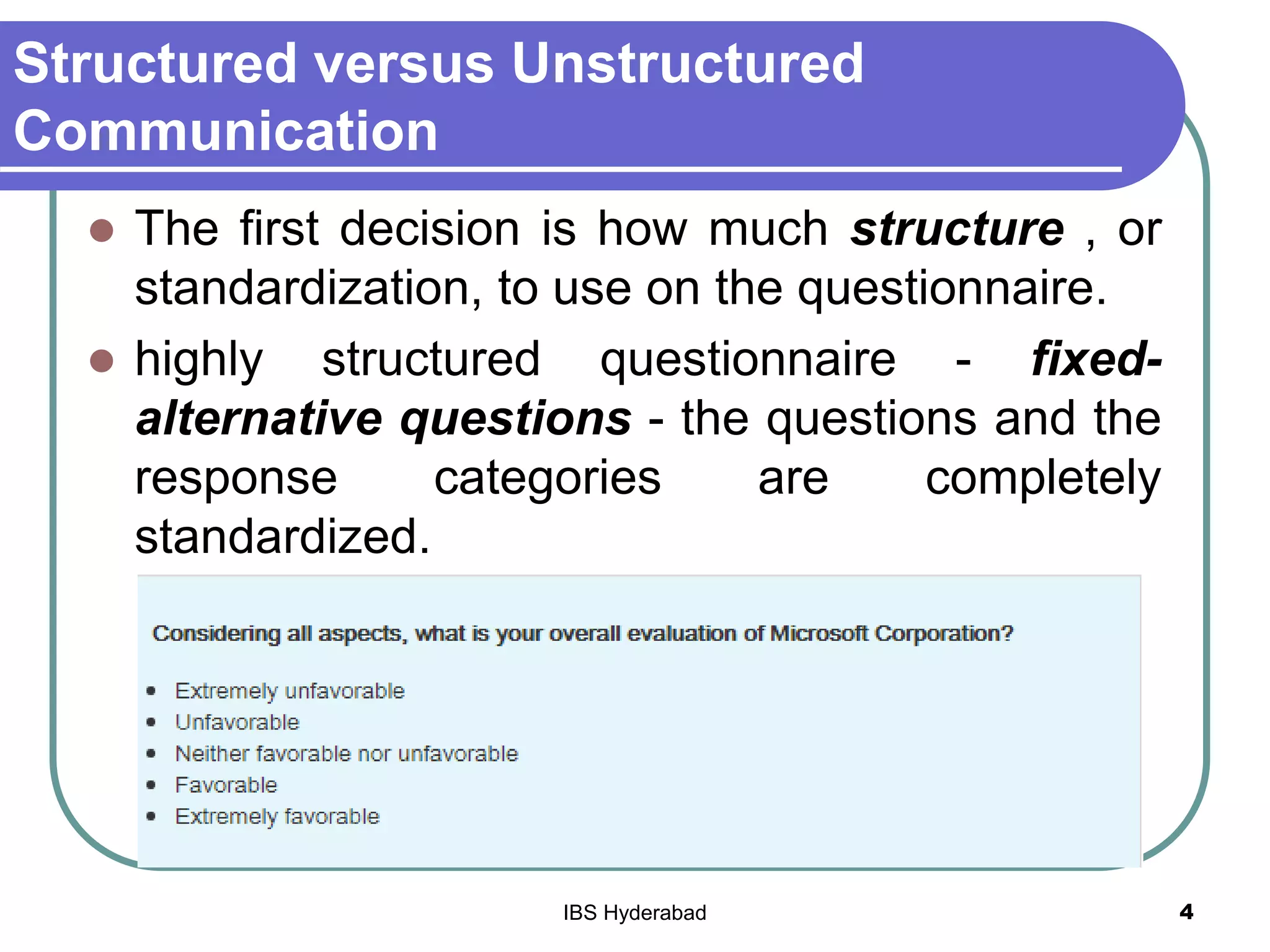
 The first decision is how much structure , or
standardization, to use on the questionnaire.
 highly structured questionnaire - fixed-
alternative questions - the questions and the
response categories are completely
standardized.
4IBS Hyderabad
Structured versus Unstructured
Communication
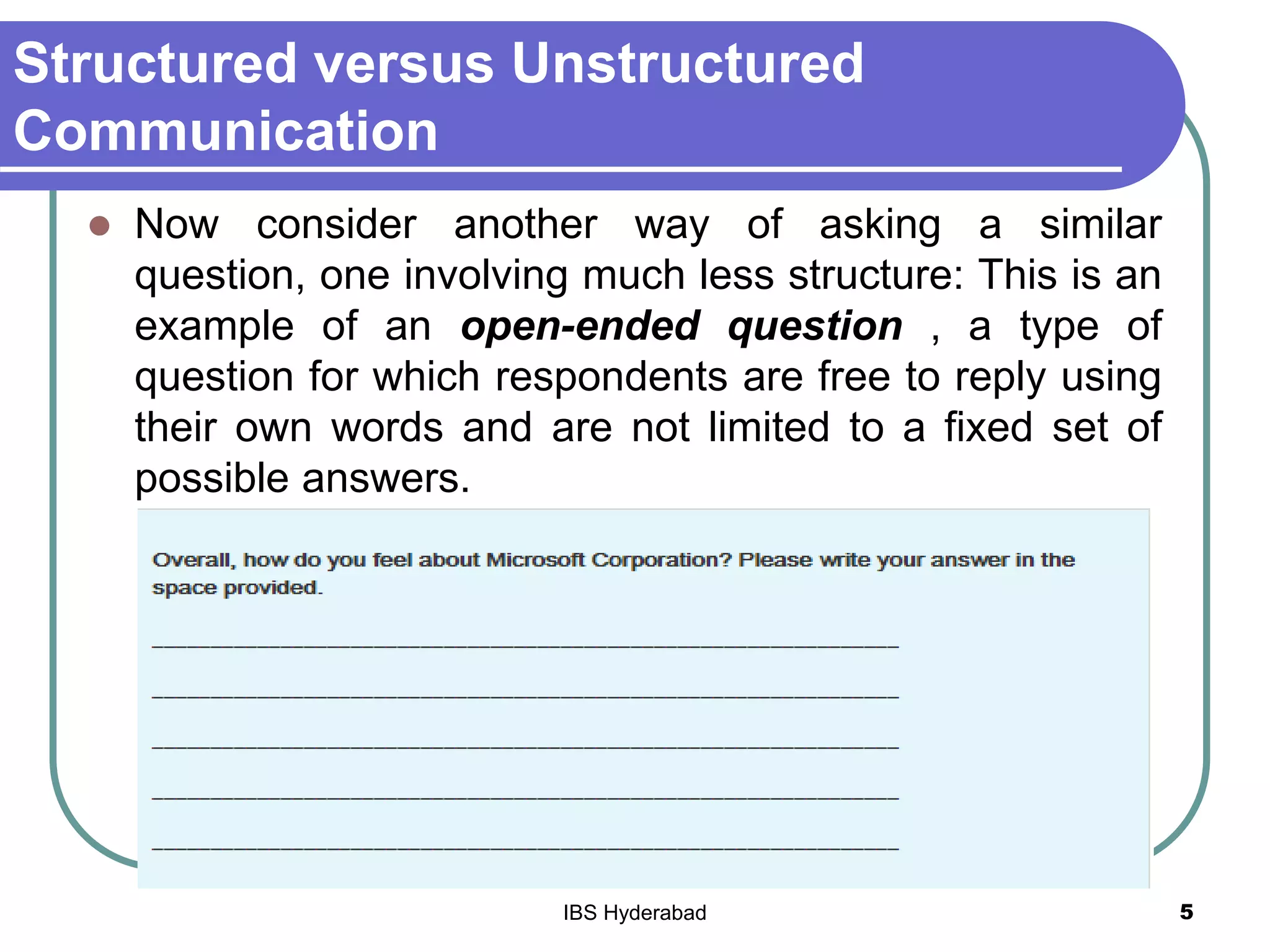
 Now consider another way of asking a similar
question, one involving much less structure: This is an
example of an open-ended question , a type of
question for which respondents are free to reply using
their own words and are not limited to a fixed set of
possible answers.
5IBS Hyderabad
Structured versus Unstructured
Communication
 Most open-ended questions used for collecting
primary data for descriptive research have a
standardized question that everyone receives.
 Highly structured questionnaires, like the first
question above, are relatively simple to
administer.
 Highly structured questions also help improve
the consistency of responses across different
people because standardized questions and
responses.
6IBS Hyderabad
Structured versus Unstructured
Communication
 There are certain disadvantages associated with high
degrees of structure –
 Fixed alternative questions tend to provide the most
reliable responses, they may also encourage
misleading answers.
 High structure is most useful when the possible replies
are well known, limited in number, and clear-cut.
 They work well for obtaining factual information &
obtaining expressions of opinion.
 They are not very good at getting primary data on
motivations.
7IBS Hyderabad
Disguised versus Undisguised
Communication
 The second consideration in the use of
communication to gather primary data
concerns disguise .
 Disguise - The amount of knowledge about the
purpose or sponsor of a study communicated
to the respondent. An undisguised
questionnaire, for example, is one in which the
purpose of the research is obvious.
8IBS Hyderabad
Disguised versus Undisguised
Communication
 An undisguised questionnaire makes the
purpose of the research obvious, either in the
introduction, the instructions, or the questions
themselves.
 There are two general situations in which the
use of disguise is often necessary –
1. When knowledge of the sponsor or topic of the
survey is likely to cause respondents to change
their answers.
2. Disguise is also used to help create a more
natural environment in which to collect data from
individuals.
9IBS Hyderabad
Disguised versus Undisguised
Communication
 The Ethics of Disguise -
 It seems a little strange to suggest that
deception can be used to get at the truth in a
situation.
 Research participants have a right to know
why they are being asked to provide answers.
 Debriefing - The process of providing
appropriate information to respondents after
data have been collected using disguise.
10IBS Hyderabad
Disguised versus Undisguised
Communication
 The Ethics of Disguise -
 It seems a little strange to suggest that
deception can be used to get at the truth in a
situation.
 Research participants have a right to know
why they are being asked to provide answers.
 Debriefing - The process of providing
appropriate information to respondents after
data have been collected using disguise.
11IBS Hyderabad
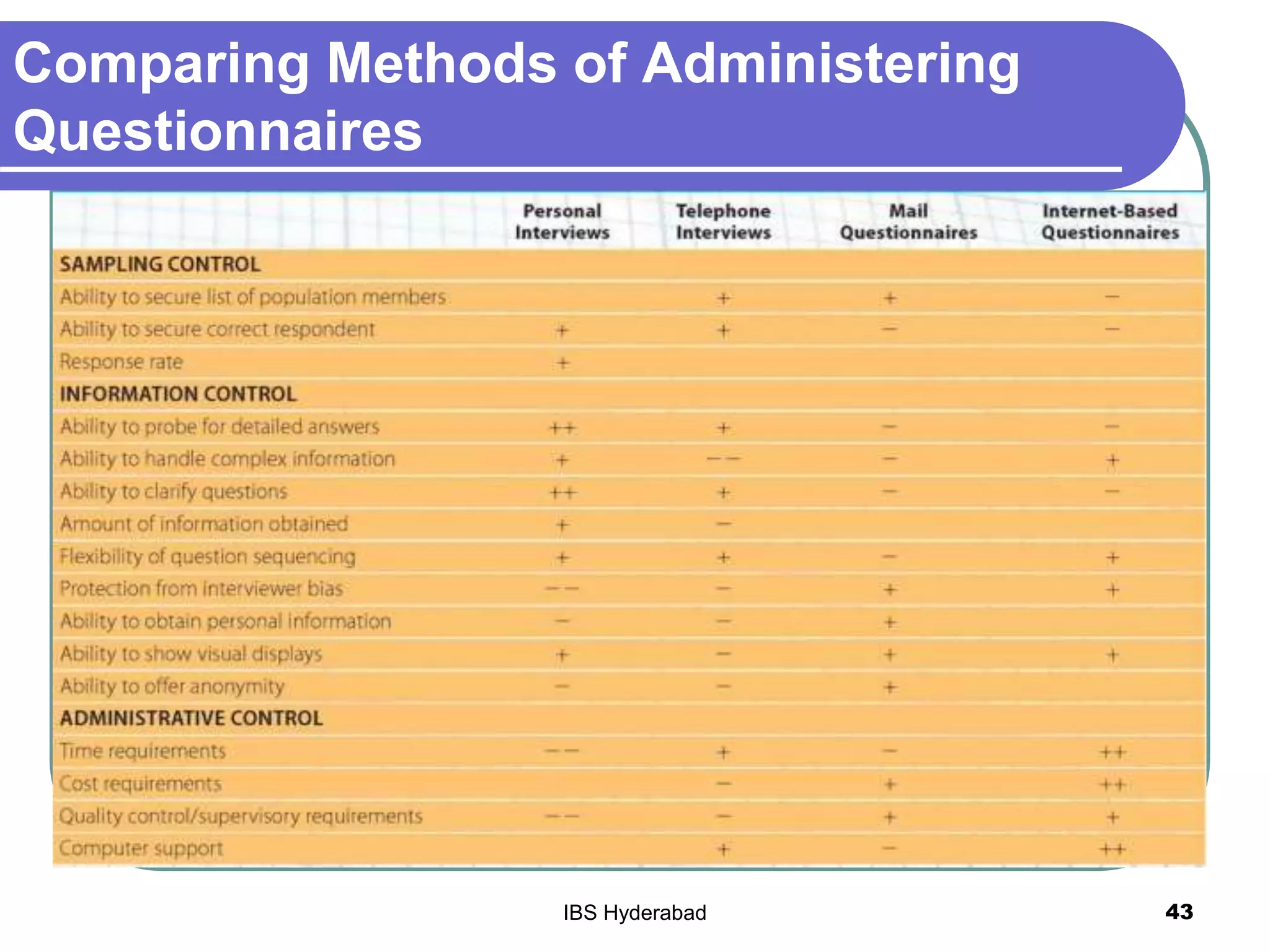
Methods of Administering Questionnaires
 General Methods are –
1. Personal interviews
2. Telephone interviews
3. Mail questionnaires
4. Internet-based questionnaires.
12IBS Hyderabad
Methods of Administering Questionnaires
 There are three key aspects to consider –
1. Sampling control - Response rate.
2. Information control - Questions & the degree
of error in the answers or their interpretation
3. administrative control - Time and monetary
costs of the different approaches.
13IBS Hyderabad
Methods of Administering Questionnaires
1. Personal interviews - A personal
interview involves a direct face-to-face
conversation between an interviewer and the
respondent.
 Time and place of personal interview
depends on the needs of the research and
the convenience of the respondents.
 Mall intercepts are popular for conducting
personal interviews among consumers.
14IBS Hyderabad
Methods of Administering Questionnaires
1. Personal interviews –
 Computer Aided Personal Interview -
Computerized personal interviewing or
computer-assisted personal interviewing
(CAPI) involves either the interviewer or the
respondent recording the answers at a
computer terminal.
 Sampling Control - whom to contact in a
study; Response rates are also higher.
15IBS Hyderabad
Methods of Administering Questionnaires
1. Personal interviews –
 Information Control - Personal interviews
can be conducted using questionnaires with
any degree of structure.
 One can gather a lot of information in a
personal interview.
 This process is full of opportunities for
researcher bias & bias from the respondent's
side.
 personal interviews must be undertaken with
great care, including substantial interviewer
training.
16IBS Hyderabad
Methods of Administering Questionnaires
1. Personal interviews –
 Administrative Control - Personal
interviews cost more to conduct than any
other communication method.
 Using personal interviews generally takes a
great deal of time.
17IBS Hyderabad
Methods of Administering Questionnaires
2. Telephone Interviews -
 A telephone interview is similar in some
ways to a personal interview, except that the
conversation between researcher and
respondent takes place over the telephone.
 Response rates have usually been quite
reasonable; Costs are much lower than with
personal interviews.
 As a result, telephone interviews have been a
popular means of securing communication
data for many years.
18IBS Hyderabad
Methods of Administering Questionnaires
2. Telephone Interviews -
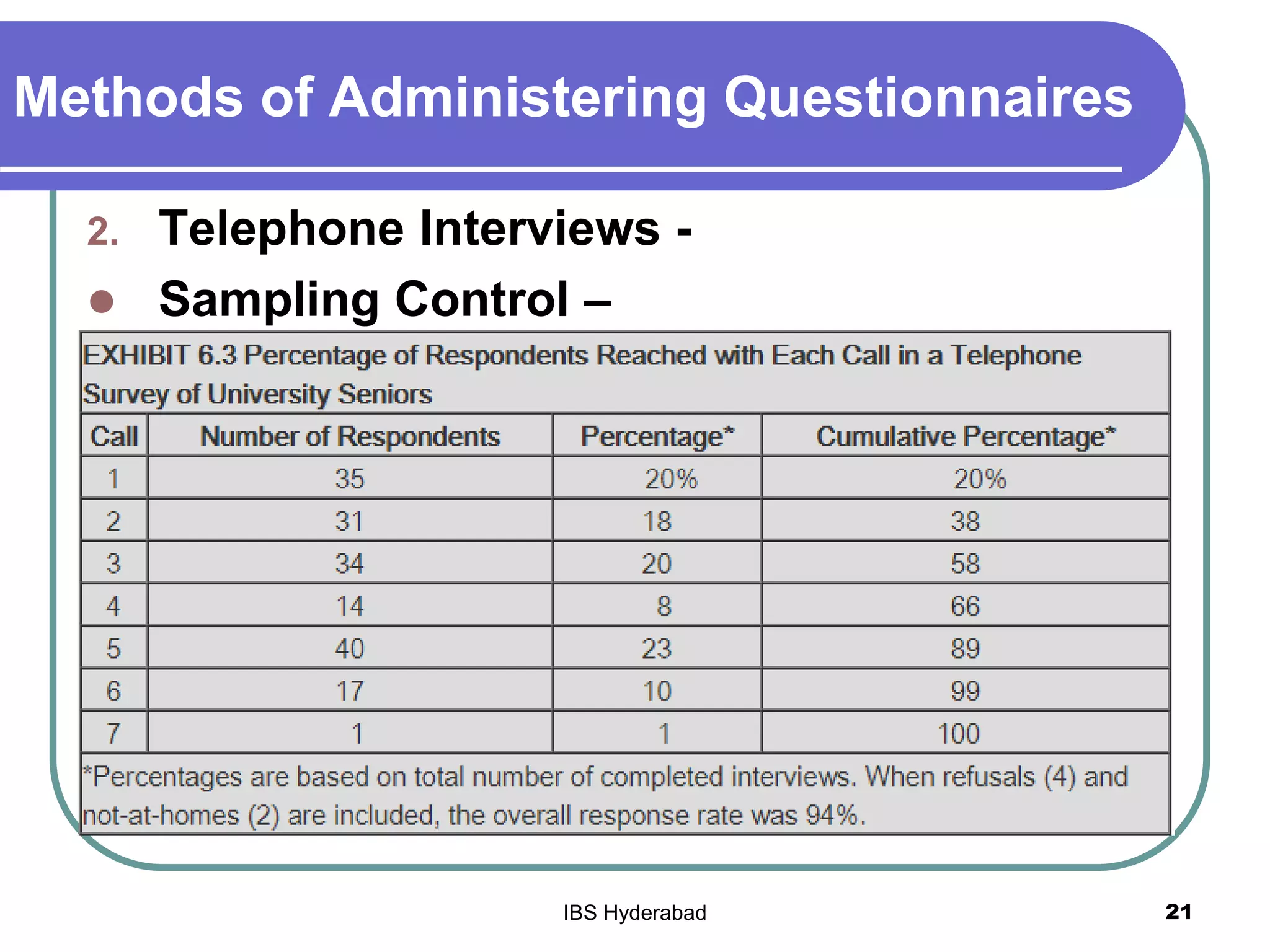
 Sampling Control - Several companies
generate and sell lists of consumer or
business telephone numbers from which to
draw a random sample.
 One or more telephone books might also
serve as a list of potential sampling elements
– drawbacks unlisted numbers, not up to
date.
19IBS Hyderabad
Methods of Administering Questionnaires
2. Telephone Interviews -
 Sampling Control –
 random-digit dialing (RDD) , which uses a
computer to randomly generate numbers to
be called. These systems usually
automatically dial the calls as well.
 Response rates that have traditionally been
fairly good have begun to suffer in recent
years, mostly as a result of caller ID and
answering machines used for screening calls.
20IBS Hyderabad
Methods of Administering Questionnaires
2. Telephone Interviews -
 Sampling Control –
21IBS Hyderabad
Methods of Administering Questionnaires
2. Telephone Interviews -
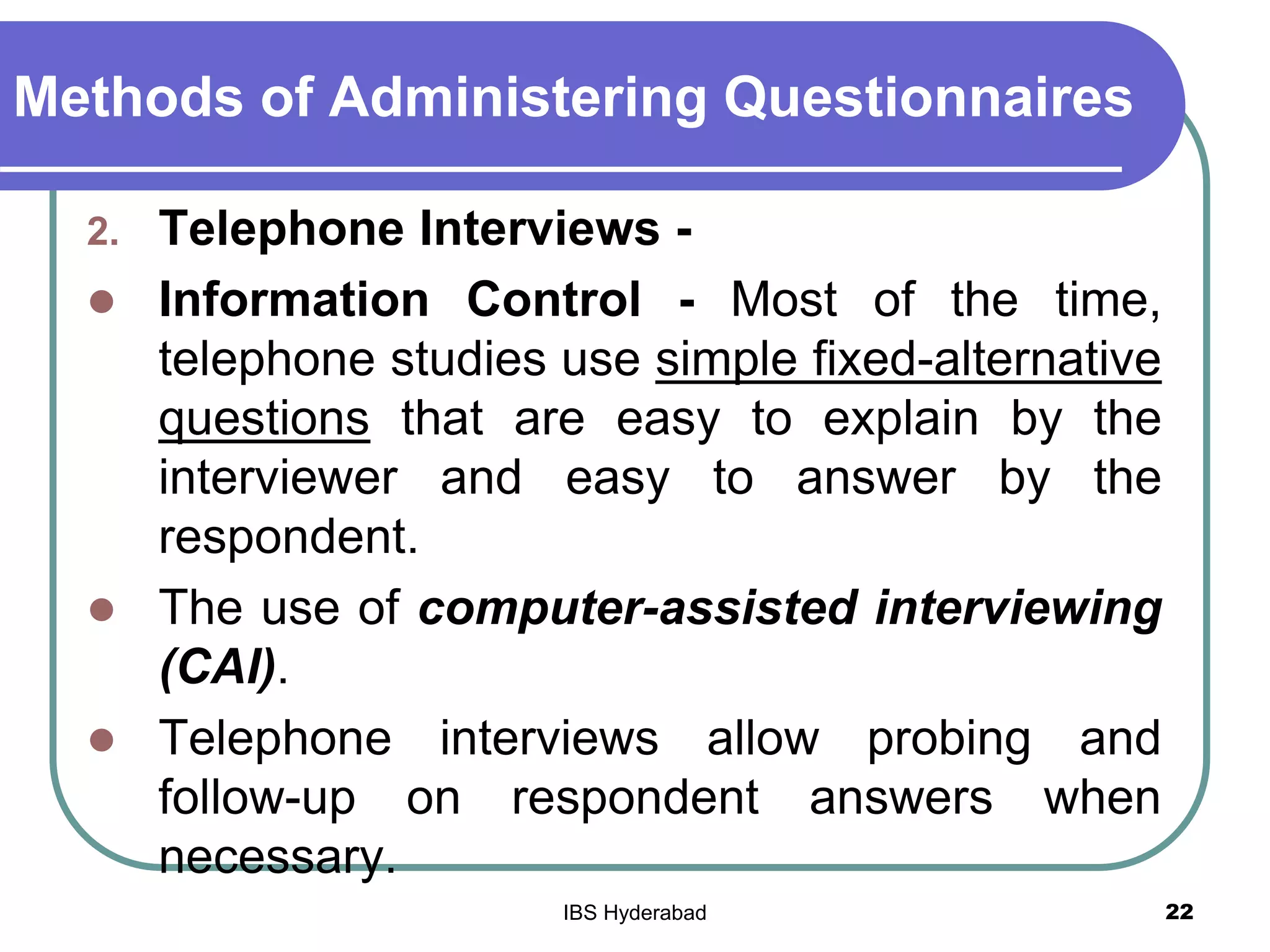
 Information Control - Most of the time,
telephone studies use simple fixed-alternative
questions that are easy to explain by the
interviewer and easy to answer by the
respondent.
 The use of computer-assisted interviewing
(CAI).
 Telephone interviews allow probing and
follow-up on respondent answers when
necessary.
22IBS Hyderabad
Methods of Administering Questionnaires
2. Telephone Interviews -
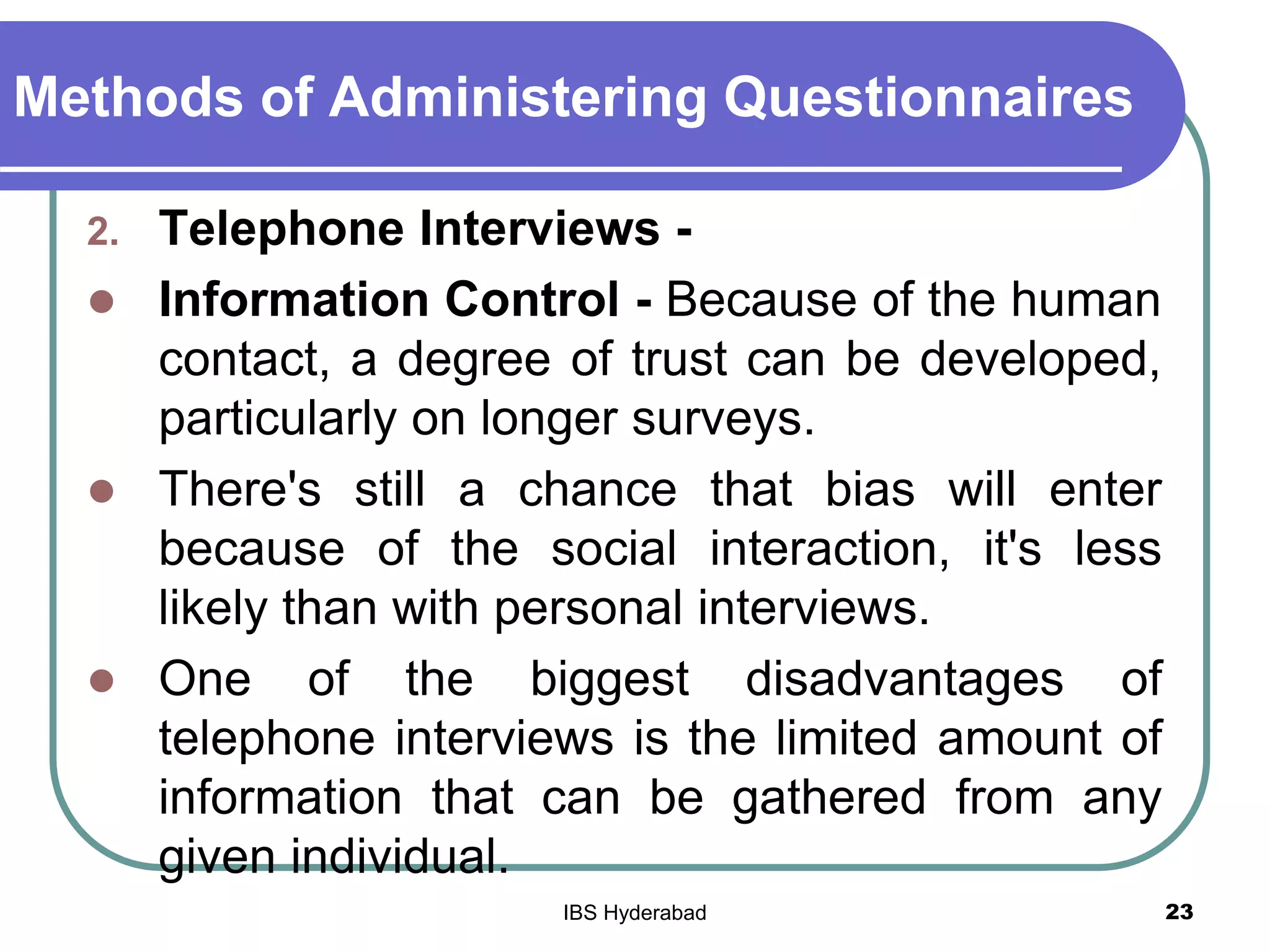
 Information Control - Because of the human
contact, a degree of trust can be developed,
particularly on longer surveys.
 There's still a chance that bias will enter
because of the social interaction, it's less
likely than with personal interviews.
 One of the biggest disadvantages of
telephone interviews is the limited amount of
information that can be gathered from any
given individual.
23IBS Hyderabad
Methods of Administering Questionnaires
2. Telephone Interviews -
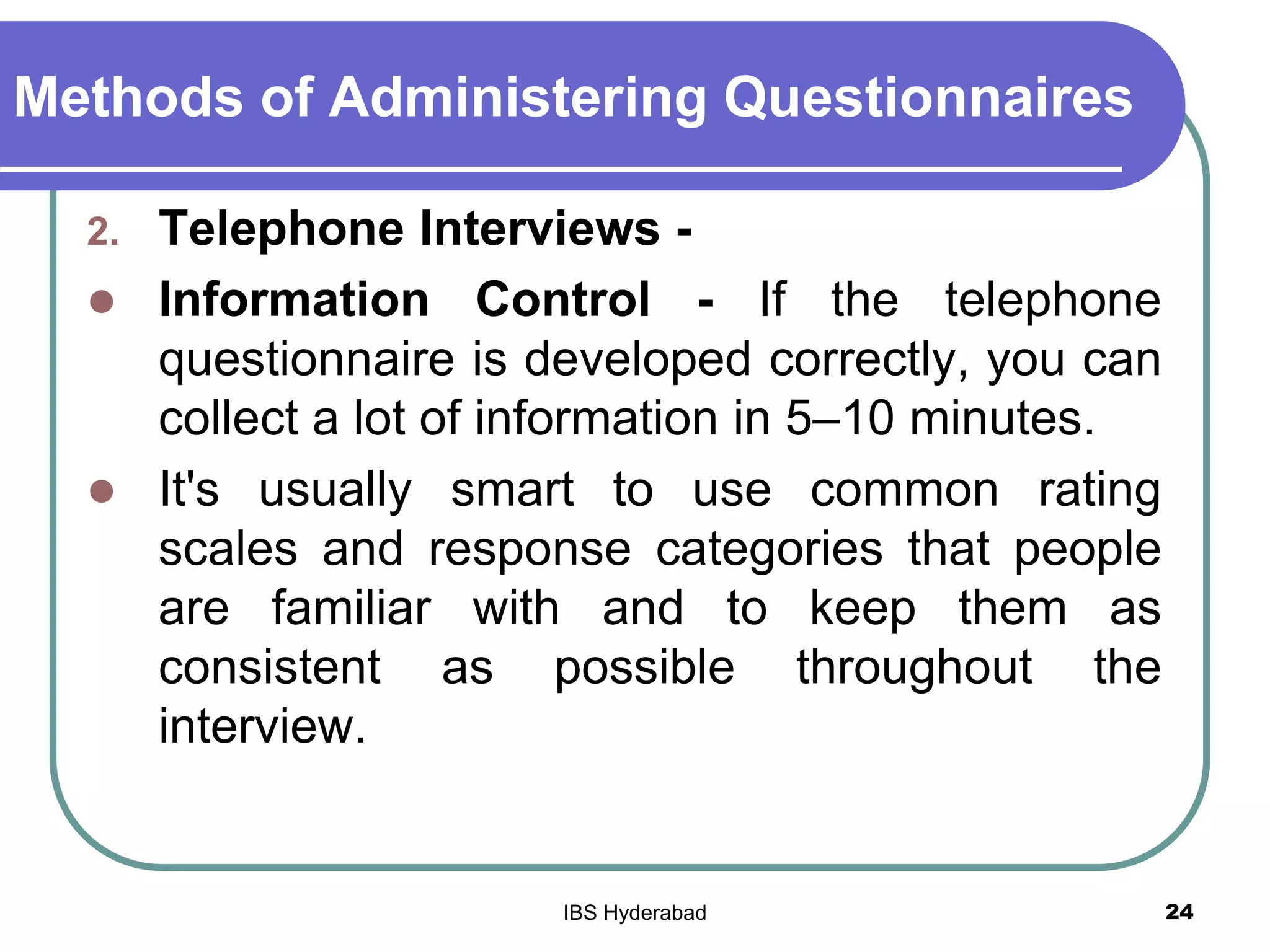
 Information Control - If the telephone
questionnaire is developed correctly, you can
collect a lot of information in 5–10 minutes.
 It's usually smart to use common rating
scales and response categories that people
are familiar with and to keep them as
consistent as possible throughout the
interview.
24IBS Hyderabad
Methods of Administering Questionnaires
2. Telephone Interviews -
 Administrative Control - Although it is usually
more costly to collect data using telephone interviews
compared with mail or Web-based questionnaires, the
solid response rates for this method have traditionally
kept the cost-per-contact reasonable.
 Interviewers must be recruited and trained, and as
with personal interviews, each interviewer can visit
with only one respondent at a time.
 Quality control can be assured by having supervisors
periodically listen in on interviews in progress.
25IBS Hyderabad
Methods of Administering Questionnaires
3. Mail Questionnaires - The mail
questionnaire approach involves surveys
sent to designated respondents with an
accompanying cover letter and reply
envelope.
 It has different forms also like surveys can be
e-mailed to respondents as well.
26IBS Hyderabad
Methods of Administering Questionnaires
3. Mail Questionnaires –
 Sampling Control
 If you want to be able to project the results of
the survey to the overall population, you'll have
to start with an accurate mailing list of the
people in the population.
27IBS Hyderabad
Methods of Administering Questionnaires
3. Mail Questionnaires –
 Sampling Control
 Mail questionnaires provide little control in
getting a response from the intended
respondent. You can carefully identify desired
respondents and offer them incentives, but
you can't control whether the respondents
actually complete and return the
questionnaires.
28IBS Hyderabad
Methods of Administering Questionnaires
3. Mail Questionnaires –
 Sampling Control
 There's no way to know that the intended
respondent really completed a returned
questionnaire, or if someone else may have
completed it.
29IBS Hyderabad
Methods of Administering Questionnaires
3. Mail Questionnaires –
 Information Control -
 With written questions, there is no opportunity
for interviewer bias from the wording of
questions or the way that the questions are
asked.
 It's also possible to include graphics, pictures,
or other artwork if respondents need to see a
stimulus in order to respond effectively.
30IBS Hyderabad
Methods of Administering Questionnaires
3. Mail Questionnaires –
 Information Control –
 Mail questionnaires is that they are the only
method that can be truly anonymous.
 Mail questionnaires do not allow clarification of
questions or response categories, and you
can't ask follow-up questions or clarify
answers.
 More work for respondents translates into
fewer questionnaires returned.
31IBS Hyderabad
Methods of Administering Questionnaires
3. Mail Questionnaires –
 Information Control –
 Respondents can review the entire
questionnaire before answering the questions.
This is a real problem if the researcher wants
to assess awareness for certain brands and
also ask specific questions about those brands
in the same survey.
32IBS Hyderabad
Methods of Administering Questionnaires
3. Mail Questionnaires –
 Administrative Control –
 Compared with hiring and training
interviewers, it doesn't cost a lot to print
surveys, buy a mailing list, and pay postage
(outbound and inbound), so mail surveys have
an advantage over personal interviews and
telephone questionnaires when it comes to
cost.
33IBS Hyderabad
Methods of Administering Questionnaires
3. Mail Questionnaires –
 Administrative Control –
 They take longer than telephone surveys (but
they're often faster than personal interviews)
because the surveys must go through the
postal system going and coming, and
respondents respond if and when they want to.
 Not everyone can be reached by e-mail.
34IBS Hyderabad
Methods of Administering Questionnaires
4. Internet-Based Questionnaires -
 A questionnaire that relies on the Internet for
recruitment and/or completion; two forms
include e-mail surveys and questionnaires
completed on the Web.
35IBS Hyderabad
Methods of Administering Questionnaires
4. Internet-Based Questionnaires -
 The cost of mail surveys coupled with the low
response rates and increased reliance on
electronic communications make online
surveys increasingly attractive - so attractive,
in fact, that more and more major research
firms are using Web-based surveys with
Internet panels as the primary point of access
to potential respondents.
36IBS Hyderabad
Methods of Administering Questionnaires
4. Internet-Based Questionnaires –
 Sampling Control -
 As with all techniques, the ability to obtain an
accurate list of population members’ contact
information is the first key aspect of sampling
control.
 You should note, however, that many e-mail
samples are developed by encouraging
individuals to join a panel in exchange for gifts
and/or other incentives.
37IBS Hyderabad
Methods of Administering Questionnaires
4. Internet-Based Questionnaires –
 Sampling Control -
 Sometimes Web-based studies produce very
respectable to excellent response rates.
Studies using purchased e-mail lists or online
panels, however, often have very low
response rates just like other communication
methods.
 The key is to do the necessary background
work to distinguish the good panel that is
managed properly from the one populated with
“professional” panelists. 38IBS Hyderabad
Methods of Administering Questionnaires
4. Internet-Based Questionnaires –
 Sampling Control -
 the good news is that established firms are
well aware of these issues and take panel
management quite seriously. The bad news is
there is no perfect approach.
 The response rate is a much better indicator of
the quality of the research effort and, in
particular.
39IBS Hyderabad
Methods of Administering Questionnaires
4. Internet-Based Questionnaires –
 Information Control
 Web-based questionnaires are very effective if
you need to include pictures and/or other
graphics with the questionnaire.
 you can collect a lot more information.
 There is essentially no interviewer bias in the
way questions are asked, and any type of
question can be used.
40IBS Hyderabad
Methods of Administering Questionnaires
4. Internet-Based Questionnaires –
 Information Control
 There is no ability to probe, explain questions,
or ask for respondents to explain their
answers.
 Question sequencing can be programmed into
the survey, ensuring that the appropriate next
question appears on the screen for the
respondent.
 The comfort level of respondents is likely
higher with Web-based questionnaires than
with any other approach except mail.
41IBS Hyderabad
Methods of Administering Questionnaires
4. Internet-Based Questionnaires –
 Administrative Control –
 They are quite inexpensive and they provide
very quick turnaround.
 Respondents effectively code their own
responses when they reply to the questions on
the survey. This eliminates one step where
error can enter into the data set.
42IBS Hyderabad
Comparing Methods of Administering
Questionnaires
43IBS Hyderabad
Review
 The concept of structure as it relates to
questionnaires.
 Drawbacks of using high degrees of structure.
 Explain what is meant by disguise in a
questionnaire context.
 Differentiate among the main methods of
administering questionnaires.
 Discuss three important aspects used to
compare the four different methods of
administering questionnaires.
44IBS Hyderabad
References
 MARKETING RESEARCH – A SOUTH ASIAN
PERSPECTIVE by Brown, Sutter , Adhikari,
Cengage Learning, India.
 Business Research Methods - Donald R
Cooper, Pamela S Schindler, J K Sharma,
MCGraw Hill Education
 Business Research Methods - Naval Bajpai,
Pearson Education, India.
45IBS Hyderabad
Thank You!
46IBS Hyderabad

Unit no 06_collecting primary data by communication

  • 1.
    Collecting Primary Databy Communication Dr. Dhobale J V Assistant Professor IBS, IFHE, Hyderabad. IBS Hyderabad 1 Business Research Methods (SHRM-431) Chapter No.-06
  • 2.
    Objectives  The conceptof structure as it relates to questionnaires.  Drawbacks of using high degrees of structure.  Explain what is meant by disguise in a questionnaire context.  Differentiate among the main methods of administering questionnaires.  Discuss three important aspects used to compare the four different methods of administering questionnaires. 2IBS Hyderabad
  • 3.
    Introduction  Although observationalresearch usually results in more accurate data about individual behavior, communication techniques must be used to capture most other kinds of data from individuals.  We'll discuss the three key decisions that you'll need to make when using communication: 1. The degree of structure to use. 2. Whether to disguise the questionnaire. 3. Which method to use. 3IBS Hyderabad
  • 4.
    Structured versus Unstructured Communication The first decision is how much structure , or standardization, to use on the questionnaire.  highly structured questionnaire - fixed- alternative questions - the questions and the response categories are completely standardized. 4IBS Hyderabad
  • 5.
    Structured versus Unstructured Communication Now consider another way of asking a similar question, one involving much less structure: This is an example of an open-ended question , a type of question for which respondents are free to reply using their own words and are not limited to a fixed set of possible answers. 5IBS Hyderabad
  • 6.
    Structured versus Unstructured Communication Most open-ended questions used for collecting primary data for descriptive research have a standardized question that everyone receives.  Highly structured questionnaires, like the first question above, are relatively simple to administer.  Highly structured questions also help improve the consistency of responses across different people because standardized questions and responses. 6IBS Hyderabad
  • 7.
    Structured versus Unstructured Communication There are certain disadvantages associated with high degrees of structure –  Fixed alternative questions tend to provide the most reliable responses, they may also encourage misleading answers.  High structure is most useful when the possible replies are well known, limited in number, and clear-cut.  They work well for obtaining factual information & obtaining expressions of opinion.  They are not very good at getting primary data on motivations. 7IBS Hyderabad
  • 8.
    Disguised versus Undisguised Communication The second consideration in the use of communication to gather primary data concerns disguise .  Disguise - The amount of knowledge about the purpose or sponsor of a study communicated to the respondent. An undisguised questionnaire, for example, is one in which the purpose of the research is obvious. 8IBS Hyderabad
  • 9.
    Disguised versus Undisguised Communication An undisguised questionnaire makes the purpose of the research obvious, either in the introduction, the instructions, or the questions themselves.  There are two general situations in which the use of disguise is often necessary – 1. When knowledge of the sponsor or topic of the survey is likely to cause respondents to change their answers. 2. Disguise is also used to help create a more natural environment in which to collect data from individuals. 9IBS Hyderabad
  • 10.
    Disguised versus Undisguised Communication The Ethics of Disguise -  It seems a little strange to suggest that deception can be used to get at the truth in a situation.  Research participants have a right to know why they are being asked to provide answers.  Debriefing - The process of providing appropriate information to respondents after data have been collected using disguise. 10IBS Hyderabad
  • 11.
    Disguised versus Undisguised Communication The Ethics of Disguise -  It seems a little strange to suggest that deception can be used to get at the truth in a situation.  Research participants have a right to know why they are being asked to provide answers.  Debriefing - The process of providing appropriate information to respondents after data have been collected using disguise. 11IBS Hyderabad
  • 12.
    Methods of AdministeringQuestionnaires  General Methods are – 1. Personal interviews 2. Telephone interviews 3. Mail questionnaires 4. Internet-based questionnaires. 12IBS Hyderabad
  • 13.
    Methods of AdministeringQuestionnaires  There are three key aspects to consider – 1. Sampling control - Response rate. 2. Information control - Questions & the degree of error in the answers or their interpretation 3. administrative control - Time and monetary costs of the different approaches. 13IBS Hyderabad
  • 14.
    Methods of AdministeringQuestionnaires 1. Personal interviews - A personal interview involves a direct face-to-face conversation between an interviewer and the respondent.  Time and place of personal interview depends on the needs of the research and the convenience of the respondents.  Mall intercepts are popular for conducting personal interviews among consumers. 14IBS Hyderabad
  • 15.
    Methods of AdministeringQuestionnaires 1. Personal interviews –  Computer Aided Personal Interview - Computerized personal interviewing or computer-assisted personal interviewing (CAPI) involves either the interviewer or the respondent recording the answers at a computer terminal.  Sampling Control - whom to contact in a study; Response rates are also higher. 15IBS Hyderabad
  • 16.
    Methods of AdministeringQuestionnaires 1. Personal interviews –  Information Control - Personal interviews can be conducted using questionnaires with any degree of structure.  One can gather a lot of information in a personal interview.  This process is full of opportunities for researcher bias & bias from the respondent's side.  personal interviews must be undertaken with great care, including substantial interviewer training. 16IBS Hyderabad
  • 17.
    Methods of AdministeringQuestionnaires 1. Personal interviews –  Administrative Control - Personal interviews cost more to conduct than any other communication method.  Using personal interviews generally takes a great deal of time. 17IBS Hyderabad
  • 18.
    Methods of AdministeringQuestionnaires 2. Telephone Interviews -  A telephone interview is similar in some ways to a personal interview, except that the conversation between researcher and respondent takes place over the telephone.  Response rates have usually been quite reasonable; Costs are much lower than with personal interviews.  As a result, telephone interviews have been a popular means of securing communication data for many years. 18IBS Hyderabad
  • 19.
    Methods of AdministeringQuestionnaires 2. Telephone Interviews -  Sampling Control - Several companies generate and sell lists of consumer or business telephone numbers from which to draw a random sample.  One or more telephone books might also serve as a list of potential sampling elements – drawbacks unlisted numbers, not up to date. 19IBS Hyderabad
  • 20.
    Methods of AdministeringQuestionnaires 2. Telephone Interviews -  Sampling Control –  random-digit dialing (RDD) , which uses a computer to randomly generate numbers to be called. These systems usually automatically dial the calls as well.  Response rates that have traditionally been fairly good have begun to suffer in recent years, mostly as a result of caller ID and answering machines used for screening calls. 20IBS Hyderabad
  • 21.
    Methods of AdministeringQuestionnaires 2. Telephone Interviews -  Sampling Control – 21IBS Hyderabad
  • 22.
    Methods of AdministeringQuestionnaires 2. Telephone Interviews -  Information Control - Most of the time, telephone studies use simple fixed-alternative questions that are easy to explain by the interviewer and easy to answer by the respondent.  The use of computer-assisted interviewing (CAI).  Telephone interviews allow probing and follow-up on respondent answers when necessary. 22IBS Hyderabad
  • 23.
    Methods of AdministeringQuestionnaires 2. Telephone Interviews -  Information Control - Because of the human contact, a degree of trust can be developed, particularly on longer surveys.  There's still a chance that bias will enter because of the social interaction, it's less likely than with personal interviews.  One of the biggest disadvantages of telephone interviews is the limited amount of information that can be gathered from any given individual. 23IBS Hyderabad
  • 24.
    Methods of AdministeringQuestionnaires 2. Telephone Interviews -  Information Control - If the telephone questionnaire is developed correctly, you can collect a lot of information in 5–10 minutes.  It's usually smart to use common rating scales and response categories that people are familiar with and to keep them as consistent as possible throughout the interview. 24IBS Hyderabad
  • 25.
    Methods of AdministeringQuestionnaires 2. Telephone Interviews -  Administrative Control - Although it is usually more costly to collect data using telephone interviews compared with mail or Web-based questionnaires, the solid response rates for this method have traditionally kept the cost-per-contact reasonable.  Interviewers must be recruited and trained, and as with personal interviews, each interviewer can visit with only one respondent at a time.  Quality control can be assured by having supervisors periodically listen in on interviews in progress. 25IBS Hyderabad
  • 26.
    Methods of AdministeringQuestionnaires 3. Mail Questionnaires - The mail questionnaire approach involves surveys sent to designated respondents with an accompanying cover letter and reply envelope.  It has different forms also like surveys can be e-mailed to respondents as well. 26IBS Hyderabad
  • 27.
    Methods of AdministeringQuestionnaires 3. Mail Questionnaires –  Sampling Control  If you want to be able to project the results of the survey to the overall population, you'll have to start with an accurate mailing list of the people in the population. 27IBS Hyderabad
  • 28.
    Methods of AdministeringQuestionnaires 3. Mail Questionnaires –  Sampling Control  Mail questionnaires provide little control in getting a response from the intended respondent. You can carefully identify desired respondents and offer them incentives, but you can't control whether the respondents actually complete and return the questionnaires. 28IBS Hyderabad
  • 29.
    Methods of AdministeringQuestionnaires 3. Mail Questionnaires –  Sampling Control  There's no way to know that the intended respondent really completed a returned questionnaire, or if someone else may have completed it. 29IBS Hyderabad
  • 30.
    Methods of AdministeringQuestionnaires 3. Mail Questionnaires –  Information Control -  With written questions, there is no opportunity for interviewer bias from the wording of questions or the way that the questions are asked.  It's also possible to include graphics, pictures, or other artwork if respondents need to see a stimulus in order to respond effectively. 30IBS Hyderabad
  • 31.
    Methods of AdministeringQuestionnaires 3. Mail Questionnaires –  Information Control –  Mail questionnaires is that they are the only method that can be truly anonymous.  Mail questionnaires do not allow clarification of questions or response categories, and you can't ask follow-up questions or clarify answers.  More work for respondents translates into fewer questionnaires returned. 31IBS Hyderabad
  • 32.
    Methods of AdministeringQuestionnaires 3. Mail Questionnaires –  Information Control –  Respondents can review the entire questionnaire before answering the questions. This is a real problem if the researcher wants to assess awareness for certain brands and also ask specific questions about those brands in the same survey. 32IBS Hyderabad
  • 33.
    Methods of AdministeringQuestionnaires 3. Mail Questionnaires –  Administrative Control –  Compared with hiring and training interviewers, it doesn't cost a lot to print surveys, buy a mailing list, and pay postage (outbound and inbound), so mail surveys have an advantage over personal interviews and telephone questionnaires when it comes to cost. 33IBS Hyderabad
  • 34.
    Methods of AdministeringQuestionnaires 3. Mail Questionnaires –  Administrative Control –  They take longer than telephone surveys (but they're often faster than personal interviews) because the surveys must go through the postal system going and coming, and respondents respond if and when they want to.  Not everyone can be reached by e-mail. 34IBS Hyderabad
  • 35.
    Methods of AdministeringQuestionnaires 4. Internet-Based Questionnaires -  A questionnaire that relies on the Internet for recruitment and/or completion; two forms include e-mail surveys and questionnaires completed on the Web. 35IBS Hyderabad
  • 36.
    Methods of AdministeringQuestionnaires 4. Internet-Based Questionnaires -  The cost of mail surveys coupled with the low response rates and increased reliance on electronic communications make online surveys increasingly attractive - so attractive, in fact, that more and more major research firms are using Web-based surveys with Internet panels as the primary point of access to potential respondents. 36IBS Hyderabad
  • 37.
    Methods of AdministeringQuestionnaires 4. Internet-Based Questionnaires –  Sampling Control -  As with all techniques, the ability to obtain an accurate list of population members’ contact information is the first key aspect of sampling control.  You should note, however, that many e-mail samples are developed by encouraging individuals to join a panel in exchange for gifts and/or other incentives. 37IBS Hyderabad
  • 38.
    Methods of AdministeringQuestionnaires 4. Internet-Based Questionnaires –  Sampling Control -  Sometimes Web-based studies produce very respectable to excellent response rates. Studies using purchased e-mail lists or online panels, however, often have very low response rates just like other communication methods.  The key is to do the necessary background work to distinguish the good panel that is managed properly from the one populated with “professional” panelists. 38IBS Hyderabad
  • 39.
    Methods of AdministeringQuestionnaires 4. Internet-Based Questionnaires –  Sampling Control -  the good news is that established firms are well aware of these issues and take panel management quite seriously. The bad news is there is no perfect approach.  The response rate is a much better indicator of the quality of the research effort and, in particular. 39IBS Hyderabad
  • 40.
    Methods of AdministeringQuestionnaires 4. Internet-Based Questionnaires –  Information Control  Web-based questionnaires are very effective if you need to include pictures and/or other graphics with the questionnaire.  you can collect a lot more information.  There is essentially no interviewer bias in the way questions are asked, and any type of question can be used. 40IBS Hyderabad
  • 41.
    Methods of AdministeringQuestionnaires 4. Internet-Based Questionnaires –  Information Control  There is no ability to probe, explain questions, or ask for respondents to explain their answers.  Question sequencing can be programmed into the survey, ensuring that the appropriate next question appears on the screen for the respondent.  The comfort level of respondents is likely higher with Web-based questionnaires than with any other approach except mail. 41IBS Hyderabad
  • 42.
    Methods of AdministeringQuestionnaires 4. Internet-Based Questionnaires –  Administrative Control –  They are quite inexpensive and they provide very quick turnaround.  Respondents effectively code their own responses when they reply to the questions on the survey. This eliminates one step where error can enter into the data set. 42IBS Hyderabad
  • 43.
    Comparing Methods ofAdministering Questionnaires 43IBS Hyderabad
  • 44.
    Review  The conceptof structure as it relates to questionnaires.  Drawbacks of using high degrees of structure.  Explain what is meant by disguise in a questionnaire context.  Differentiate among the main methods of administering questionnaires.  Discuss three important aspects used to compare the four different methods of administering questionnaires. 44IBS Hyderabad
  • 45.
    References  MARKETING RESEARCH– A SOUTH ASIAN PERSPECTIVE by Brown, Sutter , Adhikari, Cengage Learning, India.  Business Research Methods - Donald R Cooper, Pamela S Schindler, J K Sharma, MCGraw Hill Education  Business Research Methods - Naval Bajpai, Pearson Education, India. 45IBS Hyderabad
  • 46.