Developing Sampling Plan
Dr. Dhobale J V
Assistant Professor
IBS, IFHE, Hyderabad.
IBS Hyderabad 1
Business Research Methods (SHRM-431)
Chapter No.-09
Objectives
 Defining the Target Population .
 Identifying the Sampling Frame.
 Selecting a Sampling Procedure.
 Determining How Big a Sample You Need.
2IBS Hyderabad
Introduction
 Once you've specified the problem, developed
an appropriate research design, and carefully
crafted your data collection instrument, it's
time to think about the people from which you'll
collect data.
 As we'll see, the ability to make inferences
about the overall population from a sample of
population members depends on how we
select the sample.
3IBS Hyderabad
Introduction
 Sample - Selection of a subset of elements
from a larger group of objects.
 Census - A type of sampling plan in which
data are collected from or about each member
of a population.
4IBS Hyderabad
Introduction
5IBS Hyderabad
• Six-Step Procedure for Drawing a Sample
Defining the Target Population
 We typically work with a sample, rather than a
census, because a sample is often easier and
less costly to obtain than a census.
 Parameter - A characteristic or measure of a
population.
 We could describe this population on a
number of parameters, including average age,
proportion with a college degree, range of
incomes, attitude toward a new service
offering, so on.
6IBS Hyderabad
Defining the Target Population
 When we work with a sample drawn from a
population, we are attempting to describe the
population parameters based on the measures
we take from the sample members.
 Statistic - A characteristic or measure of a
sample.
 When we work with a sample instead of a
census, it is likely that our results will be at
least a little different than they would have
been had we gathered information from every
member of the population. This difference is
known as sampling error. 7IBS Hyderabad
Defining the Target Population
 Sampling error is something that you'll want to
take into account, but unless you're working
with a really small sample, it's probably not as
much a problem as are other kinds of errors.
8IBS Hyderabad
Identifying the Sampling Frame
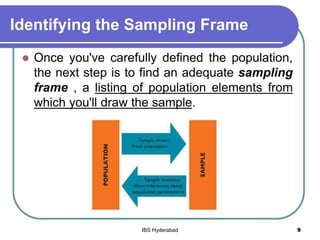
 Once you've carefully defined the population,
the next step is to find an adequate sampling
frame , a listing of population elements from
which you'll draw the sample.
9IBS Hyderabad
Identifying the Sampling Frame
 Unfortunately, perfect sampling frames usually
don't exist except in unusual circumstances.
That makes developing an acceptable
sampling frame one of your most important
and creative tasks.
10IBS Hyderabad
Selecting a Sampling Procedure
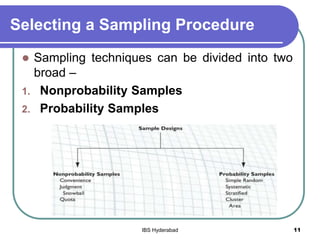
 Sampling techniques can be divided into two
broad –
1. Nonprobability Samples
2. Probability Samples
11IBS Hyderabad
Selecting a Sampling Procedure
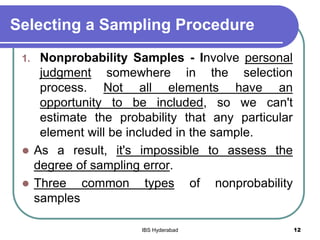
1. Nonprobability Samples - Involve personal
judgment somewhere in the selection
process. Not all elements have an
opportunity to be included, so we can't
estimate the probability that any particular
element will be included in the sample.
 As a result, it's impossible to assess the
degree of sampling error.
 Three common types of nonprobability
samples
12IBS Hyderabad
Selecting a Sampling Procedure
1. Nonprobability Samples –
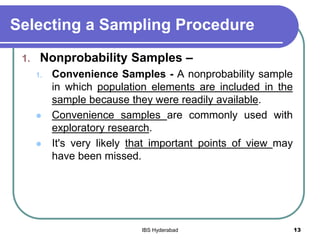
1. Convenience Samples - A nonprobability sample
in which population elements are included in the
sample because they were readily available.
 Convenience samples are commonly used with
exploratory research.
 It's very likely that important points of view may
have been missed.
13IBS Hyderabad
Selecting a Sampling Procedure
1. Nonprobability Samples –
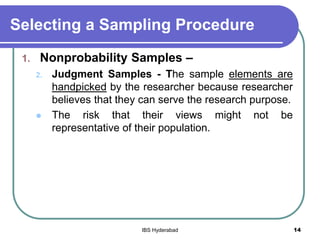
2. Judgment Samples - The sample elements are
handpicked by the researcher because researcher
believes that they can serve the research purpose.
 The risk that their views might not be
representative of their population.
14IBS Hyderabad
Selecting a Sampling Procedure
1. Nonprobability Samples –
2. Judgment Samples –
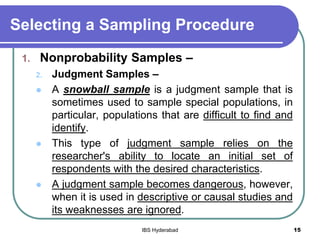
 A snowball sample is a judgment sample that is
sometimes used to sample special populations, in
particular, populations that are difficult to find and
identify.
 This type of judgment sample relies on the
researcher's ability to locate an initial set of
respondents with the desired characteristics.
 A judgment sample becomes dangerous, however,
when it is used in descriptive or causal studies and
its weaknesses are ignored.
15IBS Hyderabad
Selecting a Sampling Procedure
1. Nonprobability Samples –
2. Quota Samples – Researchers sometimes use
a quota sample that mirrors the population in one
or more important aspects.
 The goal would be to build a sample that looks like
the larger population.
 Many online panels in use today are essentially
large quota samples.
 These panels are widely used in both consumer
and business research and often contain millions
of panel members.
16IBS Hyderabad
Selecting a Sampling Procedure
1. Nonprobability Samples –
2. Quota Samples –
 The specific sample elements to be used in a
quota sample are left to the discretion of the
researcher.
 That's what makes a quota sample a
nonprobability sampling plan.
 Even though the resulting sample looks like the
overall population in key aspects, it may not
accurately reflect other aspects of the population.
17IBS Hyderabad
Selecting a Sampling Procedure
2. Probability Samples – In a probability
sample , each member of the target
population has a known, nonzero chance of
being included in the sample.
 The chances of each member of the target
population being included in the sample may
not be equal, but everyone has some chance
of being included.
18IBS Hyderabad
Selecting a Sampling Procedure
2. Probability Samples –
 There is a random component in how
population elements are selected for the
sample to ensure that they are selected
objectively and not according to the whims of
the researcher or fieldworker.
 Because of which, researcher can make
inferences to the larger population based on
the results from the sample and estimate the
likely amount of sampling error.
19IBS Hyderabad
Selecting a Sampling Procedure
2. Probability Samples –
 Probability samples depend on the sampling
distribution of the particular statistic being
considered for the ability to draw inferences
about the larger population.
 That is, we'll be able to project the range within
which the population parameter is likely to fall
in the population based on the sample
statistic. (This range is known as
the confidence interval)
20IBS Hyderabad
Selecting a Sampling Procedure
2. Probability Samples –
1. Simple Random Samples - In a simple random
sample, each unit included in the sample has a
known and equal chance of being selected for
study, and every combination of population
elements is a sample possibility.
 Drawing a simple random sample depends mainly
on having a good sampling frame. For some
populations, this isn't a problem—a list of
population members is readily available.
 A digital version of the sampling frame is a real
advantage.
21IBS Hyderabad
Selecting a Sampling Procedure
2. Probability Samples –
2. Systematic Samples - A probability sampling
plan in which every kth element in the population
is selected for the sample pool after a random
start.
 Ex. Suppose you were asked to conduct
telephone interviews with 250 college students at
a particular school and from directory of 5,000
students.
 let's assume for a moment that we'll be able to
interview all 250 college students who are
selected for the sample. We'll end up interviewing
one out of every 20 students on campus
(5,000/250 = 20). 22IBS Hyderabad
Selecting a Sampling Procedure
2. Probability Samples –
2. Systematic Samples –
 So, you would randomly select one of the first 20
names n the student directory, then count down
20 names on the list and select that name, count
down 20 more names and select that name, and
so on, until you have gone through the entire
directory.
 The first element is randomly selected, and every
other element selected for the sample is a function
of the first element, which makes them all
randomly selected, in effect.
23IBS Hyderabad
Selecting a Sampling Procedure
2. Probability Samples –
2. Systematic Samples –
 Sampling interval - The number of population
elements to count (k) when selecting the sample
members in a systematic sample.
 5000/250 = 20
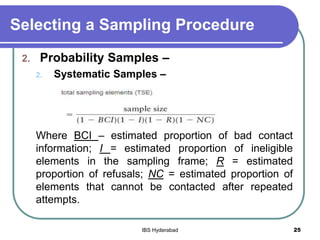
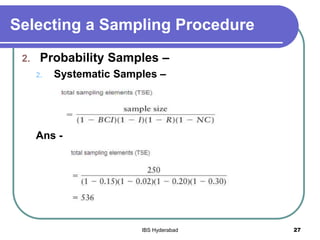
 Total sampling elements (TSE) - The number of
population elements that must be drawn from the
population and included in the initial sample pool
in order to end up with the desired sample size.
24IBS Hyderabad
Selecting a Sampling Procedure
2. Probability Samples –
2. Systematic Samples –
Where BCI – estimated proportion of bad contact
information; I = estimated proportion of ineligible
elements in the sampling frame; R = estimated
proportion of refusals; NC = estimated proportion of
elements that cannot be contacted after repeated
attempts.
25IBS Hyderabad
Selecting a Sampling Procedure
2. Probability Samples –
2. Systematic Samples –
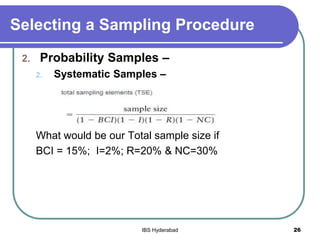
What would be our Total sample size if
BCI = 15%; I=2%; R=20% & NC=30%
26IBS Hyderabad
Selecting a Sampling Procedure
2. Probability Samples –
2. Systematic Samples –
Ans -
27IBS Hyderabad
Selecting a Sampling Procedure
2. Probability Samples –
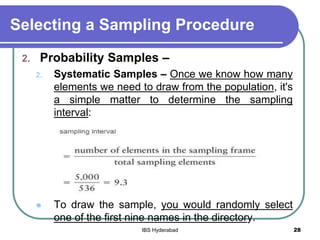
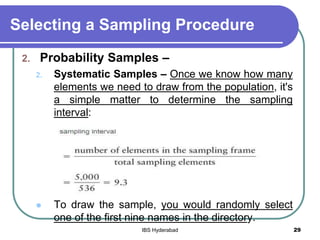
2. Systematic Samples – Once we know how many
elements we need to draw from the population, it's
a simple matter to determine the sampling
interval:
 To draw the sample, you would randomly select
one of the first nine names in the directory.
28IBS Hyderabad
Selecting a Sampling Procedure
2. Probability Samples –
2. Systematic Samples – Once we know how many
elements we need to draw from the population, it's
a simple matter to determine the sampling
interval:
 To draw the sample, you would randomly select
one of the first nine names in the directory.
29IBS Hyderabad
Selecting a Sampling Procedure
2. Probability Samples –
3. Stratified Samples - A stratified sample is a
probability sample in which (1) the population is
divided into mutually exclusive and exhaustive
subgroups (i.e., each population element fits into
one—and only one—subgroup) and (2) samples
are chosen from each of the subgroups.
30IBS Hyderabad
Selecting a Sampling Procedure
2. Probability Samples –
3. Stratified Samples –
4. You'll have to be able to group population
elements that are likely to be similar to one
another on the parameter of interest into
subgroups.
 The subgroups should be homogeneous within the
groups. Once the subgroups have been formed,
samples are taken from each of them so that all
subgroups are represented in the final sample.
 Stratified sampling is one way of ensuring adequate
representation from each subgroup of interest.
31IBS Hyderabad
Selecting a Sampling Procedure
2. Probability Samples –
4. Cluster Samples – A probability sampling plan
in which (1) the parent population is divided into
mutually exclusive and exhaustive subsets, and
(2) a random sample of one or more subsets
(clusters) is selected.
 Area sample - A form of cluster sampling in which
areas (e.g., census tracts, blocks) serve as the
primary sampling units. Using maps, the population
is divided into mutually exclusive and exhaustive
areas, and a random sample of areas is selected.
32IBS Hyderabad
Determining How Big a Sample You
Need
1. Basic Considerations in Determining
Sample Size
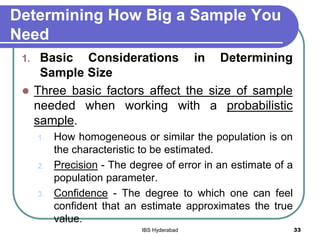
 Three basic factors affect the size of sample
needed when working with a probabilistic
sample.
1. How homogeneous or similar the population is on
the characteristic to be estimated.
2. Precision - The degree of error in an estimate of a
population parameter.
3. Confidence - The degree to which one can feel
confident that an estimate approximates the true
value.
33IBS Hyderabad
Determining How Big a Sample You
Need
1. Basic Considerations in Determining
Sample Size –
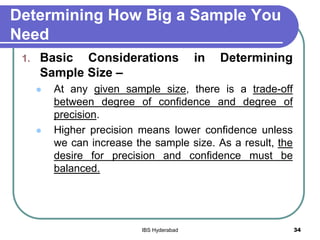
 At any given sample size, there is a trade-off
between degree of confidence and degree of
precision.
 Higher precision means lower confidence unless
we can increase the sample size. As a result, the
desire for precision and confidence must be
balanced.
34IBS Hyderabad
Determining How Big a Sample You
Need
2. Multiple Estimates in a Single Project –
 Sample size is calculated based on individual
items, you will usually end up with different sample
size requirements for many of the items when you
are measuring multiple characteristics in a study.
 The best approach is to focus on the variables that
are most critical and select a sample that is big
enough to estimate them with the required
precision and confidence.
35IBS Hyderabad
Reviews
 We have discussed –
 Defining the Target Population .
 Identifying the Sampling Frame.
 Selecting a Sampling Procedure.
 Determining How Big a Sample You Need.
36IBS Hyderabad
References
 MARKETING RESEARCH – A SOUTH ASIAN
PERSPECTIVE by Brown, Sutter , Adhikari,
Cengage Learning, India.
 Business Research Methods - Donald R
Cooper, Pamela S Schindler, J K Sharma,
MCGraw Hill Education
 Business Research Methods - Naval Bajpai,
Pearson Education, India.
37IBS Hyderabad
Thank You!
38IBS Hyderabad

Unit no 09_developing sampling plan

  • 1.
    Developing Sampling Plan Dr.Dhobale J V Assistant Professor IBS, IFHE, Hyderabad. IBS Hyderabad 1 Business Research Methods (SHRM-431) Chapter No.-09
  • 2.
    Objectives  Defining theTarget Population .  Identifying the Sampling Frame.  Selecting a Sampling Procedure.  Determining How Big a Sample You Need. 2IBS Hyderabad
  • 3.
    Introduction  Once you'vespecified the problem, developed an appropriate research design, and carefully crafted your data collection instrument, it's time to think about the people from which you'll collect data.  As we'll see, the ability to make inferences about the overall population from a sample of population members depends on how we select the sample. 3IBS Hyderabad
  • 4.
    Introduction  Sample -Selection of a subset of elements from a larger group of objects.  Census - A type of sampling plan in which data are collected from or about each member of a population. 4IBS Hyderabad
  • 5.
    Introduction 5IBS Hyderabad • Six-StepProcedure for Drawing a Sample
  • 6.
    Defining the TargetPopulation  We typically work with a sample, rather than a census, because a sample is often easier and less costly to obtain than a census.  Parameter - A characteristic or measure of a population.  We could describe this population on a number of parameters, including average age, proportion with a college degree, range of incomes, attitude toward a new service offering, so on. 6IBS Hyderabad
  • 7.
    Defining the TargetPopulation  When we work with a sample drawn from a population, we are attempting to describe the population parameters based on the measures we take from the sample members.  Statistic - A characteristic or measure of a sample.  When we work with a sample instead of a census, it is likely that our results will be at least a little different than they would have been had we gathered information from every member of the population. This difference is known as sampling error. 7IBS Hyderabad
  • 8.
    Defining the TargetPopulation  Sampling error is something that you'll want to take into account, but unless you're working with a really small sample, it's probably not as much a problem as are other kinds of errors. 8IBS Hyderabad
  • 9.
    Identifying the SamplingFrame  Once you've carefully defined the population, the next step is to find an adequate sampling frame , a listing of population elements from which you'll draw the sample. 9IBS Hyderabad
  • 10.
    Identifying the SamplingFrame  Unfortunately, perfect sampling frames usually don't exist except in unusual circumstances. That makes developing an acceptable sampling frame one of your most important and creative tasks. 10IBS Hyderabad
  • 11.
    Selecting a SamplingProcedure  Sampling techniques can be divided into two broad – 1. Nonprobability Samples 2. Probability Samples 11IBS Hyderabad
  • 12.
    Selecting a SamplingProcedure 1. Nonprobability Samples - Involve personal judgment somewhere in the selection process. Not all elements have an opportunity to be included, so we can't estimate the probability that any particular element will be included in the sample.  As a result, it's impossible to assess the degree of sampling error.  Three common types of nonprobability samples 12IBS Hyderabad
  • 13.
    Selecting a SamplingProcedure 1. Nonprobability Samples – 1. Convenience Samples - A nonprobability sample in which population elements are included in the sample because they were readily available.  Convenience samples are commonly used with exploratory research.  It's very likely that important points of view may have been missed. 13IBS Hyderabad
  • 14.
    Selecting a SamplingProcedure 1. Nonprobability Samples – 2. Judgment Samples - The sample elements are handpicked by the researcher because researcher believes that they can serve the research purpose.  The risk that their views might not be representative of their population. 14IBS Hyderabad
  • 15.
    Selecting a SamplingProcedure 1. Nonprobability Samples – 2. Judgment Samples –  A snowball sample is a judgment sample that is sometimes used to sample special populations, in particular, populations that are difficult to find and identify.  This type of judgment sample relies on the researcher's ability to locate an initial set of respondents with the desired characteristics.  A judgment sample becomes dangerous, however, when it is used in descriptive or causal studies and its weaknesses are ignored. 15IBS Hyderabad
  • 16.
    Selecting a SamplingProcedure 1. Nonprobability Samples – 2. Quota Samples – Researchers sometimes use a quota sample that mirrors the population in one or more important aspects.  The goal would be to build a sample that looks like the larger population.  Many online panels in use today are essentially large quota samples.  These panels are widely used in both consumer and business research and often contain millions of panel members. 16IBS Hyderabad
  • 17.
    Selecting a SamplingProcedure 1. Nonprobability Samples – 2. Quota Samples –  The specific sample elements to be used in a quota sample are left to the discretion of the researcher.  That's what makes a quota sample a nonprobability sampling plan.  Even though the resulting sample looks like the overall population in key aspects, it may not accurately reflect other aspects of the population. 17IBS Hyderabad
  • 18.
    Selecting a SamplingProcedure 2. Probability Samples – In a probability sample , each member of the target population has a known, nonzero chance of being included in the sample.  The chances of each member of the target population being included in the sample may not be equal, but everyone has some chance of being included. 18IBS Hyderabad
  • 19.
    Selecting a SamplingProcedure 2. Probability Samples –  There is a random component in how population elements are selected for the sample to ensure that they are selected objectively and not according to the whims of the researcher or fieldworker.  Because of which, researcher can make inferences to the larger population based on the results from the sample and estimate the likely amount of sampling error. 19IBS Hyderabad
  • 20.
    Selecting a SamplingProcedure 2. Probability Samples –  Probability samples depend on the sampling distribution of the particular statistic being considered for the ability to draw inferences about the larger population.  That is, we'll be able to project the range within which the population parameter is likely to fall in the population based on the sample statistic. (This range is known as the confidence interval) 20IBS Hyderabad
  • 21.
    Selecting a SamplingProcedure 2. Probability Samples – 1. Simple Random Samples - In a simple random sample, each unit included in the sample has a known and equal chance of being selected for study, and every combination of population elements is a sample possibility.  Drawing a simple random sample depends mainly on having a good sampling frame. For some populations, this isn't a problem—a list of population members is readily available.  A digital version of the sampling frame is a real advantage. 21IBS Hyderabad
  • 22.
    Selecting a SamplingProcedure 2. Probability Samples – 2. Systematic Samples - A probability sampling plan in which every kth element in the population is selected for the sample pool after a random start.  Ex. Suppose you were asked to conduct telephone interviews with 250 college students at a particular school and from directory of 5,000 students.  let's assume for a moment that we'll be able to interview all 250 college students who are selected for the sample. We'll end up interviewing one out of every 20 students on campus (5,000/250 = 20). 22IBS Hyderabad
  • 23.
    Selecting a SamplingProcedure 2. Probability Samples – 2. Systematic Samples –  So, you would randomly select one of the first 20 names n the student directory, then count down 20 names on the list and select that name, count down 20 more names and select that name, and so on, until you have gone through the entire directory.  The first element is randomly selected, and every other element selected for the sample is a function of the first element, which makes them all randomly selected, in effect. 23IBS Hyderabad
  • 24.
    Selecting a SamplingProcedure 2. Probability Samples – 2. Systematic Samples –  Sampling interval - The number of population elements to count (k) when selecting the sample members in a systematic sample.  5000/250 = 20  Total sampling elements (TSE) - The number of population elements that must be drawn from the population and included in the initial sample pool in order to end up with the desired sample size. 24IBS Hyderabad
  • 25.
    Selecting a SamplingProcedure 2. Probability Samples – 2. Systematic Samples – Where BCI – estimated proportion of bad contact information; I = estimated proportion of ineligible elements in the sampling frame; R = estimated proportion of refusals; NC = estimated proportion of elements that cannot be contacted after repeated attempts. 25IBS Hyderabad
  • 26.
    Selecting a SamplingProcedure 2. Probability Samples – 2. Systematic Samples – What would be our Total sample size if BCI = 15%; I=2%; R=20% & NC=30% 26IBS Hyderabad
  • 27.
    Selecting a SamplingProcedure 2. Probability Samples – 2. Systematic Samples – Ans - 27IBS Hyderabad
  • 28.
    Selecting a SamplingProcedure 2. Probability Samples – 2. Systematic Samples – Once we know how many elements we need to draw from the population, it's a simple matter to determine the sampling interval:  To draw the sample, you would randomly select one of the first nine names in the directory. 28IBS Hyderabad
  • 29.
    Selecting a SamplingProcedure 2. Probability Samples – 2. Systematic Samples – Once we know how many elements we need to draw from the population, it's a simple matter to determine the sampling interval:  To draw the sample, you would randomly select one of the first nine names in the directory. 29IBS Hyderabad
  • 30.
    Selecting a SamplingProcedure 2. Probability Samples – 3. Stratified Samples - A stratified sample is a probability sample in which (1) the population is divided into mutually exclusive and exhaustive subgroups (i.e., each population element fits into one—and only one—subgroup) and (2) samples are chosen from each of the subgroups. 30IBS Hyderabad
  • 31.
    Selecting a SamplingProcedure 2. Probability Samples – 3. Stratified Samples – 4. You'll have to be able to group population elements that are likely to be similar to one another on the parameter of interest into subgroups.  The subgroups should be homogeneous within the groups. Once the subgroups have been formed, samples are taken from each of them so that all subgroups are represented in the final sample.  Stratified sampling is one way of ensuring adequate representation from each subgroup of interest. 31IBS Hyderabad
  • 32.
    Selecting a SamplingProcedure 2. Probability Samples – 4. Cluster Samples – A probability sampling plan in which (1) the parent population is divided into mutually exclusive and exhaustive subsets, and (2) a random sample of one or more subsets (clusters) is selected.  Area sample - A form of cluster sampling in which areas (e.g., census tracts, blocks) serve as the primary sampling units. Using maps, the population is divided into mutually exclusive and exhaustive areas, and a random sample of areas is selected. 32IBS Hyderabad
  • 33.
    Determining How Biga Sample You Need 1. Basic Considerations in Determining Sample Size  Three basic factors affect the size of sample needed when working with a probabilistic sample. 1. How homogeneous or similar the population is on the characteristic to be estimated. 2. Precision - The degree of error in an estimate of a population parameter. 3. Confidence - The degree to which one can feel confident that an estimate approximates the true value. 33IBS Hyderabad
  • 34.
    Determining How Biga Sample You Need 1. Basic Considerations in Determining Sample Size –  At any given sample size, there is a trade-off between degree of confidence and degree of precision.  Higher precision means lower confidence unless we can increase the sample size. As a result, the desire for precision and confidence must be balanced. 34IBS Hyderabad
  • 35.
    Determining How Biga Sample You Need 2. Multiple Estimates in a Single Project –  Sample size is calculated based on individual items, you will usually end up with different sample size requirements for many of the items when you are measuring multiple characteristics in a study.  The best approach is to focus on the variables that are most critical and select a sample that is big enough to estimate them with the required precision and confidence. 35IBS Hyderabad
  • 36.
    Reviews  We havediscussed –  Defining the Target Population .  Identifying the Sampling Frame.  Selecting a Sampling Procedure.  Determining How Big a Sample You Need. 36IBS Hyderabad
  • 37.
    References  MARKETING RESEARCH– A SOUTH ASIAN PERSPECTIVE by Brown, Sutter , Adhikari, Cengage Learning, India.  Business Research Methods - Donald R Cooper, Pamela S Schindler, J K Sharma, MCGraw Hill Education  Business Research Methods - Naval Bajpai, Pearson Education, India. 37IBS Hyderabad
  • 38.