Copyright 2002 Prentice-Hall, Inc.
Modern Systems Analysis
and Design
Third Edition
Jeffrey A. Hoffer
Joey F. George
Joseph S. Valacich
Chapter 13
Designing Forms and Reports
13.1
Learning Objectives
Explain the process of designing forms and
reports and the deliverables for their creation
Discuss general guidelines for formatting
forms and reports
Use color and know when color improves the
usability of information
Learn how to effectively format text, tables
and lists
Explain how to assess usability
13.2
Learning Objectives
Explain interface design guidelines
unique to the design of Internet-based
electronic commerce systems
13.3
Designing Forms and Reports
System inputs and outputs are produced at
the end of the analysis phase
 Precise appearance was not defined during this
phase
Forms and reports are integrally related to
DFD and E-R diagrams
13.4
Designing Forms and Reports
Key Concepts
Form
 A business document that contains some predefined data
and may include some areas where additional data are to
be filled in
 An instance of a form is typically based on one database
record
Report
 A business document that contains only predefined data
 A passive document for reading or viewing data
 Typically contains data from many database records or
transactions
13.5
The Process of Designing
Forms and Reports
User-focused activity
Follows a prototyping approach
Requirements determination
 Who will use the form or report?
 What is the purpose of the form or report?
 When is the report needed or used?
 Where does the form or report need to be
delivered and used?
 How many people need to use or view the form or
report?
13.6
The Process of Designing
Forms and Reports
Prototyping
 Initial prototype is designed from
requirements
 Users review prototype design and either
accept the design or request changes
 If changes are requested, the construction-
evaluation-refinement cycle is repeated
until the design is accepted
13.7
Deliverables and Outcome
Design specifications are major
deliverable and contain three sections
1. Narrative overview
2. Sample design
3. Testing and usability assessment
13.8
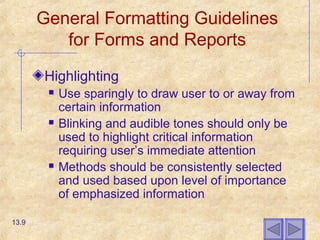
General Formatting Guidelines
for Forms and Reports
Highlighting
 Use sparingly to draw user to or away from
certain information
 Blinking and audible tones should only be
used to highlight critical information
requiring user’s immediate attention
 Methods should be consistently selected
and used based upon level of importance
of emphasized information
13.9
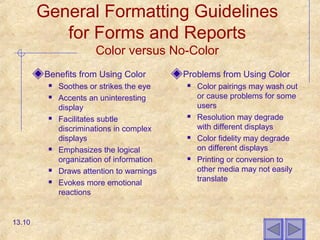
General Formatting Guidelines
for Forms and Reports
Color versus No-Color
Benefits from Using Color
 Soothes or strikes the eye
 Accents an uninteresting
display
 Facilitates subtle
discriminations in complex
displays
 Emphasizes the logical
organization of information
 Draws attention to warnings
 Evokes more emotional
reactions
Problems from Using Color
 Color pairings may wash out
or cause problems for some
users
 Resolution may degrade
with different displays
 Color fidelity may degrade
on different displays
 Printing or conversion to
other media may not easily
translate
13.10
General Formatting Guidelines
for Forms and Reports
Displaying Text
 Display text in mixed upper and lower case and
use conventional punctuation
 Use double spacing if space permits. If not, place
a blank line between paragraphs
 Left-justify text and leave a ragged right margin
 Do not hyphenate words between lines
 Use abbreviations and acronyms only when they
are widely understood by users and are
significantly shorter than the full text
13.11
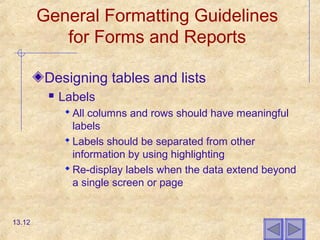
General Formatting Guidelines
for Forms and Reports
Designing tables and lists
 Labels
 All columns and rows should have meaningful
labels
 Labels should be separated from other
information by using highlighting
 Re-display labels when the data extend beyond
a single screen or page
13.12
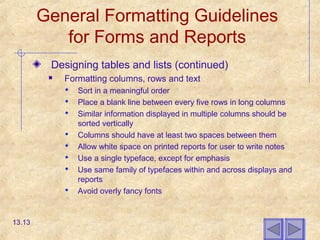
General Formatting Guidelines
for Forms and Reports
Designing tables and lists (continued)
 Formatting columns, rows and text
 Sort in a meaningful order
 Place a blank line between every five rows in long columns
 Similar information displayed in multiple columns should be
sorted vertically
 Columns should have at least two spaces between them
 Allow white space on printed reports for user to write notes
 Use a single typeface, except for emphasis
 Use same family of typefaces within and across displays and
reports
 Avoid overly fancy fonts
13.13
General Formatting Guidelines
for Forms and Reports
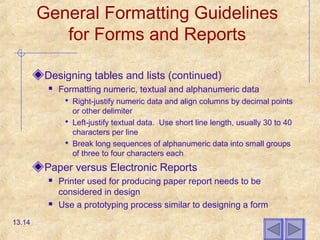
Designing tables and lists (continued)
 Formatting numeric, textual and alphanumeric data
 Right-justify numeric data and align columns by decimal points
or other delimiter
 Left-justify textual data. Use short line length, usually 30 to 40
characters per line
 Break long sequences of alphanumeric data into small groups
of three to four characters each
Paper versus Electronic Reports
 Printer used for producing paper report needs to be
considered in design
 Use a prototyping process similar to designing a form
13.14
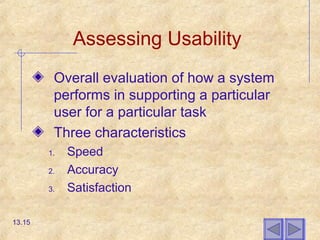
Assessing Usability
Overall evaluation of how a system
performs in supporting a particular
user for a particular task
Three characteristics
1. Speed
2. Accuracy
3. Satisfaction
13.15
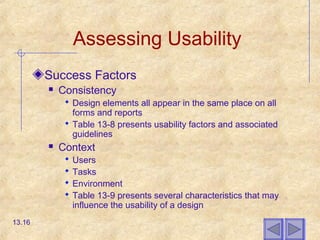
Assessing Usability
Success Factors
 Consistency
 Design elements all appear in the same place on all
forms and reports
 Table 13-8 presents usability factors and associated
guidelines
 Context
 Users
 Tasks
 Environment
 Table 13-9 presents several characteristics that may
influence the usability of a design
13.16
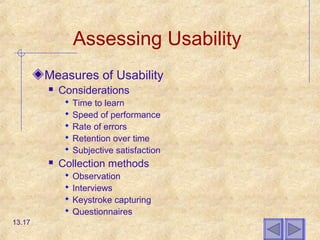
Assessing Usability
Measures of Usability
 Considerations
 Time to learn
 Speed of performance
 Rate of errors
 Retention over time
 Subjective satisfaction
 Collection methods
 Observation
 Interviews
 Keystroke capturing
 Questionnaires
13.17
Electronic Commerce Application:
Designing the Human Interface at Pine
Valley Furniture
General Guidelines
 Table 13-10 provides a summary of errors
that are detrimental to the user’s
experience
13.18
Designing Forms and Reports
at Pine Valley Furniture
Lightweight Graphics
 The use of small images to allow a Web page to
be displayed more quickly
Forms and Data Integrity
 All forms that record information should be clearly
labeled and provide room for input
 Clear examples of input should be provided to
reduce data errors
 Site must clearly designate which fields are
required, which are optional and which have a
range of values
13.19
Designing Forms and Reports
at Pine Valley Furniture
Template-based HTML
 Templates to display and process common
attributes of higher-level, more abstract
items
 Creates an interface that is very easy to
maintain
13.20
Summary
Designing Forms and Reports
General guidelines for designing forms
and reports
Formatting text, tables and lists
Assessing Usability
Interface design guidelines unique to
the Internet
13.21

Chapter13 designing forms and reports

  • 1.
    Copyright 2002 Prentice-Hall,Inc. Modern Systems Analysis and Design Third Edition Jeffrey A. Hoffer Joey F. George Joseph S. Valacich Chapter 13 Designing Forms and Reports 13.1
  • 2.
    Learning Objectives Explain theprocess of designing forms and reports and the deliverables for their creation Discuss general guidelines for formatting forms and reports Use color and know when color improves the usability of information Learn how to effectively format text, tables and lists Explain how to assess usability 13.2
  • 3.
    Learning Objectives Explain interfacedesign guidelines unique to the design of Internet-based electronic commerce systems 13.3
  • 4.
    Designing Forms andReports System inputs and outputs are produced at the end of the analysis phase  Precise appearance was not defined during this phase Forms and reports are integrally related to DFD and E-R diagrams 13.4
  • 5.
    Designing Forms andReports Key Concepts Form  A business document that contains some predefined data and may include some areas where additional data are to be filled in  An instance of a form is typically based on one database record Report  A business document that contains only predefined data  A passive document for reading or viewing data  Typically contains data from many database records or transactions 13.5
  • 6.
    The Process ofDesigning Forms and Reports User-focused activity Follows a prototyping approach Requirements determination  Who will use the form or report?  What is the purpose of the form or report?  When is the report needed or used?  Where does the form or report need to be delivered and used?  How many people need to use or view the form or report? 13.6
  • 7.
    The Process ofDesigning Forms and Reports Prototyping  Initial prototype is designed from requirements  Users review prototype design and either accept the design or request changes  If changes are requested, the construction- evaluation-refinement cycle is repeated until the design is accepted 13.7
  • 8.
    Deliverables and Outcome Designspecifications are major deliverable and contain three sections 1. Narrative overview 2. Sample design 3. Testing and usability assessment 13.8
  • 9.
    General Formatting Guidelines forForms and Reports Highlighting  Use sparingly to draw user to or away from certain information  Blinking and audible tones should only be used to highlight critical information requiring user’s immediate attention  Methods should be consistently selected and used based upon level of importance of emphasized information 13.9
  • 10.
    General Formatting Guidelines forForms and Reports Color versus No-Color Benefits from Using Color  Soothes or strikes the eye  Accents an uninteresting display  Facilitates subtle discriminations in complex displays  Emphasizes the logical organization of information  Draws attention to warnings  Evokes more emotional reactions Problems from Using Color  Color pairings may wash out or cause problems for some users  Resolution may degrade with different displays  Color fidelity may degrade on different displays  Printing or conversion to other media may not easily translate 13.10
  • 11.
    General Formatting Guidelines forForms and Reports Displaying Text  Display text in mixed upper and lower case and use conventional punctuation  Use double spacing if space permits. If not, place a blank line between paragraphs  Left-justify text and leave a ragged right margin  Do not hyphenate words between lines  Use abbreviations and acronyms only when they are widely understood by users and are significantly shorter than the full text 13.11
  • 12.
    General Formatting Guidelines forForms and Reports Designing tables and lists  Labels  All columns and rows should have meaningful labels  Labels should be separated from other information by using highlighting  Re-display labels when the data extend beyond a single screen or page 13.12
  • 13.
    General Formatting Guidelines forForms and Reports Designing tables and lists (continued)  Formatting columns, rows and text  Sort in a meaningful order  Place a blank line between every five rows in long columns  Similar information displayed in multiple columns should be sorted vertically  Columns should have at least two spaces between them  Allow white space on printed reports for user to write notes  Use a single typeface, except for emphasis  Use same family of typefaces within and across displays and reports  Avoid overly fancy fonts 13.13
  • 14.
    General Formatting Guidelines forForms and Reports Designing tables and lists (continued)  Formatting numeric, textual and alphanumeric data  Right-justify numeric data and align columns by decimal points or other delimiter  Left-justify textual data. Use short line length, usually 30 to 40 characters per line  Break long sequences of alphanumeric data into small groups of three to four characters each Paper versus Electronic Reports  Printer used for producing paper report needs to be considered in design  Use a prototyping process similar to designing a form 13.14
  • 15.
    Assessing Usability Overall evaluationof how a system performs in supporting a particular user for a particular task Three characteristics 1. Speed 2. Accuracy 3. Satisfaction 13.15
  • 16.
    Assessing Usability Success Factors Consistency  Design elements all appear in the same place on all forms and reports  Table 13-8 presents usability factors and associated guidelines  Context  Users  Tasks  Environment  Table 13-9 presents several characteristics that may influence the usability of a design 13.16
  • 17.
    Assessing Usability Measures ofUsability  Considerations  Time to learn  Speed of performance  Rate of errors  Retention over time  Subjective satisfaction  Collection methods  Observation  Interviews  Keystroke capturing  Questionnaires 13.17
  • 18.
    Electronic Commerce Application: Designingthe Human Interface at Pine Valley Furniture General Guidelines  Table 13-10 provides a summary of errors that are detrimental to the user’s experience 13.18
  • 19.
    Designing Forms andReports at Pine Valley Furniture Lightweight Graphics  The use of small images to allow a Web page to be displayed more quickly Forms and Data Integrity  All forms that record information should be clearly labeled and provide room for input  Clear examples of input should be provided to reduce data errors  Site must clearly designate which fields are required, which are optional and which have a range of values 13.19
  • 20.
    Designing Forms andReports at Pine Valley Furniture Template-based HTML  Templates to display and process common attributes of higher-level, more abstract items  Creates an interface that is very easy to maintain 13.20
  • 21.
    Summary Designing Forms andReports General guidelines for designing forms and reports Formatting text, tables and lists Assessing Usability Interface design guidelines unique to the Internet 13.21