Collecting Primary Data by Observation
Dr. Dhobale J V
Assistant Professor
IBS, IFHE, Hyderabad.
IBS Hyderabad 1
Business Research Methods (SHRM-431)
Chapter No.-05
Objectives
 Types of Primary data.
 Methods to obtain Primary data.
 Observation Research.
2IBS Hyderabad
Introduction
 Although there are important advantages to
using secondary data, we often find it
necessary to collect primary data.
 In this chapter, we'll highlight the seven
different types of primary data that might be
collected from (or about) individuals.
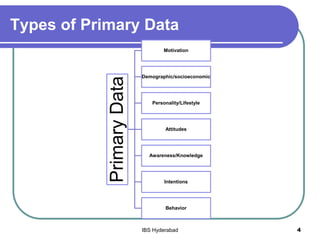
 The types of primary data about individuals
that you will collect generally fall into one of
seven categories:
3IBS Hyderabad
Types of Primary Data
4IBS Hyderabad
PrimaryData
Motivation
Demographic/socioeconomic
Personality/Lifestyle
Attitudes
Awareness/Knowledge
Intentions
Behavior
Types of Primary Data
 We need to understand each type of data and
some of the issues involved in collecting it.
5IBS Hyderabad
Types of Primary Data
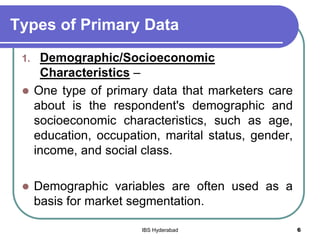
1. Demographic/Socioeconomic
Characteristics –
 One type of primary data that marketers care
about is the respondent's demographic and
socioeconomic characteristics, such as age,
education, occupation, marital status, gender,
income, and social class.
 Demographic variables are often used as a
basis for market segmentation.
6IBS Hyderabad
Types of Primary Data
2. Personality/Lifestyle Characteristics -
 Another type of primary data involves a
respondent's personality and lifestyle
characteristics in the form of personality traits,
activities, interests, and values.
 Personality refers to the normal patterns of
behavior exhibited by an individual—the
attributes, traits, and mannerisms that
distinguish one individual from another.
7IBS Hyderabad
Types of Primary Data
2. Personality/Lifestyle Characteristics -
 We often characterize people by the
personality traits—aggressiveness,
dominance, friendliness, sociability—they
display.
 Many marketers believe that personality can
affect a consumer's choice of stores or
products or an individual's response to an
advertisement or point-of-purchase display.
8IBS Hyderabad
Types of Primary Data
3. Attitudes-
 An attitude refers to an individual's overall
evaluation of something.
 Attitude is one of the more important notions
for marketers.
 Attitudes and other psychological variables are
very important for marketing researchers.
9IBS Hyderabad
Types of Primary Data
4. Awareness/Knowledge-
 Awareness/knowledge as used in business research
refers to what respondents do and do not know or
believe about some product, brand, company,
advertisement, or other element.
 Marketers are often interested in understanding what
different audiences know or believe about their brands
and companies.
 Approached used to measure awareness -
1. Unaided recall
2. Aided recall
3. Recognition
10IBS Hyderabad
Types of Primary Data
5. Intentions-
 A person's intentions refer to their
anticipated or planned future behavior.
 definitely would buy
 probably would buy
 undecided
 probably would not buy
 definitely would not buy
11IBS Hyderabad
Types of Primary Data
6. Motivation-
 A motive is a need, want, drive, urge, wish,
desire, impulse, or any inner state that directs
behavior toward goals.
 A Business researcher's interest in motives
typically involves determining why people
behave as they do.
 If we understand the forces underlying
consumer behavior, we are in a better position
to design and offer products and services that
can satisfy the motives driving that behavior.
12IBS Hyderabad
Types of Primary Data
7. Behavior-
 Behavior is a physical activity or action that
takes place under specific circumstances, at a
particular time, and involves one or more
actors or participants.
 Behavioral data are becoming increasingly
available through various technologies (e.g.,
scanners and the Web) and increasingly
important to marketers.
13IBS Hyderabad
Method of Obtaining Primary Data
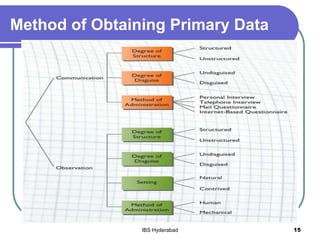
 The primary decision is whether to use
communication or observation.
 Communication - A method of data collection
involving questioning of respondents to secure
the desired information, using a data collection
instrument called a questionnaire.
 Observation- A method of data collection in
which the situation of interest is watched and
the relevant facts, actions or behaviors are
recorded.
14IBS Hyderabad
Method of Obtaining Primary Data
15IBS Hyderabad
Method of Obtaining Primary Data
 Both the communication and observation
methods have advantages and disadvantages.
 Communication method of data collection has
the general advantages of versatility, speed,
and cost;
 Observational data are typically more objective
and accurate.
16IBS Hyderabad
Method of Obtaining Primary Data
 Versatility.
 Speed and Cost.
 Objectivity and Accuracy.
17IBS Hyderabad
Observation Research
 Communication-based research relies on
interviews and surveys and, as a result, there
are lots of ways for error to enter into the
analysis.
 Although observational research is not
completely free from error, it is often the best
method for generating valid data about what
people do.
18IBS Hyderabad
Observation Research
 Observation is a fact of everyday life.
 The observations are systematically planned
and carefully recorded.
 The best predictor of future behavior is usually
past behavior.
19IBS Hyderabad
Observation Research
 Structured versus Unstructured Observation:
 Structured Observations - The problem has
been defined precisely enough so that the
behaviors that will be observed can be
specified beforehand, as can the categories
that will be used to record and analyze the
situation.
 Unstructured Observation- The problem has
not been specifically defined, so a great deal
of flexibility is allowed the observers in terms
of what they note and record.
20IBS Hyderabad
Observation Research
 Structured versus Unstructured Observation:
 Unstructured observation is much more likely
to be used in exploratory research than in
descriptive or causal research.
 To use the more structured approach, you
must decide precisely which behaviors will be
observed and which specific categories and
units will be used to record the observations.
21IBS Hyderabad
Observation Research
 Disguised versus Undisguised Observation:
 With undisguised observation, people know
they are being observed;
 In disguised observation , they don't.
 Two important Concerns with disguised
Observations-
1. There are ethical concerns involved in observing
people without their prior knowledge.
2. How will you obtain other relevant background
information, such as demographic and attitudinal
information?
22IBS Hyderabad
Observation Research
 Natural versus Contrived Setting for
Observation: Observations may be obtained in
either natural or contrived settings.
 Natural - Subjects are observed in the
environment where the behavior normally
takes place.
 contrived - Subjects are observed in an
environment that has been specially designed
for recording their behavior.
23IBS Hyderabad
Observation Research
 Human versus Mechanical Observation-
 With human observation , one or more
people are trained to systematically watch
consumers or whatever else is being studied
and to record the events that take place.
 Electrical or mechanical observation has
become increasingly important in marketing
research.
24IBS Hyderabad
Observation Research
 Human versus Mechanical Observation-
 Mechanical Observation -
1. Scanner – No / frequency.
2. Galvanometer – Emotional Changes.
3. Voice-pitch analysis - Emotional arousal.
4. Eye tracker camera - Subject's eye
movements.
25IBS Hyderabad
Observation Research
 Trace Analysis - Trace analysis is an
observation technique that involves
researchers collecting data on the basis of
trace evidence and the earlier activities of
users.
 Ex. A study of the wrappers in the bin can
provide information about the brands used.
 Content analysis, whereby they analyze the
contents of advertisements, newspaper
articles, and letters.
26IBS Hyderabad
Review
 Types of Primary data.
 Methods to obtain Primary data.
 Observation Research.
27IBS Hyderabad
References
 MARKETING RESEARCH – A SOUTH ASIAN
PERSPECTIVE by Brown, Sutter , Adhikari,
Cengage Learning, India.
 Business Research Methods - Donald R
Cooper, Pamela S Schindler, J K Sharma,
MCGraw Hill Education
 Business Research Methods - Naval Bajpai,
Pearson Education, India.
28IBS Hyderabad
Thank You!
29IBS Hyderabad

Unit no 05_collecting primary data by observation

  • 1.
    Collecting Primary Databy Observation Dr. Dhobale J V Assistant Professor IBS, IFHE, Hyderabad. IBS Hyderabad 1 Business Research Methods (SHRM-431) Chapter No.-05
  • 2.
    Objectives  Types ofPrimary data.  Methods to obtain Primary data.  Observation Research. 2IBS Hyderabad
  • 3.
    Introduction  Although thereare important advantages to using secondary data, we often find it necessary to collect primary data.  In this chapter, we'll highlight the seven different types of primary data that might be collected from (or about) individuals.  The types of primary data about individuals that you will collect generally fall into one of seven categories: 3IBS Hyderabad
  • 4.
    Types of PrimaryData 4IBS Hyderabad PrimaryData Motivation Demographic/socioeconomic Personality/Lifestyle Attitudes Awareness/Knowledge Intentions Behavior
  • 5.
    Types of PrimaryData  We need to understand each type of data and some of the issues involved in collecting it. 5IBS Hyderabad
  • 6.
    Types of PrimaryData 1. Demographic/Socioeconomic Characteristics –  One type of primary data that marketers care about is the respondent's demographic and socioeconomic characteristics, such as age, education, occupation, marital status, gender, income, and social class.  Demographic variables are often used as a basis for market segmentation. 6IBS Hyderabad
  • 7.
    Types of PrimaryData 2. Personality/Lifestyle Characteristics -  Another type of primary data involves a respondent's personality and lifestyle characteristics in the form of personality traits, activities, interests, and values.  Personality refers to the normal patterns of behavior exhibited by an individual—the attributes, traits, and mannerisms that distinguish one individual from another. 7IBS Hyderabad
  • 8.
    Types of PrimaryData 2. Personality/Lifestyle Characteristics -  We often characterize people by the personality traits—aggressiveness, dominance, friendliness, sociability—they display.  Many marketers believe that personality can affect a consumer's choice of stores or products or an individual's response to an advertisement or point-of-purchase display. 8IBS Hyderabad
  • 9.
    Types of PrimaryData 3. Attitudes-  An attitude refers to an individual's overall evaluation of something.  Attitude is one of the more important notions for marketers.  Attitudes and other psychological variables are very important for marketing researchers. 9IBS Hyderabad
  • 10.
    Types of PrimaryData 4. Awareness/Knowledge-  Awareness/knowledge as used in business research refers to what respondents do and do not know or believe about some product, brand, company, advertisement, or other element.  Marketers are often interested in understanding what different audiences know or believe about their brands and companies.  Approached used to measure awareness - 1. Unaided recall 2. Aided recall 3. Recognition 10IBS Hyderabad
  • 11.
    Types of PrimaryData 5. Intentions-  A person's intentions refer to their anticipated or planned future behavior.  definitely would buy  probably would buy  undecided  probably would not buy  definitely would not buy 11IBS Hyderabad
  • 12.
    Types of PrimaryData 6. Motivation-  A motive is a need, want, drive, urge, wish, desire, impulse, or any inner state that directs behavior toward goals.  A Business researcher's interest in motives typically involves determining why people behave as they do.  If we understand the forces underlying consumer behavior, we are in a better position to design and offer products and services that can satisfy the motives driving that behavior. 12IBS Hyderabad
  • 13.
    Types of PrimaryData 7. Behavior-  Behavior is a physical activity or action that takes place under specific circumstances, at a particular time, and involves one or more actors or participants.  Behavioral data are becoming increasingly available through various technologies (e.g., scanners and the Web) and increasingly important to marketers. 13IBS Hyderabad
  • 14.
    Method of ObtainingPrimary Data  The primary decision is whether to use communication or observation.  Communication - A method of data collection involving questioning of respondents to secure the desired information, using a data collection instrument called a questionnaire.  Observation- A method of data collection in which the situation of interest is watched and the relevant facts, actions or behaviors are recorded. 14IBS Hyderabad
  • 15.
    Method of ObtainingPrimary Data 15IBS Hyderabad
  • 16.
    Method of ObtainingPrimary Data  Both the communication and observation methods have advantages and disadvantages.  Communication method of data collection has the general advantages of versatility, speed, and cost;  Observational data are typically more objective and accurate. 16IBS Hyderabad
  • 17.
    Method of ObtainingPrimary Data  Versatility.  Speed and Cost.  Objectivity and Accuracy. 17IBS Hyderabad
  • 18.
    Observation Research  Communication-basedresearch relies on interviews and surveys and, as a result, there are lots of ways for error to enter into the analysis.  Although observational research is not completely free from error, it is often the best method for generating valid data about what people do. 18IBS Hyderabad
  • 19.
    Observation Research  Observationis a fact of everyday life.  The observations are systematically planned and carefully recorded.  The best predictor of future behavior is usually past behavior. 19IBS Hyderabad
  • 20.
    Observation Research  Structuredversus Unstructured Observation:  Structured Observations - The problem has been defined precisely enough so that the behaviors that will be observed can be specified beforehand, as can the categories that will be used to record and analyze the situation.  Unstructured Observation- The problem has not been specifically defined, so a great deal of flexibility is allowed the observers in terms of what they note and record. 20IBS Hyderabad
  • 21.
    Observation Research  Structuredversus Unstructured Observation:  Unstructured observation is much more likely to be used in exploratory research than in descriptive or causal research.  To use the more structured approach, you must decide precisely which behaviors will be observed and which specific categories and units will be used to record the observations. 21IBS Hyderabad
  • 22.
    Observation Research  Disguisedversus Undisguised Observation:  With undisguised observation, people know they are being observed;  In disguised observation , they don't.  Two important Concerns with disguised Observations- 1. There are ethical concerns involved in observing people without their prior knowledge. 2. How will you obtain other relevant background information, such as demographic and attitudinal information? 22IBS Hyderabad
  • 23.
    Observation Research  Naturalversus Contrived Setting for Observation: Observations may be obtained in either natural or contrived settings.  Natural - Subjects are observed in the environment where the behavior normally takes place.  contrived - Subjects are observed in an environment that has been specially designed for recording their behavior. 23IBS Hyderabad
  • 24.
    Observation Research  Humanversus Mechanical Observation-  With human observation , one or more people are trained to systematically watch consumers or whatever else is being studied and to record the events that take place.  Electrical or mechanical observation has become increasingly important in marketing research. 24IBS Hyderabad
  • 25.
    Observation Research  Humanversus Mechanical Observation-  Mechanical Observation - 1. Scanner – No / frequency. 2. Galvanometer – Emotional Changes. 3. Voice-pitch analysis - Emotional arousal. 4. Eye tracker camera - Subject's eye movements. 25IBS Hyderabad
  • 26.
    Observation Research  TraceAnalysis - Trace analysis is an observation technique that involves researchers collecting data on the basis of trace evidence and the earlier activities of users.  Ex. A study of the wrappers in the bin can provide information about the brands used.  Content analysis, whereby they analyze the contents of advertisements, newspaper articles, and letters. 26IBS Hyderabad
  • 27.
    Review  Types ofPrimary data.  Methods to obtain Primary data.  Observation Research. 27IBS Hyderabad
  • 28.
    References  MARKETING RESEARCH– A SOUTH ASIAN PERSPECTIVE by Brown, Sutter , Adhikari, Cengage Learning, India.  Business Research Methods - Donald R Cooper, Pamela S Schindler, J K Sharma, MCGraw Hill Education  Business Research Methods - Naval Bajpai, Pearson Education, India. 28IBS Hyderabad
  • 29.