ISSN : 2348 - 9065 (Online)
ISSN : 2349 - 3143 (Print)
www.ijrect.com
International Journal of Research in Electronics
and Communication Technology (IJRECT 2014)
© 2014, IJRECT All Rights Reserved
54
Vol. 1, Issue 2 April - June 2014
Wired and Wireless Computer Network Performance Evaluation
Using OMNeT++ Simulation Environment
I
Dhobale J V, II
Dr. Kalyankar N V, III
Dr. Khamitkar S D
I
Assist. Professor, Shri. D B P C O M, Manur, Nashik (MH)
II
Principal,Yeshwant College Nanded (MH)
III
Reader & Director, School of computational sciences, SRTMU, Nanded
I. Introduction
The Application areas of wired and wireless computer networks
are different. The performance of the both these networks are
investigated on the basis of common parameters to know how
both these networks behave. The performance of the Network
configurations is measured using simulation environment. We
preferred OMNeT++ Version 4.2 (Objective Modular Network
Testbed ) object oriented modular discrete event network
simulation framework with INETframework for OMNeT++ with
2.2.0-ae90ecdrelease.OMNeT++isprimarilyusedtosimulatethe
communication networks and other distributed systems. It is used
for academic as well as Industrial research purposes. OMNeT++
runs on Windows, Mac & Linux Operating Systems. Here are
the features of OMNeT++ which makes it different from other
simulation environment:
OMNeT++ is designed to support network simulation on a1.	
large scale.
Modular structure.2.	
The design of NED (Network Description).3.	
GUI Interface with Graphical Editor.4.	
Separation of Model and Experiments.5.	
Simple Module Programming Model.6.	
Design of the Simulation Library.7.	
Parallel Simulation Support.8.	
Real-Time Simulation, Network Emulation.9.	
Animation and Tracing Facility.10.	
Visualization of Dynamic Behaviour.11.	
Enriched Result Analysis Mechanism12.	
INET consists of several simulation application models. We
use Nclients network application with basic HTTP network
setup from INET as wired network and Wireless Host to Host
network application with 802.11b Mac protocol in combination
with Ieee80211Radio module as wireless network. Both these
networks support client server environment with variable number
of clients.
Performance evaluation parameters are set through initialization
(INI)andNetworkDescription(NED)filesandinourexperiments
those files are basicHTTP.ini and Nclients.ned for wired networks
whileomnetpp.iniandThroughput.nedforwirelessnetworksetup.
Results of the experiments are collected through answer (ANF)
file.Inourexperiments networkperformanceofboththe networks
is evaluated in terms of Server Throughput. Throughput from the
serverismeasuredthroughThruputFrommodulewhilethroughput
to the server is evaluated throughThruputTo module.Throughput
is number of bits transferred per second from server to the client
or vice versa.
II. Related Work
Research paper Performance Analysis of DiffServ based Quality
of Service in a Multimedia Wired Network and VPN effect using
OPNET. In current paper Researchers presented simulation and
performance analysis of Quality of Service (QoS) based on two
majorqueuingdisciplinesi.e.PriorityQueuing(PQ)andWeighted
Fair Queuing (WFQ). Theanalysis was done in terms of delay
and its variants for four different services; Voice over IP, Video
Conferencing, Database and FTP based on packet identification
under Differentiated Services Code Point (DSCP).The simulation
results show that WFQ is a better discipline than PQ as lesser
queuing delay and jitter were observed in WFQ for low priority
services (FTP and Database). These metrics were found having
same values in both PQ andWFQ for high priority services (Voice
andVideo).Therefore,lowpriorityservicesalsogettheirweighted
share of bandwidth in the network when QoS is applied withWFQ
discipline in the presence of high priority services like interactive
voiceandlivestreamingvideo.Voiceandvideotrafficwerefurther
examined through simulation and discussion on ‘Traffic Drop’,
Buffer Usage’ and ‘Packet Delay Variation’ metrics by varying
router’s buffer size.
Research paper Performance Evaluation of Wireless Controller
Area Network (WCAN) Using Token Frame Scheme proposed a
newwirelessprotocolso-calledwirelesscontrollerareanetworkis
introduced.WCAN is an adaptation of its wired cousin, controller
area network protocol. The proposed WCAN uses token frame
scheme in providing channel access to nodes in the system. This
token frame method follows the example used in wireless token
ring protocol which is a wireless network protocol that reduces the
number of retransmissions as a result of collisions. This scheme
basedonCANprotocolallowsnodestoshareacommonbroadcast
channel by taking turns in transmitting upon receiving the token
frame that circulates around the network for a specified amount
of time. The token frame allows nodes to access the network one
at a time, giving ‘fair’ chance to all nodes instead of competing
against one another. This method provides high throughput in a
Abstract
With this research paper we are investigating the performance of wired and wireless computer networks using OMNeT++ Simulation
environment. The performance of the Network is evaluated on the basis of Throughput. To investigate the problem we use OMNeT++
network simulation framework along with Nclient application module as wired simulation network and Wireless Host to Host
application module as Wireless simulation network from INET framework. Both these modules support client server environment
with variable number of clients. We have kept data packet size constant i.e 1000bytes for both networks.
Keywords
Bitrate, Clients, Client Host, Datarate, OMNeT++, Throughput, Server Host.
ISSN : 2348 - 9065 (Online)
ISSN : 2349 - 3143 (Print)
www.ijrect.com
International Journal of Research in Electronics
and Communication Technology (IJRECT 2014)
© All Rights Reserved, IJRECT 201455
Vol. 1, Issue 2 April - June 2014
bounded latency environment.The proposedWCAN protocol has
been developed and simulated by means of QUalNet simulator.
Theperformancesofthisproposedprotocolareevaluatedfromthe
perspective of throughput, end-to-end delay and packet delivery
ration, and are compared against the IEEE 802.11 protocol.
Simulation result shows that the proposed WCAN outperforms
IEEE 802.11 based protocol by 62.5% in terms of throughput with
increasing network size. Also, it shows an improvement of 6%
compared to IEEE 802.11 standard at a higher data rate.
III. Research Methodology
To investigate the performance evaluation of wired and wireless
networks we use OMNeT++ Simulation environment framework.
WerunallthesesimulationsonWindows7.0Professionalplatform
on Laptop with AMD Athlon (tm) II P320 Dual-Core Processor
2.10 GHz with 3.00GB RAM and 32-bir Operating System.Wired
network simulation experiment is setup with Nclient application
form INET. There are three basic setup provided under Nclients
in INET those TelenetApp, File transfer and basicHTTP module.
OutofthesewechoosebasicHTTPmodulewithTCPBasicCliApp
and TCPGenericSrvApp modules. TelenetApp generates very
low traffic.
Fig. 1: Nclients.Ned: Client Server experimental setup
configuration
To measure the performance of the present network we use
thruputMeter modules. This module is placed between TCP
and TCPApp layer. We required two modules to collect result
for incoming and outgoing traffic to the server. Our client and
server are the StandardHost modules provided in the INET. We
have modified the StandardHost with thruputMeter. Modified
structure of standardHost along with thruputMeter is show in
figure 2 below.
Fig. 2: StandardHost with thruputMeter module between tcp &
tcpApp
Wireless network Simulation experiment is setup with Wireless –
HosttoHostapplicationfromINET.WesetupupourwirelessHost
to Host network configuration in circular mobility configuration
with1mpsmobilityspeed.Thehostandtheaccesspointtransmitter
powers are configured so that every host hears all the others
Fig. 3: Wireless - Host to Host Network configuration with 11-
clients Host, 1-Access point & a server Host setup.
It consists of 802.11b MAC protocol in combination with the
Ieee80211Radio module as the physical layer. It clubbed to form
Ieee80211NicSTASimplified module in INET. We modified this
module by adding two throughput meters to measure in and out
throughput value between mac and radio modules. Throughput
fromServerhostismeasuredusingthroughputFromandthroughput
to the server host is measured using throughputTo module. The
modified structure is shown below:
ISSN : 2348 - 9065 (Online)
ISSN : 2349 - 3143 (Print)
www.ijrect.com
International Journal of Research in Electronics
and Communication Technology (IJRECT 2014)
© 2014, IJRECT All Rights Reserved
56
Vol. 1, Issue 2 April - June 2014
Fig. 4 : Ieee80211NicSTASimplified with two throughput
meter.
The results of the experiments are collected in excel file from
the default .ans file. .ans file in OMNeT++ gives two types of
results vector and scalar.Vector results are recording of time series
data and scalar results are supposed to record a single value per
simulation run. We have considered scalar result as avg. thruput
for our analysis purpose, Throughput of both thruputMeter i.e.
thruputFrom & thruputTo related to the server.
Toevaluatetheperformanceofboththesenetworksweconsidered
two parameters:
Datarate (bitrate in wirelsee networks).1.	
Number of clients per server.2.	
We collect the readings of the simulation experiment by two
ways:
We Kept datarate/bitrate constant and changed the number1.	
of clients on the server and average throughput scalar values
are collected for respective experiments.
For specific number of clients setup on a server we change2.	
the datarate/bitrate and collect the scalar average throughput
values.
Unless and until specified all the parameters of INI and NED files
for both experimental setups are kept at defaults. Throughput
values of the server are collected by changing datarate/bitrate
value from 10Mbps to 100Mbps with the interval of 10Mbps,
same way throughput of the server is also collected by changing
the number of clients from 1 number to 15 numbers with server.
Here server throughput means throughput from the server and
throughput to the server. We have kept data packet size constant
i.e. 1000bytes for our experiment.
Wecollectedthereadingofthesimulationexperimentbychanging
datarate/bitrate from 10Mbps to 100Mbps with the interval of
10Mbps and increasing the number of client hosts from 1 client
to 15 clients. Total readings collected are 10*15=150 times for
both wired and wireless networks.
IV. Result Analysis
The result of the experiments are collected in excel file. We have
collectedThroughputresultsofserverhostat10,20,30,40,50,60,
70, 80, 90 & 100Mbps datarate/bitrate. With 1, 2, 3, ....,13,14,15
clients with server.Average throughput values from the serve and
to the server given by two throughput meters for the set network
configurations are considered to measure the performance of
networks.
Throughput is the average number of bits transferred per second.
Packet size for all the experimental setup is kept constant i.e.
1000bytes.
At specific datarate/bitrate by changing number of clients hosts
from 1 to 15 numbers we took readings of server throughput i.e.
throughputfrom – outgoing throughput values from the server and
throughputto- incoming throughput values to the server. These
reading are collected at 10Mbps to 100Mbps with the interval
of 10Mbps.
Theresultsoftheexperimentsareanalysedwithrespecttodatarate/
bitrate and number of clients to the server.
A. With Constant Datarate/Bitrate
When we change number of clients with server at specific datarate
from 1 client to 15 clients for both the network setups, we found
that throughput from the server for wired network is increasing
with increase in the number of clients from 1 number to 14 number
of clients per server except number of clients with 6, 8, 12 &
15 where it shows downfall trend in the throughput from the
server.
Fig 5: Graph showing throughput from server at 10MBPS for
Nclient wired network.
Fig 6: Graph showing throughput from server at 100MBPS for
Nclient wired network.
Our result shows that the throughput pattern of wired network
ISSN : 2348 - 9065 (Online)
ISSN : 2349 - 3143 (Print)
www.ijrect.com
International Journal of Research in Electronics
and Communication Technology (IJRECT 2014)
© All Rights Reserved, IJRECT 201457
Vol. 1, Issue 2 April - June 2014
is same for all the datarate interval experiments i.e. 10MBPS,
20MBPS, 30MBPS,......., 100MBPS.
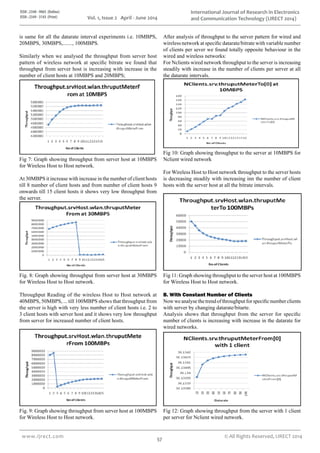
Similarly when we analysed the throughput from server host
pattern of wireless network at specific bitrate we found that
throughput from server host is increasing with increase in the
number of client hosts at 10MBPS and 20MBPS;
Fig 7: Graph showing throughput from server host at 10MBPS
for Wireless Host to Host network.
At 30MBPS it increase with increase in the number of client hosts
till 8 number of client hosts and from number of client hosts 9
onwards till 15 client hosts it shows very low throughput from
the server.
Fig. 8: Graph showing throughput from server host at 30MBPS
for Wireless Host to Host network.
Throughput Reading of the wireless Host to Host network at
40MBPS, 50MBPS, ... till 100MBPS shows that throughput from
the server is high with very less number of client hosts i.e. 2 to
3 client hosts with server host and it shows very low throughput
from server for increased number of client hosts.
Fig. 9: Graph showing throughput from server host at 100MBPS
for Wireless Host to Host network.
After analysis of throughput to the server pattern for wired and
wireless network at specific datarate/bitrate with variable number
of clients per sever we found totally opposite behaviour in the
wired and wireless networks:
For Nclients wired network throughput to the server is increasing
steadily with increase in the number of clients per server at all
the datarate intervals.
Fig 10: Graph showing throughput to the server at 10MBPS for
Nclient wired network
For Wireless Host to Host network throughput to the server hosts
is decreasing steadily with increasing inn the number of client
hosts with the server host at all the bitrate intervals.
Fig 11: Graph showing throughput to the server host at 100MBPS
for Wireless Host to Host network.
B. With Constant Number of Clients
Nowweanalysethetrendofthroughputforspecificnumberclients
with server by changing datarate/bitarte.
Analysis shows that throughput from the server for specific
number of clients is increasing with increase in the datarate for
wired networks.
Fig 12: Graph showing throughput from the server with 1 client
per server for Nclient wired network.
ISSN : 2348 - 9065 (Online)
ISSN : 2349 - 3143 (Print)
www.ijrect.com
International Journal of Research in Electronics
and Communication Technology (IJRECT 2014)
© 2014, IJRECT All Rights Reserved
58
Vol. 1, Issue 2 April - June 2014
Wireless Host to Host to network throughput from the server
host for specific number of client host with the server host is
increasing with increase in the bitrate for number of client hosts
1 and 2 with server host;
Fig 13: Graph showing throughput from server host with 1 client
host for Wireless Host to Host network.
Fornumberofclienthosts3to15withserverhosts,thethroughput
from the server pattern for wireless Host to Host network is high
with less number of bitrate and it gives low throughput from the
serve with increase in the bitrate.
Fig 14: Graph showing throughput from server host with 15 client
hosts for Wireless Host to Host network.
Throughput to the server for specific number of clients for wired
network is increasing with increase in the datarate, this trend is
common for all number of clients with server.
Fig 15: Graph showing throughput to the server with 15 clients
per server for Nclient wired network.
Wireless Host to Host network gives increasing throughput to
the server Host with increase in the bitrate from 10MBPS to
100MBPS for all number of client Hosts with server host, which
is similar kind of throughput to the server trend as wired network
recorded.
Fig 16: Graph showing throughput to the server host with 1 client
host for Wireless Host to Host network.
V. Conclusions
By analysing the throughput values of the simulation experiment
for both wired and wireless network we came to know that
Thethroughputpatternbehaviourofboththenetworksaredifferent
for evaluated parameters except throughput patter to the server
with constant number of clients.
VI. AcknowledgEment
WearethankfultoallthestaffofSchoolofComputationalSciences,
SRTMU, Nanded for providing us the necessary guidance and
facility to carry out present research.
References
[1]	 Muhammad Aamir, Mustafa Zaidi and Husnain Mansoon,
“PerformanceAnalysisofDiffServbasedQualityofServicein
aMultimediaWiredNetworkandVPNeffectusingOPNET”.
International Journal of Computer Science Issues, Vol. 9,
Issue 3, No 2, May 2012.
[2]	 Wei Lun Ng, Chee Kyun Ng, Borhanuddin Mohd Ali, Nor
Kamariah Noordin, “Performance Evaluation of Wireless
Controller Area Network (WCAN) Using Token Frame
Scheme”. Wireless Pers Commun (2013) 72: 1847-1873.
[3]	 Mr. Dhobale J V, Dr. Kalyankar N V, Dr. Khamitkar S D,
“Computer Network Performance Evaluation based on
Datarate and Number of Clients per server using OMNeT++
Simulation”. Global Journal of Computer Science and
Technology, Volume 14 issue 3 June-2014.
[4]	 Mr. Dhobale J V, Dr. Kalyankar N V, Dr. Khamitkar S D,
“Wireless-HosttoHostNetworkPerformanceevlautionbased
on bitrate and Number of Host with server using OMNeT++
Simulation Environment”. Indian Stream Reserach Journal,
June-2014 (2230-7850) accepted.
[5]	 Esma Yildirim – Tevfik Kosar, “End-to-end data flow
parallelism for throughput optimization in High Speed
Networks,” J Grid Computing (2012) 10:395-418.
[6]	 Mohd Nazri, Ismail and Abdullah Mohd Zin, “Development
of simulation model in heterogeneous network environment:
comparing the accuracy of simulation model for data
transfer measurement over wide area network,” Information
Technology Journal 7 (6): 897-903, 2008.
[7]	 AndrasVarga,RudolfHornig,“AnoverviewoftheOMNeT++
simulation environment,” SIMUTools, March 03-07, 2008,
Marseille, France. ISBN:978-963-9799-20-2.
[8]	 Andras Varga and OpenSim Ltd. OMNeT++ User manual
version 4.2.
ISSN : 2348 - 9065 (Online)
ISSN : 2349 - 3143 (Print)
www.ijrect.com
International Journal of Research in Electronics
and Communication Technology (IJRECT 2014)
© All Rights Reserved, IJRECT 201459
Vol. 1, Issue 2 April - June 2014
[9]	 INET Framework for OMNeT++ Manual
Author’s Profile
Dr. Kalyankar N. V.: Principal, Yeshwant
Mahavidyalaya, Nanded. Author is recognised
Ph.D. guide of SRTMU, Nanded in the subject
of Computer Science and Physics. He is having
69 Research Paper publications in various
international journals along with 2 books.
He has chaired number of International and
national conferences during his 33 years of
services. His area of interest is Networking, Cyber
security & Image Processing. He is Fellow and member of various
International and National Research organizations.
Dr. Khamitkar S. D.: Reader & Director, School
of Computational Sciences, Swami Ramanand
TeerthMarathwadaUniversity,Nanded.Author
is Renowned Ph.D. guide in the subject of
Computer Science. He is having 14 years of PG
teaching experience and has 16 international
Research publications under his belt. Currently
he is guiding 11 Research Scholars for Ph.
D. Programme. His area of interest is Networking & Image
Processing.AuthorhaschairedvariousnationalandInternational
conferencesandalsoResearchandacademiccommitteesatSRTM
University, Nanded.
Mr. Dhobale J. V.: Assistant Professor, Shri.
DhonduBaliramPawarCollegeofManagement
& Research Scholar Swami Ramanad Teerth
Marathawada University Nanded. Author has
completed his M.Sc. (Computer Applications)
in 2001 and started his carrier as Lecturer. In
2010 he has completed his MBA degree with
MarketingSpecialization. Heishaving13years
of UG & PG teaching experience. During his tenure of services
he has published 15 national and international Research papers
in the area of Computers science and Management. Currently he
is pursuing Ph. D. degree from SRTM University, Nanded. His
area of interest is Computer Networks.

Wired and Wireless Computer Network Performance Evaluation Using OMNeT++ Simulation Environment

  • 1.
    ISSN : 2348- 9065 (Online) ISSN : 2349 - 3143 (Print) www.ijrect.com International Journal of Research in Electronics and Communication Technology (IJRECT 2014) © 2014, IJRECT All Rights Reserved 54 Vol. 1, Issue 2 April - June 2014 Wired and Wireless Computer Network Performance Evaluation Using OMNeT++ Simulation Environment I Dhobale J V, II Dr. Kalyankar N V, III Dr. Khamitkar S D I Assist. Professor, Shri. D B P C O M, Manur, Nashik (MH) II Principal,Yeshwant College Nanded (MH) III Reader & Director, School of computational sciences, SRTMU, Nanded I. Introduction The Application areas of wired and wireless computer networks are different. The performance of the both these networks are investigated on the basis of common parameters to know how both these networks behave. The performance of the Network configurations is measured using simulation environment. We preferred OMNeT++ Version 4.2 (Objective Modular Network Testbed ) object oriented modular discrete event network simulation framework with INETframework for OMNeT++ with 2.2.0-ae90ecdrelease.OMNeT++isprimarilyusedtosimulatethe communication networks and other distributed systems. It is used for academic as well as Industrial research purposes. OMNeT++ runs on Windows, Mac & Linux Operating Systems. Here are the features of OMNeT++ which makes it different from other simulation environment: OMNeT++ is designed to support network simulation on a1. large scale. Modular structure.2. The design of NED (Network Description).3. GUI Interface with Graphical Editor.4. Separation of Model and Experiments.5. Simple Module Programming Model.6. Design of the Simulation Library.7. Parallel Simulation Support.8. Real-Time Simulation, Network Emulation.9. Animation and Tracing Facility.10. Visualization of Dynamic Behaviour.11. Enriched Result Analysis Mechanism12. INET consists of several simulation application models. We use Nclients network application with basic HTTP network setup from INET as wired network and Wireless Host to Host network application with 802.11b Mac protocol in combination with Ieee80211Radio module as wireless network. Both these networks support client server environment with variable number of clients. Performance evaluation parameters are set through initialization (INI)andNetworkDescription(NED)filesandinourexperiments those files are basicHTTP.ini and Nclients.ned for wired networks whileomnetpp.iniandThroughput.nedforwirelessnetworksetup. Results of the experiments are collected through answer (ANF) file.Inourexperiments networkperformanceofboththe networks is evaluated in terms of Server Throughput. Throughput from the serverismeasuredthroughThruputFrommodulewhilethroughput to the server is evaluated throughThruputTo module.Throughput is number of bits transferred per second from server to the client or vice versa. II. Related Work Research paper Performance Analysis of DiffServ based Quality of Service in a Multimedia Wired Network and VPN effect using OPNET. In current paper Researchers presented simulation and performance analysis of Quality of Service (QoS) based on two majorqueuingdisciplinesi.e.PriorityQueuing(PQ)andWeighted Fair Queuing (WFQ). Theanalysis was done in terms of delay and its variants for four different services; Voice over IP, Video Conferencing, Database and FTP based on packet identification under Differentiated Services Code Point (DSCP).The simulation results show that WFQ is a better discipline than PQ as lesser queuing delay and jitter were observed in WFQ for low priority services (FTP and Database). These metrics were found having same values in both PQ andWFQ for high priority services (Voice andVideo).Therefore,lowpriorityservicesalsogettheirweighted share of bandwidth in the network when QoS is applied withWFQ discipline in the presence of high priority services like interactive voiceandlivestreamingvideo.Voiceandvideotrafficwerefurther examined through simulation and discussion on ‘Traffic Drop’, Buffer Usage’ and ‘Packet Delay Variation’ metrics by varying router’s buffer size. Research paper Performance Evaluation of Wireless Controller Area Network (WCAN) Using Token Frame Scheme proposed a newwirelessprotocolso-calledwirelesscontrollerareanetworkis introduced.WCAN is an adaptation of its wired cousin, controller area network protocol. The proposed WCAN uses token frame scheme in providing channel access to nodes in the system. This token frame method follows the example used in wireless token ring protocol which is a wireless network protocol that reduces the number of retransmissions as a result of collisions. This scheme basedonCANprotocolallowsnodestoshareacommonbroadcast channel by taking turns in transmitting upon receiving the token frame that circulates around the network for a specified amount of time. The token frame allows nodes to access the network one at a time, giving ‘fair’ chance to all nodes instead of competing against one another. This method provides high throughput in a Abstract With this research paper we are investigating the performance of wired and wireless computer networks using OMNeT++ Simulation environment. The performance of the Network is evaluated on the basis of Throughput. To investigate the problem we use OMNeT++ network simulation framework along with Nclient application module as wired simulation network and Wireless Host to Host application module as Wireless simulation network from INET framework. Both these modules support client server environment with variable number of clients. We have kept data packet size constant i.e 1000bytes for both networks. Keywords Bitrate, Clients, Client Host, Datarate, OMNeT++, Throughput, Server Host.
  • 2.
    ISSN : 2348- 9065 (Online) ISSN : 2349 - 3143 (Print) www.ijrect.com International Journal of Research in Electronics and Communication Technology (IJRECT 2014) © All Rights Reserved, IJRECT 201455 Vol. 1, Issue 2 April - June 2014 bounded latency environment.The proposedWCAN protocol has been developed and simulated by means of QUalNet simulator. Theperformancesofthisproposedprotocolareevaluatedfromthe perspective of throughput, end-to-end delay and packet delivery ration, and are compared against the IEEE 802.11 protocol. Simulation result shows that the proposed WCAN outperforms IEEE 802.11 based protocol by 62.5% in terms of throughput with increasing network size. Also, it shows an improvement of 6% compared to IEEE 802.11 standard at a higher data rate. III. Research Methodology To investigate the performance evaluation of wired and wireless networks we use OMNeT++ Simulation environment framework. WerunallthesesimulationsonWindows7.0Professionalplatform on Laptop with AMD Athlon (tm) II P320 Dual-Core Processor 2.10 GHz with 3.00GB RAM and 32-bir Operating System.Wired network simulation experiment is setup with Nclient application form INET. There are three basic setup provided under Nclients in INET those TelenetApp, File transfer and basicHTTP module. OutofthesewechoosebasicHTTPmodulewithTCPBasicCliApp and TCPGenericSrvApp modules. TelenetApp generates very low traffic. Fig. 1: Nclients.Ned: Client Server experimental setup configuration To measure the performance of the present network we use thruputMeter modules. This module is placed between TCP and TCPApp layer. We required two modules to collect result for incoming and outgoing traffic to the server. Our client and server are the StandardHost modules provided in the INET. We have modified the StandardHost with thruputMeter. Modified structure of standardHost along with thruputMeter is show in figure 2 below. Fig. 2: StandardHost with thruputMeter module between tcp & tcpApp Wireless network Simulation experiment is setup with Wireless – HosttoHostapplicationfromINET.WesetupupourwirelessHost to Host network configuration in circular mobility configuration with1mpsmobilityspeed.Thehostandtheaccesspointtransmitter powers are configured so that every host hears all the others Fig. 3: Wireless - Host to Host Network configuration with 11- clients Host, 1-Access point & a server Host setup. It consists of 802.11b MAC protocol in combination with the Ieee80211Radio module as the physical layer. It clubbed to form Ieee80211NicSTASimplified module in INET. We modified this module by adding two throughput meters to measure in and out throughput value between mac and radio modules. Throughput fromServerhostismeasuredusingthroughputFromandthroughput to the server host is measured using throughputTo module. The modified structure is shown below:
  • 3.
    ISSN : 2348- 9065 (Online) ISSN : 2349 - 3143 (Print) www.ijrect.com International Journal of Research in Electronics and Communication Technology (IJRECT 2014) © 2014, IJRECT All Rights Reserved 56 Vol. 1, Issue 2 April - June 2014 Fig. 4 : Ieee80211NicSTASimplified with two throughput meter. The results of the experiments are collected in excel file from the default .ans file. .ans file in OMNeT++ gives two types of results vector and scalar.Vector results are recording of time series data and scalar results are supposed to record a single value per simulation run. We have considered scalar result as avg. thruput for our analysis purpose, Throughput of both thruputMeter i.e. thruputFrom & thruputTo related to the server. Toevaluatetheperformanceofboththesenetworksweconsidered two parameters: Datarate (bitrate in wirelsee networks).1. Number of clients per server.2. We collect the readings of the simulation experiment by two ways: We Kept datarate/bitrate constant and changed the number1. of clients on the server and average throughput scalar values are collected for respective experiments. For specific number of clients setup on a server we change2. the datarate/bitrate and collect the scalar average throughput values. Unless and until specified all the parameters of INI and NED files for both experimental setups are kept at defaults. Throughput values of the server are collected by changing datarate/bitrate value from 10Mbps to 100Mbps with the interval of 10Mbps, same way throughput of the server is also collected by changing the number of clients from 1 number to 15 numbers with server. Here server throughput means throughput from the server and throughput to the server. We have kept data packet size constant i.e. 1000bytes for our experiment. Wecollectedthereadingofthesimulationexperimentbychanging datarate/bitrate from 10Mbps to 100Mbps with the interval of 10Mbps and increasing the number of client hosts from 1 client to 15 clients. Total readings collected are 10*15=150 times for both wired and wireless networks. IV. Result Analysis The result of the experiments are collected in excel file. We have collectedThroughputresultsofserverhostat10,20,30,40,50,60, 70, 80, 90 & 100Mbps datarate/bitrate. With 1, 2, 3, ....,13,14,15 clients with server.Average throughput values from the serve and to the server given by two throughput meters for the set network configurations are considered to measure the performance of networks. Throughput is the average number of bits transferred per second. Packet size for all the experimental setup is kept constant i.e. 1000bytes. At specific datarate/bitrate by changing number of clients hosts from 1 to 15 numbers we took readings of server throughput i.e. throughputfrom – outgoing throughput values from the server and throughputto- incoming throughput values to the server. These reading are collected at 10Mbps to 100Mbps with the interval of 10Mbps. Theresultsoftheexperimentsareanalysedwithrespecttodatarate/ bitrate and number of clients to the server. A. With Constant Datarate/Bitrate When we change number of clients with server at specific datarate from 1 client to 15 clients for both the network setups, we found that throughput from the server for wired network is increasing with increase in the number of clients from 1 number to 14 number of clients per server except number of clients with 6, 8, 12 & 15 where it shows downfall trend in the throughput from the server. Fig 5: Graph showing throughput from server at 10MBPS for Nclient wired network. Fig 6: Graph showing throughput from server at 100MBPS for Nclient wired network. Our result shows that the throughput pattern of wired network
  • 4.
    ISSN : 2348- 9065 (Online) ISSN : 2349 - 3143 (Print) www.ijrect.com International Journal of Research in Electronics and Communication Technology (IJRECT 2014) © All Rights Reserved, IJRECT 201457 Vol. 1, Issue 2 April - June 2014 is same for all the datarate interval experiments i.e. 10MBPS, 20MBPS, 30MBPS,......., 100MBPS. Similarly when we analysed the throughput from server host pattern of wireless network at specific bitrate we found that throughput from server host is increasing with increase in the number of client hosts at 10MBPS and 20MBPS; Fig 7: Graph showing throughput from server host at 10MBPS for Wireless Host to Host network. At 30MBPS it increase with increase in the number of client hosts till 8 number of client hosts and from number of client hosts 9 onwards till 15 client hosts it shows very low throughput from the server. Fig. 8: Graph showing throughput from server host at 30MBPS for Wireless Host to Host network. Throughput Reading of the wireless Host to Host network at 40MBPS, 50MBPS, ... till 100MBPS shows that throughput from the server is high with very less number of client hosts i.e. 2 to 3 client hosts with server host and it shows very low throughput from server for increased number of client hosts. Fig. 9: Graph showing throughput from server host at 100MBPS for Wireless Host to Host network. After analysis of throughput to the server pattern for wired and wireless network at specific datarate/bitrate with variable number of clients per sever we found totally opposite behaviour in the wired and wireless networks: For Nclients wired network throughput to the server is increasing steadily with increase in the number of clients per server at all the datarate intervals. Fig 10: Graph showing throughput to the server at 10MBPS for Nclient wired network For Wireless Host to Host network throughput to the server hosts is decreasing steadily with increasing inn the number of client hosts with the server host at all the bitrate intervals. Fig 11: Graph showing throughput to the server host at 100MBPS for Wireless Host to Host network. B. With Constant Number of Clients Nowweanalysethetrendofthroughputforspecificnumberclients with server by changing datarate/bitarte. Analysis shows that throughput from the server for specific number of clients is increasing with increase in the datarate for wired networks. Fig 12: Graph showing throughput from the server with 1 client per server for Nclient wired network.
  • 5.
    ISSN : 2348- 9065 (Online) ISSN : 2349 - 3143 (Print) www.ijrect.com International Journal of Research in Electronics and Communication Technology (IJRECT 2014) © 2014, IJRECT All Rights Reserved 58 Vol. 1, Issue 2 April - June 2014 Wireless Host to Host to network throughput from the server host for specific number of client host with the server host is increasing with increase in the bitrate for number of client hosts 1 and 2 with server host; Fig 13: Graph showing throughput from server host with 1 client host for Wireless Host to Host network. Fornumberofclienthosts3to15withserverhosts,thethroughput from the server pattern for wireless Host to Host network is high with less number of bitrate and it gives low throughput from the serve with increase in the bitrate. Fig 14: Graph showing throughput from server host with 15 client hosts for Wireless Host to Host network. Throughput to the server for specific number of clients for wired network is increasing with increase in the datarate, this trend is common for all number of clients with server. Fig 15: Graph showing throughput to the server with 15 clients per server for Nclient wired network. Wireless Host to Host network gives increasing throughput to the server Host with increase in the bitrate from 10MBPS to 100MBPS for all number of client Hosts with server host, which is similar kind of throughput to the server trend as wired network recorded. Fig 16: Graph showing throughput to the server host with 1 client host for Wireless Host to Host network. V. Conclusions By analysing the throughput values of the simulation experiment for both wired and wireless network we came to know that Thethroughputpatternbehaviourofboththenetworksaredifferent for evaluated parameters except throughput patter to the server with constant number of clients. VI. AcknowledgEment WearethankfultoallthestaffofSchoolofComputationalSciences, SRTMU, Nanded for providing us the necessary guidance and facility to carry out present research. References [1] Muhammad Aamir, Mustafa Zaidi and Husnain Mansoon, “PerformanceAnalysisofDiffServbasedQualityofServicein aMultimediaWiredNetworkandVPNeffectusingOPNET”. International Journal of Computer Science Issues, Vol. 9, Issue 3, No 2, May 2012. [2] Wei Lun Ng, Chee Kyun Ng, Borhanuddin Mohd Ali, Nor Kamariah Noordin, “Performance Evaluation of Wireless Controller Area Network (WCAN) Using Token Frame Scheme”. Wireless Pers Commun (2013) 72: 1847-1873. [3] Mr. Dhobale J V, Dr. Kalyankar N V, Dr. Khamitkar S D, “Computer Network Performance Evaluation based on Datarate and Number of Clients per server using OMNeT++ Simulation”. Global Journal of Computer Science and Technology, Volume 14 issue 3 June-2014. [4] Mr. Dhobale J V, Dr. Kalyankar N V, Dr. Khamitkar S D, “Wireless-HosttoHostNetworkPerformanceevlautionbased on bitrate and Number of Host with server using OMNeT++ Simulation Environment”. Indian Stream Reserach Journal, June-2014 (2230-7850) accepted. [5] Esma Yildirim – Tevfik Kosar, “End-to-end data flow parallelism for throughput optimization in High Speed Networks,” J Grid Computing (2012) 10:395-418. [6] Mohd Nazri, Ismail and Abdullah Mohd Zin, “Development of simulation model in heterogeneous network environment: comparing the accuracy of simulation model for data transfer measurement over wide area network,” Information Technology Journal 7 (6): 897-903, 2008. [7] AndrasVarga,RudolfHornig,“AnoverviewoftheOMNeT++ simulation environment,” SIMUTools, March 03-07, 2008, Marseille, France. ISBN:978-963-9799-20-2. [8] Andras Varga and OpenSim Ltd. OMNeT++ User manual version 4.2.
  • 6.
    ISSN : 2348- 9065 (Online) ISSN : 2349 - 3143 (Print) www.ijrect.com International Journal of Research in Electronics and Communication Technology (IJRECT 2014) © All Rights Reserved, IJRECT 201459 Vol. 1, Issue 2 April - June 2014 [9] INET Framework for OMNeT++ Manual Author’s Profile Dr. Kalyankar N. V.: Principal, Yeshwant Mahavidyalaya, Nanded. Author is recognised Ph.D. guide of SRTMU, Nanded in the subject of Computer Science and Physics. He is having 69 Research Paper publications in various international journals along with 2 books. He has chaired number of International and national conferences during his 33 years of services. His area of interest is Networking, Cyber security & Image Processing. He is Fellow and member of various International and National Research organizations. Dr. Khamitkar S. D.: Reader & Director, School of Computational Sciences, Swami Ramanand TeerthMarathwadaUniversity,Nanded.Author is Renowned Ph.D. guide in the subject of Computer Science. He is having 14 years of PG teaching experience and has 16 international Research publications under his belt. Currently he is guiding 11 Research Scholars for Ph. D. Programme. His area of interest is Networking & Image Processing.AuthorhaschairedvariousnationalandInternational conferencesandalsoResearchandacademiccommitteesatSRTM University, Nanded. Mr. Dhobale J. V.: Assistant Professor, Shri. DhonduBaliramPawarCollegeofManagement & Research Scholar Swami Ramanad Teerth Marathawada University Nanded. Author has completed his M.Sc. (Computer Applications) in 2001 and started his carrier as Lecturer. In 2010 he has completed his MBA degree with MarketingSpecialization. Heishaving13years of UG & PG teaching experience. During his tenure of services he has published 15 national and international Research papers in the area of Computers science and Management. Currently he is pursuing Ph. D. degree from SRTM University, Nanded. His area of interest is Computer Networks.