Open Source Software
Commercial Software
Freeware Software
Shareware Software
Proprietary Software
PROFESSIONAL PRACTICES (CS-341)
M. HAROON, LECTURER, UNIVERSITY OF GUJRAT LAHORE SUB CAMPUS
Open Source Software
Open source software is the computer software developed either by an
individual, group or an organization to meet certain requirements and it is
available for any modifications based on its developing body’s interest.
Open source software is published openly for general public and here
the source code is open for all.
For open source software the users do not need to spend any cost. It is
available under free licensing. It depends on donations and support as its
main source of find.
Some examples of open source software are Firefox, OpenOffice, Zimbra,
VCL media player, Thunderbird.
M. HAROON, LECTURER, UNIVERSITY OF GUJRAT LAHORE SUB CAMPUS
Commercial Software
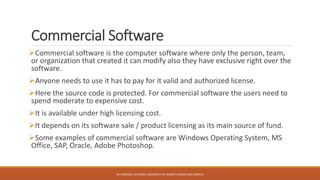
Commercial software is the computer software where only the person, team,
or organization that created it can modify also they have exclusive right over the
software.
Anyone needs to use it has to pay for it valid and authorized license.
Here the source code is protected. For commercial software the users need to
spend moderate to expensive cost.
It is available under high licensing cost.
It depends on its software sale / product licensing as its main source of fund.
Some examples of commercial software are Windows Operating System, MS
Office, SAP, Oracle, Adobe Photoshop.
M. HAROON, LECTURER, UNIVERSITY OF GUJRAT LAHORE SUB CAMPUS
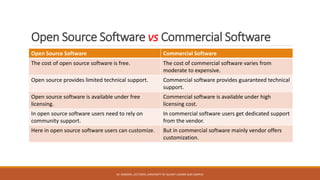
Open Source Software vs Commercial Software
Open Source Software Commercial Software
The cost of open source software is free. The cost of commercial software varies from
moderate to expensive.
Open source provides limited technical support. Commercial software provides guaranteed technical
support.
Open source software is available under free
licensing.
Commercial software is available under high
licensing cost.
In open source software users need to rely on
community support.
In commercial software users get dedicated support
from the vendor.
Here in open source software users can customize. But in commercial software mainly vendor offers
customization.
M. HAROON, LECTURER, UNIVERSITY OF GUJRAT LAHORE SUB CAMPUS
Freeware Software
Freeware is cost-free software but under copyright.
A freeware applications have its source code freely available.
The program itself does not cost and is completely usable without
charge, but that doesn’t mean that the program is editable and can
be transformed to create something new, or inspected to learn more
about the inner-workings.
Examples: Mozilla Firefox, Google Chrome, PDF Acrobat Reader,
Skype, Zoom etc.
M. HAROON, LECTURER, UNIVERSITY OF GUJRAT LAHORE SUB CAMPUS
Why Developers Release Freeware ?
Freeware often exists to advertise a developer's commercial
software.
This is usually done by giving out a version with similar but limited
features. For example, this edition might have advertisements or
some features might be locked down until a license is provided.
Some programs might be available at no cost because the installer
file advertises other paid-for programs that the user might click on to
generate revenue for the developer.
M. HAROON, LECTURER, UNIVERSITY OF GUJRAT LAHORE SUB CAMPUS
Shareware Software
Shareware software is a software that are freely distributed to users
on trial basis.
There is a time limit inbuilt in the software( for example- free for 30
days or 2 months).
As the time limit gets over, it will be deactivated. To use it after
time limit, you have to pay for the software.
Users prefer shareware because it helps to know about the product
before buying it
M. HAROON, LECTURER, UNIVERSITY OF GUJRAT LAHORE SUB CAMPUS
Proprietary software
Proprietary software refers to the software which is owned by an
individual or a company. There are restrictions on its distribution and
use. It is also sometimes known as closed-source software.
Examples: MacOS, Microsoft Windows Professional Edition, Adobe
Suite
M. HAROON, LECTURER, UNIVERSITY OF GUJRAT LAHORE SUB CAMPUS
Advantages
Stability – Its releases are stable throughout and the software does not
crash easily.
Reliable – It can be relied upon during handling of critical processes.
Uniqueness – It is unique in nature and does not have much alternatives.
Compatibility – It is compatible with many Operating systems.
M. HAROON, LECTURER, UNIVERSITY OF GUJRAT LAHORE SUB CAMPUS

Open source software, commercial software, freeware software, shareware software, proprietary software

  • 1.
    Open Source Software CommercialSoftware Freeware Software Shareware Software Proprietary Software PROFESSIONAL PRACTICES (CS-341) M. HAROON, LECTURER, UNIVERSITY OF GUJRAT LAHORE SUB CAMPUS
  • 2.
    Open Source Software Opensource software is the computer software developed either by an individual, group or an organization to meet certain requirements and it is available for any modifications based on its developing body’s interest. Open source software is published openly for general public and here the source code is open for all. For open source software the users do not need to spend any cost. It is available under free licensing. It depends on donations and support as its main source of find. Some examples of open source software are Firefox, OpenOffice, Zimbra, VCL media player, Thunderbird. M. HAROON, LECTURER, UNIVERSITY OF GUJRAT LAHORE SUB CAMPUS
  • 3.
    Commercial Software Commercial softwareis the computer software where only the person, team, or organization that created it can modify also they have exclusive right over the software. Anyone needs to use it has to pay for it valid and authorized license. Here the source code is protected. For commercial software the users need to spend moderate to expensive cost. It is available under high licensing cost. It depends on its software sale / product licensing as its main source of fund. Some examples of commercial software are Windows Operating System, MS Office, SAP, Oracle, Adobe Photoshop. M. HAROON, LECTURER, UNIVERSITY OF GUJRAT LAHORE SUB CAMPUS
  • 4.
    Open Source Softwarevs Commercial Software Open Source Software Commercial Software The cost of open source software is free. The cost of commercial software varies from moderate to expensive. Open source provides limited technical support. Commercial software provides guaranteed technical support. Open source software is available under free licensing. Commercial software is available under high licensing cost. In open source software users need to rely on community support. In commercial software users get dedicated support from the vendor. Here in open source software users can customize. But in commercial software mainly vendor offers customization. M. HAROON, LECTURER, UNIVERSITY OF GUJRAT LAHORE SUB CAMPUS
  • 5.
    Freeware Software Freeware iscost-free software but under copyright. A freeware applications have its source code freely available. The program itself does not cost and is completely usable without charge, but that doesn’t mean that the program is editable and can be transformed to create something new, or inspected to learn more about the inner-workings. Examples: Mozilla Firefox, Google Chrome, PDF Acrobat Reader, Skype, Zoom etc. M. HAROON, LECTURER, UNIVERSITY OF GUJRAT LAHORE SUB CAMPUS
  • 6.
    Why Developers ReleaseFreeware ? Freeware often exists to advertise a developer's commercial software. This is usually done by giving out a version with similar but limited features. For example, this edition might have advertisements or some features might be locked down until a license is provided. Some programs might be available at no cost because the installer file advertises other paid-for programs that the user might click on to generate revenue for the developer. M. HAROON, LECTURER, UNIVERSITY OF GUJRAT LAHORE SUB CAMPUS
  • 7.
    Shareware Software Shareware softwareis a software that are freely distributed to users on trial basis. There is a time limit inbuilt in the software( for example- free for 30 days or 2 months). As the time limit gets over, it will be deactivated. To use it after time limit, you have to pay for the software. Users prefer shareware because it helps to know about the product before buying it M. HAROON, LECTURER, UNIVERSITY OF GUJRAT LAHORE SUB CAMPUS
  • 8.
    Proprietary software Proprietary softwarerefers to the software which is owned by an individual or a company. There are restrictions on its distribution and use. It is also sometimes known as closed-source software. Examples: MacOS, Microsoft Windows Professional Edition, Adobe Suite M. HAROON, LECTURER, UNIVERSITY OF GUJRAT LAHORE SUB CAMPUS
  • 9.
    Advantages Stability – Itsreleases are stable throughout and the software does not crash easily. Reliable – It can be relied upon during handling of critical processes. Uniqueness – It is unique in nature and does not have much alternatives. Compatibility – It is compatible with many Operating systems. M. HAROON, LECTURER, UNIVERSITY OF GUJRAT LAHORE SUB CAMPUS