Development lifecycle models
• Types of Software developing life cycles
(SDLC)
• Waterfall Model
• V-Shaped Model
• Evolutionary Prototyping Model
• Spiral Method (SDM)
• Iterative and Incremental Method
• Agile developmen
Waterfall Model
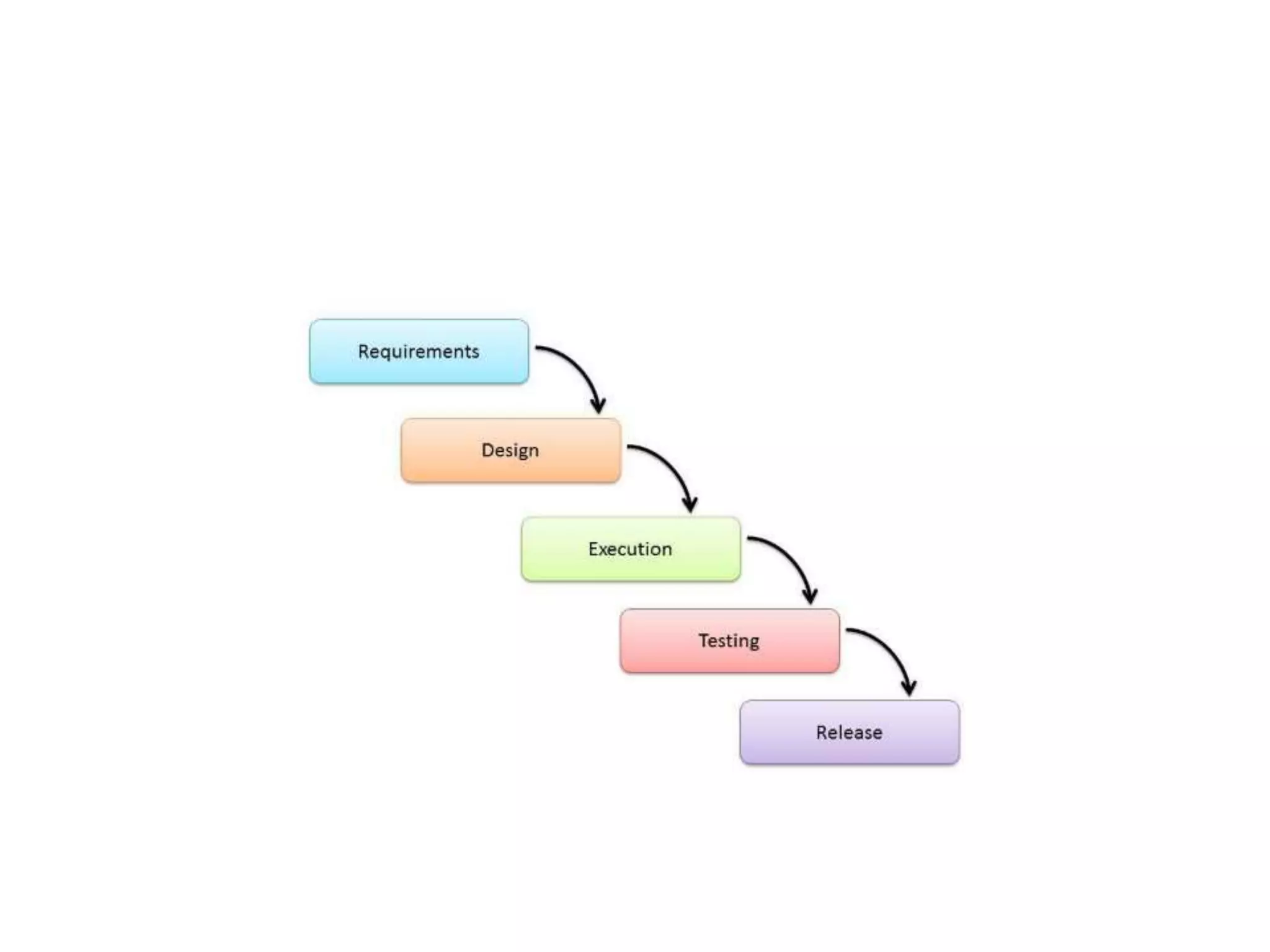
• The Waterfall Model is a linear sequential flow. In
which progress is seen as flowing steadily
downwards (like a waterfall) through the phases
of software implementation. This means that any
phase in the development process begins only if
the previous phase is complete. The waterfall
approach does not define the process to go back
to the previous phase to handle changes in
requirement. The waterfall approach is the
earliest approach and most widely known that
was used for software development.
The usage
• For projects which not focus on changing the
requirements, for example, projects initiated
from a request for proposals (RFPs), the
customer has very clear documented
requirements
Advantages
• Easy to explain to the users.
• Structures approach.
• Stages and activities are well defined.
• Helps to plan and schedule the project.
• Verification at each stage ensures early
detection of errors/misunderstandings.
• Each phase has specific deliverables.
Disadvantages
• Assumes that the requirements of a system
can be frozen.
• Very difficult to go back to any stage after it is
finished.
•
A little flexibility and adjusting the scope are
difficult and expensive.
• Costly and required more time, in addition to
the detailed plan.
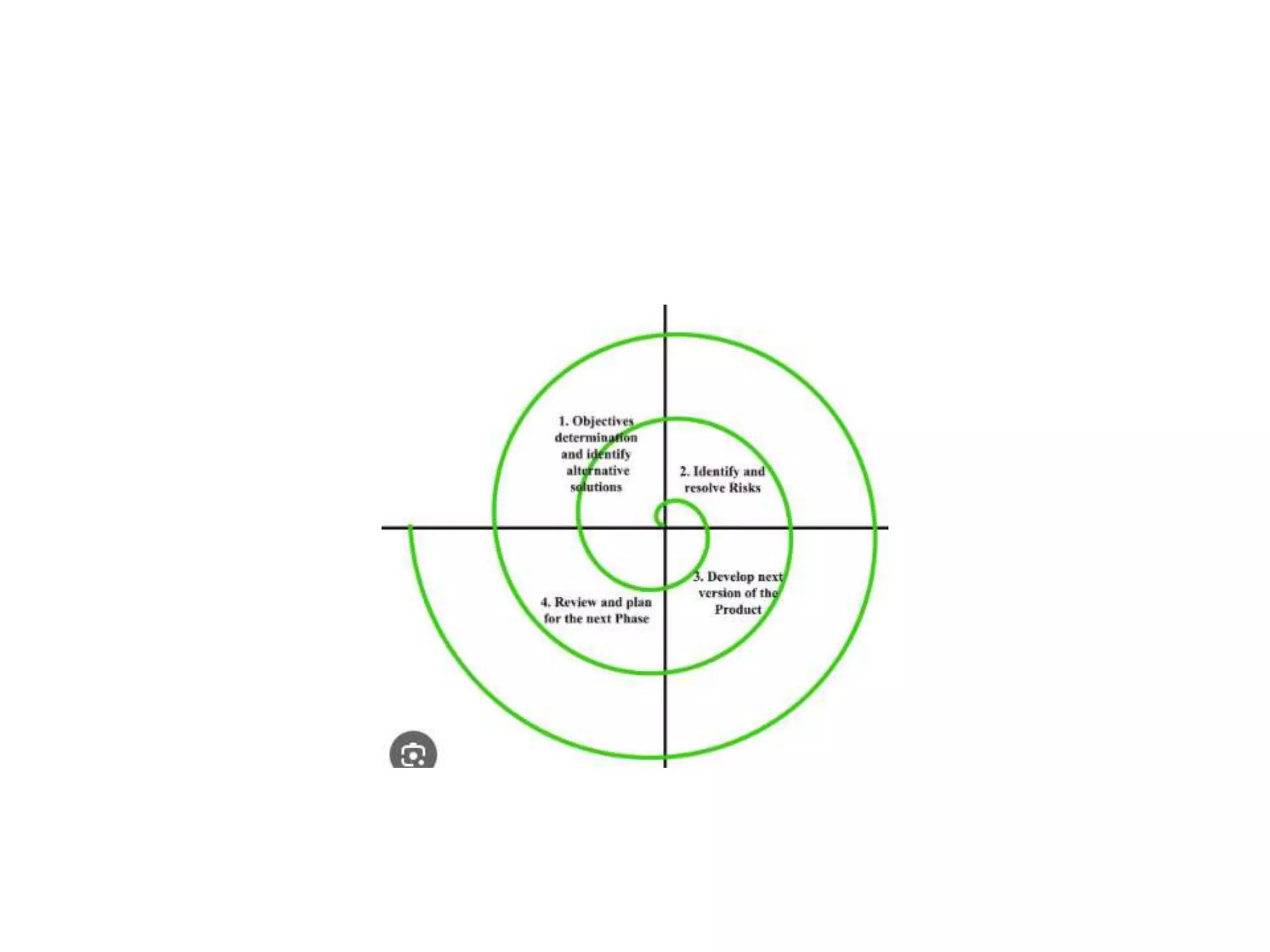
Spiral Model Description
(SDM)
• It is combining elements of both design and
prototyping-in-stages, in an effort to combine
advantages of top-down and bottom-up
concepts. This model of development combines
the features of the prototyping model and the
waterfall model. The spiral model is favored for
large, expensive, and complicated projects. This
model uses many of the same phases as the
waterfall model, in essentially the same order,
separated by planning, risk assessment, and the
building of prototypes and simulations.
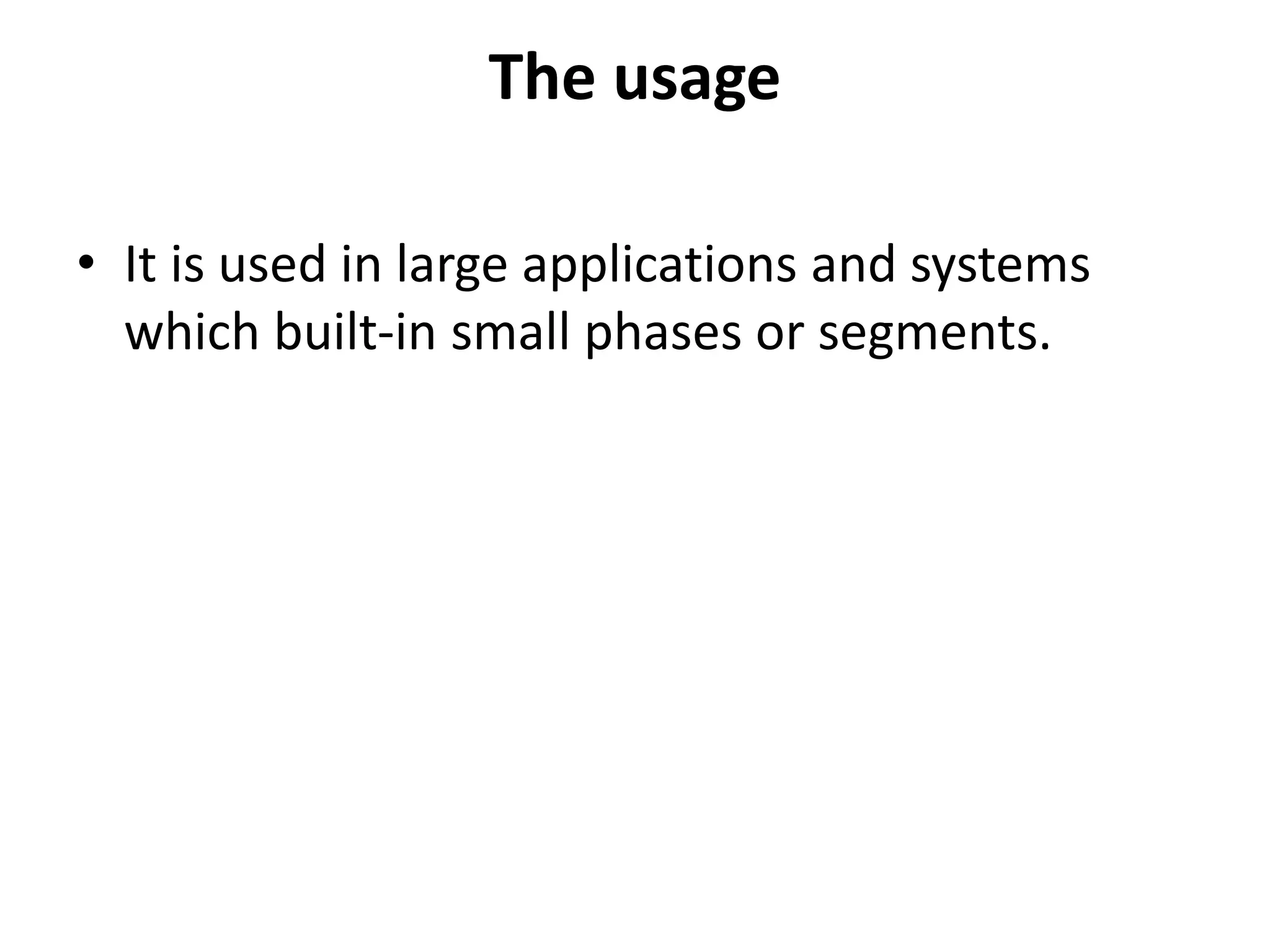
The usage
• It is used in large applications and systems
which built-in small phases or segments.
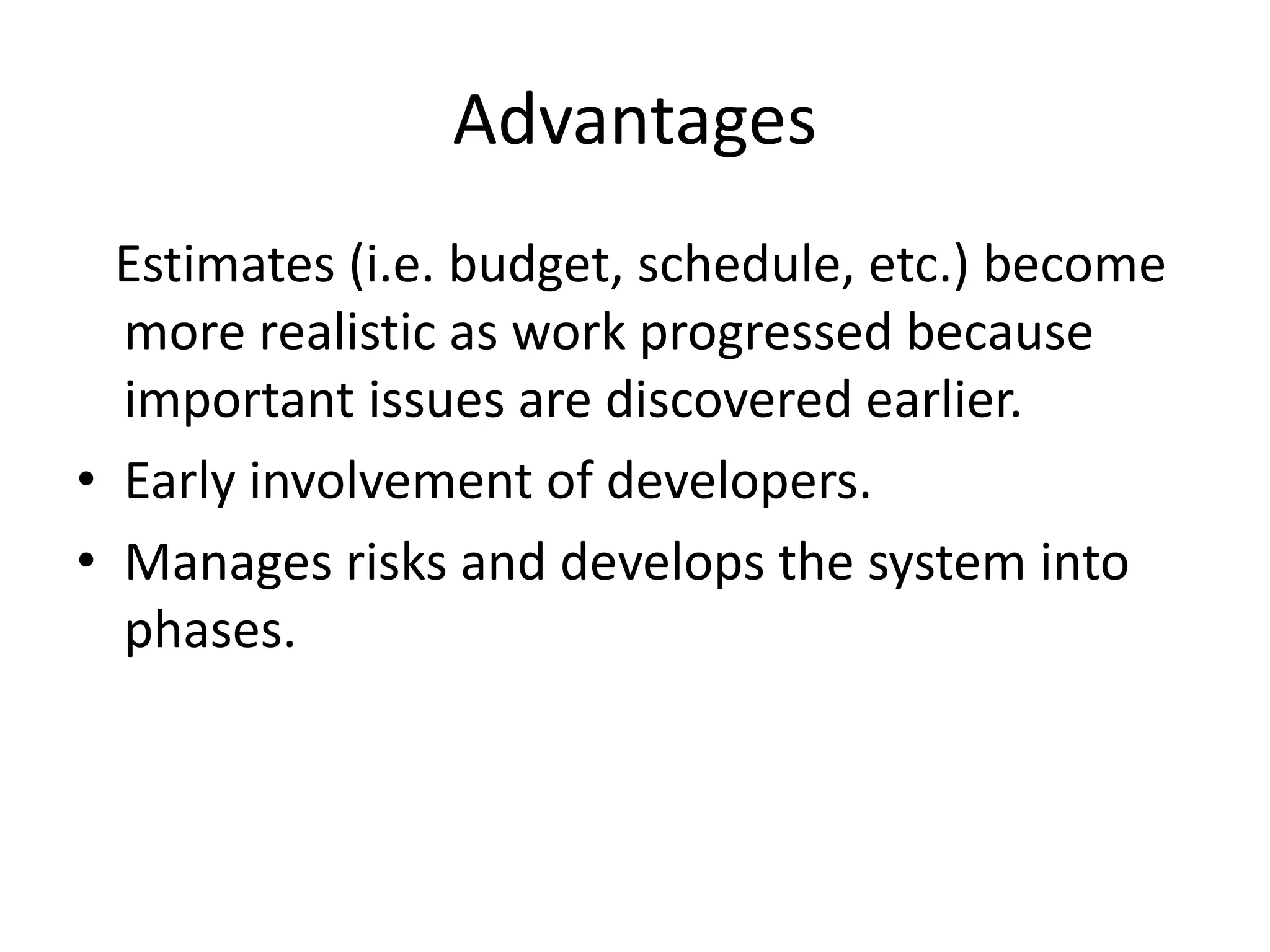
Advantages
Estimates (i.e. budget, schedule, etc.) become
more realistic as work progressed because
important issues are discovered earlier.
• Early involvement of developers.
• Manages risks and develops the system into
phases.
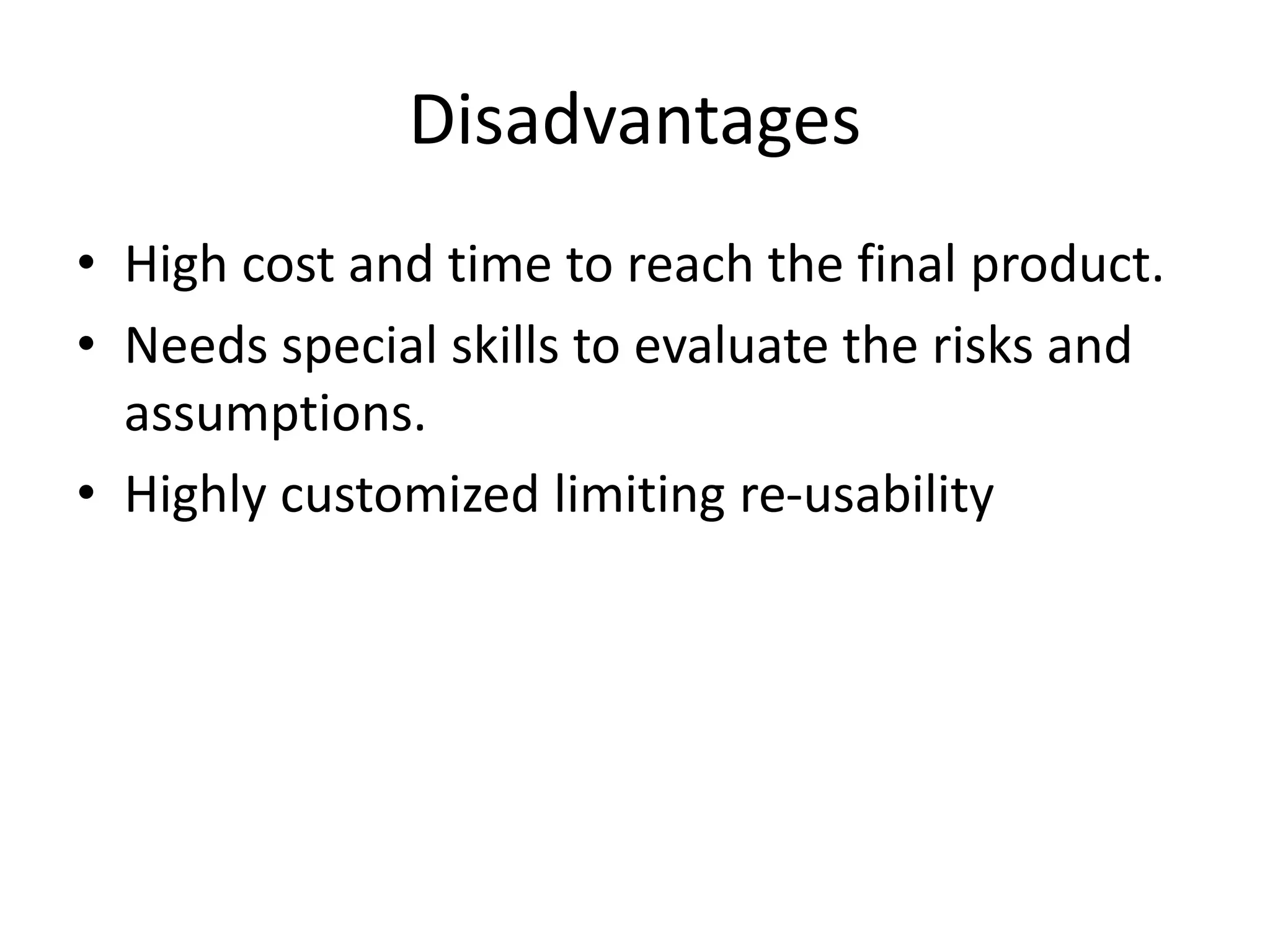
Disadvantages
• High cost and time to reach the final product.
• Needs special skills to evaluate the risks and
assumptions.
• Highly customized limiting re-usability
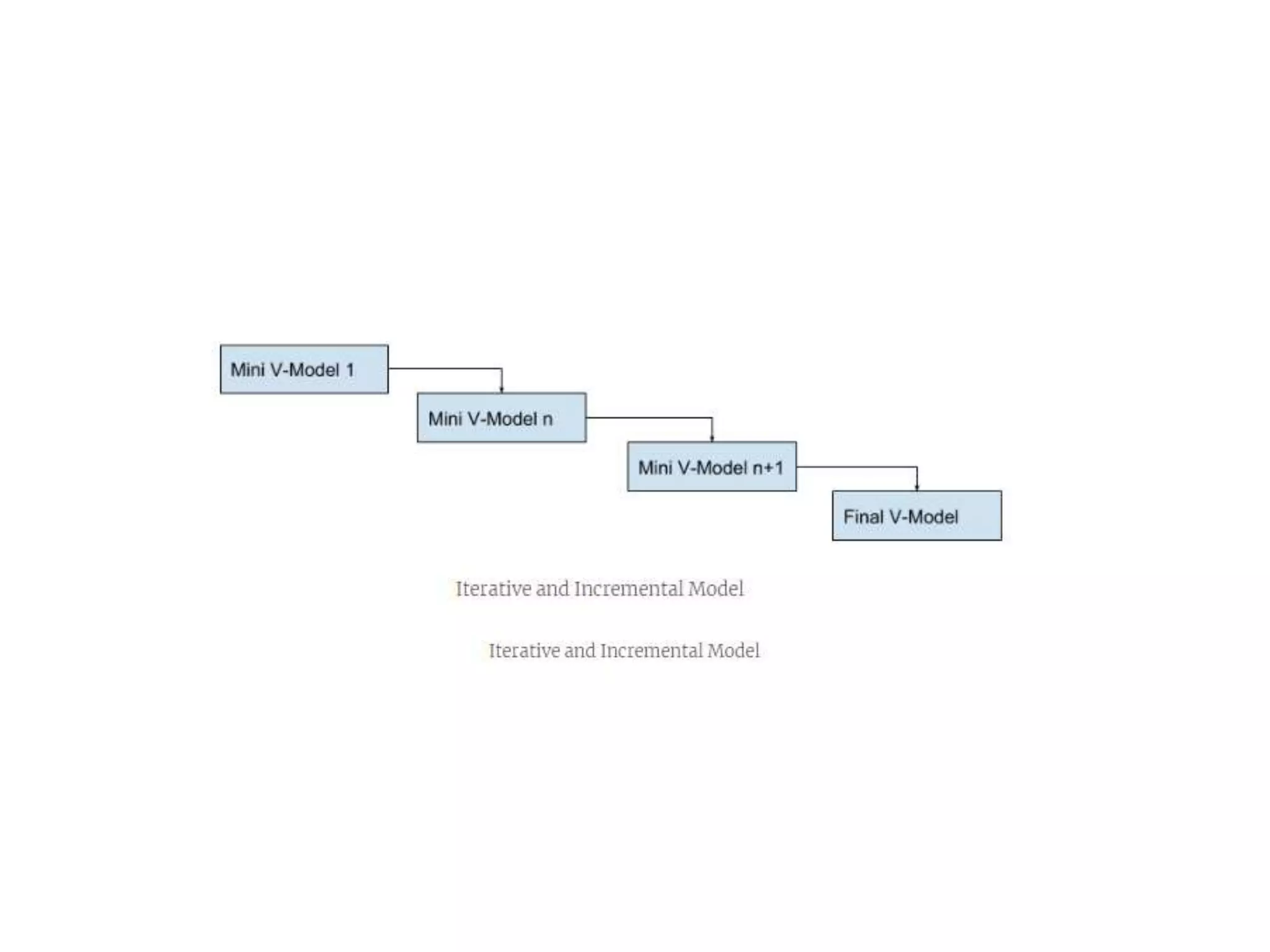
Iterative and Incremental Model
• It is developed to overcome the weaknesses of
the waterfall model. It starts with initial planning
and ends with deployment with the cyclic
interactions in between. The basic idea behind
this method is to develop a system through
repeated cycles (iterative) and in smaller portions
at a time (incremental), allowing software
developers to take advantage of what was
learned during the development of earlier parts
or versions of the system. It can consist of mini
waterfalls or mini V-Shaped models.
The usage
• It is used in shrink-wrap applications and large
systems which built-in small phases or
segments. Also, can be used in a system that
has separated components, for example, an
ERP system. Which we can start with the
budget module as a first iteration and then we
can start with the inventory module and so
forth.
Advantages
• Produces business value early in the
development lifecycle.
• Better use of scarce resources through proper
increment definition.
• Can accommodate some change requests
between increments.
• More focused on customer value than the linear
approaches.
• We can detect project issues and changes earlier.
Disadvantages
• Requires heavy documentation.
• Follows a defined set of processes.
• Defines increments based on function and feature
dependencies.
• Requires more customer involvement than the linear
approaches.
• Partitioning the functions and features might be
problematic.
• Integration between the iterations can be an issue if it
is not considered during the development and project
planning.

null-1.pptx

  • 1.
  • 2.
    • Types ofSoftware developing life cycles (SDLC) • Waterfall Model • V-Shaped Model • Evolutionary Prototyping Model • Spiral Method (SDM) • Iterative and Incremental Method • Agile developmen
  • 3.
    Waterfall Model • TheWaterfall Model is a linear sequential flow. In which progress is seen as flowing steadily downwards (like a waterfall) through the phases of software implementation. This means that any phase in the development process begins only if the previous phase is complete. The waterfall approach does not define the process to go back to the previous phase to handle changes in requirement. The waterfall approach is the earliest approach and most widely known that was used for software development.
  • 5.
    The usage • Forprojects which not focus on changing the requirements, for example, projects initiated from a request for proposals (RFPs), the customer has very clear documented requirements
  • 6.
    Advantages • Easy toexplain to the users. • Structures approach. • Stages and activities are well defined. • Helps to plan and schedule the project. • Verification at each stage ensures early detection of errors/misunderstandings. • Each phase has specific deliverables.
  • 7.
    Disadvantages • Assumes thatthe requirements of a system can be frozen. • Very difficult to go back to any stage after it is finished. • A little flexibility and adjusting the scope are difficult and expensive. • Costly and required more time, in addition to the detailed plan.
  • 8.
    Spiral Model Description (SDM) •It is combining elements of both design and prototyping-in-stages, in an effort to combine advantages of top-down and bottom-up concepts. This model of development combines the features of the prototyping model and the waterfall model. The spiral model is favored for large, expensive, and complicated projects. This model uses many of the same phases as the waterfall model, in essentially the same order, separated by planning, risk assessment, and the building of prototypes and simulations.
  • 10.
    The usage • Itis used in large applications and systems which built-in small phases or segments.
  • 11.
    Advantages Estimates (i.e. budget,schedule, etc.) become more realistic as work progressed because important issues are discovered earlier. • Early involvement of developers. • Manages risks and develops the system into phases.
  • 12.
    Disadvantages • High costand time to reach the final product. • Needs special skills to evaluate the risks and assumptions. • Highly customized limiting re-usability
  • 13.
    Iterative and IncrementalModel • It is developed to overcome the weaknesses of the waterfall model. It starts with initial planning and ends with deployment with the cyclic interactions in between. The basic idea behind this method is to develop a system through repeated cycles (iterative) and in smaller portions at a time (incremental), allowing software developers to take advantage of what was learned during the development of earlier parts or versions of the system. It can consist of mini waterfalls or mini V-Shaped models.
  • 14.
    The usage • Itis used in shrink-wrap applications and large systems which built-in small phases or segments. Also, can be used in a system that has separated components, for example, an ERP system. Which we can start with the budget module as a first iteration and then we can start with the inventory module and so forth.
  • 16.
    Advantages • Produces businessvalue early in the development lifecycle. • Better use of scarce resources through proper increment definition. • Can accommodate some change requests between increments. • More focused on customer value than the linear approaches. • We can detect project issues and changes earlier.
  • 17.
    Disadvantages • Requires heavydocumentation. • Follows a defined set of processes. • Defines increments based on function and feature dependencies. • Requires more customer involvement than the linear approaches. • Partitioning the functions and features might be problematic. • Integration between the iterations can be an issue if it is not considered during the development and project planning.