SOFTWARE ENGINEERING
UNIT-I
Ms SURBHI SAROHA(Assistant Professor) 1
Software engineering
 Software Engineering is the application
of engineering to the development of software in a
systematic method.
 "The application of a systematic, disciplined,
quantifiable approach to the development,
operation, and maintenance of software"—
IEEE Standard Glossary of Software Engineering
Terminology
Ms SURBHI SAROHA(Assistant Professor) 2
Software Life Cycle Models
 The goal of Software Engineering is to provide
models and processes that lead to the production of
well-documented maintainable software in a
manner that is predictable.
Ms SURBHI SAROHA(Assistant Professor) 3
Software Life Cycle Models
 “The period of time that starts when a software product is
conceived and ends when the product is no longer
available for use.
 The software life cycle typically includes a requirement
phase, design phase, implementation phase, test phase,
installation and check out phase, operation and
maintenance phase, and sometimes retirement phase”.
Ms SURBHI SAROHA(Assistant Professor) 4
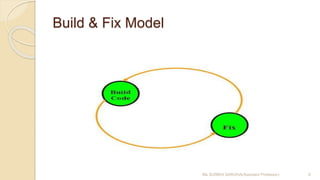
Build & Fix Model
 Build
 Code
 Fix
 Product is constructed without
specifications or any attempt at design
Adhoc approach and not well defined
Simple two phase model
Ms SURBHI SAROHA(Assistant Professor) 5
Build & Fix Model
Ms SURBHI SAROHA(Assistant Professor) 6
Build & Fix Model
Suitable for small programming exercises of
100 or 200 lines
Unsatisfactory for software for any
reasonable size
Code soon becomes unfixable &
unenhanceable
No room for structured design
Maintenance is practically not possible
Ms SURBHI SAROHA(Assistant Professor) 7
Waterfall Model
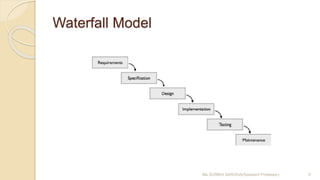
 This model is named “waterfall model” because its
diagrammatic representation resembles a cascade of
waterfalls.
Ms SURBHI SAROHA(Assistant Professor) 8
Waterfall Model
Ms SURBHI SAROHA(Assistant Professor) 9
Problems of waterfall model
 It is difficult to define all requirements at the
beginning of a project
 This model is not suitable for accommodating any
change
 A working version of the system is not seen until late
in the project’s life
 It does not scale up well to large projects.
 Real projects are rarely sequential.
Ms SURBHI SAROHA(Assistant Professor) 10
Incremental Process Model
 They are effective in the situations where
requirements are defined precisely and there is no
confusion about the functionality of the final product.
 After every cycle a useable product is given to the
customer.
Popular particularly when we have to quickly
deliver a limited functionality system.
Ms SURBHI SAROHA(Assistant Professor) 11
Iterative Enhancement Model
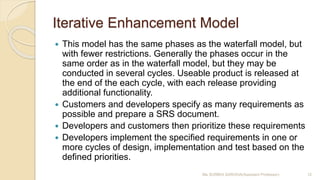
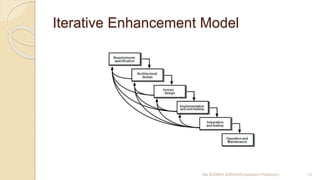
 This model has the same phases as the waterfall model, but
with fewer restrictions. Generally the phases occur in the
same order as in the waterfall model, but they may be
conducted in several cycles. Useable product is released at
the end of the each cycle, with each release providing
additional functionality.
 Customers and developers specify as many requirements as
possible and prepare a SRS document.
 Developers and customers then prioritize these requirements
 Developers implement the specified requirements in one or
more cycles of design, implementation and test based on the
defined priorities.
Ms SURBHI SAROHA(Assistant Professor) 12
Iterative Enhancement Model
Ms SURBHI SAROHA(Assistant Professor) 13
Rapid Application Development(RAD) Model
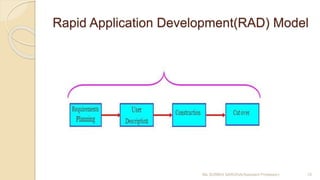
◦ Build a rapid prototype
◦ Give it to user for evaluation & obtain feedback
◦ Prototype is refined
 With active participation of users
Ms SURBHI SAROHA(Assistant Professor) 14
Rapid Application Development(RAD) Model
Ms SURBHI SAROHA(Assistant Professor) 15
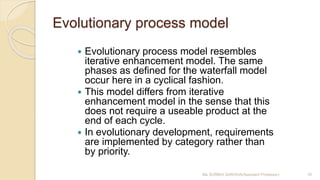
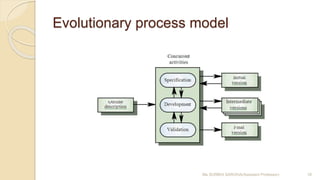
Evolutionary process model
 Evolutionary process model resembles
iterative enhancement model. The same
phases as defined for the waterfall model
occur here in a cyclical fashion.
 This model differs from iterative
enhancement model in the sense that this
does not require a useable product at the
end of each cycle.
 In evolutionary development, requirements
are implemented by category rather than
by priority.
Ms SURBHI SAROHA(Assistant Professor) 16
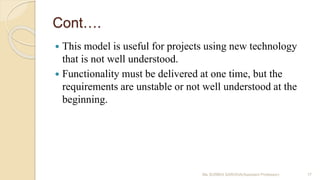
Cont….
 This model is useful for projects using new technology
that is not well understood.
 Functionality must be delivered at one time, but the
requirements are unstable or not well understood at the
beginning.
Ms SURBHI SAROHA(Assistant Professor) 17
Evolutionary process model
Ms SURBHI SAROHA(Assistant Professor) 18
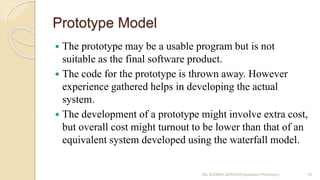
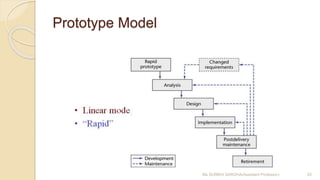
Prototype Model
 The prototype may be a usable program but is not
suitable as the final software product.
 The code for the prototype is thrown away. However
experience gathered helps in developing the actual
system.
 The development of a prototype might involve extra cost,
but overall cost might turnout to be lower than that of an
equivalent system developed using the waterfall model.
Ms SURBHI SAROHA(Assistant Professor) 19
Prototype Model
Ms SURBHI SAROHA(Assistant Professor) 20
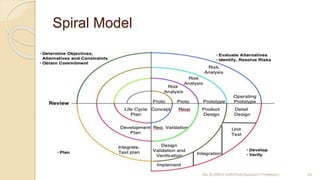
Spiral Model
 Models do not deal with uncertainly which is
inherent to software projects.
 Important software projects have failed
because project risks were neglected & nobody
was prepared when something unforeseen
happened.
 Barry Boehm recognized this and tired to
incorporate the “project risk” factor into a life
cycle model.
 The result is the spiral model, which was
presented in 1986.
Ms SURBHI SAROHA(Assistant Professor) 21
Spiral Model
 The radial dimension of the model represents the cumulative
costs. Each path around the spiral is indicative of increased
costs. The angular dimension represents the progress made in
completing each cycle. Each loop of the spiral from X-axis
clockwise through 360o represents one phase. One phase is
split roughly into four sectors of major activities.
 Planning: Determination of objectives, alternatives &
constraints.
 Risk Analysis: Analyze alternatives and attempts to
identify and resolve the risks involved.
 Development: Product development and testing product.
 Assessment: Customer evaluation
Ms SURBHI SAROHA(Assistant Professor) 22
Cont…
 An important feature of the spiral model is that each phase is
completed with a review by the people concerned with the project
(designers and programmers)
 The advantage of this model is the wide range of options to
accommodate the good features of other life cycle models.
 It becomes equivalent to another life cycle model in appropriate
situations.
 The spiral model has some difficulties that need to be resolved
before it can be a universally applied life cycle model. These
difficulties include lack of explicit process guidance in determining
objectives, constraints, alternatives; relying on risk assessment
expertise; and provides more flexibility than required for many
applications.
Ms SURBHI SAROHA(Assistant Professor) 23
Spiral Model
Ms SURBHI SAROHA(Assistant Professor) 24
Ms SURBHI SAROHA(Assistant Professor) 25
 THANK YOU

Software Engineering(unit 1)

  • 1.
    SOFTWARE ENGINEERING UNIT-I Ms SURBHISAROHA(Assistant Professor) 1
  • 2.
    Software engineering  SoftwareEngineering is the application of engineering to the development of software in a systematic method.  "The application of a systematic, disciplined, quantifiable approach to the development, operation, and maintenance of software"— IEEE Standard Glossary of Software Engineering Terminology Ms SURBHI SAROHA(Assistant Professor) 2
  • 3.
    Software Life CycleModels  The goal of Software Engineering is to provide models and processes that lead to the production of well-documented maintainable software in a manner that is predictable. Ms SURBHI SAROHA(Assistant Professor) 3
  • 4.
    Software Life CycleModels  “The period of time that starts when a software product is conceived and ends when the product is no longer available for use.  The software life cycle typically includes a requirement phase, design phase, implementation phase, test phase, installation and check out phase, operation and maintenance phase, and sometimes retirement phase”. Ms SURBHI SAROHA(Assistant Professor) 4
  • 5.
    Build & FixModel  Build  Code  Fix  Product is constructed without specifications or any attempt at design Adhoc approach and not well defined Simple two phase model Ms SURBHI SAROHA(Assistant Professor) 5
  • 6.
    Build & FixModel Ms SURBHI SAROHA(Assistant Professor) 6
  • 7.
    Build & FixModel Suitable for small programming exercises of 100 or 200 lines Unsatisfactory for software for any reasonable size Code soon becomes unfixable & unenhanceable No room for structured design Maintenance is practically not possible Ms SURBHI SAROHA(Assistant Professor) 7
  • 8.
    Waterfall Model  Thismodel is named “waterfall model” because its diagrammatic representation resembles a cascade of waterfalls. Ms SURBHI SAROHA(Assistant Professor) 8
  • 9.
    Waterfall Model Ms SURBHISAROHA(Assistant Professor) 9
  • 10.
    Problems of waterfallmodel  It is difficult to define all requirements at the beginning of a project  This model is not suitable for accommodating any change  A working version of the system is not seen until late in the project’s life  It does not scale up well to large projects.  Real projects are rarely sequential. Ms SURBHI SAROHA(Assistant Professor) 10
  • 11.
    Incremental Process Model They are effective in the situations where requirements are defined precisely and there is no confusion about the functionality of the final product.  After every cycle a useable product is given to the customer. Popular particularly when we have to quickly deliver a limited functionality system. Ms SURBHI SAROHA(Assistant Professor) 11
  • 12.
    Iterative Enhancement Model This model has the same phases as the waterfall model, but with fewer restrictions. Generally the phases occur in the same order as in the waterfall model, but they may be conducted in several cycles. Useable product is released at the end of the each cycle, with each release providing additional functionality.  Customers and developers specify as many requirements as possible and prepare a SRS document.  Developers and customers then prioritize these requirements  Developers implement the specified requirements in one or more cycles of design, implementation and test based on the defined priorities. Ms SURBHI SAROHA(Assistant Professor) 12
  • 13.
    Iterative Enhancement Model MsSURBHI SAROHA(Assistant Professor) 13
  • 14.
    Rapid Application Development(RAD)Model ◦ Build a rapid prototype ◦ Give it to user for evaluation & obtain feedback ◦ Prototype is refined  With active participation of users Ms SURBHI SAROHA(Assistant Professor) 14
  • 15.
    Rapid Application Development(RAD)Model Ms SURBHI SAROHA(Assistant Professor) 15
  • 16.
    Evolutionary process model Evolutionary process model resembles iterative enhancement model. The same phases as defined for the waterfall model occur here in a cyclical fashion.  This model differs from iterative enhancement model in the sense that this does not require a useable product at the end of each cycle.  In evolutionary development, requirements are implemented by category rather than by priority. Ms SURBHI SAROHA(Assistant Professor) 16
  • 17.
    Cont….  This modelis useful for projects using new technology that is not well understood.  Functionality must be delivered at one time, but the requirements are unstable or not well understood at the beginning. Ms SURBHI SAROHA(Assistant Professor) 17
  • 18.
    Evolutionary process model MsSURBHI SAROHA(Assistant Professor) 18
  • 19.
    Prototype Model  Theprototype may be a usable program but is not suitable as the final software product.  The code for the prototype is thrown away. However experience gathered helps in developing the actual system.  The development of a prototype might involve extra cost, but overall cost might turnout to be lower than that of an equivalent system developed using the waterfall model. Ms SURBHI SAROHA(Assistant Professor) 19
  • 20.
    Prototype Model Ms SURBHISAROHA(Assistant Professor) 20
  • 21.
    Spiral Model  Modelsdo not deal with uncertainly which is inherent to software projects.  Important software projects have failed because project risks were neglected & nobody was prepared when something unforeseen happened.  Barry Boehm recognized this and tired to incorporate the “project risk” factor into a life cycle model.  The result is the spiral model, which was presented in 1986. Ms SURBHI SAROHA(Assistant Professor) 21
  • 22.
    Spiral Model  Theradial dimension of the model represents the cumulative costs. Each path around the spiral is indicative of increased costs. The angular dimension represents the progress made in completing each cycle. Each loop of the spiral from X-axis clockwise through 360o represents one phase. One phase is split roughly into four sectors of major activities.  Planning: Determination of objectives, alternatives & constraints.  Risk Analysis: Analyze alternatives and attempts to identify and resolve the risks involved.  Development: Product development and testing product.  Assessment: Customer evaluation Ms SURBHI SAROHA(Assistant Professor) 22
  • 23.
    Cont…  An importantfeature of the spiral model is that each phase is completed with a review by the people concerned with the project (designers and programmers)  The advantage of this model is the wide range of options to accommodate the good features of other life cycle models.  It becomes equivalent to another life cycle model in appropriate situations.  The spiral model has some difficulties that need to be resolved before it can be a universally applied life cycle model. These difficulties include lack of explicit process guidance in determining objectives, constraints, alternatives; relying on risk assessment expertise; and provides more flexibility than required for many applications. Ms SURBHI SAROHA(Assistant Professor) 23
  • 24.
    Spiral Model Ms SURBHISAROHA(Assistant Professor) 24
  • 25.
    Ms SURBHI SAROHA(AssistantProfessor) 25  THANK YOU