SDLC Models
Waterfall
Iterative Waterfall
Spiral
OUR PRESENTATION TOPIC IS
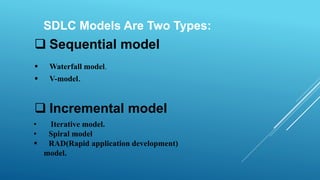
 Sequential model
 Waterfall model.
 V-model.
 Incremental model
• Iterative model.
• Spiral model
 RAD(Rapid application development)
model.
SDLC Models Are Two Types:
1)The first formal description of the waterfall
model is often cited as a 1970 article by
Winston W. Royce
2)Royce did not use the term "waterfall" in
this article.
3)Royce presented this model as an example
of a flawed, non-working model.
o A Water Fall Model is easy to flow.
o It can be implemented for any size of project.
o Every stage has to be done separately at the right
time so you cannot jump stages.
o Documentation is produced at every stage of a
waterfall model allowing people to understand what
has been done.
o Testing is done at every stage.
Where to use the
waterfall model?
 Requirements are very well known.
 Product definition is stable.
 Technology is understood.
 New version of an existing product.
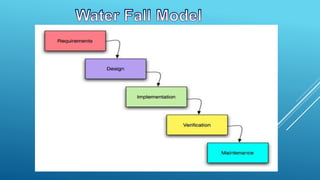
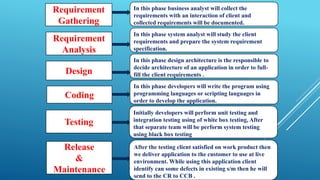
Requirement
Gathering
Requirement
Analysis
Design
Coding
Testing
Release
&
Maintenance
In this phase business analyst will collect the
requirements with an interaction of client and
collected requirements will be documented.
In this phase system analyst will study the client
requirements and prepare the system requirement
specification.
In this phase design architecture is the responsible to
decide architecture of an application in order to full-
fill the client requirements .
In this phase developers will write the program using
programming languages or scripting languages in
order to develop the application.
Initially developers will perform unit testing and
integration testing using of white box testing, After
that separate team will be perform system testing
using black box testing
After the testing client satisfied on work product then
we deliver application to the customer to use at live
environment. While using this application client
identify can some defects in existing s/m then he will
send to the CR to CCB .
ADVANTAGES
o A waterfall model is easy to implementation.
o It helps to find errors earlier
o Easy to understand, easy to use.
o Works well when quality is more important
than cost or schedule
o Documentation is produced at every stage of a
waterfall model allowing people to understand
what has been done.
o Testing is done at every stage.
Disadvantages
 It is only suitable for the small size projects.
 Constant testing of the design is needed.
 If requirements may change the Waterfall model may
not work.
 Difficult to estimate time and cost for each stage of
the development process.
 Adjust scope during the life cycle can kill a project.
 High amount of risk and uncertainty.
 This model is not suitable to handle dynamic changes
in the requirements
INTRODUCTION OF ITERATIVE MODEL :
This model was not the first model to discuss iterative development.
 As originally envisioned, the iterations were typically 6 months to 2
years long.
 Each phase starts with a design goal and ends with the client (who
may be internal) reviewing the progress thus far.
 Analysis and engineering efforts are applied at each phase of the
project, with an eye toward the end goal of the project.
Iterative Waterfall
 This approach carries less risk than a traditional Waterfall approach but is still far more risky
and less efficient than a more Agile approaches.
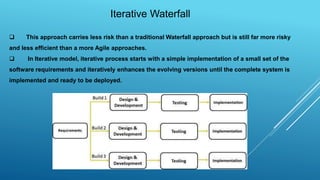
 In Iterative model, iterative process starts with a simple implementation of a small set of the
software requirements and iteratively enhances the evolving versions until the complete system is
implemented and ready to be deployed.
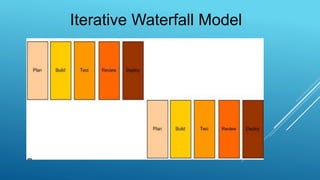
Iterative Waterfall Model
Iterative Waterfall
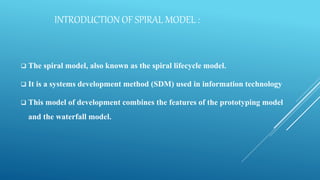
The design, development, integration, and testing (DDIT) stage is a sequential
process in a Waterfall project. The graphics below illustrate this difference:
Which model to use when?
• Waterfall- Use for small projects <1
month with clear requirements
• Iterative waterfall- Use for large projects
>6 months with unclear requirements or
requirements that may change or
need validating.
INTRODUCTION OF SPIRAL MODEL :
 The spiral model, also known as the spiral lifecycle model.
 It is a systems development method (SDM) used in information technology
 This model of development combines the features of the prototyping model
and the waterfall model.
WHAT IS SPIRAL MODEL?
The spiral model is similar to the incremental model, with more emphasis
placed on risk analysis.
The spiral model has four phases: Planning, Risk Analysis, Engineering
and Evaluation.
 Software project repeatedly passes through these four phases in
iterations (called Spirals).
The baseline spiral, starting in the planning phase, requirements are
gathered and risk is assessed. Each subsequent spirals builds on the
baseline spiral.
HISTORY
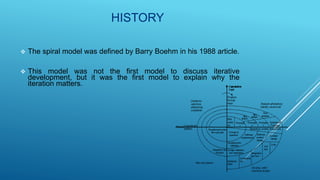
 The spiral model was defined by Barry Boehm in his 1988 article.
 This model was not the first model to discuss iterative
development, but it was the first model to explain why the
iteration matters.
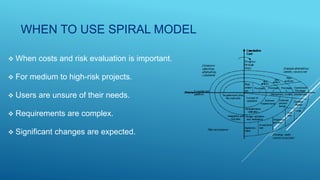
WHEN TO USE SPIRAL MODEL
 When costs and risk evaluation is important.
 For medium to high-risk projects.
 Users are unsure of their needs.
 Requirements are complex.
 Significant changes are expected.
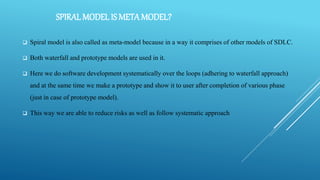
SPIRALMODEL IS METAMODEL?
 Spiral model is also called as meta-model because in a way it comprises of other models of SDLC.
 Both waterfall and prototype models are used in it.
 Here we do software development systematically over the loops (adhering to waterfall approach)
and at the same time we make a prototype and show it to user after completion of various phase
(just in case of prototype model).
 This way we are able to reduce risks as well as follow systematic approach
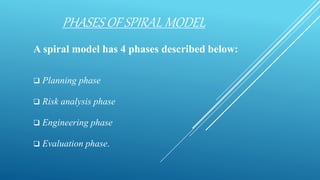
PHASES OF SPIRAL MODEL
A spiral model has 4 phases described below:
 Planning phase
 Risk analysis phase
 Engineering phase
 Evaluation phase.
PLANING
Requirements are studied and gathered.
Feasibility study
Reviews and walkthroughs to streamline the requirements
Requirements understanding document
Finalized list of requirements.
The project is reviewed and a decision made whether to continue with a
further loop of the spiral.
If it is decided to continue, plans are drawn up for the next phase of the
project.
RISK ANALYSIS
Requirements are studied and brain storming sessions are done to identify
the potential risks
Once the risks are identified , risk mitigation strategy is planned and
finalized
Document which highlights all the risks and its mitigation plans
ENGINEERING WORKS
 Actual development and testing if the software takes place in this
phase
 Code
 Test cases and test results
 Test summary report and defect report.
EVALUATION
 Customers evaluate the software and provide their feedback
and approval
 Features implemented document
ADVANTAGES :
 Development is fast
 Larger projects / software are created and handled in a strategic way
 Risk evaluation is proper.
 Control towards all the phases of development.
 More and more features are added in a systematic way.
 Software is produced early.
 Has room for customer feedback and the changes are implemented faster.
 Risk reduction mechanisms are in place.
 Supports iteration and reflects real-world practices –Systematic approach
DISADVANTAGES :
 Risk analysis is important phase so requires expert people.
 Is not beneficial for smaller projects.
 Spiral may go infinitely.
 Documentation is more as it has intermediate phases.
 Complex, relatively difficult to follow strictly.
 Applicable only to large systems
 It is costly for smaller projects.
COMPARISON
Spiral Model
Risk factors are considered.
The requirements are not
freeze.
works in loop.
costly as Risk factor is
covered.
Better communication between
developer and customer.
Waterfall model
Risk factors are not considered.
The requirements are freeze.
Is linear sequential model.
Not much costly.
Communication level is not high
Examples
o The US military had adopted the spiral model for its Future Combat Systems program.
The FCS project was cancelled after six years (2003–2009), it had a two year iteration
(spiral).
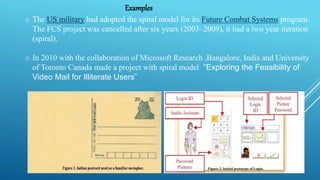
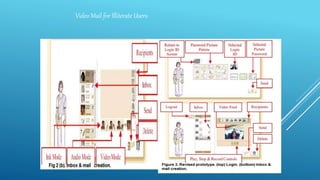
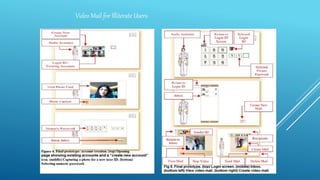
o In 2010 with the collaboration of Microsoft Research ,Bangalore, India and University
of Toronto Canada made a project with spiral model “Exploring the Feasibility of
Video Mail for Illiterate Users”
Video Mail for Illiterate Users
SDLC Model (Waterfall,Iterative Waterfall,Spiral)

SDLC Model (Waterfall,Iterative Waterfall,Spiral)

  • 1.
  • 2.
     Sequential model Waterfall model.  V-model.  Incremental model • Iterative model. • Spiral model  RAD(Rapid application development) model. SDLC Models Are Two Types:
  • 3.
    1)The first formaldescription of the waterfall model is often cited as a 1970 article by Winston W. Royce 2)Royce did not use the term "waterfall" in this article. 3)Royce presented this model as an example of a flawed, non-working model.
  • 4.
    o A WaterFall Model is easy to flow. o It can be implemented for any size of project. o Every stage has to be done separately at the right time so you cannot jump stages. o Documentation is produced at every stage of a waterfall model allowing people to understand what has been done. o Testing is done at every stage.
  • 5.
    Where to usethe waterfall model?  Requirements are very well known.  Product definition is stable.  Technology is understood.  New version of an existing product.
  • 7.
    Requirement Gathering Requirement Analysis Design Coding Testing Release & Maintenance In this phasebusiness analyst will collect the requirements with an interaction of client and collected requirements will be documented. In this phase system analyst will study the client requirements and prepare the system requirement specification. In this phase design architecture is the responsible to decide architecture of an application in order to full- fill the client requirements . In this phase developers will write the program using programming languages or scripting languages in order to develop the application. Initially developers will perform unit testing and integration testing using of white box testing, After that separate team will be perform system testing using black box testing After the testing client satisfied on work product then we deliver application to the customer to use at live environment. While using this application client identify can some defects in existing s/m then he will send to the CR to CCB .
  • 8.
    ADVANTAGES o A waterfallmodel is easy to implementation. o It helps to find errors earlier o Easy to understand, easy to use. o Works well when quality is more important than cost or schedule o Documentation is produced at every stage of a waterfall model allowing people to understand what has been done. o Testing is done at every stage.
  • 9.
    Disadvantages  It isonly suitable for the small size projects.  Constant testing of the design is needed.  If requirements may change the Waterfall model may not work.  Difficult to estimate time and cost for each stage of the development process.  Adjust scope during the life cycle can kill a project.  High amount of risk and uncertainty.  This model is not suitable to handle dynamic changes in the requirements
  • 10.
    INTRODUCTION OF ITERATIVEMODEL : This model was not the first model to discuss iterative development.  As originally envisioned, the iterations were typically 6 months to 2 years long.  Each phase starts with a design goal and ends with the client (who may be internal) reviewing the progress thus far.  Analysis and engineering efforts are applied at each phase of the project, with an eye toward the end goal of the project.
  • 11.
    Iterative Waterfall  Thisapproach carries less risk than a traditional Waterfall approach but is still far more risky and less efficient than a more Agile approaches.  In Iterative model, iterative process starts with a simple implementation of a small set of the software requirements and iteratively enhances the evolving versions until the complete system is implemented and ready to be deployed.
  • 12.
  • 13.
    Iterative Waterfall The design,development, integration, and testing (DDIT) stage is a sequential process in a Waterfall project. The graphics below illustrate this difference:
  • 14.
    Which model touse when? • Waterfall- Use for small projects <1 month with clear requirements • Iterative waterfall- Use for large projects >6 months with unclear requirements or requirements that may change or need validating.
  • 15.
    INTRODUCTION OF SPIRALMODEL :  The spiral model, also known as the spiral lifecycle model.  It is a systems development method (SDM) used in information technology  This model of development combines the features of the prototyping model and the waterfall model.
  • 16.
    WHAT IS SPIRALMODEL? The spiral model is similar to the incremental model, with more emphasis placed on risk analysis. The spiral model has four phases: Planning, Risk Analysis, Engineering and Evaluation.  Software project repeatedly passes through these four phases in iterations (called Spirals). The baseline spiral, starting in the planning phase, requirements are gathered and risk is assessed. Each subsequent spirals builds on the baseline spiral.
  • 17.
    HISTORY  The spiralmodel was defined by Barry Boehm in his 1988 article.  This model was not the first model to discuss iterative development, but it was the first model to explain why the iteration matters.
  • 18.
    WHEN TO USESPIRAL MODEL  When costs and risk evaluation is important.  For medium to high-risk projects.  Users are unsure of their needs.  Requirements are complex.  Significant changes are expected.
  • 19.
    SPIRALMODEL IS METAMODEL? Spiral model is also called as meta-model because in a way it comprises of other models of SDLC.  Both waterfall and prototype models are used in it.  Here we do software development systematically over the loops (adhering to waterfall approach) and at the same time we make a prototype and show it to user after completion of various phase (just in case of prototype model).  This way we are able to reduce risks as well as follow systematic approach
  • 20.
    PHASES OF SPIRALMODEL A spiral model has 4 phases described below:  Planning phase  Risk analysis phase  Engineering phase  Evaluation phase.
  • 21.
    PLANING Requirements are studiedand gathered. Feasibility study Reviews and walkthroughs to streamline the requirements Requirements understanding document Finalized list of requirements. The project is reviewed and a decision made whether to continue with a further loop of the spiral. If it is decided to continue, plans are drawn up for the next phase of the project.
  • 22.
    RISK ANALYSIS Requirements arestudied and brain storming sessions are done to identify the potential risks Once the risks are identified , risk mitigation strategy is planned and finalized Document which highlights all the risks and its mitigation plans
  • 23.
    ENGINEERING WORKS  Actualdevelopment and testing if the software takes place in this phase  Code  Test cases and test results  Test summary report and defect report.
  • 24.
    EVALUATION  Customers evaluatethe software and provide their feedback and approval  Features implemented document
  • 25.
    ADVANTAGES :  Developmentis fast  Larger projects / software are created and handled in a strategic way  Risk evaluation is proper.  Control towards all the phases of development.  More and more features are added in a systematic way.  Software is produced early.  Has room for customer feedback and the changes are implemented faster.  Risk reduction mechanisms are in place.  Supports iteration and reflects real-world practices –Systematic approach
  • 26.
    DISADVANTAGES :  Riskanalysis is important phase so requires expert people.  Is not beneficial for smaller projects.  Spiral may go infinitely.  Documentation is more as it has intermediate phases.  Complex, relatively difficult to follow strictly.  Applicable only to large systems  It is costly for smaller projects.
  • 27.
    COMPARISON Spiral Model Risk factorsare considered. The requirements are not freeze. works in loop. costly as Risk factor is covered. Better communication between developer and customer. Waterfall model Risk factors are not considered. The requirements are freeze. Is linear sequential model. Not much costly. Communication level is not high
  • 28.
    Examples o The USmilitary had adopted the spiral model for its Future Combat Systems program. The FCS project was cancelled after six years (2003–2009), it had a two year iteration (spiral). o In 2010 with the collaboration of Microsoft Research ,Bangalore, India and University of Toronto Canada made a project with spiral model “Exploring the Feasibility of Video Mail for Illiterate Users”
  • 29.
    Video Mail forIlliterate Users
  • 30.
    Video Mail forIlliterate Users

Editor's Notes

  • #20 The systems development life cycle (SDLC).