Prepared By :Aditya Pareek
MBA 1st Year
 The

word decision has been derived from the
latin word ‘decidere’ which means cutting
away or cutting off,

A

decision involve a cut of alternative
between those that are desirable and those
are non desirable
 Decision

making is the developing concepts
leading to the selection of a course of action
among variations. Every decision making
process produces a final choice
 It can be an action or an opinion. It begins
when we need to do something but we do
not know what
 e.g. Decision to raise a Purchase Order
Cognition:Activities of mind associated with
knowledge
 Conation:The action of the mind implied by such
words as willing, desire etc..
 Affectation:The aspect of mind associated with
emotion, feeling, mood.

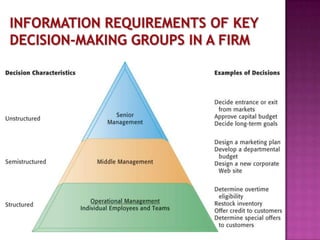
 Unstructured/
 Structured/

Nonprogrammed

Programmed

 Semi-structured
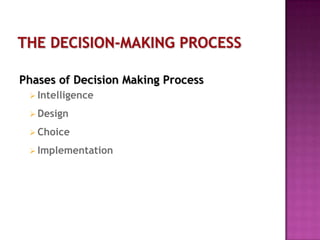
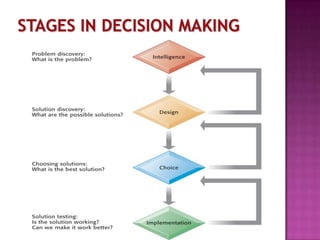
Phases of Decision Making Process
 Intelligence
 Design

 Choice
 Implementation
A

management information system (MIS)
provides information that organizations
require to manage themselves efficiently and
effectively.

 MIS

is set up by an organization with the
prime objective to obtain management
information to be used by its managers in
decision-making.
 The

term is commonly used to refer to the
study of how individuals, groups, and
organizations evaluate, design, implement,
manage, and utilize systems to generate
information to improve efficiency and
effectiveness of decision making
•

Help managers monitor and control a
business

•

Produce regular reports on
performance, such as monthly or annual
sales

•

Sometimes highlight exceptional
conditions

•

Reports often available online
 Data

Capturing:- MIS captures data from
various internal and external sources of an
organization
 Processing of data:-The captured data is
processed to convert it into the required
management information.
 Storage of information:-MIS stores processed
or unprocessed data for future use
 Retrieval

of information:-MIS retrieves
information from its stores as and when
required by various users.

 Dissemination

of MI:-Management
information, which is a finished product of
MIS, is disseminated to the users in the
organization.
Decision making and mis

Decision making and mis

  • 1.
    Prepared By :AdityaPareek MBA 1st Year
  • 2.
     The word decisionhas been derived from the latin word ‘decidere’ which means cutting away or cutting off, A decision involve a cut of alternative between those that are desirable and those are non desirable
  • 3.
     Decision making isthe developing concepts leading to the selection of a course of action among variations. Every decision making process produces a final choice  It can be an action or an opinion. It begins when we need to do something but we do not know what  e.g. Decision to raise a Purchase Order
  • 4.
    Cognition:Activities of mindassociated with knowledge  Conation:The action of the mind implied by such words as willing, desire etc..  Affectation:The aspect of mind associated with emotion, feeling, mood. 
  • 5.
  • 7.
    Phases of DecisionMaking Process  Intelligence  Design  Choice  Implementation
  • 10.
    A management information system(MIS) provides information that organizations require to manage themselves efficiently and effectively.  MIS is set up by an organization with the prime objective to obtain management information to be used by its managers in decision-making.
  • 11.
     The term iscommonly used to refer to the study of how individuals, groups, and organizations evaluate, design, implement, manage, and utilize systems to generate information to improve efficiency and effectiveness of decision making
  • 12.
    • Help managers monitorand control a business • Produce regular reports on performance, such as monthly or annual sales • Sometimes highlight exceptional conditions • Reports often available online
  • 13.
     Data Capturing:- MIScaptures data from various internal and external sources of an organization  Processing of data:-The captured data is processed to convert it into the required management information.  Storage of information:-MIS stores processed or unprocessed data for future use
  • 14.
     Retrieval of information:-MISretrieves information from its stores as and when required by various users.  Dissemination of MI:-Management information, which is a finished product of MIS, is disseminated to the users in the organization.