Welcomes to Departmentof Computer Application
Class: SYBBA(CA) [Sem – III]
Subject: – Software Engineering
Subject Teacher – Dr. Sunil B. Patil
1
MIT Arts Commerce and Science College
Alandi (D). Pune - 412105
2.
Ch 1Introduction to System Concepts
Content:
1.1 Definition
1.2 Basic Components
1.3 Elements of the System
1.4 Types of System
1.5 System Characteristics
2
3.
Introduction:
TheWord ‘System’ means different things to different things to different people.
A system is a group of interrelated components working together towards a
common goal, by accepting inputs and producing outputs in an organized
transformation process.
The interrelated components which are systematically arranged to form a system
are called subsystems.
In simple words, system is a set of elements which operate together to accomplish
an objective.
Systems may be physical, like the sun and its planets; biological like the human
body; technological, like an oil refinery; and socio-economic, like a business
organization.
In everyday life, we talk of education system, computer system, solar system,
transportation system, communication system, the body’s nervous system,
weapons system, accounting system, production system and so on. 3
4.
1.1 Definition:
A System is an integrated collection of components which satisfy function
necessary to archive the system’s goals and which have relationships to one
another that give cohesion to the system and define its structure.
System can be defined as a group of interrelated or interacting elements forming
a unified whole.
It may be either physical or abstract.
An abstract system is an orderly arrangement of interdependent ideas or
contracts.
But a physical system is defined as a set of elements which operate together to
accomplish a goal; it is made up of objects such as land, building, machines,
people and other tangible things.
A system can also be understood as an organized or complex whole, an assemblage
or combination of things or parts forming a complex or unitary whole.
4
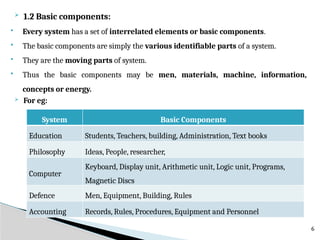
1.2 Basiccomponents:
Every system has a set of interrelated elements or basic components.
The basic components are simply the various identifiable parts of a system.
They are the moving parts of system.
Thus the basic components may be men, materials, machine, information,
concepts or energy.
For eg:
6
System Basic Components
Education Students, Teachers, building, Administration, Text books
Philosophy Ideas, People, researcher,
Computer
Keyboard, Display unit, Arithmetic unit, Logic unit, Programs,
Magnetic Discs
Defence Men, Equipment, Building, Rules
Accounting Records, Rules, Procedures, Equipment and Personnel
7.
1.3 Elementsof System:
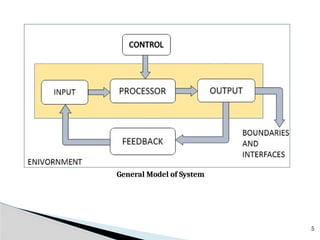
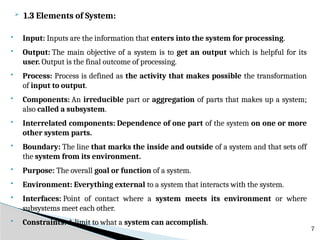
Input: Inputs are the information that enters into the system for processing.
Output: The main objective of a system is to get an output which is helpful for its
user. Output is the final outcome of processing.
Process: Process is defined as the activity that makes possible the transformation
of input to output.
Components: An irreducible part or aggregation of parts that makes up a system;
also called a subsystem.
Interrelated components: Dependence of one part of the system on one or more
other system parts.
Boundary: The line that marks the inside and outside of a system and that sets off
the system from its environment.
Purpose: The overall goal or function of a system.
Environment: Everything external to a system that interacts with the system.
Interfaces: Point of contact where a system meets its environment or where
subsystems meet each other.
Constraints: A limit to what a system can accomplish.
7
8.
1.4 Typesof System:
In General, systems fall into a number of categories.
Conceptual and Physical System:
System can be abstract (Conceptual or analytical) or physical (empirical).
An abstract or conceptual system is an orderly arrangement of independent ideas.
Conceptual systems are concerned with theoretical structures which may or may not
have counterpart in the real world.
Economic theory, Philosophy, Non-Euclidean geometry, Abstract Algebra and
General Theory of Relativity are examples of conceptual systems.
In practical management affairs, plan, accounting system structures, classification of
policies and procedures are conceptual systems.
Physical or Empirical systems are generally concrete operational systems made up of
people materials, machines energy and other physical things.
Physical system can display activity or behavior. Management information system,
computer system Business Organizations are physical systems. 8
9.
Deterministic andProbabilistic System:
System can also be classified as deterministic or probabilistic.
A Deterministic system operates in a predictable manner.
If one knows the state of the system at a given point of time then it is a deterministic
system if one can predict the next state without error.
In a computer system the outputs are deterministic.
For example, the economic forecasting is probabilistic. Similarly, in an inventory
system, average demand, lead time etc. are probabilistic.
Natural and Artificial Systems:
Solar system, Water System and Human being as a system are examples of Natural
system.
A business organization, computer system, air conditioning system, social system,
economic system, and management information system is examples of Artificial
systems. 9
10.
Open andClosed Systems:
An Open system is one that interacts with the environment.
A business organization is an open system because it exchanges men, material,
money and information with the environment.
An open system does not provide for its own control or modification.
It does not supervise itself. It needs to be supervised by people.
For eg. If the high speed printers used with computer systems do not have a switch to
sense whether paper is in the printer, then a person would have to notice when the paper
runs out and signal (push a switch) the system to stop printing.
A Closed system is a system which is self-contained.
It does not exchange material, information or energy with its environment.
In a Daniel cell, chemical reaction takes place in a sealed, insulated container.
Such closed systems will finally run down or become disorganized.
In fact what constitutes a closed system is very difficult to judge.
In organizations and in information systems, we come across systems that are relatively
closed.
A computer system is a relatively closed system.
A relatively closed system is one that has only controlled and well defined inputs and
outputs. It is not subject to disturbances from outside the system. 10
11.
A Closedsystem is a system which is self-contained.
It does not exchange material, information or energy with its environment.
In a Daniel cell, chemical reaction takes place in a sealed, insulated container.
Such closed systems will finally run down or become disorganized.
In fact what constitutes a closed system is very difficult to judge.
In organizations and in information systems, we come across systems that are
relatively closed.
A computer system is a relatively closed system.
A relatively closed system is one that has only controlled and well defined inputs
and outputs.
It is not subject to disturbances from outside the system.
11
12.
Man –Machine System:
Normally, most of the artificial systems are man – machine systems.
A motor car is a machine system. But motor-car cannot work without a person.
Computer system is machine system. Information system is a man-machine,
relatively closed and deterministic system.
1.5 System Characteristics:
There are five types of characteristics for a system. Such as,
1. Organization
2. Interaction
3. Interdependence
4. Integration
5. A central objective
12
13.
ORGANIZATION:
Thisimplies structure and order.
It can also be defined as the arrangement of components that help to achieve
objectives.
For example, Hierarchical system in a company.
INTERACTION:
This shows the manner in which each component functions with other components
of the system.
It specifies there should be an interrelationship between every component of a
system.
For example, the main memory holds the data that has to be operated by the ALU.
13
14.
INTERDEPENDENCE:
Thismeans the components of a computer system depend on one another.
Each component should depend on other components of the system.
One component depends on the input of another component for proper functioning.
The output of one subsystem is the required input for another subsystem.
For example, A decision to computerize an application is initiated by the user, analyzed
and designed by the analyst, programmed and tested by the computer operator.
None of the persons can perform properly without the required input from others in the
computer center subsystem.
INTEGRATION:
It is concerned with how a system is tied together.
It is more than sharing physical components or locations.
It means that components of the system work together within the system even though
each component performs a unique function.
14
15.
CENTRAL OBJECTIVE:
Systems always have a central goal.
These goals may be real or stated.
The important point is that users must know the central objective of a computer
application early in the analysis for a successful design and conversion.
15
![Welcomes to Department of Computer Application
Class: SYBBA(CA) [Sem – III]
Subject: – Software Engineering
Subject Teacher – Dr. Sunil B. Patil
1
MIT Arts Commerce and Science College
Alandi (D). Pune - 412105](https://image.slidesharecdn.com/ch1-250222051303-c44bff34/85/Software-engineer-notes-is-to-i5-i3-idhi-iru-jeep-1-320.jpg)
![Welcomes to Department of Computer Application
Class: SYBBA(CA) [Sem – III]
Subject: – Software Engineering
Subject Teacher – Dr. Sunil B. Patil
1
MIT Arts Commerce and Science College
Alandi (D). Pune - 412105](https://image.slidesharecdn.com/ch1-250222051303-c44bff34/75/Software-engineer-notes-is-to-i5-i3-idhi-iru-jeep-1-2048.jpg)