Electronic Data Interchange
Electronic Data Interchange (EDI) is the computer-to-
computer exchange of business documents in a standard
electronic format between business partners.
Features (Nature) of EDI
 Exchange of structured business information in standard
formats between computers.
 It has reduced data entry link, eliminates the need for a
paper bases system and improved business cycle.
 EDI transfer structured business documents internally
among groups of departments or externally with its
suppliers, customers and subsidiaries.
 In EDI, information transferred over a network will not
have to read, retyped or printed but must have predefine
structure agreed between the two company's which send
and receive data.
 The two companies or groups which exchanged
information through EDI are called the Trading Partners.
Components of EDI
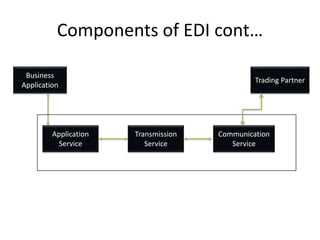
There are 3 types of component
1. Application service
2. Translation service
3. Communication service
Components of EDI cont…
Business
Application
Trading Partner
Application
Service
Transmission
Service
Communication
Service
EDI services
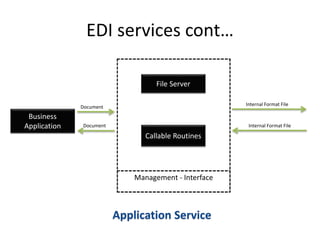
1. Application Services :-
It provides the link between application and
EDI. It allows you to send documents from an
EDI system. The set of callable routine is used
to transfer document from the business
application into EDI document destination
can be either intra-company or to the external
companies .
EDI services cont…
Business
Application
File Server
Callable Routines
Document
Document
Internal Format File
Management - Interface
Application Service
EDI services
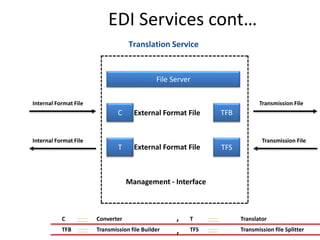
2. Translation service:-
Converts the out going documents from an
internal format file to an agreed external
format.
Translates internal document from external
format to EDI internal format file.
EDI Services cont…
Translation Service
File Server
C TFB
T TFS
Management - Interface
External Format File
Transmission FileInternal Format File
Internal Format File Transmission File
C
TFSTransmission file BuilderTFB
TranslatorTConverter
Transmission file Splitter
,
,
EDI Services cont…
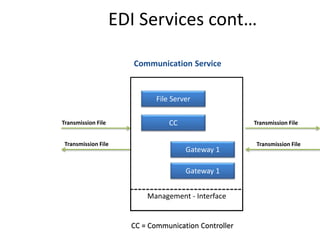
• 3. Communication service:-
The communication service sends and
receives transmission files to and from the
trading partners either directly or by using
party service called a valued added
network(VAN).
EDI Services cont…
Communication Service
File Server
CC
Management - Interface
CC = Communication Controller
Gateway 1
Gateway 1
Transmission File
Transmission File
Transmission File
Transmission File
Benefits(advantage)(merit) of EDI
• Generation of a paper document on a form by
software application.
• Delivery of a few copies of document to the
internal dept to be filed and others to the trade
partners via postal service.
• Retyping the document received by the trading
partner on the form into their computers which
may offer introduce errors.
• Generation of a paper acknowledgement and
sending it to the originating company.
• Generation of a file containing the processed
document by the application program.
Benefits (advantage) (merit) of EDI cont…
• Conversion of the document into agreed
standard format.
• Electronic transmission of the file containing
the document over the network , which may
link the originating company and its trading
partner.
• Automatic generation of the receipt and its
delivery over the network to the originating
company.
Benefits of EDI
• Transactions speed
– has greatly increased with the creation of EDI.
– EDI drastically reduces this problem by sending
transactions electronically where they can be sent
and received almost simultaneously.
Benefits of EDI
• Direct transmission
– EDI includes the direct transmission of data
between organizations VAN. EDI is not facsimile
transmission (fax) of information nor is it
electronic mail (e-mail). Both of these
transmission types are in “free format” (not
standard format) and, therefore, generally require
rekeying of data into the receiver’s computer
system.
Benefits of EDI
• Cut down the possibility of human error
– EDI would also cut down on the tendency for
"human error”. EDI eliminates this possibility
because the receiving end is a computer that
simply translates the message that has already
been keyed into the system.
Benefits of EDI
• Reduces the risk of lost data
– whether that means the data is physically unable
to be located, or if only part of the data has been
lost through the numerous steps require to
conduct business through the use of paper.
Benefits of EDI
• The benefits of EDI include:
– Time savings and associated financial savings
accrued,
– Improved accuracy,
– Improved trading partner relationships and client
interactions,
– Improved reconciliation of transactions
exchanged.
EDI Benefits
Cost Reduction
• Manpower, communications, resources, storage
Speed
• Electronic transfer Vs mail/ courier
Accuracy
• Avoids duplicate data entry and error margin
Security
• Information less susceptible to interception/
falsification
System Integration
• EDI can be integrated with internal system to push &
pull data
(Demerits) Disadvantages of EDI
Contrasted to XML, which is not strictly standardized, many
consider EDI to have too many standards.
There are various standards bodies who have developed
'standard document formats' for EDI which can cause problems
with cross compatibility.
These standards bodies also push standards revisions annually
which could cause problems if you have a more recent version of
a document than a business partner.
EDI systems are extremely expensive making it difficult for small
businesses to implement.
Many large organizations will only work with others who utilize
EDI. This may limit the business small companies are able to do
with such organizations and limit trading partners.
(Demerits) Disadvantages of EDI
Too Many Standards
There are too many standards bodies developing standard documents
formats for EDI. For example your company may be following the X12
standard format, while your trading partner follows the EDIFACT standard
format.
Changing Standards
Each year, most standards bodies publish revisions to the standards. This
poses a problem to EDI users. You may be using one version of the standard
while your trading partners are still using older versions.
EDI is Too Expensive
Some companies are only doing business with others who use EDI. If a
company wants to do business with these organizations, they have to
implement an EDI program. This expense may be very costly for small
companies.
Limit Your Trading Partners
Some large companies tend to stop doing business with companies who
don't comply with EDI. For example Wall Mart is only doing business with
other companies that use EDI. The result of this is a limited group of people
you can do business with.
 EDI

EDI

  • 1.
    Electronic Data Interchange ElectronicData Interchange (EDI) is the computer-to- computer exchange of business documents in a standard electronic format between business partners.
  • 2.
    Features (Nature) ofEDI  Exchange of structured business information in standard formats between computers.  It has reduced data entry link, eliminates the need for a paper bases system and improved business cycle.  EDI transfer structured business documents internally among groups of departments or externally with its suppliers, customers and subsidiaries.  In EDI, information transferred over a network will not have to read, retyped or printed but must have predefine structure agreed between the two company's which send and receive data.  The two companies or groups which exchanged information through EDI are called the Trading Partners.
  • 3.
    Components of EDI Thereare 3 types of component 1. Application service 2. Translation service 3. Communication service
  • 4.
    Components of EDIcont… Business Application Trading Partner Application Service Transmission Service Communication Service
  • 5.
    EDI services 1. ApplicationServices :- It provides the link between application and EDI. It allows you to send documents from an EDI system. The set of callable routine is used to transfer document from the business application into EDI document destination can be either intra-company or to the external companies .
  • 6.
    EDI services cont… Business Application FileServer Callable Routines Document Document Internal Format File Internal Format File Management - Interface Application Service
  • 7.
    EDI services 2. Translationservice:- Converts the out going documents from an internal format file to an agreed external format. Translates internal document from external format to EDI internal format file.
  • 8.
    EDI Services cont… TranslationService File Server C TFB T TFS Management - Interface External Format File External Format File Transmission FileInternal Format File Internal Format File Transmission File C TFSTransmission file BuilderTFB TranslatorTConverter Transmission file Splitter , ,
  • 9.
    EDI Services cont… •3. Communication service:- The communication service sends and receives transmission files to and from the trading partners either directly or by using party service called a valued added network(VAN).
  • 10.
    EDI Services cont… CommunicationService File Server CC Management - Interface CC = Communication Controller Gateway 1 Gateway 1 Transmission File Transmission File Transmission File Transmission File
  • 11.
    Benefits(advantage)(merit) of EDI •Generation of a paper document on a form by software application. • Delivery of a few copies of document to the internal dept to be filed and others to the trade partners via postal service. • Retyping the document received by the trading partner on the form into their computers which may offer introduce errors. • Generation of a paper acknowledgement and sending it to the originating company. • Generation of a file containing the processed document by the application program.
  • 12.
    Benefits (advantage) (merit)of EDI cont… • Conversion of the document into agreed standard format. • Electronic transmission of the file containing the document over the network , which may link the originating company and its trading partner. • Automatic generation of the receipt and its delivery over the network to the originating company.
  • 13.
    Benefits of EDI •Transactions speed – has greatly increased with the creation of EDI. – EDI drastically reduces this problem by sending transactions electronically where they can be sent and received almost simultaneously.
  • 14.
    Benefits of EDI •Direct transmission – EDI includes the direct transmission of data between organizations VAN. EDI is not facsimile transmission (fax) of information nor is it electronic mail (e-mail). Both of these transmission types are in “free format” (not standard format) and, therefore, generally require rekeying of data into the receiver’s computer system.
  • 15.
    Benefits of EDI •Cut down the possibility of human error – EDI would also cut down on the tendency for "human error”. EDI eliminates this possibility because the receiving end is a computer that simply translates the message that has already been keyed into the system.
  • 16.
    Benefits of EDI •Reduces the risk of lost data – whether that means the data is physically unable to be located, or if only part of the data has been lost through the numerous steps require to conduct business through the use of paper.
  • 17.
    Benefits of EDI •The benefits of EDI include: – Time savings and associated financial savings accrued, – Improved accuracy, – Improved trading partner relationships and client interactions, – Improved reconciliation of transactions exchanged.
  • 18.
    EDI Benefits Cost Reduction •Manpower, communications, resources, storage Speed • Electronic transfer Vs mail/ courier Accuracy • Avoids duplicate data entry and error margin Security • Information less susceptible to interception/ falsification System Integration • EDI can be integrated with internal system to push & pull data
  • 19.
    (Demerits) Disadvantages ofEDI Contrasted to XML, which is not strictly standardized, many consider EDI to have too many standards. There are various standards bodies who have developed 'standard document formats' for EDI which can cause problems with cross compatibility. These standards bodies also push standards revisions annually which could cause problems if you have a more recent version of a document than a business partner. EDI systems are extremely expensive making it difficult for small businesses to implement. Many large organizations will only work with others who utilize EDI. This may limit the business small companies are able to do with such organizations and limit trading partners.
  • 20.
    (Demerits) Disadvantages ofEDI Too Many Standards There are too many standards bodies developing standard documents formats for EDI. For example your company may be following the X12 standard format, while your trading partner follows the EDIFACT standard format. Changing Standards Each year, most standards bodies publish revisions to the standards. This poses a problem to EDI users. You may be using one version of the standard while your trading partners are still using older versions. EDI is Too Expensive Some companies are only doing business with others who use EDI. If a company wants to do business with these organizations, they have to implement an EDI program. This expense may be very costly for small companies. Limit Your Trading Partners Some large companies tend to stop doing business with companies who don't comply with EDI. For example Wall Mart is only doing business with other companies that use EDI. The result of this is a limited group of people you can do business with.