UNIT 2 : CONCEPTS OF SYSTEMS
2.1. Definition of system in an organization
2.2. Types of systems
2.2.1. Deterministic probabilistic systems
2.2.2. Open and close systems
System in an organization
 A system is an organized collection of
parts (components) that are highly
integrated (interrelated) in order to
accomplish an overall goal.
 The system has various inputs which are
processed to produce certain outputs
that together, accomplish the overall goal
desired by the organization.
 There is ongoing feedback among
these various parts to ensure they
remain aligned to accomplish the
overall goal of the organization.
 There are several classes of systems,
ranging from very simple frameworks
all the way to social systems, which
are the most complex. Organizations
are, of course, social systems.
 Systems have inputs, processes,
outputs and outcomes.
 Each organization has numerous
subsystems. Common examples of
subsystems are departments,
programs, projects, teams, processes
to produce products or services, etc.
Input Processing Output
Feedback
Information System
Suppliers
Environment
Customers
Agenicies Stockholders Competitors
System Boundaries
 Systems have boundaries.
 The 'boundaries' of system are the
limits within which system works.
 Boundaries may in the form of
features, areas or constraints.
 System operates within the boundary.
Types of Systems
1. Conceptual and Empirical
2. Natural and Manufactured
3. Social, People-Machine and machine
4. Open and Closed
5. Permanent and Temporary
6. Stationary and Non-stationary
7. Sub-system and Non-subsystem
8. Adaptive and non-adaptive
9. Simple and Complex
10.Stable and Dynamic
11.Deterministic and Probabilistic
1. Conceptual and Empirical
 Conceptual Systems are concern with
theoretical structured, which may or
may not have counter part in the
world. Eg. Business Decision Map
 Empirical System is made up of
people, materials, machines, energy
and physical things.
2. Natural and Manufactured
 Natural systems are created by the
nature.
 For example:
 Stellar Systems : Galaxies, solar systems etc.
 Geological Systems: Rivers, mountain ranges, etc.
 Biological Systems : Humans.
 Molecular Systems : Complex organizations of atoms.
 Manufactured System is the man-
made system. For example, Rockets,
dams, trains.
3. Social, People-Machine and
machine
 Social System is made up of people. For
example, social clubs, societies.
 In Human-Machine System, both
human and machines are involved to
perform a particular task. For example,
Computer programming.
 Machine System is where human
interference is neglected. All the tasks are
performed by the machine. For example,
an autonomous robot.
4. Open and Closed
 An open system must interact with
its environment.
 It receives inputs from and delivers
outputs to the outside of the system.
 For example, an information system
which must adapt to the changing
environmental conditions.
 A closed system does not interact
with its environment.
 It is isolated from environmental
influences.
 A completely closed system is rare in
reality.
5. Permanent and Temporary
 Permanent System persists for long
time.
 For example, business policies.
 Temporary System is made for
specified time and after that they are
demolished.
 For example, A DJ system is set up for
a program and it is dissembled after
the program.
6. Stationary and Non-stationary
 A Stationary system is one whose
properties and operations either do
not very in repetitive cycle.
 For example: Factory, Super Market
Operation
 An advertising organization, Research
and Development laboratory are non-
stationary systems.
7. Sub-system and Non-subsystem
 Each system is part of a large system.
The business firm is viewed as the
system or total system when focus is
on production, distribution of goal and
sources of profit and income.
 The total system consists of all the
objects, attributes and relationship
necessary to accomplish an objective
given a number of constraints.
7. Sub-system and Non-subsystem
 Sub systems are the smaller systems
within a system.
 Super system denotes extremely large
and complex system.
8. Adaptive and non-adaptive
 A system that reacts to its environment
to such way to improve with
functioning achievement of survival
its called adaptive system,
 Ex :Human beings.
 Those system that do not react or
adapt to the environment are called
non-adaptive system.
 Ex :Machines.
9. Simple and Complex
 Simple system have few component
and the relationship or interaction
between elements is an uncomplicated
and straight.
 Complex system has many
component that are highly related and
inter connected.
10. Stable and Dynamic
 Stable systems undergoes very little
change over time.
 Dynamic systems repeatedly goes over
time.
11. Deterministic and Probabilistic
 Deterministic system operates in a
predictable manner and the
interaction between system
components is known with certainty.
 For example, two molecules of
hydrogen and one molecule of oxygen
makes water.
Deterministic System
 A system is deterministic if its outputs are
certain.
 This means that the relationships between
its components are fully known and
certain.
 A deterministic system is one in which the
occurrence of all events is known with
certainty.
 If the description of the system state at a
particular point of time of its operation is
given, the next state can be perfectly
predicted.
 A Deterministic System has a single
result or set of results given a set of
input parameters.
Probabilistic System
 Probabilistic System shows uncertain
behavior. The exact output is not
known.
 For example, Weather forecasting,
mail delivery.
 It is also known as Stochastic Model,
Stochastic Process or Stochastic
System.
 Solved using Monte-Carlo Method.
 A Computer Program uses a pseudo
random number generator to provide
values of the attributes of the system that
vary.
 The alternative to this method is to solve
the problem using mathematics of
probability.
Open System
 Open systems are computer systems
that provide some combination of
interoperability, portability and open
software standards.
 Open systems are systems which allow
users to contributes, manipulate, edit,
use, reuse, mashup and in some way
actually create or alter content.
 If you modify a software it is probably
an open system.
 If your system is exchange from
environment and is influenced by the
environment then it is called OPEN
SYSTEM.
 All real systems are open systems.
 For example:
 For example: Human body and forecasting
Closed System
 If a system is functioning in isolation
from the environment, then the
system does not have any exchange
with the environment nor it is
influenced by the environment changes
such systems are CLOSED SYSTEM.
 For example: Accounting System, stock
 Closed systems are systems which
allow user to use content as it is,
with minimal to modification to the
actual system or program.
 The earth is a closed system. It
receives lots of energy from the sun
but the exchange of matter with the
outside is not possible.
 For example: Accounting System, stock,
solar system.
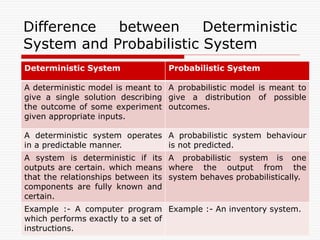
Difference between Deterministic
System and Probabilistic System
Deterministic System Probabilistic System
A deterministic model is meant to
give a single solution describing
the outcome of some experiment
given appropriate inputs.
A probabilistic model is meant to
give a distribution of possible
outcomes.
A deterministic system operates
in a predictable manner.
A probabilistic system behaviour
is not predicted.
A system is deterministic if its
outputs are certain. which means
that the relationships between its
components are fully known and
certain.
A probabilistic system is one
where the output from the
system behaves probabilistically.
Example :- A computer program
which performs exactly to a set of
instructions.
Example :- An inventory system.
Difference between Open and Closed
System
Open System Closed System
An open system is one that
interacts with its environment.
A closed system is one that does
not interacts with its
environment.
All systems containing living
organism are obviously open
systems because they are
affected by what is sensed by
the organism.
Whatever environment
surrounds, the closed system
does not change or if it does, a
barrier exists between the
environment and the system
from being affected.
In reality, an open system must
exist.
Whether a closed system never
exists.
Open System Closed System
The demand forecasting is an
example of open system.
All kind of accounting system,
case, stock, attendance of
employee is closed system.
Example: Industry is a part of
national economic system, which
is in turn a system, within the
world system is also an open
system.
Example: The scientists who
device a laboratory system to
measure the elastically of a
metal is assuming a closed
system.
Every social organization is an
open system.
For simple operational lower
level functional management is
closed system.

UNIT2.ppt

  • 1.
    UNIT 2 :CONCEPTS OF SYSTEMS 2.1. Definition of system in an organization 2.2. Types of systems 2.2.1. Deterministic probabilistic systems 2.2.2. Open and close systems
  • 2.
    System in anorganization  A system is an organized collection of parts (components) that are highly integrated (interrelated) in order to accomplish an overall goal.  The system has various inputs which are processed to produce certain outputs that together, accomplish the overall goal desired by the organization.
  • 3.
     There isongoing feedback among these various parts to ensure they remain aligned to accomplish the overall goal of the organization.  There are several classes of systems, ranging from very simple frameworks all the way to social systems, which are the most complex. Organizations are, of course, social systems.
  • 4.
     Systems haveinputs, processes, outputs and outcomes.  Each organization has numerous subsystems. Common examples of subsystems are departments, programs, projects, teams, processes to produce products or services, etc.
  • 5.
    Input Processing Output Feedback InformationSystem Suppliers Environment Customers Agenicies Stockholders Competitors
  • 6.
    System Boundaries  Systemshave boundaries.  The 'boundaries' of system are the limits within which system works.  Boundaries may in the form of features, areas or constraints.  System operates within the boundary.
  • 7.
    Types of Systems 1.Conceptual and Empirical 2. Natural and Manufactured 3. Social, People-Machine and machine 4. Open and Closed 5. Permanent and Temporary 6. Stationary and Non-stationary 7. Sub-system and Non-subsystem 8. Adaptive and non-adaptive 9. Simple and Complex 10.Stable and Dynamic 11.Deterministic and Probabilistic
  • 8.
    1. Conceptual andEmpirical  Conceptual Systems are concern with theoretical structured, which may or may not have counter part in the world. Eg. Business Decision Map  Empirical System is made up of people, materials, machines, energy and physical things.
  • 9.
    2. Natural andManufactured  Natural systems are created by the nature.  For example:  Stellar Systems : Galaxies, solar systems etc.  Geological Systems: Rivers, mountain ranges, etc.  Biological Systems : Humans.  Molecular Systems : Complex organizations of atoms.  Manufactured System is the man- made system. For example, Rockets, dams, trains.
  • 10.
    3. Social, People-Machineand machine  Social System is made up of people. For example, social clubs, societies.  In Human-Machine System, both human and machines are involved to perform a particular task. For example, Computer programming.  Machine System is where human interference is neglected. All the tasks are performed by the machine. For example, an autonomous robot.
  • 11.
    4. Open andClosed  An open system must interact with its environment.  It receives inputs from and delivers outputs to the outside of the system.  For example, an information system which must adapt to the changing environmental conditions.
  • 12.
     A closedsystem does not interact with its environment.  It is isolated from environmental influences.  A completely closed system is rare in reality.
  • 13.
    5. Permanent andTemporary  Permanent System persists for long time.  For example, business policies.  Temporary System is made for specified time and after that they are demolished.  For example, A DJ system is set up for a program and it is dissembled after the program.
  • 14.
    6. Stationary andNon-stationary  A Stationary system is one whose properties and operations either do not very in repetitive cycle.  For example: Factory, Super Market Operation  An advertising organization, Research and Development laboratory are non- stationary systems.
  • 15.
    7. Sub-system andNon-subsystem  Each system is part of a large system. The business firm is viewed as the system or total system when focus is on production, distribution of goal and sources of profit and income.  The total system consists of all the objects, attributes and relationship necessary to accomplish an objective given a number of constraints.
  • 16.
    7. Sub-system andNon-subsystem  Sub systems are the smaller systems within a system.  Super system denotes extremely large and complex system.
  • 17.
    8. Adaptive andnon-adaptive  A system that reacts to its environment to such way to improve with functioning achievement of survival its called adaptive system,  Ex :Human beings.  Those system that do not react or adapt to the environment are called non-adaptive system.  Ex :Machines.
  • 18.
    9. Simple andComplex  Simple system have few component and the relationship or interaction between elements is an uncomplicated and straight.  Complex system has many component that are highly related and inter connected.
  • 19.
    10. Stable andDynamic  Stable systems undergoes very little change over time.  Dynamic systems repeatedly goes over time.
  • 20.
    11. Deterministic andProbabilistic  Deterministic system operates in a predictable manner and the interaction between system components is known with certainty.  For example, two molecules of hydrogen and one molecule of oxygen makes water.
  • 21.
    Deterministic System  Asystem is deterministic if its outputs are certain.  This means that the relationships between its components are fully known and certain.  A deterministic system is one in which the occurrence of all events is known with certainty.  If the description of the system state at a particular point of time of its operation is given, the next state can be perfectly predicted.
  • 22.
     A DeterministicSystem has a single result or set of results given a set of input parameters.
  • 23.
    Probabilistic System  ProbabilisticSystem shows uncertain behavior. The exact output is not known.  For example, Weather forecasting, mail delivery.
  • 24.
     It isalso known as Stochastic Model, Stochastic Process or Stochastic System.  Solved using Monte-Carlo Method.  A Computer Program uses a pseudo random number generator to provide values of the attributes of the system that vary.  The alternative to this method is to solve the problem using mathematics of probability.
  • 25.
    Open System  Opensystems are computer systems that provide some combination of interoperability, portability and open software standards.  Open systems are systems which allow users to contributes, manipulate, edit, use, reuse, mashup and in some way actually create or alter content.
  • 26.
     If youmodify a software it is probably an open system.  If your system is exchange from environment and is influenced by the environment then it is called OPEN SYSTEM.
  • 27.
     All realsystems are open systems.  For example:  For example: Human body and forecasting
  • 28.
    Closed System  Ifa system is functioning in isolation from the environment, then the system does not have any exchange with the environment nor it is influenced by the environment changes such systems are CLOSED SYSTEM.  For example: Accounting System, stock
  • 29.
     Closed systemsare systems which allow user to use content as it is, with minimal to modification to the actual system or program.
  • 30.
     The earthis a closed system. It receives lots of energy from the sun but the exchange of matter with the outside is not possible.  For example: Accounting System, stock, solar system.
  • 31.
    Difference between Deterministic Systemand Probabilistic System Deterministic System Probabilistic System A deterministic model is meant to give a single solution describing the outcome of some experiment given appropriate inputs. A probabilistic model is meant to give a distribution of possible outcomes. A deterministic system operates in a predictable manner. A probabilistic system behaviour is not predicted. A system is deterministic if its outputs are certain. which means that the relationships between its components are fully known and certain. A probabilistic system is one where the output from the system behaves probabilistically. Example :- A computer program which performs exactly to a set of instructions. Example :- An inventory system.
  • 32.
    Difference between Openand Closed System Open System Closed System An open system is one that interacts with its environment. A closed system is one that does not interacts with its environment. All systems containing living organism are obviously open systems because they are affected by what is sensed by the organism. Whatever environment surrounds, the closed system does not change or if it does, a barrier exists between the environment and the system from being affected. In reality, an open system must exist. Whether a closed system never exists.
  • 33.
    Open System ClosedSystem The demand forecasting is an example of open system. All kind of accounting system, case, stock, attendance of employee is closed system. Example: Industry is a part of national economic system, which is in turn a system, within the world system is also an open system. Example: The scientists who device a laboratory system to measure the elastically of a metal is assuming a closed system. Every social organization is an open system. For simple operational lower level functional management is closed system.