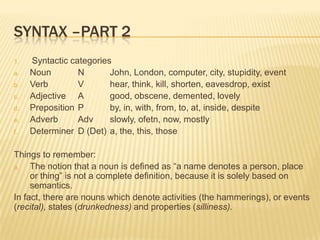
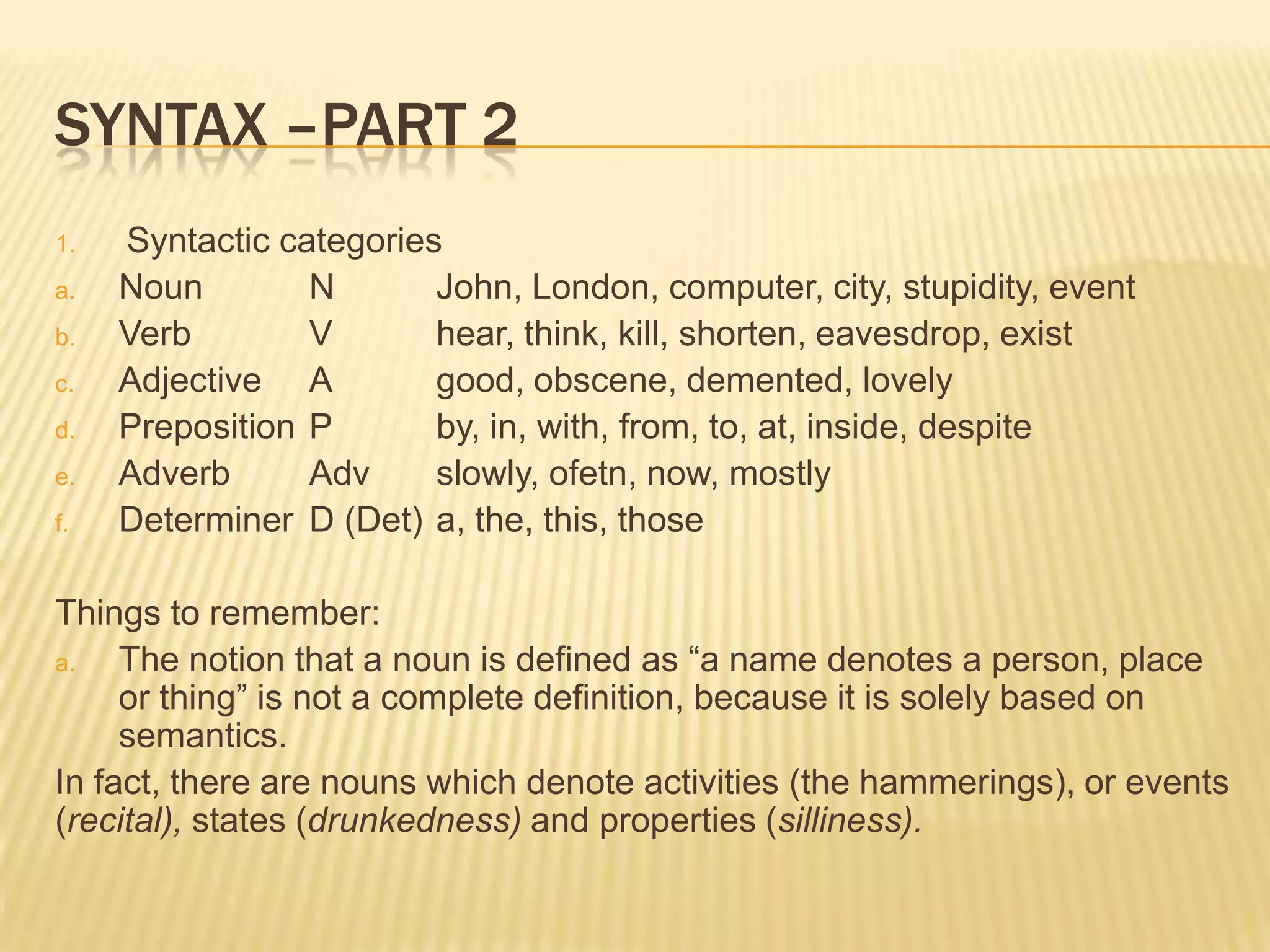
Syntax –part 2Syntactic categoriesNoun	N	John, London, computer, city, stupidity, eventVerb	V	hear, think, kill, shorten, eavesdrop, existAdjective	A	good, obscene, demented, lovelyPreposition	P	by, in, with, from, to, at, inside, despiteAdverb	Adv	slowly, ofetn, now, mostlyDeterminer	D (Det)	a, the, this, thoseThings to remember:The notion that a noun is defined as “a name denotes a person, place or thing” is not a complete definition, because it is solely based on semantics.In fact, there are nouns which denote activities (the hammerings), or events (recital), states (drunkedness) and properties (silliness).
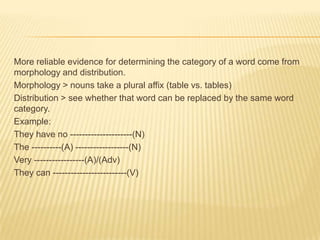
More reliable evidence for determining the category of a word come from morphology and distribution.Morphology > nouns take a plural affix (table vs. tables)Distribution > see whether that word can be replaced by the same word category.Example:They have no ---------------------(N)The ----------(A) ------------------(N)Very -----------------(A)/(Adv)They can -------------------------(V)
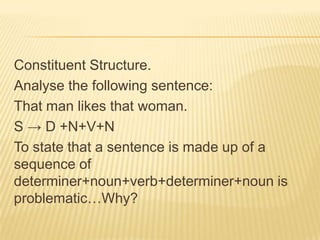
Constituent Structure.Analyse the following sentence:That man likes that woman.S -> D +N+V+NTo state that a sentence is made up of a sequence of determiner+noun+verb+determiner+nounis problematic…Why?
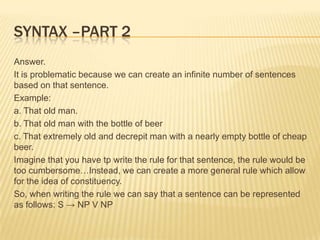
Syntax –part 2Answer.It is problematic because we can create an infinite number of sentences based on that sentence.Example:a. That old man.b. That old man with the bottle of beerc. That extremely old and decrepit man with a nearly empty bottle of cheap beer.Imagine that you have tp write the rule for that sentence, the rule would be too cumbersome…Instead, we can create a more general rule which allow for the idea of constituency.So, when writing the rule we can say that a sentence can be represented as follows: S -> NP V NP
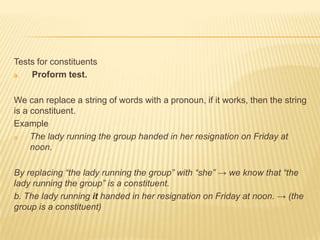
Tests for constituentsProform test. We can replace a string of words with a pronoun, if it works, then the string  is a constituent.ExampleThe lady running the group handed in her resignation on Friday at noon.By replacing “the lady running the group” with “she” -> we know that “the lady running the group” is a constituent.b. The lady running it handed in her resignation on Friday at noon. -> (the group is a constituent)
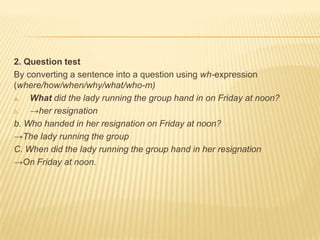
2. Question testBy converting a sentence into a question using wh-expression (where/how/when/why/what/who-m)What did the lady running the group hand in on Friday at noon?->her resignation b. Who handed in her resignation on Friday at noon?->The lady running the groupC. When did the lady running the group hand in her resignation->On Friday at noon.
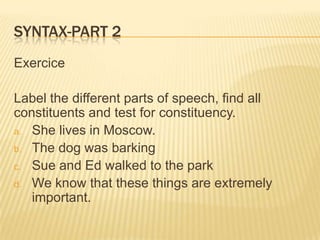
Syntax-part 2ExerciceLabel the different parts of speech, find all constituents and test for constituency.She lives in Moscow.The dog was barkingSue and Ed walked to the parkWe know that these things are extremely important.
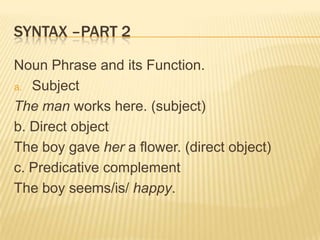
Syntax –Part 2Noun Phrase and its Function.SubjectThe man works here. (subject)b. Direct objectThe boy gave her a flower. (direct object)c. Predicative complementThe boy seems/is/ happy.

Syntax –part 2

  • 1.
    Syntax –part 2SyntacticcategoriesNoun N John, London, computer, city, stupidity, eventVerb V hear, think, kill, shorten, eavesdrop, existAdjective A good, obscene, demented, lovelyPreposition P by, in, with, from, to, at, inside, despiteAdverb Adv slowly, ofetn, now, mostlyDeterminer D (Det) a, the, this, thoseThings to remember:The notion that a noun is defined as “a name denotes a person, place or thing” is not a complete definition, because it is solely based on semantics.In fact, there are nouns which denote activities (the hammerings), or events (recital), states (drunkedness) and properties (silliness).
  • 2.
    More reliable evidencefor determining the category of a word come from morphology and distribution.Morphology > nouns take a plural affix (table vs. tables)Distribution > see whether that word can be replaced by the same word category.Example:They have no ---------------------(N)The ----------(A) ------------------(N)Very -----------------(A)/(Adv)They can -------------------------(V)
  • 3.
    Constituent Structure.Analyse thefollowing sentence:That man likes that woman.S -> D +N+V+NTo state that a sentence is made up of a sequence of determiner+noun+verb+determiner+nounis problematic…Why?
  • 4.
    Syntax –part 2Answer.Itis problematic because we can create an infinite number of sentences based on that sentence.Example:a. That old man.b. That old man with the bottle of beerc. That extremely old and decrepit man with a nearly empty bottle of cheap beer.Imagine that you have tp write the rule for that sentence, the rule would be too cumbersome…Instead, we can create a more general rule which allow for the idea of constituency.So, when writing the rule we can say that a sentence can be represented as follows: S -> NP V NP
  • 5.
    Tests for constituentsProformtest. We can replace a string of words with a pronoun, if it works, then the string is a constituent.ExampleThe lady running the group handed in her resignation on Friday at noon.By replacing “the lady running the group” with “she” -> we know that “the lady running the group” is a constituent.b. The lady running it handed in her resignation on Friday at noon. -> (the group is a constituent)
  • 6.
    2. Question testByconverting a sentence into a question using wh-expression (where/how/when/why/what/who-m)What did the lady running the group hand in on Friday at noon?->her resignation b. Who handed in her resignation on Friday at noon?->The lady running the groupC. When did the lady running the group hand in her resignation->On Friday at noon.
  • 7.
    Syntax-part 2ExerciceLabel thedifferent parts of speech, find all constituents and test for constituency.She lives in Moscow.The dog was barkingSue and Ed walked to the parkWe know that these things are extremely important.
  • 8.
    Syntax –Part 2NounPhrase and its Function.SubjectThe man works here. (subject)b. Direct objectThe boy gave her a flower. (direct object)c. Predicative complementThe boy seems/is/ happy.